Does Snyk Work in China? Developer Security Data, Data Residency & PIPL Cross-Border Transfer
Snyk's dependency, code, container and IaC scanning is usable from mainland China, so reachability isn't the real question. Snyk runs no data center in the mainland — its data-residency regions are in the US, the EU (Frankfurt) and Australia, plus a US government region — so the source code, vulnerability findings and developer account data it ingests from your China engineers come to rest offshore, a cross-border transfer (数据出境) under PIPL (Articles 38–40), with the Cybersecurity Law's in-country storage duty under Article 39 (formerly Article 37) in play for a critical information infrastructure operator, and a code- and vulnerability-confidentiality dimension on top. A compliance-first look at Snyk's regions, the data-residency and cross-border questions, and the lawful in-country path.
Does Snyk work in China?
The question isn't whether Snyk's scanner connects from China — it runs inside your CI, pull-request and IDE workflow — but where the source code, vulnerability findings and developer identities it ingests come to rest. That is settled by data residency, and Snyk documents the answer.
Snyk runs no data center in mainland China; its regional-hosting page lists only US, EU (Frankfurt) and Australia regions, plus a US government region. So the project data and developer account records Snyk gathers from your China teams land offshore, which makes their collection a cross-border transfer (数据出境) under PIPL — notice, a separate consent, and a transfer mechanism (Articles 38–40) — and above thresholds may trigger China's data-export security assessment. Source code and a current map of your unpatched vulnerabilities are commercially sensitive, so a confidentiality question sits on top. For a critical information infrastructure operator, the Cybersecurity Law's Article 39 (formerly Article 37) requires such data to be stored in China — which no offshore Snyk region can satisfy.
21YunBox maps your cross-border, residency and confidentiality exposure, keeps the China code and developer data on an in-country, consented footing (sending Snyk only what may lawfully leave), and delivers your China-facing app in-country on ICP-filed infrastructure — with no rebuild, and never any form of circumvention. Treat the specifics as a risk to confirm with counsel.
What Snyk's own documentation says about China
| Fact | Primary source |
|---|---|
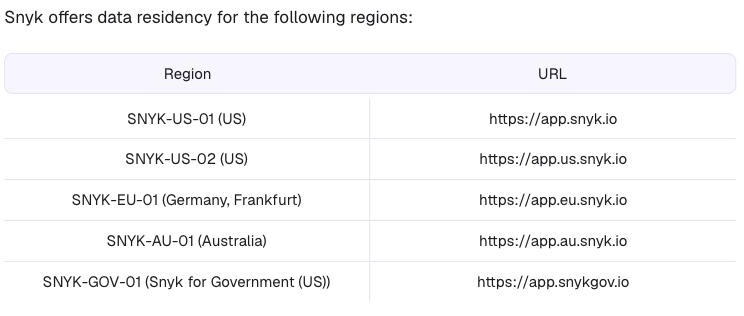
| Snyk runs no data-residency region in mainland China. Snyk's "Regional hosting and data residency" documentation states, "Snyk offers data residency for the following regions:" and lists SNYK-US-01 and SNYK-US-02 (US), SNYK-EU-01 (Germany, Frankfurt), SNYK-AU-01 (Australia) and SNYK-GOV-01 (Snyk for Government, US) — none in the mainland. It also says, "Snyk can host your data in a number of regions." | Snyk Docs, "Regional hosting and data residency" (docs.snyk.io), retrieved 2026-10-09 |
| Even in a chosen region, some data is held globally — and a region can only be selected on Enterprise plans. Snyk says data residency lets you "control the region in which Snyk hosts a selected subset of your data," and that it is "available only for Enterprise plans." Its documentation separates "Regionally stored data types" (including "Customer source code," vulnerability data and audit logs) from "Globally stored data types" (including "User authentication data" and "Product analytics") — so your China developers' account identities leave the region entirely. | Snyk Docs, "Regional hosting and data residency" (docs.snyk.io), retrieved 2026-10-09 |
| Snyk ingests both your source code and personal data about identifiable developers. Snyk is a developer-security platform — software composition analysis, static analysis, container and IaC scanning — that reads dependency manifests and source-code metadata, derives vulnerability findings, and records the accounts of the engineers who use it. For a China codebase, with no China region available, "Customer source code" and the vulnerability findings derived from it rest in a Snyk region abroad. | Snyk Docs, "Regional hosting and data residency" (docs.snyk.io), retrieved 2026-10-09 |
| China-collected personal information sent to an offshore Snyk region is a PIPL cross-border transfer, with an in-country storage duty for some handlers. Moving developer and project data collected in mainland China to a Snyk region in the US, the EU or Australia triggers PIPL Articles 38–40 — notice, a separate consent, and one transfer mechanism (a CAC security assessment, the CAC standard contract, or certification) — and for a critical information infrastructure operator the Cybersecurity Law's Article 39 (formerly Article 37) requires such data to be stored in China. | Personal Information Protection Law of the PRC, Articles 38–40 (cac.gov.cn); Cybersecurity Law Article 39 (formerly Article 37), retrieved 2026-10-09 |
Sources verified by the 21YunBox compliance team on 2026-10-09.
For an engineering team shipping to mainland China, the first instinct with Snyk is to ask whether the scanner reaches it — whether the CLI, the source-control integration and the IDE plugin can talk to Snyk from inside the country. That is the wrong gate. Snyk does its work at commit, pull-request and build time, and wherever those connections complete, the decision that matters is not speed — it is where the things Snyk ingests come to rest: the source-code metadata and vulnerability findings pulled from your repositories, and the account and identity data of the developers doing the work. Both are governed by Chinese law the moment they leave the mainland, and Snyk documents, in its own words, that they leave.
Snyk in China at a glance
| What decides it | In Snyk's own terms — and China's law |
|---|---|
| What it is | Snyk is a developer-security platform — software composition analysis, static analysis (Snyk Code), and container and infrastructure-as-code scanning, with AppRisk on top. It reads dependency manifests and source-code metadata, produces project and vulnerability findings, and records the accounts of the developers who use it — so it holds both potentially proprietary code and security data and personal information about identifiable engineers. |
| Where the data lives | Snyk documents data-residency regions in the US (SNYK-US-01, SNYK-US-02), the EU (SNYK-EU-01, Frankfurt) and Australia (SNYK-AU-01), plus a US government region (SNYK-GOV-01). None is inside mainland China. |
| What you can — and can't — keep in-region | Snyk says data residency controls only “a selected subset of your data,” and is “available only for Enterprise plans.” “Customer source code,” vulnerability data and audit logs follow your chosen region; but “User authentication data” and “Product analytics” are listed under “Globally stored data types,” held outside your region whatever you pick — so your China developers' account identities leave the region question entirely. |
| Your China developers' and project data | The identities, source-code metadata and vulnerability findings collected in China and held in a Snyk region abroad are a cross-border transfer (数据出境) under PIPL (Articles 38–40): notice, a separate consent, and one transfer mechanism. For a critical information infrastructure operator or large-volume handler, the Cybersecurity Law's Article 39 (formerly Article 37) in-country storage duty cannot be met by an offshore region. |
| A confidentiality dimension on top | Source code and a current list of your unpatched vulnerabilities are commercially sensitive, and for critical systems moving them offshore may warrant a data-export security assessment. This is a security-governance question as well as a personal-information one. |
| The lawful path | Keep the China project and developer data on an in-country, consented footing, send Snyk only what may lawfully leave, keep Snyk for your other markets, and deliver the China-facing app it protects in-country on ICP-filed infrastructure. 21YunBox maps, localizes and delivers; it never uses or suggests circumvention. |
Where Snyk keeps your data — regions abroad, none in mainland China
Snyk’s position is set in its own documentation, not by a load-time test. Its regional-hosting page states plainly, “Snyk can host your data in a number of regions,” and then names them: SNYK-US-01 and SNYK-US-02 in the US, SNYK-EU-01 in Frankfurt, SNYK-AU-01 in Australia, and SNYK-GOV-01 for US government — with no mainland-China region among them. New US enterprise accounts are provisioned on SNYK-US-02; accounts created before September 2024 and Free-plan users sit on SNYK-US-01. Whichever applies to you, the territory is the US, the EU or Australia.
Two further details sharpen the picture before performance ever enters it. First, data residency is “available only for Enterprise plans,” so a Free or Team account has no region to choose at all — its data rests in Snyk’s US region by default. Second, even on Enterprise the control is partial: Snyk says data residency lets you “control the region in which Snyk hosts a selected subset of your data,” and separates “Regionally stored data types” from “Globally stored data types.” Your “Customer source code,” vulnerability data and audit logs follow your chosen region; but “User authentication data” and “Product analytics” fall under “Globally stored data types,” held outside that region no matter what you pick. The account and identity data of your China developers, in other words, leaves the region question entirely.
Your developers’ data — and your source code — cross the border
Here is the gate most teams miss. Every one of Snyk’s regions is outside the mainland, so the moment the source-code metadata, project structure, vulnerability findings and developer account records Snyk gathers from people and repositories in China land in a US, EU or Australian Snyk, you have made a cross-border transfer of personal information under China’s Personal Information Protection Law. PIPL places the duty on the handler — you, the organization, not Snyk the processor: Articles 38–40 require notice, a separate consent distinct from any general tooling agreement, and one transfer mechanism — a CAC security assessment, the CAC standard contract, or certification. Your developers are identifiable natural persons; their account and activity data is their personal information, and employment does not strip away the PIPL duties attached to it.
Above certain thresholds, or where what you move counts as “important data,” the transfer may also require China’s data-export security assessment (数据出境安全评估) before anything leaves. And if your organization is a critical information infrastructure operator, the Cybersecurity Law’s Article 39 (formerly Article 37 — the data-localization clause was renumbered by the 2025 amendment that took effect on January 1, 2026, with its substance unchanged) requires personal information generated in China to be stored in China, an in-country duty no offshore Snyk region can satisfy. Which of these bind your specific case turns on what you scan, your data volumes and your role under Chinese law. This is a risk map, not a verdict — worth settling with counsel before your pipeline depends on it.
The code itself is sensitive — confidentiality on top of PIPL
There is a second exposure particular to a security scanner. Snyk’s job is to read your source and hand back a precise, current inventory of your weaknesses — which dependencies are vulnerable, where the injection risk lives, which container layers are unpatched. That inventory, and the source it is derived from, sit among the most commercially sensitive assets you hold; a live map of your unremediated vulnerabilities is exactly what an attacker would want. Snyk stores “Customer source code” in your chosen region, but with no China region on offer, for a China codebase that region is necessarily abroad. So beyond the personal-information question, moving code and vulnerability data out of the mainland is a trade-secret and security-governance decision — and for critical systems it may be the kind of export that warrants heightened scrutiny. None of this is a reason to route around anything: 21YunBox never uses or suggests circumvention of any kind. It is a reason to decide, deliberately, what may leave.
Why “just pick a region” doesn’t settle it
The natural move is to set the region and keep the data in-country — but the regions Snyk offers are the US, the EU and Australia, and none is in mainland China, so none resolves a China residency duty; moving a China project from the US region to the EU region relocates the cross-border transfer, it does not end it. And because “User authentication data” and analytics are held under “Globally stored data types” regardless, even a perfectly chosen region leaves your developers’ identities offshore. Keeping China-collected code and developer data in-country means a different shape altogether: an in-country scanning-and-storage path for the data that must stay, with Snyk receiving only what may lawfully leave. The Snyk Broker helps on the access side — its client runs inside your own network, so your source-control credentials stay within your perimeter and Snyk’s reach is narrowed to an approved request list — but Snyk still analyzes the code it is shown, so the Broker limits exposure without turning an offshore region into a China-resident store. That split — what stays, what may go — is a legal judgment before it is a technical one.
The lawful path — map, localize, deliver
Running Snyk for a China engineering team has a compliant shape, and it begins with a question of law, not latency. First, map: our China team works through your PIPL exposure on both edges of the problem — the developer identities Snyk records and the project, source-code and vulnerability data it ingests — marking what was collected in China, what must stay in the country, what may lawfully cross the border, and where a data-export security assessment or an Article 39 storage duty comes into play. The legal conclusions are reached with your counsel; we build the technical picture those conclusions rest on.
Then localize: we keep the China side of your scanning on an in-country, consented footing — using the Snyk Broker so your source-control credentials never leave your own network and Snyk’s access is narrowed to an approved request list, pairing it with an in-country or self-hosted scanning-and-storage path for the code and developer data that has to stay, and sending offshore only what may lawfully go. Your teams in other markets keep Snyk exactly as they run it today.
Then deliver: the China-facing application whose code you are scanning is itself a public service in the mainland, so it carries an ICP filing (备案) duty and needs compliant, in-country delivery. 21YunBox delivers it in-country — the 21YunBox Optimizer — set in front of what you already run, with no rebuild and no re-platform. What we never do, and what no one may lawfully do, is move personal information or source code out of China by stealth or route around any network restriction: we keep what must stay in-country and deliver in the open. The result is a security pipeline that runs legally and compliantly for your users in China.
Related reading:
- Cross-border data transfers under PIPL
- China’s data-export security assessment
- China’s Cybersecurity Law (data localization, Article 39)
- How to get an ICP filing for China