Does Okta Work in China? Data Residency, PIPL & Offshore Identity Cells
Okta is reachable from mainland China, but the deciding question is data residency, not speed. Okta stores identity and user data in cells located in the US, EMEA, Japan, Australia, Canada and India — none in mainland China — so the accounts and login records of your Chinese users sit offshore: a cross-border transfer PIPL governs. A compliance-first look at the data door.
Does Okta work in China?
Okta is reachable from mainland China, but it keeps no identity data there: it runs no cell inside the mainland, so every account, profile and sign-in record it holds for your China users is stored offshore. That makes Okta in China a data-residency and PIPL question rather than a speed one — an identity provider holds the accounts your organization runs on, and where it keeps them is what China's law responds to.
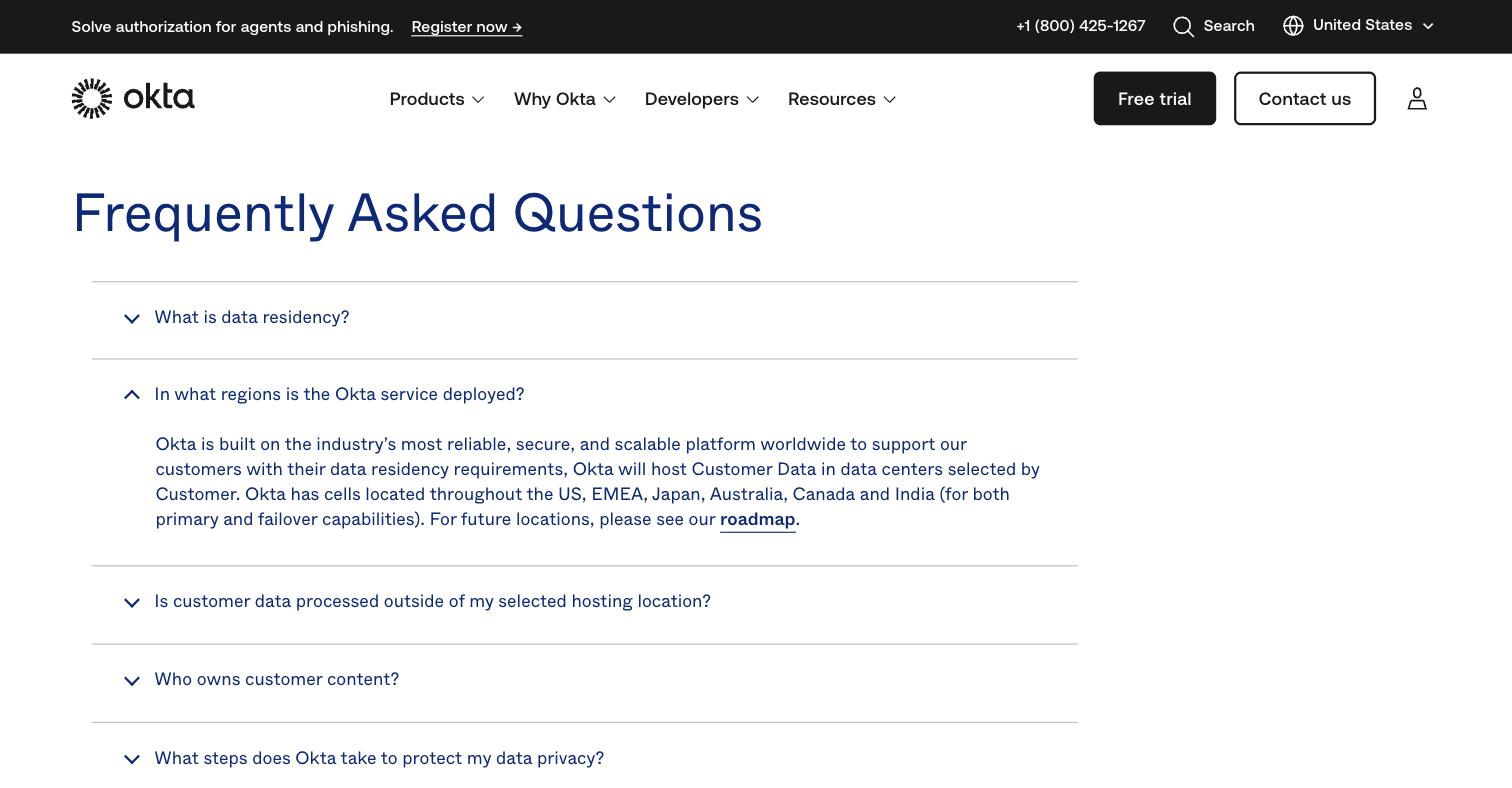
By Okta's own data-residency documentation, "data residency refers to the actual geographic location where your organization's content is stored," and its identity cells are "located throughout the US, EMEA, Japan, Australia, Canada and India" — none of them in mainland China. Keeping your China users' identities and login records there is a cross-border transfer of personal information that PIPL governs, needing notice, separate consent, a transfer mechanism, and for a CIIO or large-volume handler, in-country storage. Because sign-in is answered from that same offshore cell, the authentication round trip crosses the border too. The table below is Okta's own wording and the rules it triggers.
This is a risk picture, not a verdict — your obligations turn on your data volumes and your role. Our China team can map your Okta exposure with you →
Compliance snapshot
- ! Reachable, but served from offshore cells — sign-in and assets cross the border
- ! Stores identity & user data in offshore cells (US, EMEA, Japan, Australia, Canada, India)
- ! Identity data held offshore is a cross-border transfer — PIPL applies
- ✕ No mainland-China cell or data-residency option
- ✓ A compliant in-country delivery path exists — no rebuild, no migration
What Okta's documentation says, and what we measured from inside China
| Fact | Primary source |
|---|---|
| In Okta's own words: "data residency refers to the actual geographic location where your organization's content is stored," and to meet it "Okta has created cell architecture that allows customers to purchase local cells in which to store customer data." Those cells are "located throughout the US, EMEA, Japan, Australia, Canada and India (for both primary and failover capabilities)" — none is in mainland China, the nearest being Japan. | Okta — Okta + Data Residency, retrieved 2026-10-07 |
| Okta holds personal information — identities, profiles, group memberships and authentication logs — and keeps it in whichever offshore cell your org is assigned. Data gathered from users in China therefore leaves the country. PIPL governs that cross-border transfer: the personal-information handler (you, Okta's customer — not Okta) must give notice, obtain separate consent, and satisfy one transfer mechanism — a CAC security assessment, the CAC standard contract, or certification. | PIPL Chapter III, Articles 38–43 |
| The exposure scales with volume and role, not merely with using the tool: under the CAC's March 2024 cross-border rules, a non-CIIO transferring fewer than 100,000 individuals' non-sensitive personal information in a calendar year is exempt from the security assessment, standard contract and certification. | CAC — Regulations on Promoting and Regulating Cross-border Data Flows, March 2024 |
| For a CIIO or large-volume handler, personal information collected in China must be stored inside mainland China (CSL Article 39 (formerly Article 37); PIPL Article 40). Okta publishes no mainland-China cell, so the only way to keep your China users' identity data on Chinese soil is to run that identity and its storage on infrastructure inside the mainland — and standing that up legally is what brings an ICP filing into the picture. | PIPL Article 40; CSL Article 39 (formerly Article 37); Okta — Okta + Data Residency (cell regions), retrieved 2026-10-07 |
Reachability is a delivery matter, not the compliance question. Requested from a residential broadband line in Beijing on 2026-08-30, okta.com answered and painted on all 3 attempts (median time to first byte 1,049ms, largest-contentful-paint 3,052ms) but navigation did not complete within the 60-second window on any of the 3 — three offshore third-party dependencies (Google Fonts, Google Tag Manager and a OneTrust geolocation call) hung, while Okta's own hosts returned every request. It is reachable; what decides whether you may use it is where the identity data lives. | 21YunBox — China delivery measurement, measured from inside mainland China |
Sources verified by the 21YunBox compliance team on 2026-10-19.
For a mainland-China audience, the deciding question about Okta is not how fast it signs people in — it is where the identities it holds are allowed to live. Okta is an identity provider: it stores the accounts, profiles, group memberships and authentication records your organization runs on. By its own documentation that data sits in a geographic cell, and not one of Okta’s cells is in mainland China. So a China-facing deployment on Okta is reachable, yet every identity it keeps for your Chinese users is held offshore — a cross-border transfer China’s data law governs, not a performance problem. And because sign-in itself is answered from that offshore cell, the authentication round trip crosses the border on every login. Reaching Okta is not the issue; where it keeps your users’ identities is.
Okta in China at a glance
| What decides it | In Okta's own terms |
|---|---|
| Where your identity data lives | Each Okta org is assigned to a cell, and customer data is stored in that cell. Okta's cells are “located throughout the US, EMEA, Japan, Australia, Canada and India (for both primary and failover capabilities).” None is in mainland China; the nearest, Japan, is still offshore. |
| The cross-border transfer | The identities, profiles and sign-in records you authenticate for users in China land in that offshore cell. That is a cross-border transfer of personal information PIPL governs — and the handler is you, the Okta customer, not Okta. |
| When the rules bite harder | Exposure scales with volume and role. Under the CAC's March 2024 cross-border rules, a non-CIIO moving fewer than 100,000 individuals' non-sensitive personal information in a calendar year is exempt from the security assessment, standard contract and certification. |
| Data residency | For a CIIO or large-volume handler, personal information collected in China must be stored inside the mainland (CSL Article 39 (formerly Article 37); PIPL Article 40) — a duty no Okta cell can meet. |
| Is it reachable? | Yes — okta.com answered and painted on every attempt from a residential line in Beijing (2026-08-30), but navigation did not complete within 60 seconds as offshore third-party dependencies hung. Reachable, not instant — and reachability is not the compliance question. |
Where your Okta identity data actually lives
Okta runs a cell-based architecture: each customer org is assigned to a cell, and that cell is where its data physically lives. In Okta’s own data-residency material, “data residency refers to the actual geographic location where your organization’s content is stored,” and “to support customers with data residency needs, Okta has created cell architecture that allows customers to purchase local cells in which to store customer data.” The cells themselves are “located throughout the US, EMEA, Japan, Australia, Canada and India (for both primary and failover capabilities).”
That list is the whole point for China: it has no mainland entry. The nearest cell to the mainland is in Japan, and it is still outside it. So the moment your organization authenticates users in China, the identities, profiles and login records Okta writes for them are kept abroad — and that, not latency, is what China’s data law responds to.
Serve China users from Okta and their identity data crosses the border
Personal information your organization authenticates through Okta — names, email addresses, login identities, group memberships, authentication logs — is written to that one offshore cell. Under China’s Personal Information Protection Law, storing it outside the mainland is a cross-border transfer, and the obligation lands on the personal-information handler, which is you as the Okta customer and not Okta as the platform. PIPL asks that handler to give affected users notice, obtain their separate consent for the transfer, and clear one transfer mechanism: a CAC security assessment, the CAC standard contract, or certification. “We already run on Okta” settles none of that; reaching China and being cleared to move Chinese users’ identity data out of it are different questions.
How much is at stake depends on your volume and your role
The weight of these duties is not uniform. Under the CAC’s March 2024 Regulations on Promoting and Regulating Cross-border Data Flows, a handler that is not a critical information infrastructure operator and moves fewer than 100,000 individuals’ non-sensitive personal information in a calendar year is exempt from the security assessment, the standard contract and certification — a genuinely lighter path for a smaller deployment.
At the other end, a CIIO or a large-volume handler carries a data-residency duty: personal information collected in China must be stored inside the mainland (Cybersecurity Law Article 39 (formerly Article 37); PIPL Article 40). No Okta cell can satisfy that, because none sits in China. The only way to keep your Chinese users’ identity data on Chinese soil is to run that identity and its storage on infrastructure inside the mainland, and standing that up legally is what brings an ICP filing into the picture.
Reachable, but served from offshore — which is why this is a data question
Okta is not walled off from China. In 21YunBox’s own measurement from inside the mainland — a residential broadband line in Beijing on 2026-08-30 — okta.com answered and painted on every one of three attempts, with a median time to first byte of 1,049 ms and a largest-contentful-paint of 3,052 ms. But navigation did not complete within the 60-second measurement window on any of the three: three offshore third-party dependencies — Google Fonts, Google Tag Manager and a OneTrust geolocation call — hung and never returned, while Okta’s own hosts answered every request. That is the texture of offshore identity delivery from inside China: the content arrives, yet the experience is at the mercy of a cross-border round trip and whatever else it drags in.
Reachability, though, is the delivery question, not the compliance one. Even if every byte arrived instantly, the identities would still be stored offshore — and that is the fact PIPL responds to.
This is a risk map, not a verdict: whether you owe notice and consent only, a full transfer mechanism, or in-country storage of the identity data itself turns on how much personal information you hold and whether your role pulls you into the CIIO or large-volume tier — a question to work through with counsel before you build.
Where 21YunBox fits — a compliant overlay, not a migration
You keep running Okta; your identity provider does not move. What we add is the layer an identity platform with no mainland cell cannot give you on its own: compliant, ICP-filed delivery from inside the mainland, set in front of your existing origin — no re-architecture and no second codebase. Our China team first maps your cross-border and data-residency obligations against your entity and your data volumes. Then, for the case the law treats most strictly — where Chinese users’ identity data has to remain on the mainland — we help you stand up the in-country delivery and storage that a lawful China presence needs, while Okta stays exactly where it already runs.
Related reading:
Frequently Asked Questions
Does Okta store Chinese users' identity data in China?
No. By Okta's own data-residency documentation, customer data is stored in the cell your org is assigned to, and its cells are located throughout the US, EMEA, Japan, Australia, Canada and India — none in mainland China. So the identities, profiles and login records of your China users are held offshore.
Is it against the law to use Okta in China?
Not inherently. The issue is the cross-border transfer of personal information, which PIPL permits if you give notice, obtain separate consent and meet one of its transfer mechanisms. Whether you also face a data-localization obligation depends on your role (for example, whether you are a CIIO) and the volume of personal information you handle. Treat this as a risk to assess with counsel, not a blanket prohibition.
Can 21YunBox help make our Okta setup compliant in China?
Yes. Our China team can help you assess the cross-border and data-residency exposure for your data volumes and role, and stand up the compliant, ICP-filed in-country delivery — and, where the law requires your China users' identity data to stay on the mainland, in-country storage. Get in touch to work through your specific case.