Does OneTrust Work in China? Consent Data, PIPL & Data Residency
OneTrust is a privacy-compliance platform — yet its own Help Center says customer data is "not stored in China" and its services run from the US and EEA. For mainland China that turns the consent records it collects into a cross-border transfer under PIPL, with no ICP-filing footing. A compliance-first look at the data-residency and reachability exposure.
Does OneTrust work in China?
The irony is the answer: OneTrust is a privacy-compliance platform that, used as-is for mainland China, can become a compliance exposure of its own. Reaching it isn't the problem — where it keeps your Chinese users' consent records is.
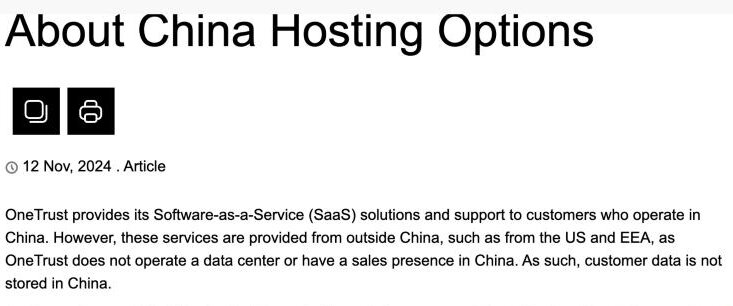
By OneTrust's own Help Center its services are "provided from outside China, such as from the US and EEA," and "customer data is not stored in China." So every consent record, cookie-scan result and data-subject request it captures from a Chinese visitor is personal information that leaves the mainland — a cross-border transfer PIPL governs (notice, separate consent and a transfer mechanism, Articles 38–43), with an in-country storage duty for a CIIO or large-volume handler (PIPL Article 40; Cybersecurity Law Article 39 (formerly Article 37)). The banner itself is fetched from an offshore CDN, so from inside China it can load slowly or fail — and a consent gate that can't load can hold up the page it guards. The table below is OneTrust's own wording and the rule each line triggers.
This is a risk map, not a verdict — what you owe turns on your data volumes, your role as handler and who your users are, and it's worth settling with counsel. Our China team can map your exposure with you →
What OneTrust's own documentation says about China
| Fact | Primary source |
|---|---|
| OneTrust states plainly that it keeps customer data out of China. In its own Help Center, OneTrust says its services are "provided from outside China, such as from the US and EEA," that it does not operate a data center in the country, and that "customer data is not stored in China." For a consent and privacy platform that is the point in reverse: the record proving a Chinese user consented is itself personal information held offshore — a cross-border transfer of personal information under PIPL (notice, separate consent and a transfer mechanism, Articles 38–43). | OneTrust Help Center — About China Hosting Options, retrieved 2026-10-07; PIPL Articles 38–43 |
| OneTrust's hosting localities don't include mainland China. Per its Help Center, OneTrust cloud hosting runs on Microsoft Azure, across localities spanning the United States, Canada, Brazil, the United Kingdom, Europe, Australia and Asia — the nearest to China still sits outside the mainland. With no in-country region on offer, there is no mainland hosting resource for consent, cookie-scan and data-subject-request data to live on, and none to attach an ICP filing to. | OneTrust Help Center — About OneTrust Hosting Options, Locations, and Backup, retrieved 2026-10-07 |
| The consent banner is delivered from an offshore CDN and keyed to a geo-IP lookup. OneTrust's developer documentation describes the script pulling its configuration from "The CDN location for the JSON that the SDK fetches" — "Usually, but not always, cdn.cookielaw.org" — and notes that an optional country code "can be used to bypass the automatic IP lookup performed by the SDK," so by default the banner geo-locates each visitor by IP. Served from outside the mainland, that gate can load slowly or fail from inside China, and a consent banner that can't load can hold up the very page it is meant to gate. Reachability is the delivery half of the question, not the legal half that decides whether you may use it. | OneTrust Developer Documentation — SDK configuration parameters, retrieved 2026-10-07 |
| For some handlers the data must stay in China — and serving from inside the mainland triggers an ICP filing. Where the handler is a critical information infrastructure operator or moves personal information at volume, personal information collected in China must be stored in the mainland (PIPL Article 40; Cybersecurity Law Article 39 (formerly Article 37)) — which an offshore consent store cannot satisfy. And any public site actually served from inside China must carry an ICP filing (State Council Order No. 292; MIIT Order No. 33), bound to a mainland hosting resource OneTrust does not provide. | PIPL Article 40; Cybersecurity Law Article 39 (formerly Article 37); State Council Order No. 292; MIIT Order No. 33 |
Sources verified by the 21YunBox compliance team on 2026-10-07.
For a mainland-China audience, the question about OneTrust carries an awkward twist. OneTrust is the tool organizations buy in order to stay compliant — cookie consent, data-subject requests, cookie scanning, data mapping — yet used as-is for China it can become a compliance exposure of its own. This is not a speed problem: the banner reaches China. It is that the consent records, cookie-scan results and request data OneTrust captures from your Chinese users are held outside the mainland, and that the banner arrives over an offshore network. The first is a data-residency and cross-border question under China’s law; the second is a reachability one. Both sit upstream of performance, and OneTrust answers both in its own documentation.
OneTrust in China at a glance
| What decides it | In OneTrust's own terms |
|---|---|
| Where the data lives | OneTrust says its services are “provided from outside China, such as from the US and EEA,” and that “customer data is not stored in China.” The consent, cookie-scan and data-subject-request records it captures sit offshore. |
| Hosting footprint | Per its Help Center, OneTrust cloud hosting runs on Microsoft Azure across localities in the US, Canada, Brazil, the UK, Europe, Australia and Asia. None is inside mainland China; the nearest is still offshore. |
| How the banner arrives | The consent script pulls its configuration from an offshore CDN — “Usually, but not always, cdn.cookielaw.org” — and picks an experience from an automatic IP lookup. Delivered from outside the mainland, the gate can stall or fail. |
| Serving the public | A site served to mainland visitors from inside China needs an ICP filing tied to a mainland hosting resource. OneTrust names no mainland region, so there is nothing of its own to file against. |
| Your China users' data | Personal information OneTrust stores offshore is a cross-border transfer PIPL governs, plus a data-localization duty for CIIOs and large-volume handlers that offshore regions cannot meet. |
The record of consent is itself personal information — kept offshore
The awkward part is structural, not incidental. OneTrust’s whole job is to collect and store proof that you handled personal information lawfully — who consented, to what, when, and the trail behind a data-subject request. But in its own Help Center OneTrust states that its services are “provided from outside China, such as from the US and EEA,” that it runs no data center in the country, and that “customer data is not stored in China.” So the record proving a Chinese user consented is held in the United States or Europe — which means the privacy tool has quietly created the exact thing it exists to document.
Under China’s Personal Information Protection Law that is a cross-border transfer, and the obligation lands on the personal-information handler — you, not OneTrust. You have to give notice, obtain separate consent for the overseas transfer, and clear one transfer mechanism: a CAC security assessment, the CAC standard contract, or certification (PIPL Articles 38–43). The tool collecting the consent does not discharge the duty attached to where that consent is then stored.
No mainland region, so no in-country storage and no ICP footing
OneTrust’s hosting localities, per its Help Center, run on Microsoft Azure across the US, Canada, Brazil, the UK, Europe, Australia and Asia — not one of them inside mainland China, and the closest is still outside it. That geography settles two separate questions before performance ever enters the picture.
First, residency: if you are a critical information infrastructure operator or a large-volume handler, personal information collected in China must be stored in the mainland (PIPL Article 40; Cybersecurity Law Article 39 (formerly Article 37)) — a duty an offshore consent store cannot satisfy no matter how it is tuned. Second, licensing: a public-facing site actually served to mainland visitors from inside China turns on an ICP filing (ICP 备案) under State Council Order No. 292 and MIIT Order No. 33, and that filing must attach to a hosting resource physically in the mainland. OneTrust provides none, so there is nothing on OneTrust to file against. “We already run OneTrust for privacy” does not carry into China; the data-handling story the tool is supposed to give you is the very thing it leaves open here.
A consent gate delivered from offshore can hold up the page
The reachability half is real too, and it is sharper for a consent banner than for most scripts. OneTrust’s developer documentation describes the client pulling its configuration from “The CDN location for the JSON that the SDK fetches” — “Usually, but not always, cdn.cookielaw.org” — and notes that an optional country code “can be used to bypass the automatic IP lookup performed by the SDK,” so by default each visitor is geo-located by IP to decide which experience to show. Both the configuration and that lookup originate outside the mainland.
A banner is often wired to gate the page until a choice is made. So when an offshore-served consent script loads slowly or fails from inside China, it does not fail quietly in the corner — it can hold up the very content it is meant to guard. That is a delivery problem, not a legal one, but on a China-facing site the two stack: the banner that is hardest to deliver is also the one carrying the cross-border exposure.
This is a risk map, not a verdict: whether you owe separate consent, a transfer mechanism, in-country storage, an ICP filing, or some combination depends on your data volumes, your role as handler, and who your users are — worth settling with counsel before you rely on it.
Where 21YunBox fits — a compliant overlay, not a migration
You keep running OneTrust. We add the piece a US- and EEA-hosted privacy platform structurally cannot: compliant, ICP-filed delivery from inside the mainland, set in front of your existing origin — no rebuild, no second codebase, and no move off OneTrust. Our China team maps the PIPL cross-border and data-residency obligations that attach to the consent and preference data OneTrust collects, against your entity and data volumes, then stands up the in-country delivery and storage a lawful China presence needs — while your privacy stack stays exactly where it already runs.
Related reading: