Does Google Authenticator Work in China? Offline Codes, Blocked Account, Synced Secrets
Google Authenticator computes its six-digit codes offline on the phone, so an app that's already set up keeps working inside mainland China — what breaks is the Google-account layer around it: sign-in, cloud backup, restore and cross-device sync. The only cross-border-data wrinkle is the optional cloud sync, which backs up your 2FA secrets to Google servers outside China.
Does Google Authenticator work in China?
Whether Google Authenticator works in China is mostly an access question, not a data-residency one. The app computes its six-digit codes offline on your phone, so a device that is already set up keeps producing valid codes inside mainland China — what breaks is the Google-account layer around it.
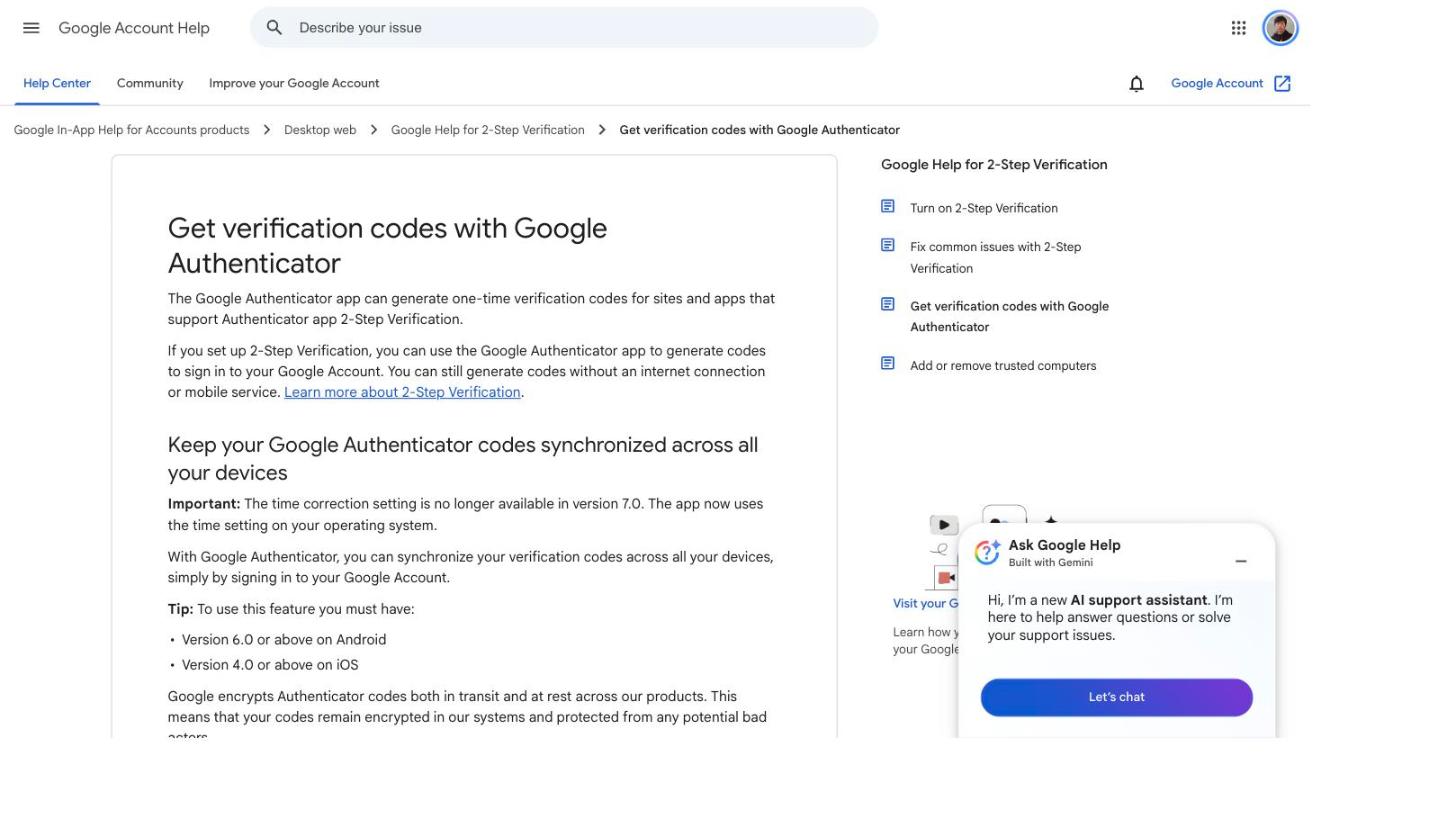
In Google's own words, "You can still generate codes without an internet connection or mobile service," yet syncing those codes works only "by signing in to your Google Account" — and reaching Google's account services from inside the mainland is exactly what our probes could not do. There is a narrower compliance angle too: if you switch on cloud sync, your 2FA secrets are backed up to Google servers outside China, which Google says it encrypts "in transit and at rest" — not end-to-end. The table below separates what still works offline from the account-dependent and cross-border pieces that don't.
This is an exposure picture, not a verdict — most of the risk disappears if cloud sync stays off, and the rest turns on your role and data volumes. Our China team can map your exposure with you →
Compliance snapshot
- ✓ Codes generate offline — an app that's already set up keeps working in China
- ✕ Google Account sign-in, cloud backup, restore and cross-device sync don't reach China
- ! Optional cloud sync sends your 2FA secrets to Google servers outside China
- ! Google's wording is "in transit and at rest" — not end-to-end
- ✓ Lower-exposure path: keep cloud sync off so secrets stay on the device
What Google Authenticator App's documentation says, and what we measured from inside China
| Fact | Primary source |
|---|---|
| In Google's own words, the codes are generated on the device: "You can still generate codes without an internet connection or mobile service." Google Authenticator computes a time-based one-time password from a secret held on the phone and the phone's clock, so an app that is already set up keeps producing valid six-digit codes inside mainland China even when Google's network cannot be reached. | Google Account Help — Get verification codes with Google Authenticator, retrieved 2026-10-07 |
| Backup, restore and cross-device sync are account-bound. Google's help page states you can "synchronize your verification codes across all your devices, simply by signing in to your Google Account," and that "when you sign in to your Google Account within Google Authenticator on a new device, your codes are automatically synced to this device." Every one of those steps has to reach Google — the layer that does not respond reliably from inside the mainland (see the measurement below). | Google Account Help — Get verification codes with Google Authenticator, retrieved 2026-10-07 |
| Cloud sync is optional, and the synced secrets are not end-to-end encrypted. Google added Google-Account synchronization on 2023-04-24 and states it encrypts the codes "both in transit and at rest across our products" — deliberately not end-to-end (Google has described end-to-end encryption as a future plan, not a current feature). [Inference: Google operates no infrastructure in mainland China, so the backed-up secrets sit on Google servers outside the mainland in a form Google can access.] If sync stays off, the secrets never leave the device. | Google Account Help (retrieved 2026-10-07); Google Security Blog — Google Authenticator now supports Google Account synchronization, 2023-04-24 |
| Only the optional cloud backup raises a cross-border-data question. If an organization has staff or users back up 2FA secrets to a Google Account, those secrets leave China for Google's servers abroad — a cross-border transfer of personal information under PIPL Chapter III (notice, separate consent, and one statutory transfer mechanism). Exposure scales with role and volume: since the CAC's March 2024 rules, a non-CIIO moving fewer than 100,000 individuals' non-sensitive personal information in a calendar year is exempt from the security assessment, standard contract and certification. [Inference: authentication secrets tied to identified individuals are best treated as personal information, and conservatively as sensitive — confirm the threshold and your role with counsel.] | PIPL Chapter III, Articles 38–43; CAC — Regulations on Promoting and Regulating Cross-border Data Flows, March 2024 |
Across our census we requested twelve Google-owned properties from a probe inside mainland China (Alibaba Cloud cn-zhangjiakou), three times each on 2026-08-28. Eleven of the twelve produced no response at all — not a slow response, no first byte in any attempt. The twelfth, the Google Fonts stylesheet endpoint, answered every time from that datacenter probe and then failed 54 requests out of 54 when the same measurement ran on a Beijing China Mobile residential line on 2026-08-30. | 21YunBox — 280-site China delivery census, measured from inside mainland China |
Sources verified by the 21YunBox compliance team on 2026-10-07.
For a user in mainland China, “does Google Authenticator work?” is really two questions wearing one coat. The part that matters most day to day — can the app still hand me a valid code so I can log in? — is settled entirely on the phone, with no network involved, so the honest answer there is yes, it keeps working. The part that actually trips people up — can I sign in, back up my codes, restore them onto a new phone, or sync them across devices? — all runs through a Google Account, and that is the layer that does not reach the mainland. A quieter third question sits underneath both: if you switch cloud sync on, where do your two-factor secrets end up? This page takes the three in turn, and starts with what Google itself says about the codes.
Google Authenticator in China at a glance
| What decides it | What happens for a user inside mainland China |
|---|---|
| The six-digit codes | Computed on the phone from a stored secret and the device clock — no network needed. An app that is already set up keeps producing valid codes inside the mainland, exactly as Google describes. |
| First-time sign-in to a Google Account | Has to reach Google. In 21YunBox measurements from inside the mainland, Google's own endpoints did not respond, so the initial account step is the one most likely to stall. |
| Cloud backup, restore & cross-device sync | All of these happen “by signing in to your Google Account,” so they inherit the same account layer that does not reach the mainland reliably. |
| Where your 2FA secrets live | On the device by default. Turn cloud sync on and a copy is backed up to Google servers — and Google runs no infrastructure in the mainland, so that copy lands outside China. |
| Encryption of the synced copy | Google says it encrypts the synced codes “in transit and at rest.” It has described end-to-end encryption as a future plan, so today the synced copy is not end-to-end encrypted. |
| Cross-border-data exposure | Arises only if cloud sync is switched on: secrets leaving China for Google servers abroad is a transfer under PIPL Chapter III. Keep sync off and there is no transfer. |
Codes work offline — the app keeps generating them
Google Authenticator is a time-based one-time-password (TOTP) app. When you first enroll an account, it stores a shared secret on the phone; from then on it combines that secret with the phone’s own clock to produce a fresh six-digit code every thirty seconds. None of that arithmetic touches the internet. Google states it plainly — the app can generate codes “without an internet connection or mobile service” — which is precisely why a handset that was set up before you arrived keeps logging you in from inside mainland China. Airplane mode, no SIM, no data: the code still appears. Where something works, it is worth saying clearly that it works, and this part does.
The catch is only that this holds for accounts already enrolled. Adding a brand-new account still means scanning a QR code or entering a key from the service you are protecting — and if that service is itself unreachable from China, the obstacle is the service, not the authenticator.
What breaks: the Google-account layer
Everything that is not the raw code calculation runs through a Google Account, and that is the layer that does not reach the mainland. Google’s help page ties backup, restore and multi-device use to one precondition — syncing happens “by signing in to your Google Account” — so the first sign-in, cloud backup, restore onto a replacement phone, and cross-device sync all depend on a round trip to Google that a normal China connection does not complete.
Our census put numbers on that layer. We requested twelve Google-owned endpoints three times each on 2026-08-28 from an Alibaba Cloud probe in cn-zhangjiakou; eleven of the twelve returned no first byte on any attempt — not a slow response, no response. The single endpoint that did answer from that datacenter probe, the Google Fonts stylesheet host, then failed on all fifty-four requests when the same test ran over a Beijing China Mobile residential line on 2026-08-30. That split is the honest part of the picture: a datacenter probe can paint a rosier result than a real phone, because mainland clouds sometimes carry a local copy of resources an ordinary visitor cannot reach — which is exactly why the residential-line result is the one that matters here, and it did not get through. In practice, anything inside Authenticator that waits on Google will keep a user on a home connection waiting too.
The cloud-sync wrinkle: your 2FA secrets leave China
This is the one place where Google Authenticator raises a genuine data question rather than an access one. By default the secrets stay on the device and never leave it. But Google added Google-Account synchronization on 2023-04-24, and once you switch it on, your 2FA secrets are backed up to Google’s servers. Google says those codes are encrypted “in transit and at rest” — deliberately not end-to-end; it has framed end-to-end encryption as a future plan, not a current feature. Since Google operates no infrastructure in mainland China, the reasonable inference is that the backed-up secrets sit on Google servers outside the mainland, in a form Google itself can access.
For an individual that is a personal risk call. For an organization it is a compliance one. If your staff or users back up their authenticator secrets to a Google Account, those secrets cross the border out of China — a cross-border transfer of personal information under PIPL Chapter III, which calls for notice, separate consent, and one statutory transfer mechanism. How heavy that duty is scales with your role and your volumes: since the CAC’s March 2024 cross-border rules, a non-CIIO moving fewer than 100,000 individuals’ non-sensitive personal information in a calendar year is exempt from the security assessment, the standard contract and certification. Authentication secrets tied to identified people are best treated as personal information, and conservatively as sensitive — so confirm the threshold and your own classification with counsel rather than reading the exemption as an all-clear. The lowest-exposure path needs no product at all: leave cloud sync off, and the secrets never leave the phone.
Where 21YunBox fits
Be clear about what this page is and is not. It is about whether the app works for a person in China — and for that, there is nothing for 21YunBox, or anyone, to “install” that makes the consumer app’s Google-account features reach the mainland. That layer is Google’s, and the practical advice is free: keep cloud sync off so your codes stay on-device, and enroll any new phone while you still have reliable access to your Google Account.
Where we genuinely help is one step removed — when you run a service whose login or 2FA depends on Google reaching your users inside the mainland. That dependency is the real exposure, and our China compliance team can map it with you: keeping sign-in and 2FA flows working for mainland users, and assessing the cross-border data question if cloud sync is in play. If part of your login system has to be served legally from inside the mainland, that in-country delivery is the piece that triggers an ICP filing — and we stand that up with you, around the stack you already run. If that is your situation, start here:
Get a China access & exposure review →
Related reading:
- Cross-border data transfers under PIPL — the law that governs the optional cloud-sync backup
- How to get an ICP filing for China — relevant only if you also run a service that must be served from inside the mainland
Frequently Asked Questions
Do Google Authenticator codes work in China?
The codes themselves do. Google states they are generated "without an internet connection or mobile service," so an app that is already configured keeps producing valid codes inside mainland China. What does not work reliably is anything that reaches Google's network — signing in, cloud backup and restore, cross-device sync, and enrolling a new code if the service you are protecting is itself blocked.
Is this a data-residency problem like a consent or analytics tool?
Mostly, no — and it is worth being precise. Unlike a script a website embeds to collect visitors' personal data, Google Authenticator computes codes locally and, by default, keeps the secrets on the device. The only cross-border exposure is the optional cloud-sync backup, which sends 2FA secrets to Google servers outside China (Google encrypts them in transit and at rest, but not end-to-end). Turn sync off and that exposure goes away. Where PIPL does apply, it is a narrower, conditional question than for a consent or analytics platform.
Can 21YunBox help?
Yes. Our China team can help you keep sign-in and 2FA flows working for users inside the mainland when they depend on Google, and assess the cross-border exposure if cloud sync is in play. Where your broader login system or site has to be served legally from inside mainland China, that in-country delivery is what requires an ICP filing, and we set that up with you. Get in touch to work through your case.