Does Citrix Work in China? Control Plane, PIPL Cross-Border & Data Residency
Citrix DaaS (formerly Virtual Apps and Desktops service) streams desktops and apps through Citrix Cloud, whose control plane runs only in the United States, European Union, and Asia Pacific South regions — with no mainland-China region. The brokering metadata it handles for your China users — user names, machine names, application shortcuts, and credentials held in its cloud database — is therefore routed offshore, a cross-border transfer under PIPL, while putting the VDAs in-country is only partial residency and a public-facing access point needs ICP footing. A compliance-first look at the control-plane, cross-border, data-residency, and ICP questions — and the lawful in-country path.
Does Citrix work in China?
The question isn't whether Citrix reaches China — it's where the control plane that brokers every session lives, and what it holds about your users. Citrix DaaS splits into a Citrix-hosted control plane and the VDAs you run yourself; the VDAs can sit in the mainland, but the control plane cannot.
Per Citrix's own documentation, Citrix Cloud offers its control plane in only three regions — the United States, the European Union, and Asia Pacific South — with no mainland-China region, and that control plane "has access to metadata, such as user names, machine names, and application shortcuts." For your China users those identifiers are personal information, so routing them to an offshore control plane is a cross-border transfer under PIPL (notice, a separate consent, and a transfer mechanism; Articles 38–40), which may trigger China's data-export security assessment. Putting the VDAs in-country is only partial residency while the control plane stays abroad, and for a critical information infrastructure operator the Cybersecurity Law's Article 39 (formerly Article 37) in-country storage duty is one it cannot meet. A public-facing access point served in the mainland also needs an ICP footing.
21YunBox maps your cross-border, residency, and ICP exposure, localizes the estate onto a China-legal in-country pattern — in-country resource locations, an on-premises deployment for full residency, or a compliant in-country footing for the brokering metadata — and delivers the access point in-country on ICP-filed infrastructure, with no rebuild and never any form of circumvention. Treat the specifics as a risk to confirm with counsel. Get a compliance assessment →
What Citrix's own documentation says about China
| Fact | Primary source |
|---|---|
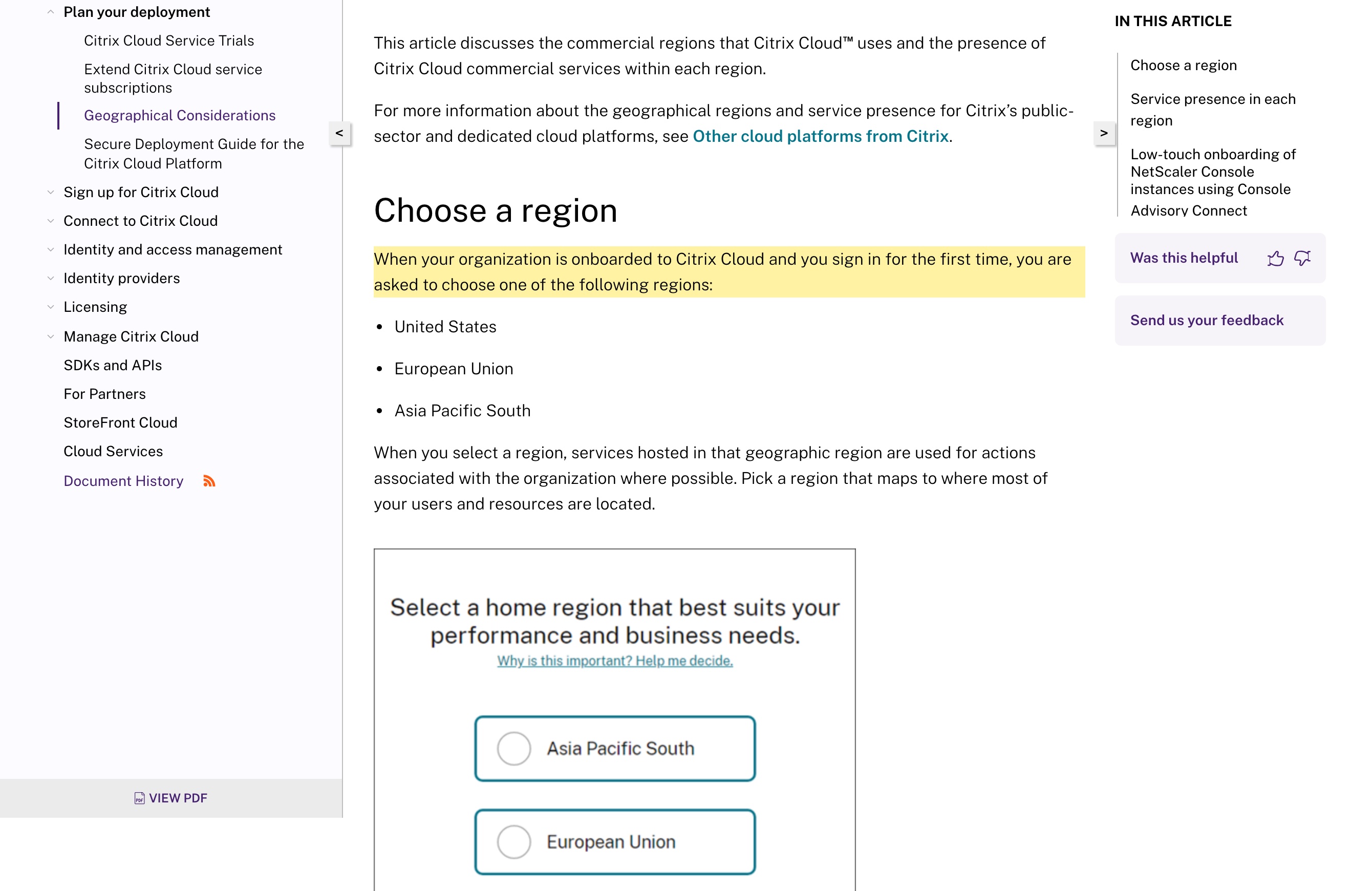
| Citrix Cloud offers its control plane in only three regions — the US, the EU, and Asia Pacific South — with no mainland-China region. Citrix's Geographical Considerations documentation says that on first sign-in "you are asked to choose one of the following regions" — "United States," "European Union," and "Asia Pacific South" — and that its only dedicated platforms beyond them are Citrix Cloud Government, "available only in the US region," and Citrix Cloud Japan, "available only in Japan." None is in the mainland, so the control plane that brokers every Citrix DaaS session runs offshore. | Citrix Product Documentation — Geographical Considerations (docs.citrix.com), retrieved 2026-10-09 |
| Citrix hosts the control plane; you host the VDAs. Citrix's Technical Security Overview states that "Citrix Cloud manages the operation of the control plane for Citrix DaaS environments" — including the Delivery Controllers, management consoles, SQL database and license server — while "the Virtual Delivery Agents (VDAs) hosting the apps and desktops remain under the customer's control in the data center of their choice, either cloud or on-premises." So the VDAs can sit in the mainland, but the brokering control plane does not. | Citrix DaaS — Technical security overview (docs.citrix.com), retrieved 2026-10-09 |
| The offshore control plane holds identifiers of your users. Per the same Citrix overview, the control plane "has access to metadata, such as user names, machine names, and application shortcuts," and Citrix DaaS "stores only the metadata needed for the brokering and monitoring of the customer's applications and desktops" — with administrator authentication and, depending on configuration, hypervisor passwords held "directly stored encrypted in the SQL database in the cloud." For users in China, those identifiers are personal information sitting abroad. | Citrix DaaS — Technical security overview (docs.citrix.com), retrieved 2026-10-09 |
| Routing China-user identifiers to the offshore control plane is a PIPL cross-border transfer. Moving personal information collected from users in mainland China to an offshore system engages PIPL Articles 38–40: notice, a separate consent, and one transfer mechanism — a CAC security assessment, the CAC standard contract, or certification. For a critical information infrastructure operator, the Cybersecurity Law's Article 39 (formerly Article 37) adds an in-country storage duty an offshore control plane cannot meet. | Personal Information Protection Law of the PRC, Articles 38–40; Cybersecurity Law Article 39 (formerly Article 37) (cac.gov.cn), retrieved 2026-10-09 |
Sources verified by the 21YunBox compliance team on 2026-10-09.
For an enterprise running Citrix in mainland China, the first instinct is to ask whether the desktops and apps will reach users there — but that is not where the China decision is settled. Citrix DaaS (formerly Virtual Apps and Desktops service) splits into two halves: a control plane that Citrix hosts in Citrix Cloud, and the Virtual Delivery Agents (VDAs) that actually run your apps and desktops, which stay in a data center you choose. The VDAs can sit inside China. The control plane cannot — Citrix Cloud offers it in only three regions, none of them the mainland — and the brokering metadata that control plane handles about your users is personal information. So the real questions are cross-border transfer, data residency, and the ICP footing a public access point needs, and Citrix answers the architecture in its own documentation.
Citrix in China at a glance
| What decides it | In Citrix's own terms — and China's law |
|---|---|
| What it is | Citrix DaaS (formerly Virtual Apps and Desktops service) streams apps and desktops from Citrix Cloud. Citrix Cloud runs the control plane — the Delivery Controllers, management consoles, SQL database and license server — while the Virtual Delivery Agents (VDAs) that host the apps and desktops “remain under the customer's control in the data center of their choice.” |
| Where the control plane lives | Offshore. Citrix Cloud's commercial regions are the United States, the European Union and Asia Pacific South; the “Citrix Cloud control plane” runs in those three. Its only dedicated platforms are Citrix Cloud Government (“available only in the US region”) and Citrix Cloud Japan (“available only in Japan”). None is in the mainland. |
| What that control plane holds | Per Citrix, it “has access to metadata, such as user names, machine names, and application shortcuts,” and stores “only the metadata needed for the brokering and monitoring.” Administrator authentication and, by configuration, hypervisor passwords sit “encrypted in the SQL database in the cloud.” |
| In-country VDAs are only partial residency | The VDAs, application data and provisioning images can stay in the mainland, but the control plane, the SQL database and the brokering metadata stay in an offshore region — so in-country VDAs alone do not make the deployment China-resident. |
| Your China users' data | The brokering identifiers tied to people in China are personal information. Holding them in a US, EU or Australian control plane is a cross-border transfer PIPL governs (notice, separate consent and a transfer mechanism; Articles 38–40), with an in-country storage duty for a CIIO or large-volume handler (PIPL Article 40; Cybersecurity Law Article 39 (formerly Article 37)). |
| Serving the public | A public-facing access point — a Workspace or StoreFront URL served to mainland users from inside China — needs an ICP filing bound to a mainland hosting resource, which Citrix Cloud's offshore access layer cannot provide. |
The control plane is hosted offshore — and that is where the brokering metadata sits
Citrix DaaS is built in two layers, and only one of them can live in China. In Citrix’s own words, “Citrix Cloud manages the operation of the control plane for Citrix DaaS environments,” and that control plane holds the Delivery Controllers, management consoles, SQL database and license server. The other layer is yours: “The Virtual Delivery Agents (VDAs) hosting the apps and desktops remain under the customer’s control in the data center of their choice, either cloud or on-premises.”
That division decides the China question before performance does. The control plane is hosted in Citrix Cloud, and Citrix Cloud’s commercial regions are, per its Geographical Considerations documentation, the United States, the European Union and Asia Pacific South — the only dedicated platforms beyond them are Citrix Cloud Government, “available only in the US region,” and Citrix Cloud Japan, “available only in Japan.” There is no mainland-China region to onboard into. So wherever your VDAs sit, the layer that brokers every session runs abroad.
And that layer is not empty of personal information. Citrix states the control plane “has access to metadata, such as user names, machine names, and application shortcuts,” and that Citrix DaaS “stores only the metadata needed for the brokering and monitoring of the customer’s applications and desktops.” User names, and the machines and sessions tied to them, are identifiers of real people. For your users in China, routing those identifiers to a control plane in the US, the EU or Australia is a cross-border transfer of personal information — regardless of how fast the session feels.
Why an in-country resource location is only half the residency story
The intuitive fix is to put the resource location — the VDAs, the application data and the provisioning images — inside the mainland, and Citrix does let you: that content “remains on the customer premises or in their public cloud vendor’s subscription,” and is “always hosted in the customer setup.” That genuinely keeps the heavy data in-country. But it does not make the deployment China-resident, because the control plane stays offshore, and the control plane is not only metadata. Citrix’s security overview notes that administrators authenticate against Citrix Cloud, that hypervisor passwords can be “directly stored encrypted in the SQL database in the cloud,” and that an optional setting allows user credentials to be uploaded to Citrix Cloud for forwarding between connectors. The brokering identifiers — and, depending on your configuration, some credentials — live in one of three offshore regions no matter where the VDAs run.
So the data-residency duty is only partly answered by in-country VDAs. Under the Personal Information Protection Law, moving the brokering metadata and any credentials to an offshore control plane is a cross-border transfer, and the duty lands on you as the handler, not on Citrix: PIPL Articles 38–40 require notice, a separate consent and one transfer mechanism — a CAC security assessment, the CAC standard contract, or certification. Above the relevant thresholds, or where the data counts as important data, that transfer may also require China’s data-export security assessment before anything leaves. And if your organization is a critical information infrastructure operator or a large-volume handler, personal information generated in China must be stored in China (PIPL Article 40; Cybersecurity Law Article 39 (formerly Article 37) — the data-localization provision was renumbered by the 2025 amendment that took effect on January 1, 2026, with its substance unchanged) — a duty an offshore control plane cannot meet while it holds the brokering metadata abroad.
A public-facing access point served in-country needs an ICP footing
Citrix DaaS reaches users through an access layer — Citrix Workspace, StoreFront, or the Citrix Gateway Service — and where that access point is served to the public from inside the mainland, it is an internet information service, which turns on an ICP filing (ICP 备案) bound to a hosting resource physically in China (State Council Order No. 292; MIIT Order No. 33). Citrix hosts its access layer in the same offshore Citrix Cloud regions as the control plane, so there is no Citrix-side mainland resource to file against; an in-country, ICP-filed access point has to be stood up on mainland infrastructure. Whether an ICP filing is required turns on how your access point is published and to whom — an internal enterprise portal and a public-facing service are not the same case — and it is worth settling with counsel.
This is a risk map, not a verdict that Citrix is “blocked” or “illegal.” Which obligations bite — a separate consent, a transfer mechanism, a data-export assessment, in-country storage, an ICP filing, or some combination — depends on your entity, the data your deployment carries, your role under Chinese law, and who your users are. None of it is a speed problem, and none of it is solved by any network workaround: 21YunBox never uses or suggests circumvention of any kind.
The lawful path — map, localize, deliver
There is a lawful way to run Citrix for a China-facing deployment, and it has a shape. First, map: our China team works through your PIPL exposure — which brokering metadata, credentials and identifiers tied to your China users leave the mainland for the control plane, whether a data-export security assessment or an in-country storage duty applies to your entity, and what your notice and consent flow must cover. The legal conclusions are settled with counsel; we build the technical picture that feeds them.
Then localize: we put the resource locations — the VDAs, application data and images — inside the mainland, and, where full residency is required, help you adopt the in-country pattern that keeps the control layer in China too. Citrix’s on-premises Virtual Apps and Desktops self-hosts the entire control plane — Delivery Controllers, database, StoreFront — so an on-premises deployment run inside the mainland keeps brokering, management and data all in-country; where a cloud-brokered model must stay, the work is to stand the brokering metadata on a compliant, consented in-country footing rather than letting it default offshore. We localize your estate onto whichever of these the law requires, replacing only what cannot run compliantly as-is.
Then deliver: the access point your users actually open — the Workspace or StoreFront URL — is a public service in the mainland, so it carries an ICP-filing duty and needs compliant, in-country delivery. 21YunBox delivers it in-country — the 21YunBox Optimizer — set in front of what you already run, with no rebuild and no re-platform. The result is a Citrix estate that runs legally and compliantly for your users in China. What we never do — and what no one lawfully can — is hand you a way around China’s data-export rules or around any network restriction.
Related reading:
- Cross-border data transfers under PIPL
- China’s data-export security assessment
- China’s Cybersecurity Law (data localization, Article 39)
- How to get an ICP filing for China