Does Yottaa Work in China? ICP Footing, PIPL Cross-Border & an Offshore Optimization Edge
Yottaa is a web-performance-optimization service for eCommerce that sits in front of your storefront and serves and sequences it from an offshore global edge. Its own pages place that edge, its subprocessors and its operations in the United States with no mainland-China point of presence — so every China shopper's request is answered offshore: a reachability question, no ICP footing, and a PIPL cross-border transfer of personal information. A compliance-first look, ending on lawful, ICP-filed in-country delivery.
Does Yottaa work in China?
Yottaa isn't a service China blocks at the border — but reachability isn't the question. Yottaa is an eCommerce performance service that sits in front of your storefront and serves and sequences it from an offshore global edge, so what decides whether you can use it in China is ICP footing and cross-border personal information, not speed.
Yottaa's own Platform page says its platform "runs on Fastly's global edge network"; its subprocessor list places every provider that delivers the platform at a United States address; and its privacy policy states Yottaa is "headquartered in the United States" — none inside mainland China, and it names no in-country point of presence. So a China shopper is answered offshore, and every request Yottaa handles (IP address, device, geo, HTTP metadata) transits that offshore layer — a cross-border transfer of personal information under PIPL (notice, a separate consent and a transfer mechanism, Articles 38–40), possibly a data-export security assessment, with an in-country storage duty for a CIIO or large-volume handler (Cybersecurity Law Article 39 (formerly Article 37); PIPL Article 40). An offshore edge also can't hold an ICP filing.
This is a risk map, not a verdict — what you owe turns on your entity, your data volumes and who your shoppers are, and it's worth settling with counsel. 21YunBox maps the path, localizes what must stay in the mainland, and delivers your storefront on ICP-filed in-country infrastructure — never any form of circumvention. Get a compliance assessment →
What Yottaa's own documentation says about China
| Fact | Primary source |
|---|---|
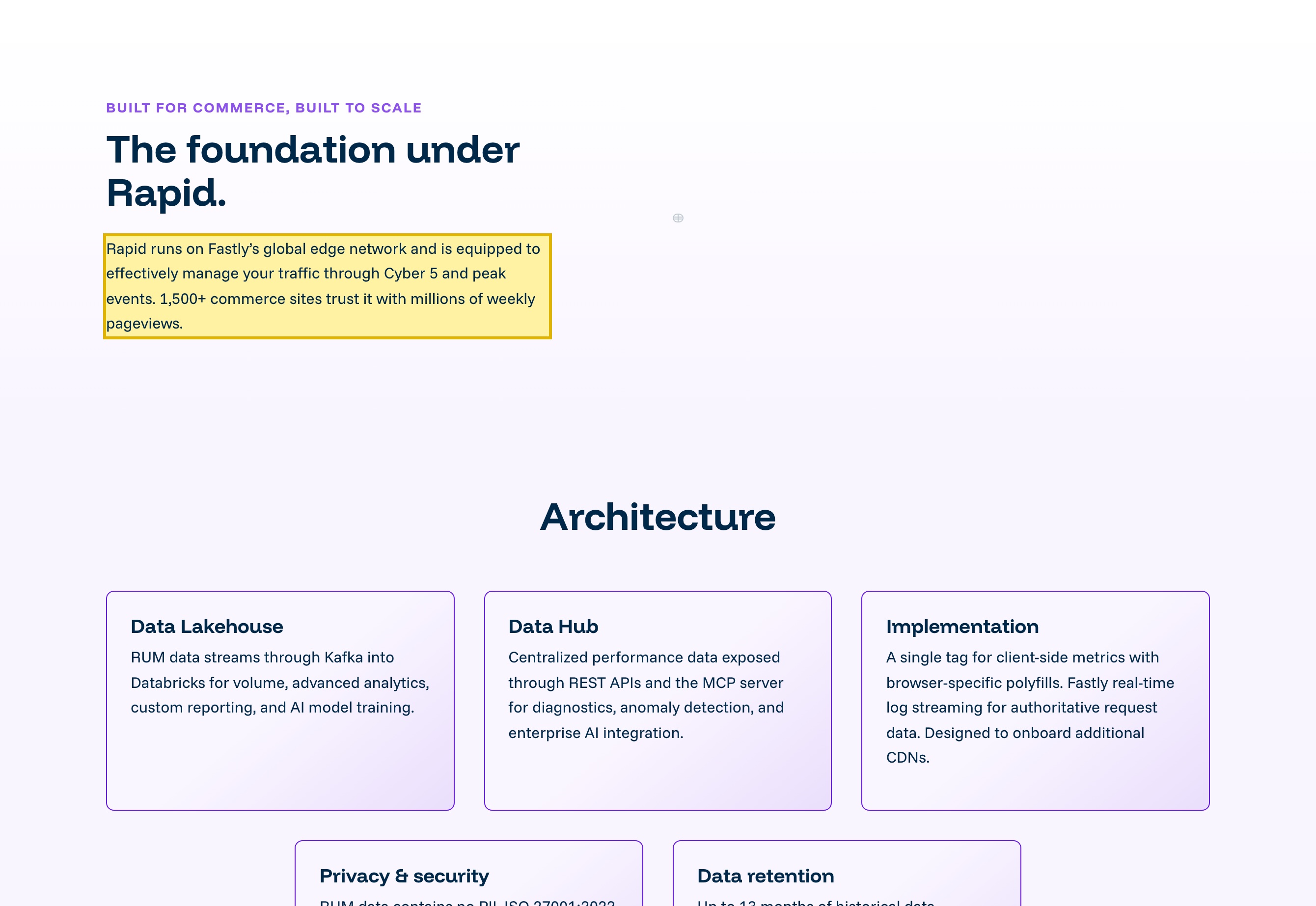
| Yottaa serves and optimizes the storefront from an offshore global edge, not from inside China. Yottaa's Platform page states, under "The foundation under Rapid," that its platform "runs on Fastly's global edge network and is equipped to effectively manage your traffic through Cyber 5 and peak events." That edge is global and offshore; Yottaa names no mainland-China point of presence, so a China shopper is answered from outside the mainland — a reachability question, and nothing in-country to attach an ICP filing to. | Yottaa, "Platform" (yottaa.com), retrieved 2026-10-09 |
| Every visitor request transits Yottaa's optimization layer. Yottaa's Platform page says its Context Intelligence "analyzes each HTTP request — device, geo, browser, connection, custom properties — and adapts delivery to fit." Serving a China shopper this way means that request — carrying the shopper's IP address and metadata — is handled offshore, which under PIPL is a cross-border transfer of personal information the handler (you, not Yottaa) must clear: notice, a separate consent, and one transfer mechanism (Articles 38–40). | Yottaa, "Platform" (yottaa.com), retrieved 2026-10-09; PIPL Articles 38–40 |
| Every subprocessor that delivers the Yottaa platform is US-based — none in mainland China. Yottaa's subprocessor list (last updated April 2026) names Amazon Web Services (Seattle), Fastly (San Francisco), Databricks (San Francisco) and Wasabi (Boston), among others — all at United States addresses, processing personal data "in connection with the delivery of the Yottaa platform." For a critical information infrastructure operator or large-volume handler, China-origin personal information must be stored in China (Cybersecurity Law Article 39 (formerly Article 37); PIPL Article 40) — a duty an all-US delivery chain cannot meet. | Yottaa, "Subprocessors" (docs.yottaa.com), retrieved 2026-10-09 |
| Yottaa is US-headquartered, with no mainland-China location in its footprint. Yottaa's privacy policy (Last Reviewed June 2026), under "International Data Transfers," states "We are headquartered in the United States" and that "Your personal information may be transferred to the United States or other locations outside of your … country where privacy laws may not be as protective as those in your … country." Nothing in Yottaa's stated footprint is inside mainland China. | Yottaa, "Privacy Policy" (yottaa.com), retrieved 2026-10-09 |
Sources verified by the 21YunBox compliance team on 2026-10-09.
For an eCommerce brand selling into mainland China, the first question about Yottaa is usually whether it will be fast there. That is the wrong axis. Yottaa is the layer that sits in front of your storefront — scoring and sequencing its third-party scripts, and serving and adapting its delivery from a global edge — and what decides whether you can use it in China is not how quickly that edge responds. It is that the edge, and everything that delivers the Yottaa platform, sits outside the mainland: there is no in-country point of presence to carry an ICP filing, and every China shopper’s request is answered offshore, which is a cross-border transfer of personal information before it is ever a speed measurement. Yottaa states each piece of this in its own documentation.
Yottaa in China at a glance
| What decides it | In Yottaa's own terms — and China's law |
|---|---|
| What it is | Yottaa is a web-performance-optimization service for eCommerce. It sits in front of your storefront, scores and sequences its third-party scripts, and serves and adapts delivery from a global edge — its platform (branded Rapid) “runs on Fastly's global edge network.” |
| Is it reachable from the mainland? | Yottaa isn't a service China blocks at the border. But it answers your China shoppers from an offshore global edge with no mainland-China point of presence, so an optimization layer wrapped around the whole storefront is served from outside the mainland — where cross-border conditions can make delivery slow or unstable. Reachability is the delivery half, not the decision. |
| Where it operates | Offshore, end to end. Every subprocessor that delivers the Yottaa platform carries a United States address — Amazon Web Services (Seattle), Fastly (San Francisco), Databricks (San Francisco) and Wasabi (Boston), among others — and Yottaa's privacy policy says it is “headquartered in the United States.” None is in mainland China. |
| Serving the public | A public site served to mainland visitors from inside China needs an ICP filing bound to a mainland hosting resource (State Council Order No. 292; MIIT Order No. 33). Yottaa names no mainland point of presence or entity, so there is nothing of Yottaa's to file against. |
| Your China shoppers' data | Each request Yottaa handles — the shopper's IP, device, geo and HTTP metadata — transits the offshore optimization layer, a cross-border transfer PIPL governs (Articles 38–40: notice, a separate consent, a transfer mechanism), possibly a data-export security assessment, with an in-country storage duty for a CIIO or large-volume handler (Cybersecurity Law Article 39 (formerly Article 37); PIPL Article 40). Yottaa says “RUM data contains no PII,” which narrows its analytics store but not the request path. |
An offshore edge in front of the storefront — reachable, but nothing to ICP-file
Yottaa does reach mainland China; it is not a platform blocked at the border. But what Yottaa is makes reachability the smaller half of the question. Yottaa sits in the delivery path in front of your storefront, and its platform (branded Rapid) “runs on Fastly’s global edge network,” a global, offshore content-delivery network. Yottaa names no mainland-China point of presence, so your China shoppers are answered from outside the mainland — and an optimization layer wrapped around the entire storefront, deciding script order and adapting each response, is the thing being served across the border. Where that crossing is slow or unstable, it is the whole storefront that feels it, not one deferred tag.
That offshore footprint also settles the licensing question before speed enters it. A public-facing site actually served to mainland visitors from inside China turns on an ICP filing (ICP 备案) under State Council Order No. 292 and MIIT Order No. 33, and that filing has to attach to a hosting resource physically in the mainland. Yottaa provides none: its subprocessor list places every provider that delivers the platform — Amazon Web Services, Fastly, Databricks, Wasabi and the rest — at United States addresses, “in connection with the delivery of the Yottaa platform,” and its privacy policy states Yottaa is “headquartered in the United States.” There is nothing of Yottaa’s inside China to file against, so “we already run Yottaa” does not carry into the mainland.
Every shopper request is handled offshore — the PIPL question
The sharper issue is cross-border personal information. Yottaa’s optimization works by standing in the request path: its Context Intelligence “analyzes each HTTP request — device, geo, browser, connection, custom properties — and adapts delivery to fit.” Run that for a shopper in Shanghai and the request Yottaa handles — carrying that shopper’s IP address, device and connection details — is processed on an offshore edge. Under China’s Personal Information Protection Law, IP addresses and online identifiers are personal information, so serving your China visitors through an offshore optimization layer is a cross-border transfer, and the duty lands on the handler — you, the retailer, not Yottaa the processor: notice, a separate consent, and one transfer mechanism (a CAC security assessment, the CAC standard contract, or certification — PIPL Articles 38–40).
Above certain volumes, or where the data is “important data,” that transfer may also require China’s data-export security assessment (数据出境安全评估) before anything leaves. And if your organization is a critical information infrastructure operator, the Cybersecurity Law’s Article 39 (formerly Article 37 — the data-localization provision was renumbered by the 2025 amendment that took effect on January 1, 2026, with its substance unchanged; PIPL Article 40 carries the parallel duty) requires personal information generated in China to be stored in China — which an all-US delivery chain cannot do.
Yottaa narrows part of this honestly: its platform page states “RUM data contains no PII,” and it reports ISO 27001:2022 certification and encryption at rest. Those reduce what sits in its analytics store, and they are worth having. But they do not answer the handler’s question, because the exposure here is the request path, not just the telemetry: the shopper’s IP and request metadata cross the border the moment the storefront is served from an offshore edge, whether or not Yottaa keeps them. Nor is “point it at a different region” a fix — Yottaa publishes no mainland-China region or edge to switch to; its footprint is offshore end to end. Keeping China delivery in-country means serving from inside the mainland on ICP-filed infrastructure, not relocating an offshore edge. Which of these obligations bite your specific storefront is a risk to confirm with counsel against what you actually collect and where your shoppers are.
The lawful path — map, localize, deliver
There is a compliant way to run Yottaa-grade performance for a China storefront, and it has a shape. First, map: our China compliance team charts the lawful path and the exposure that attaches to running your storefront through an offshore optimization layer — the PIPL cross-border and consent duties, any data-export assessment, the Article 39 residency duty, and the ICP footing — scaled to your entity, your data volumes, and who your shoppers are. The legal conclusions are settled with your counsel; we build the technical picture that feeds them.
Then localize: for whatever must stay in the mainland, we stand up and integrate a China-legal, in-country pattern — consented, in-country processing and storage — replacing what cannot run compliantly offshore, while you keep Yottaa for the markets where it already serves you.
Then deliver: the storefront your China shoppers actually load is a public service in the mainland, so it carries an ICP filing duty and needs compliant, in-country delivery. 21YunBox delivers it in-country — the 21YunBox Optimizer — set in front of the stack you already run, with no rebuild and no re-platform, so the sequencing and speed work you bought Yottaa for keeps happening while the delivery that must be in-country becomes ICP-filed and in-country. What we never do — and what no one lawfully can — is hand you a route around China’s data-export rules or around any network restriction: 21YunBox never uses or suggests circumvention of any kind. The result is a storefront that runs legally and compliantly for your users in China.
Related reading:
- Cross-border data transfers under PIPL
- China’s data-export security assessment
- China’s Cybersecurity Law (data localization, Article 39)
- How to get an ICP filing for China