Does New Relic Work in China? Telemetry Data Residency & PIPL
New Relic runs no data region inside mainland China — it stores the metrics, events, logs and traces you send in the US, the EU or Japan. When that telemetry carries personal data about Chinese users, shipping it offshore is a PIPL cross-border transfer, and New Relic says the residency choice is yours. A compliance-first look at where your observability data lives.
Does New Relic work in China?
New Relic has no data region in mainland China — it stores the telemetry you send in the US, the EU or Japan. The moment that telemetry carries personal data about your Chinese users, shipping it to New Relic is a cross-border transfer under China's PIPL, and New Relic's own documentation says the residency call is yours to make.
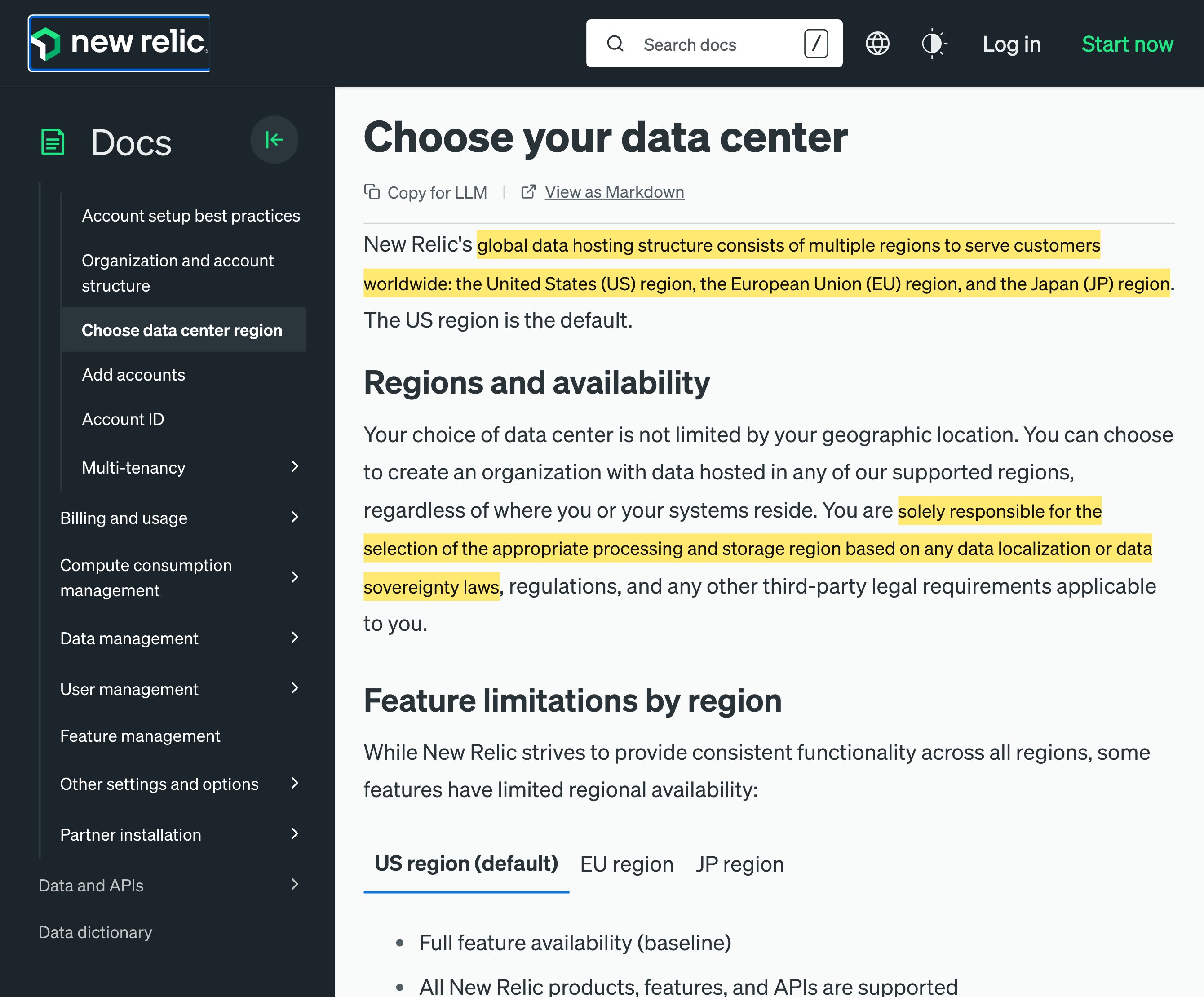
New Relic states its "global data hosting structure consists of multiple regions to serve customers worldwide: the United States (US) region, the European Union (EU) region, and the Japan (JP) region" — none inside the mainland — and that "your Customer Data is stored in your selected region." Its agents "do not collect any personal data" by default, yet customers can "configure metrics, events and traces to transmit personal data," and observability data routinely carries IP addresses, user IDs and request attributes. Send that offshore and it is a cross-border transfer of personal information PIPL governs (Articles 38–43), on servers that can never sit in China. New Relic is backend telemetry with no public page, so it needs no ICP filing of its own — that falls on the app it monitors. The table below is New Relic's own wording and the rule each line triggers.
This is a risk map, not a verdict — what counts as personal data, and whether a localization duty bites, turns on what your agents collect, your volumes and your users. Our China team can map your telemetry exposure with you →
Compliance snapshot
- ✕ No New Relic data region sits inside mainland China (US, EU and JP only)
- ! Your China users' telemetry is therefore stored offshore
- ! That telemetry can carry personal data — PIPL governs the transfer
- ! New Relic makes the compliant-region choice your responsibility
- ✓ Backend telemetry needs no ICP of its own — the monitored app does
What New Relic's own documentation says about China
| Fact | Primary source |
|---|---|
| New Relic runs no data region inside mainland China. In its own documentation New Relic says its "global data hosting structure consists of multiple regions to serve customers worldwide: the United States (US) region, the European Union (EU) region, and the Japan (JP) region." None of the three is in the mainland, and "your Customer Data is stored in your selected region for the New Relic database" — so telemetry from your Chinese users is held offshore, in the US, the EU or Japan. | New Relic — Choose your data center (docs.newrelic.com), retrieved 2026-10-07 |
| The telemetry New Relic ingests can carry personal information. New Relic's agents stream metrics, events, logs and traces; New Relic states they "do not collect any personal data" by default, but that customers can "configure metrics, events and traces to transmit personal data to the New Relic services for processing" — and application and browser data routinely include IP addresses, user identifiers and request attributes. Once that personal information about Chinese users leaves for a US, EU or Japan region, it is a cross-border transfer under PIPL, requiring notice, separate consent and a transfer mechanism (Articles 38–43). | New Relic GDPR FAQ (newrelic.com), retrieved 2026-10-07; PIPL Articles 38–43 |
| New Relic makes the data-residency decision — and its legal risk — your responsibility. You choose the region when the organization is created ("you must specify the data center region"), and New Relic states you are "solely responsible for the selection of the appropriate processing and storage region based on any data localization or data sovereignty laws, regulations, and any other third-party legal requirements applicable to you." If you are a critical information infrastructure operator or a large-volume handler, personal information collected in China must be stored in the mainland (PIPL Article 40; Cybersecurity Law Article 39 (formerly Article 37)) — a duty none of New Relic's three offshore regions can satisfy. | New Relic — Choose your data center (docs.newrelic.com), retrieved 2026-10-07; PIPL Article 40; Cybersecurity Law Article 39 (formerly Article 37) |
| New Relic treats itself as a processor — you decide what is sent, and no ICP attaches to New Relic itself. New Relic states that "New Relic acts as a processor (under the EU GDPR/UK GDPR); in other words, New Relic does NOT generally determine the purpose and means of processing." Paired with its position that you are "solely responsible" for a compliant storage region, that puts the PIPL cross-border and residency obligations on you as the handler, not on New Relic. And because New Relic is backend observability with no public page, no ICP filing (State Council Order No. 292; MIIT Order No. 33) attaches to New Relic itself — that duty sits with the mainland-facing app it monitors. | New Relic GDPR FAQ (newrelic.com), retrieved 2026-10-07; State Council Order No. 292; MIIT Order No. 33 |
Sources verified by the 21YunBox compliance team on 2026-10-07.
For a mainland-China audience, the question about New Relic is not how quickly its dashboards paint — it is where the data your agents ship ends up, and what that data contains. New Relic answers the first half in its own documentation: it hosts your telemetry in the United States, the European Union or Japan, and runs no region inside mainland China. The second half is the one that bites — observability data is not anonymous. Metrics, events, logs and traces routinely carry IP addresses, user identifiers and request details, and New Relic lets you configure your agents to transmit personal data outright. So the moment your Chinese users’ telemetry leaves for a New Relic region, you have made a cross-border transfer of personal information, stored on infrastructure that will never be inside the mainland. Reaching New Relic is not the exposure; where the data lands is.
New Relic in China at a glance
| What decides it | In New Relic's own terms |
|---|---|
| Where it runs | Three data-center regions — the United States, the European Union and Japan — chosen when you create the organization. No region is inside mainland China; the nearest, Japan, is still offshore. |
| What it ingests | Metrics, events, logs and traces from your apps. New Relic: its agents “do not collect any personal data” by default, but customers can “configure metrics, events and traces to transmit personal data” — so the pipeline can carry IP addresses, user IDs and request attributes. |
| Where your data sits | “Your Customer Data is stored in your selected region for the New Relic database” — the US, the EU or Japan. Telemetry from Chinese users is held offshore: a cross-border transfer PIPL governs. |
| Who owns the residency call | You do. New Relic states you are “solely responsible for the selection of the appropriate processing and storage region based on any data localization or data sovereignty laws.” |
| ICP filing | Not on New Relic itself — it has no public page to file. The ICP obligation sits with the mainland-facing app you monitor, not the telemetry pipeline. |
Your telemetry lands offshore — and it isn’t anonymous
New Relic hosts your data in one of three regions — the United States, the European Union or Japan — and, in its own words, “your Customer Data is stored in your selected region for the New Relic database.” There is no mainland-China region to select. That settles where a Chinese user’s telemetry ends up before performance ever enters the picture: offshore.
And that telemetry is not anonymous. New Relic’s agents ship metrics, events, logs and traces, and while New Relic says they “do not collect any personal data” by default, it also states customers can “configure metrics, events and traces to transmit personal data to the New Relic services for processing.” Even the defaults acknowledge the exposure — New Relic notes its agents “disable collection of HTTP request parameters, such as the query string of a URL,” precisely because request data can be sensitive. In practice, application and browser telemetry carries IP addresses, user identifiers and request attributes. Send that across the border to a New Relic region and you have made a cross-border transfer of personal information under China’s Personal Information Protection Law: as the handler — you, not New Relic — you must give notice, obtain separate consent, and clear one transfer mechanism (a CAC security assessment, the CAC standard contract, or certification) under Articles 38–43.
New Relic puts the residency decision on you
New Relic does not take the residency problem off your hands; it hands it to you. You pick the region when you create the organization — “you must specify the data center region” — and New Relic states you are “solely responsible for the selection of the appropriate processing and storage region based on any data localization or data sovereignty laws, regulations, and any other third-party legal requirements applicable to you.” It also frames its own role narrowly: “New Relic acts as a processor… in other words, New Relic does NOT generally determine the purpose and means of processing.”
So the compliance weight sits with you, and New Relic’s documentation says as much. If you are a critical information infrastructure operator or a large-volume handler, personal information collected in China must be stored in the mainland (PIPL Article 40; Cybersecurity Law Article 39 (formerly Article 37)) — and none of New Relic’s three regions is in the mainland. For everyone else, the cross-border transfer rules still apply the moment personal data leaves for a US, EU or Japan region.
New Relic needs no ICP — the app it watches does
It is worth being precise about which Chinese requirement does and does not apply, because forcing the wrong one onto New Relic muddies the real risk. ICP filing (ICP 备案, under State Council Order No. 292 and MIIT Order No. 33) governs public-facing websites and online services delivered to mainland users. New Relic is backend observability — there is no public New Relic page your end-users load — so no ICP filing attaches to New Relic itself. That obligation belongs to the mainland-facing website or app you are monitoring. New Relic’s own exposure is not licensing; it is residency. The honest question is not “is New Relic ICP-filed” but “where does the personal data in your telemetry live” — and the answer is: not in China.
This is a risk map, not a verdict — what counts as personal data in your telemetry, and whether a localization duty applies at all, turns on what your agents collect, how much you hold and who your users are, and it is worth settling with counsel before you rely on it.
Where 21YunBox fits — a compliant overlay, not a migration
You keep running New Relic exactly as you do today — the agents, the dashboards and the alerts all stay in place. What New Relic cannot provide is a lawful mainland footing for the application it watches: that is the piece 21YunBox adds — compliant, ICP-filed delivery from inside the mainland, set in front of your existing origin, with no rebuild and no second codebase. Our China team maps what personal information your metrics, events, logs and traces actually carry, weighs your PIPL cross-border and data-residency obligations against your entity and data volumes, and stands up the in-country delivery and storage a compliant China presence needs — while your telemetry keeps flowing to New Relic.
Related reading:
Frequently Asked Questions
Does New Relic need an ICP filing to run in China?
Not New Relic itself. ICP filing (ICP 备案) applies to a public-facing website or online service delivered to mainland users, and New Relic is backend observability with no public page your end-users load — so the filing obligation sits with the application you are monitoring, not with the telemetry pipeline. The real New Relic question is data residency: your telemetry is stored in the US, the EU or Japan, and if it carries personal data about Chinese users, sending it there is a cross-border transfer PIPL governs.
Where does New Relic store telemetry from our Chinese users?
Offshore. New Relic hosts data in one of three regions — the US, the EU or Japan — fixed when the organization is created, and states that "your Customer Data is stored in your selected region." None of the three is inside mainland China. New Relic also says you are "solely responsible" for selecting a region that meets any data-localization or data-sovereignty law applicable to you, so the residency choice and its PIPL consequences land on you as the handler, not on New Relic.
Can 21YunBox help us use New Relic compliantly in China?
Yes. Our China team can map your PIPL cross-border and data-residency exposure — what personal information your metrics, events, logs and traces actually carry, your data volumes, and whether a localization duty applies — and stand up the ICP-filed, in-country delivery and storage your mainland-facing app requires, while New Relic keeps monitoring the stack you already run. Get in touch to work through your specific setup.