Does Azure Monitor Work in China? Data Residency, PIPL & Your Telemetry
Azure Monitor collects logs, metrics and Application Insights telemetry that Microsoft itself calls personal data — stored in the Azure region you choose, none of which is inside mainland China. A compliance-first look at the PIPL cross-border and data-residency exposure of monitoring your China users.
Does Azure Monitor work in China?
Reachable is not the same as compliant. Azure Monitor runs on your global Azure subscription, and Microsoft's own documentation calls Azure Monitor Logs "a data store where personal data is likely to be found" — stored in whichever region you choose, none of which is inside mainland China. So monitoring your China users quietly exports their personal data offshore.
Microsoft states Azure Monitor "processes and stores logs in the primary and secondary regions that you choose," and on a global (commercial) subscription every one of those regions is outside the mainland. The telemetry it keeps is not anonymous: Microsoft lists "IP addresses," "user IDs" and device IDs among what Log Analytics collects. Point it at mainland users and that personal information leaves China — a cross-border transfer PIPL governs (notice, separate consent and a transfer mechanism, Articles 38–43). Azure does run inside the mainland, but only as "a physically separated instance of cloud services" operated by 21Vianet, reached through a separate Chinese entity and account — not your global subscription. The table below is Microsoft's own wording and the rule each line triggers.
This is a risk map, not a verdict — what you owe turns on your entity, your data volumes and who your users are. Our China team can map your exposure with you →
Compliance snapshot
- ! On global Azure, your telemetry sits in a region you pick — none in the mainland
- ! China users' logs, IPs and user IDs cross the border — PIPL applies
- ! Azure Monitor does run in-country — in the separate 21Vianet cloud, not your global account
- ! Reaching Azure China needs a Chinese entity, a new azure.cn account and its own terms
- ! Even if the telemetry loads fine, where it is stored is the compliance question
What Azure Monitor's own documentation says about China
| Fact | Primary source |
|---|---|
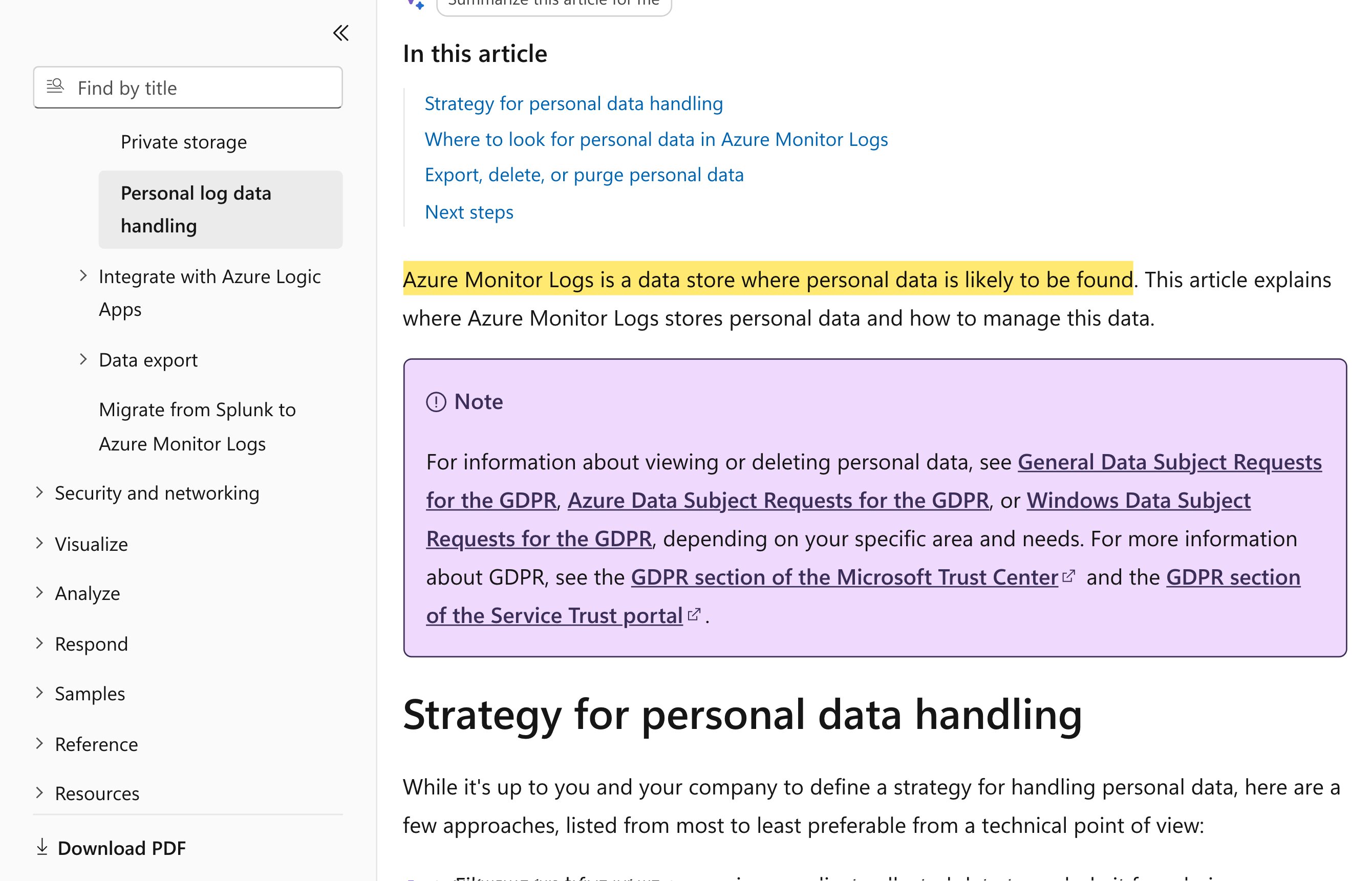
| Microsoft calls Azure Monitor Logs a store of personal data. Its own guide opens: "Azure Monitor Logs is a data store where personal data is likely to be found." It then lists what turns up there — "IP addresses: Log Analytics collects various IP information in multiple tables," alongside user names, "user IDs" and device IDs. So the logs, metrics and Application Insights telemetry you collect from China users are personal information, not anonymous counters — which puts them inside China's PIPL the moment they leave the mainland (Articles 38–43). | Microsoft Learn — Manage personal data in Azure Monitor Logs, retrieved 2026-10-07; PIPL Articles 38–43 |
| Your telemetry lives in the region you pick — and none is inside mainland China. Microsoft: "Azure Monitor processes and stores logs in the primary and secondary regions that you choose." On a global (commercial) Azure subscription, every region you can set on a Log Analytics workspace or Application Insights resource sits outside the mainland (Microsoft runs no mainland region on the global cloud — inference). Collecting from Chinese users therefore stores their personal data offshore — a cross-border transfer under PIPL, and for a CIIO or large-volume handler a data-residency breach too (PIPL Article 40; Cybersecurity Law Article 39 (formerly Article 37)). | Microsoft Learn — Log Analytics workspace replication (data residency section), retrieved 2026-10-07; PIPL Article 40; Cybersecurity Law Article 39 (formerly Article 37) |
| Azure's mainland regions are a separate cloud, not part of your global account. Microsoft describes "Microsoft Azure operated by 21Vianet (Azure in China)" as "a physically separated instance of cloud services located in China," one that is "independently operated and transacted by Shanghai Blue Cloud Technology Co., Ltd. (\"21Vianet\")." You contract with 21Vianet, not Microsoft, and register a separate azure.cn account — so moving monitoring in-country means a distinct Chinese entity and account, not a region you switch on. The public-site ICP filing regime (State Council Order No. 292; MIIT Order No. 33) governs websites shown to visitors, not a backend telemetry pipeline, so for Azure Monitor the live door is data residency. | Microsoft Learn — Microsoft Azure in China (overview of operations), retrieved 2026-10-07; State Council Order No. 292; MIIT Order No. 33 |
| Azure Monitor itself is offered in that China cloud. 21Vianet's own Azure documentation lists, region by region, the Log Analytics workspaces you can use in its China regions — China East 2, China North and China North 2 among them. So keeping China telemetry in-country is possible, but only by building the workspace on the separate 21Vianet cloud, under its own account and a Chinese entity, rather than on your global subscription. | Azure operated by 21Vianet — Traffic analytics supported regions (docs.azure.cn), last updated 2026-08-03, retrieved 2026-10-21 |
Sources verified by the 21YunBox compliance team on 2026-10-21.
For a mainland-China audience, the question to ask about Azure Monitor is not whether its dashboards load — it is where the data it collects is allowed to live. Azure Monitor gathers logs, metrics and Application Insights telemetry across your apps and infrastructure, and Microsoft’s own documentation is blunt that this telemetry is likely to contain personal data. On a global Azure subscription that data is stored in a region you choose, and not one of the regions you can choose is inside mainland China. So pointing Azure Monitor at your Chinese users quietly sends their personal information offshore — a compliance question that lands well before any performance one.
Azure Monitor in China at a glance
| What decides it | In Microsoft's own terms |
|---|---|
| Where the data lives | “Azure Monitor processes and stores logs in the primary and secondary regions that you choose.” On a global subscription, every region you can set on a workspace is outside mainland China. |
| What the data is | “Azure Monitor Logs is a data store where personal data is likely to be found” — IP addresses, user names, “user IDs” and device IDs among them. Not anonymous metrics. |
| Crossing the border | Collected from mainland users and stored offshore, that personal information is a cross-border transfer under PIPL — notice, separate consent and a transfer mechanism (Articles 38–43). |
| The in-country option | Azure's mainland regions are “a physically separated instance of cloud services” operated by 21Vianet, reached through a separate Chinese entity and azure.cn account — not your global subscription. |
| Reachability vs. residency | Whether the telemetry endpoints load from the mainland is a delivery question; where the collected personal data is allowed to reside is the compliance one. This page is about the second. |
The data Azure Monitor keeps is personal data, not anonymous metrics
Microsoft does not hedge on this. Its guide to handling personal data opens by stating that “Azure Monitor Logs is a data store where personal data is likely to be found,” and it walks through where that data hides: “IP addresses: Log Analytics collects various IP information in multiple tables,” alongside user names, “user IDs” and device IDs. Application Insights adds request URLs and parameters, session and user identifiers, and client-side telemetry gathered from real browsers. None of that is a nameless counter — it is personal information tied to identifiable people, and that is exactly the category China’s data law reaches.
It is stored where you point it — and that is never the mainland
Where does all of that telemetry come to rest? Microsoft’s answer is explicit: “Azure Monitor processes and stores logs in the primary and secondary regions that you choose.” The workspace is the boundary, and the region you set on it decides residency. On a global (commercial) Azure subscription, every region you can assign to a Log Analytics workspace or an Application Insights resource sits outside mainland China — Microsoft operates no mainland region on the global cloud. Collect from users in China, then, and their personal information is written to a store beyond the border. Under China’s Personal Information Protection Law that is a cross-border transfer, and the handler — you, not Microsoft — has to give notice, obtain separate consent, and clear one transfer mechanism: a CAC security assessment, the CAC standard contract, or certification (Articles 38–43). If you are a critical information infrastructure operator or a large-volume handler, personal information collected in China must be kept in the mainland (PIPL Article 40; Cybersecurity Law Article 39 (formerly Article 37)) — a residency duty an offshore workspace cannot satisfy.
Azure’s mainland cloud is a separate, 21Vianet-operated partition
Azure does exist inside mainland China — but not as a region you switch on from the subscription you already hold. Microsoft describes “Microsoft Azure operated by 21Vianet (Azure in China)” as “a physically separated instance of cloud services located in China,” one that is “independently operated and transacted by Shanghai Blue Cloud Technology Co., Ltd. (“21Vianet”).” You contract with 21Vianet rather than Microsoft, you register a separate azure.cn account under a Chinese entity, and your global credentials do not reach across. Standing up in-country monitoring therefore means a distinct cloud and a distinct contracting relationship, not a configuration change — “we already run on Azure” does not carry over. Worth separating from this: an ICP filing under State Council Order No. 292 and MIIT Order No. 33 governs public-facing websites and services shown to mainland visitors, not a backend telemetry pipeline, so for Azure Monitor the door that actually decides things is data residency, not ICP.
This is a risk map, not a verdict: whether you face a cross-border-transfer duty, an in-country storage duty, or both turns on your role, your data volumes and who your users are — worth settling with counsel before you wire up collection.
Where 21YunBox fits — a compliant overlay, not a migration
You keep running Azure and Azure Monitor exactly as they are. We add the piece Microsoft leaves you to solve for the mainland: compliant, ICP-filed, in-country delivery and data handling placed in front of your existing Azure origin — no rebuild, no second codebase, and no migration off your global stack. Our China team maps where your telemetry carries personal data, whether your workspace region triggers a PIPL cross-border transfer or an in-country storage duty for your entity and data volumes, and then stands up the lawful in-mainland footing a compliant China presence needs, while your application and dashboards stay precisely where they already run.
Related reading:
Frequently Asked Questions
Where does Azure Monitor store my China users' data?
In whichever Azure region you set on the Log Analytics workspace or Application Insights resource — Microsoft states it "processes and stores logs in the primary and secondary regions that you choose." On a global (commercial) Azure subscription those regions are all outside mainland China, so telemetry from your Chinese users is stored offshore. Microsoft's mainland regions belong to a separate cloud operated by 21Vianet, which your global subscription cannot write to.
Is collecting Azure Monitor telemetry from China users a problem under PIPL?
Treat it as a cross-border-transfer risk to assess with counsel, not a flat yes or no. Microsoft itself calls Azure Monitor Logs "a data store where personal data is likely to be found" and lists IP addresses, user IDs and device IDs among what it collects. When that personal information is sent to a workspace outside the mainland, China's PIPL treats it as a cross-border transfer — requiring notice, separate consent and a transfer mechanism (Articles 38–43), and for some handlers in-country storage (Article 40; Cybersecurity Law Article 39 (formerly Article 37)).
Can 21YunBox help make our Azure Monitor setup compliant in China?
Yes. Our China team can map your exposure — which telemetry carries personal data, and whether your workspace region creates a PIPL cross-border transfer or a residency duty for your entity and data volumes — then stand up compliant, ICP-filed in-country delivery and storage in front of the Azure stack you already run, with no rebuild and no move off Azure. Get in touch to work through your specific architecture.