Does n8n Work in China? It Depends Where You Host — ICP & Data Residency
n8n is self-hostable, so whether it works for mainland China comes down to where you host it. n8n Cloud and offshore self-hosts sit outside the mainland — no ICP-filing path for a public China endpoint, and the personal data your workflows process is kept on an offshore instance under PIPL. The compliant path is a self-hosted, ICP-filed n8n deployment inside the mainland. A compliance-first look at the two doors.
Does n8n work in China?
Whether n8n works in China depends on where you host it — it's an ICP and data-residency question, not a speed one. n8n is self-hostable, so the deployment you choose sets both answers that matter in the mainland.
In n8n's own documentation it "offers two primary deployment options: n8n Cloud (fully-managed) and Self-hosted." With n8n Cloud, "n8n handles hosting, updates, and scaling" — on n8n's own infrastructure offshore, with no mainland-China region. Self-hosted, you can run it "on your own infrastructure, on-premises, or in a private cloud" — anywhere, including inside mainland China. That split decides it: a public endpoint served to the mainland needs an ICP filing tied to mainland hosting, which neither n8n Cloud nor an offshore self-host can hold; and because n8n keeps the data your workflows process as execution data on the instance, an offshore instance turns the personal data of people in China into a cross-border transfer PIPL governs. The compliant path is to self-host n8n on ICP-filed infrastructure inside the mainland.
This is a risk picture, not a verdict — your obligations turn on what you serve and the data your workflows carry. Our China team can map your n8n ICP and data exposure with you →
What n8n's documentation says, and what we measured from inside China
| Fact | Primary source |
|---|---|
| In n8n's own words: n8n "offers two primary deployment options: n8n Cloud (fully-managed) and Self-hosted." With n8n Cloud, "n8n handles hosting, updates, and scaling" — it runs on n8n's own infrastructure offshore, and n8n publishes no mainland-China region. Self-hosted, you deploy n8n "on your own infrastructure" — which means you can place it anywhere, including inside mainland China. Where n8n runs is your decision, and it sets every answer below. | n8n Docs — Choosing how to use n8n, retrieved 2026-10-07 |
| A public-facing site or API served to mainland-China visitors from inside the mainland requires an ICP filing (ICP 备案) under the State Council's Order No. 292 and MIIT's Order No. 33, and that filing must attach to a hosting resource inside the mainland. n8n Cloud and any offshore self-host provide no mainland resource, so they offer no ICP-filing path — reaching China from offshore is not the same as being cleared to operate there. | PRC Regulations on Telecommunications (State Council Order No. 292); Administrative Measures for the Filing of Non-operational Internet Information Services (MIIT Order No. 33) |
| n8n moves data between the apps you connect and keeps what each run touches as execution data on the instance — so the instance's location is the data's location. Run it offshore and the personal information your workflows pull from people in China is transferred abroad, which PIPL governs: the handler (you, the n8n operator — not n8n) must give notice, obtain separate consent, and meet one transfer mechanism — a CAC security assessment, the CAC standard contract, or certification. For a CIIO or large-volume handler, data collected in China must be stored inside the mainland (PIPL Article 40; CSL Article 39 (formerly Article 37)). | PIPL Chapter III, Articles 38–43 and Article 40; Cybersecurity Law Article 39 (formerly Article 37) |
| The weight of the transfer duty scales with volume and role, not with using the tool: under the CAC's March 2024 Regulations on Promoting and Regulating Cross-border Data Flows, a non-CIIO moving fewer than 100,000 individuals' non-sensitive personal information in a calendar year is exempt from the security assessment, the standard contract and certification. | CAC — Regulations on Promoting and Regulating Cross-border Data Flows, March 2024 |
| n8n.io was reachable but offshore when measured from inside mainland China: from an Alibaba Cloud probe in cn-zhangjiakou on 2026-08-28 it completed all 3 of 3 page loads (median time to first byte 985ms, largest-contentful-paint 7,440ms); re-measured on 2026-08-30 from a Beijing residential broadband line it completed only 1 of 3 (median first byte 931ms), with n8n's own host serving while offshore third-party assets — a Google tag and an Azure blob store — hung until the page timed out. Reachable, slow and offshore — which is exactly why the deciding question is where your instance runs, not whether n8n's site loads. | 21YunBox — China delivery measurement, measured from inside mainland China (datacenter probe + paired residential line) |
Sources verified by the 21YunBox compliance team on 2026-10-07.
For a mainland-China audience, the deciding question about n8n is not how fast it runs — it is where you host it. n8n is a self-hostable workflow-automation tool, and it ships two ways: as n8n Cloud, which n8n runs for you on its own infrastructure, or self-hosted, which you run wherever you choose. That one decision — not the speed of the editor — sets both answers that matter in China: whether a public endpoint has a path to an ICP filing, and whether the personal data your workflows move is allowed to live where the instance keeps it. Reaching n8n is not the problem; where it runs, and where it stores what it processes, is.
n8n in China at a glance
| What decides it | In n8n's own terms |
|---|---|
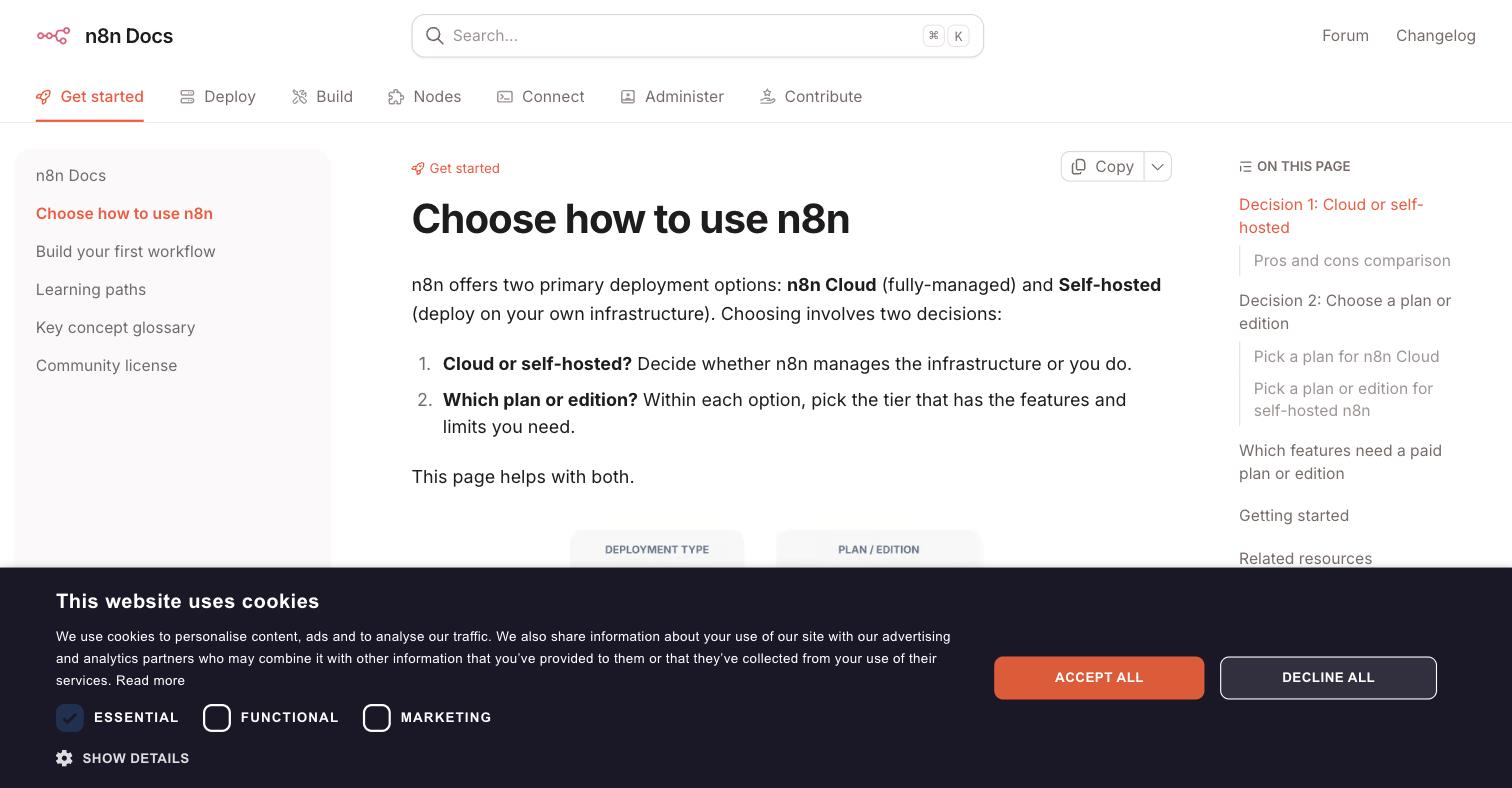
| How you deploy it | n8n ships two ways: n8n Cloud, which is “fully-managed” and where “n8n handles hosting, updates, and scaling” on n8n's own infrastructure, and self-hosted, which you run “on your own infrastructure, on-premises, or in a private cloud.” Where it runs is your choice — and it decides everything below. |
| Where it runs for China | n8n Cloud and any offshore self-host sit outside the mainland, and n8n publishes no mainland-China region for Cloud. The only in-country option is to self-host n8n on infrastructure physically inside mainland China. |
| Serving the public | A public site or API delivered to mainland visitors from inside China needs an ICP filing tied to a mainland hosting resource. Offshore — on Cloud or an offshore self-host — there is no mainland resource, so no ICP-filing path. |
| Your workflow data | n8n keeps the data your workflows process as execution data on the instance. Run the instance offshore and personal data from people in China rests and transits abroad — a cross-border transfer PIPL governs; CIIOs and large-volume handlers must keep it in-country. |
| Is it reachable? | n8n.io loaded on all 3 datacenter-probe runs from inside China on 2026-08-28, but only 1 of 3 on a Beijing home line on 2026-08-30 — its own content served while offshore third-party assets hung. Reachable and offshore, which is not the compliance question. |
n8n gives you a choice — and the choice is the compliance decision
In its own documentation n8n “offers two primary deployment options: n8n Cloud (fully-managed) and Self-hosted.” With n8n Cloud, “n8n handles hosting, updates, and scaling” — the instance runs on n8n’s own infrastructure, and n8n publishes no mainland-China region for it. Self-hosted, n8n’s hosting docs say “you can self-host n8n on your own infrastructure, on-premises, or in a private cloud,” which means you can put it anywhere, including on servers inside mainland China. Every other question on this page resolves differently depending on which of those two you pick, and where you point it.
No mainland hosting, no footing for an ICP filing
A public-facing site or API served to mainland visitors from inside China turns on an ICP filing (ICP 备案) under State Council Order No. 292 and MIIT Order No. 33, and that filing must attach to a hosting resource physically inside the mainland. n8n Cloud runs offshore, and an offshore self-host is offshore too — so in both cases there is no mainland resource for a filing to attach to, and reaching China from outside it is not the same as being cleared to operate there. The only n8n deployment with ICP footing is one you self-host on infrastructure inside the mainland. This is where “we already run it on n8n Cloud” stops: the tool is fine; the address it answers from is the problem.
Your workflow data rides with the instance
n8n’s whole job is to move data between the apps you connect — contacts from a CRM, submissions from a form, records from a database — and it keeps what each run touches as execution data on the instance itself. So the location of the instance is the location of that data. Run n8n offshore and the personal information your workflows pull from people in China lands abroad, which under China’s Personal Information Protection Law is a cross-border transfer: the handler — you, the n8n operator, not n8n — must give notice, obtain separate consent, and clear one transfer mechanism (a CAC security assessment, the CAC standard contract, or certification).
How heavy that duty is depends on volume and role. Under the CAC’s March 2024 Regulations on Promoting and Regulating Cross-border Data Flows, a non-CIIO moving fewer than 100,000 individuals’ non-sensitive personal information in a calendar year is exempt from the assessment, the standard contract and certification. At the other end, a CIIO or large-volume handler must keep personal information collected in China inside the mainland (Cybersecurity Law Article 39 (formerly Article 37); PIPL Article 40) — a residency duty only an in-country instance can meet.
This is a risk map, not a verdict: whether you owe notice and consent, a full transfer mechanism, or in-country storage of the data itself turns on how much personal information your workflows carry and whether your role pulls you into the CIIO or large-volume tier — worth settling with counsel before you build.
Reachable, slow, and offshore — which is why this is a hosting question
n8n is not walled off from China. In 21YunBox’s own measurements from inside the mainland, n8n.io completed all three loads from an Alibaba Cloud probe in Zhangjiakou on 2026-08-28 (median time to first byte 985 ms, largest-contentful-paint 7,440 ms), but only one of three from a Beijing residential broadband line on 2026-08-30 — n8n’s own host served its content while offshore third-party assets (a Google tag and an Azure blob store) hung until the page timed out. So the hosted surface is reachable, if slow and uneven. That is precisely the point: reachability says nothing about whether a public endpoint has an ICP filing, or whether your workflow data is allowed to sit where the instance keeps it. Those are compliance facts, and no amount of network tuning changes them.
Where 21YunBox fits — a compliant overlay, not a migration
You keep building your workflows in n8n exactly as you do now. What we add is the piece an offshore deployment cannot give itself: a lawful home inside the mainland. Our China team first maps your ICP and data-residency obligations against your entity and the personal data your workflows actually carry. Then, for the deployment the law treats most strictly, we help you run a self-hosted n8n instance on ICP-filed infrastructure inside China, so the execution data stays on Chinese soil and the public endpoint has a filing to stand on — with ICP-filed in-country delivery set in front of your existing origin, no rebuild and no second codebase.
Related reading: