Does Pinterest Work in China? Blocked Access, Offshore Hosting & the Embed Risk
Pinterest is blocked in mainland China and runs no in-country region — it stores data in the United States — so ordinary users can't reach it, and a Pinterest embed on your own China-facing site is a request to a blocked, offshore host that can push visitor data across the border. A compliance-first, honest look at what that means for your site.
Does Pinterest work in China?
No. Pinterest is blocked in mainland China — ordinary users can't open it without circumvention, and no ICP filing, CDN or delivery tuning can make a third-party app China has blocked reachable from your side.
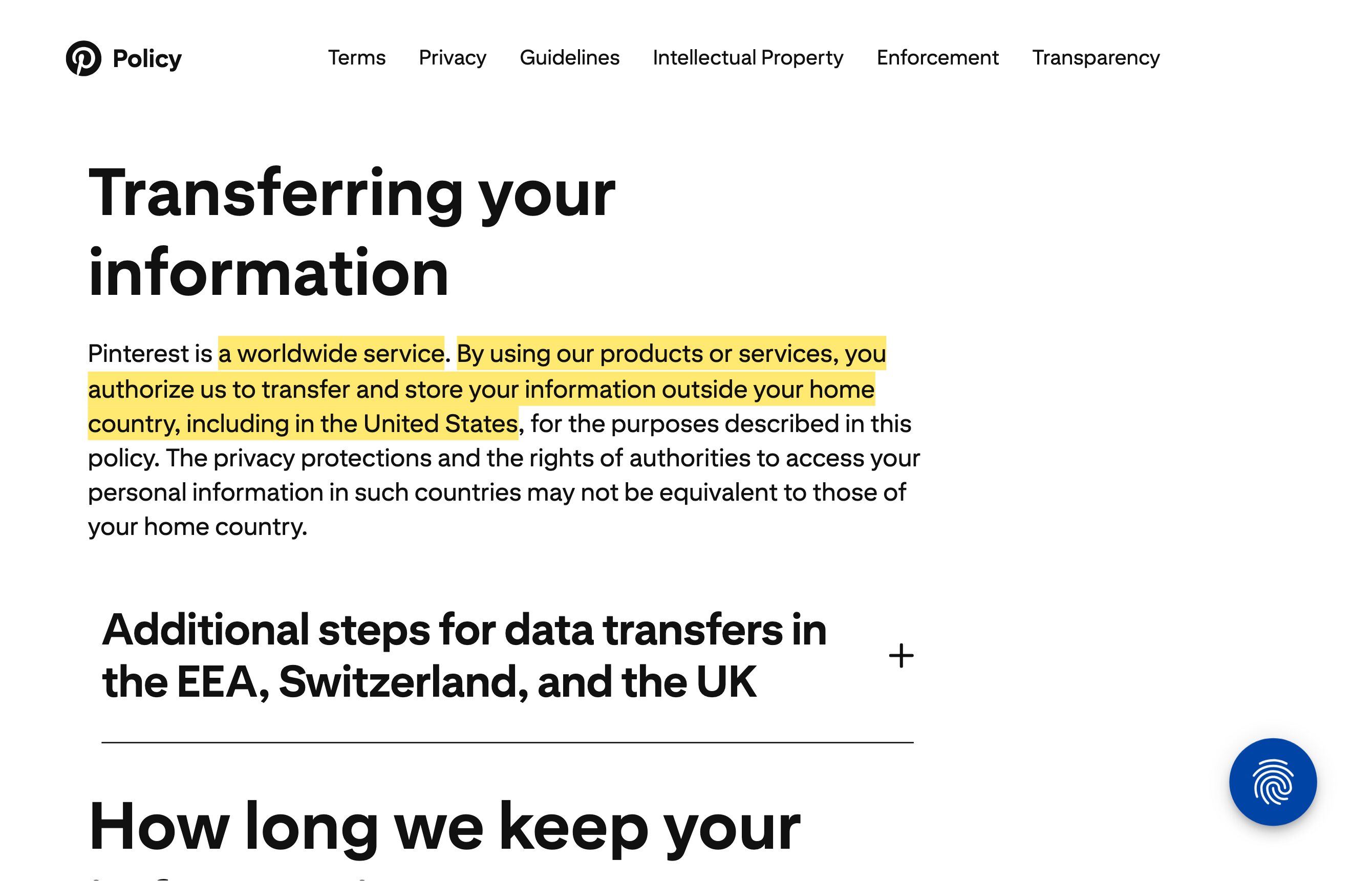
Independent censorship monitoring finds pinterest.com unreachable inside the mainland — GreatFire's live URL test reports it “blocked — 100% of the last 15 conclusive tests failed in mainland China,” consistent with the block widely reported since 2017 — and Pinterest's own privacy policy puts its data offshore: Pinterest is “a worldwide service,” and “by using our products or services, you authorize us to transfer and store your information outside your home country, including in the United States.” In practice the live risk is less Pinterest the destination than Pinterest the embed: a Save button or conversion tag on your own China-facing page is a request to that blocked, offshore host, so it stalls the page and can carry a visitor's personal data out of China — a cross-border transfer under PIPL. The table below is the honest picture, door by door.
This is a reachability and risk map, not a verdict — what matters is your own site, your embeds and where your users' data ends up. Our China team can map your exposure with you →
Compliance snapshot
- ✕ Pinterest is blocked in mainland China — ordinary users can't reach it
- ✕ No mainland region — Pinterest stores data in the United States, entirely offshore
- ! A Pinterest embed on a China-facing page calls a blocked host — it fails and stalls the page
- ! A Pinterest tag or Save button can push visitor data offshore — PIPL governs that transfer
- ! Your own mainland site still needs an ICP filing — Pinterest offers no path to one
What Pinterest's own documentation says about China
| Fact | Primary source |
|---|---|
| Pinterest is blocked in mainland China — it is not reachable to ordinary users. Independent network-censorship monitoring finds pinterest.com unreachable from inside the mainland: GreatFire's live test reports “It's blocked — 100% of the last 15 conclusive tests failed in mainland China,” and the block has been widely reported across the mainland since 2017. This is a reachability fact, not a performance one — no ICP filing, CDN or delivery tuning can make a third-party consumer app China has blocked reachable from your side. | GreatFire.org URL test for pinterest.com, retrieved 2026-10-07; block widely reported since March 2017 |
| Pinterest runs no mainland-China region — it stores your information in the United States. In its own privacy policy Pinterest describes itself as “a worldwide service” and states that “by using our products or services, you authorize us to transfer and store your information outside your home country, including in the United States.” There is no in-country Pinterest presence to serve or file against, and anything Pinterest holds about a mainland user is a cross-border transfer of personal information under PIPL (Articles 38–43). | Pinterest Privacy Policy — “Transferring your information” (policy.pinterest.com/en/privacy-policy), retrieved 2026-10-07; PIPL Articles 38–43 |
| A Pinterest widget on a mainland-facing site is a request to a blocked host — it fails, and it can push visitor data offshore. A Save button, embedded board or conversion tag loads Pinterest's scripts from its blocked, US-based servers: inside the mainland those requests time out and stall the surrounding page, and where a tag does fire it can carry a visitor's personal information out of China — a cross-border transfer PIPL governs (notice, separate consent and a transfer mechanism, Articles 38–43). The fix lives on your side of the page, not Pinterest's. | Pinterest Privacy Policy (US data storage), retrieved 2026-10-07; PIPL Articles 38–43 |
| Your own China-facing site still needs an ICP filing — Pinterest provides no path to one. Serving a public website to mainland users turns on an ICP filing (ICP 备案) bound to a mainland hosting resource, under State Council Order No. 292 and MIIT Order No. 33. Pinterest is an offshore consumer app, not a hosting provider, so it offers nothing to file against — the licensing of your site is a separate question from whether any single embed happens to load. | State Council Order No. 292; MIIT Order No. 33; Pinterest Privacy Policy (offshore host), retrieved 2026-10-07 |
Sources verified by the 21YunBox compliance team on 2026-10-07.
For a mainland-China audience, “does Pinterest work” is first a reachability question, and the honest answer is no: Pinterest is blocked behind the Great Firewall, so ordinary users in the mainland cannot open it without circumvention tools. That is not a speed problem an ICP filing, a CDN or delivery tuning can solve — a third-party app China has chosen to block cannot be made reachable from your side. Where the question turns practical is on your own site: if you embed Pinterest widgets or tags on a China-facing page, each one is a request to a blocked, offshore host — and that is where reachability and compliance meet.
Pinterest in China at a glance
| What decides it | In Pinterest's own terms |
|---|---|
| Is it reachable? | Blocked. Pinterest publishes no China availability; independent monitoring finds pinterest.com unreachable from the mainland (GreatFire: “100% of the last 15 conclusive tests failed”), and the block has been widely reported since 2017. |
| Where it runs | No mainland region. Pinterest calls itself “a worldwide service” and stores your information “outside your home country, including in the United States” — entirely offshore. |
| Embeds on your site | A Save button, board widget or conversion tag loads Pinterest's scripts from that blocked, US-based host; inside the mainland the requests time out and stall the surrounding page. |
| Your visitors' data | A Pinterest tag can carry a visitor's personal information to US servers — a cross-border transfer PIPL governs (notice, separate consent, a transfer mechanism). |
| Your site's licensing | A public mainland website needs an ICP filing on an in-country host. Pinterest, hosted offshore, offers no path to one. |
Blocked, not slow — the reachability door
Pinterest is not a performance edge case in China; it is blocked. Independent censorship monitoring finds pinterest.com unreachable from inside the mainland — GreatFire’s live URL test reports it “blocked — 100% of the last 15 conclusive tests failed in mainland China,” and access has been widely reported as cut off across the mainland since 2017, when Pinterest went from one of the few reachable Western social apps to an inaccessible one. Pinterest itself documents no China availability and, as a blocked third-party consumer app, has no reason to. The consequence is simple and unforgiving: an ordinary user in the mainland cannot open Pinterest without a circumvention tool, and nothing on the delivery side — an ICP filing, a CDN, connection tuning — changes that. You cannot make an app China has chosen to block reachable from your side of the connection.
Offshore by design — where Pinterest actually runs
Where Pinterest runs settles the rest. In its own privacy policy Pinterest describes itself as “a worldwide service” and states that “by using our products or services, you authorize us to transfer and store your information outside your home country, including in the United States.” There is no Pinterest region inside mainland China to serve from or to file against, and any personal information Pinterest holds about a Chinese user already sits abroad — which China’s Personal Information Protection Law treats as a cross-border transfer. For Pinterest the destination, that point is academic, because the app is blocked anyway. It stops being academic the moment a piece of Pinterest lives on a page you control.
The real exposure is the embed on your own site
For most teams the practical question is not “can we visit Pinterest from Shanghai” but “what does our Pinterest integration do to our China traffic.” A Save button, an embedded board, or a Pinterest conversion tag is a request to Pinterest’s blocked, offshore servers. Inside the mainland those requests do not quietly disappear — the browser waits on them, so a single blocked embed can hold up paint on an otherwise healthy page. And where such a tag does fire, it can hand a visitor’s personal data to servers in the United States, a cross-border transfer under PIPL that calls for notice, separate consent and a lawful transfer mechanism. Both halves — the stalled page and the data leaving China — are things you fix in your own markup, not on Pinterest’s platform.
This is a risk map, not a verdict: whether a given embed, tag or data flow is a real problem depends on what your page loads, what data it collects, and who your users are — worth settling with counsel before you ship.
Where 21YunBox fits — a compliant overlay, not a migration
Honesty first: 21YunBox cannot make Pinterest reachable in mainland China, and we will not pretend to. A consumer app China has blocked stays blocked, and no one can lawfully undo that from your side. What we can fix is your site. We find the blocked, offshore third-party calls — a Pinterest Save button, an embedded board, a conversion tag among them — that are quietly stalling your China-facing pages, and help you remove, defer or replace them so the page stays fast and reachable. On top of that we add the one piece an offshore app can never give you: compliant, ICP-filed delivery from inside the mainland, set in front of your existing origin — no rebuild, no second codebase, and no move off the stack you already run. And if the goal behind “Pinterest in China” is really reaching Chinese consumers, that audience lives on China’s own platforms; our China team can map that route with you too.
Related reading:
Frequently Asked Questions
Is Pinterest blocked in China, or just slow?
Blocked. Independent censorship monitoring finds pinterest.com unreachable from inside the mainland — GreatFire's live test reports 100% of recent conclusive tests failing — and the block has been widely reported since 2017. Pinterest also runs no mainland region; it is hosted offshore in the United States. So ordinary users can't open it without circumvention tools, and this is a reachability problem, not something an ICP filing, a CDN or delivery tuning fixes.
We embed Pinterest Save buttons and a Pinterest tag on our site — what happens for China visitors?
Two things. The widget's scripts load from Pinterest's blocked, US-based servers, so in the mainland those requests time out and drag the whole page down while the browser waits. And where a tag does fire, it can send a visitor's personal data out of China — which PIPL treats as a cross-border transfer requiring notice, separate consent and a transfer mechanism. For a China-facing page the sound practice is to remove, defer or conditionally gate blocked third-party embeds like these.
Can 21YunBox help us run a Pinterest-connected site in China?
Honestly, no one can make Pinterest itself reachable in the mainland — a consumer app China has blocked stays blocked, and we won't pretend otherwise. What we can do is keep your own site fast, reachable and compliant: find the blocked, offshore third-party calls (Pinterest among them) that are stalling your China pages and help you remove or replace them, then stand up ICP-filed, in-country delivery in front of your existing origin. And if the real goal is reaching Chinese consumers, that audience is on China's own platforms, not Pinterest — we can map that route too. Get in touch.