Does Facebook Work in China? Blocked Access & the Meta Pixel Data Risk
Facebook is blocked in mainland China by Meta's own account — and the Meta Pixel, Facebook Login and share widgets you embed in your own site both fail for mainland visitors and export their personal data to Meta offshore, a PIPL cross-border transfer. A compliance-first look at the reachability and data-export risk.
Does Facebook work in China?
No — Facebook is blocked in mainland China by Meta's own account, and the quieter risk is the Facebook pieces inside your own site: the Meta Pixel, Facebook Login and share widgets both fail for mainland visitors and ship their personal data to Meta offshore, a PIPL cross-border transfer.
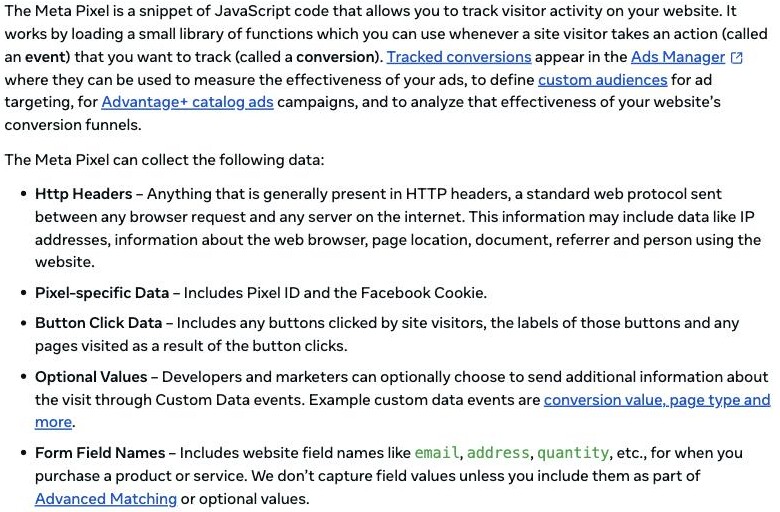
Meta's developer docs describe the Meta Pixel as "a snippet of JavaScript code that allows you to track visitor activity on your website" that "can collect" data "like IP addresses"; its Privacy Policy says that information is "stored and processed in" countries "including the United States, Ireland, Denmark and Sweden, among others" — never the mainland; and Meta's own 10-K states that user access to Facebook "has been or is currently restricted in whole or in part in China." So embedding Meta's tools in a China-facing site exports your users' personal information out of the country — a cross-border transfer PIPL governs — while the widgets themselves quietly fail to load. The table below is Meta's own wording and the rule each line triggers.
This is a risk map, not a verdict — what applies turns on your data, your users and your role under PIPL. Our China team can map your exposure with you →
What Facebook's own documentation says about China
| Fact | Primary source |
|---|---|
| Meta itself says access to Facebook is restricted in China. In its most recent annual report (Form 10-K), Meta states that user access to Facebook "has been or is currently restricted in whole or in part in China, Iran, and North Korea." For a business that is two problems at once: the platform does not reliably load for mainland visitors, and the Facebook Login, Meta Pixel and share widgets you embed in your own site all load from Meta's domains — so they stall for those visitors instead of rendering. This reachability gap is a structural block, not a slow paint you can tune away, and a public mainland site still turns on an ICP filing bound to in-country hosting (State Council Order No. 292; MIIT Order No. 33) that Facebook has no mainland region to carry. | Meta Platforms, Inc. Form 10-K FY2025 (sec.gov), retrieved 2026-10-07; State Council Order No. 292; MIIT Order No. 33 |
| The Meta tools you embed collect your visitors' personal data. Meta's developer docs describe the Meta Pixel as "a snippet of JavaScript code that allows you to track visitor activity on your website," and say it "can collect" data "like IP addresses, information about the web browser, page location, document, referrer and person using the website." Facebook Login and the Facebook SDK work the same way, running from Meta's servers. Place them on a China-facing page and that personal information flows to Meta — a cross-border transfer under PIPL (Articles 38–43). | Meta for Developers — Meta Pixel (developers.facebook.com), retrieved 2026-10-07; PIPL Articles 38–43 |
| Meta stores and processes that data offshore — never in the mainland. Meta's Privacy Policy says your information is "transferred or transmitted to, or stored and processed in" the "places we have infrastructure or data centers, including the United States, Ireland, Denmark and Sweden, among others." None is in mainland China. For personal information collected from users in China, that offshore storage is a cross-border transfer PIPL governs — requiring notice, separate consent and a transfer mechanism — and for a CIIO or large-volume handler the data must instead be kept in China (PIPL Article 40; Cybersecurity Law Article 39 (formerly Article 37)). | Meta Privacy Policy (facebook.com/privacy/policy), retrieved 2026-10-07; PIPL Articles 38–43 & 40; Cybersecurity Law Article 39 (formerly Article 37) |
| Facebook cannot be ICP-filed, and that is not the problem to solve. A public website shown to visitors inside mainland China turns on an ICP filing bound to in-country hosting (State Council Order No. 292; MIIT Order No. 33). Meta's own Privacy Policy lists its data centers as "the United States, Ireland, Denmark and Sweden, among others" — none in the mainland — so there is nothing on Facebook to file against. The compliant move is not to force a blocked platform onto a Chinese footing; it is to give your own site that footing and reach Chinese users through China-native channels. | Meta Privacy Policy (facebook.com/privacy/policy), retrieved 2026-10-07; State Council Order No. 292; MIIT Order No. 33 |
Sources verified by the 21YunBox compliance team on 2026-10-07.
For a mainland-China audience, the question about Facebook is not how quickly it paints — it is whether it reaches your users at all, and what the pieces of Facebook you embed in your own site do with those users’ data. Meta answers both in its own documents. Facebook is blocked in mainland China, by Meta’s own account; and the Meta Pixel, Facebook Login, the SDK and the share and embed widgets you drop into a China-facing page are small scripts served from Meta’s offshore infrastructure — so they stall for mainland visitors and, where they fire at all, carry those visitors’ personal information out of the country. The block is the visible half. The quieter half is the data.
Facebook in China at a glance
| What decides it | In Meta's own terms |
|---|---|
| Is it reachable? | Meta's 10-K states user access to Facebook “has been or is currently restricted in whole or in part in China.” The platform, and the widgets you embed from it, do not reliably load for mainland visitors. |
| What your embedded tools do | The Meta Pixel “can collect” data “like IP addresses, information about the web browser, page location, document, referrer,” tracking “visitor activity on your website.” Facebook Login and the SDK behave the same way. |
| Where that data goes | Meta's Privacy Policy: information is “stored and processed in” the “places we have infrastructure or data centers, including the United States, Ireland, Denmark and Sweden, among others.” None is in mainland China. |
| Serving the public | A public mainland site needs an ICP filing tied to in-country hosting. Meta runs no mainland region, so there is nothing on Facebook to file against — though your own origin can be. |
| Your China users' data | Personal information sent to Meta leaves the mainland — a cross-border transfer PIPL governs, with a localization duty for CIIOs and large-volume handlers that offshore storage cannot meet. |
Blocked by Meta’s own account — reachability is the visible half
Start with the part everyone can see. In its most recent annual report, Meta states that user access to Facebook “has been or is currently restricted in whole or in part in China, Iran, and North Korea.” That is the vendor describing its own footprint, not a third-party claim. For anyone building a China-facing presence it means the platform does not reliably reach mainland visitors — and the Facebook components you fold into your own site inherit the same fate. “Log in with Facebook,” the Like and Share buttons, an embedded page or timeline, and the Pixel all pull their code from Meta’s own domains, so on a mainland page they tend to hang on a request that never resolves rather than render.
That reachability gap also closes the licensing question before performance enters it. A public-facing website delivered to visitors inside China turns on an ICP filing (ICP 备案) under State Council Order No. 292 and MIIT Order No. 33, and that filing must attach to a hosting resource physically inside the mainland. Facebook is not something you can file — Meta operates no mainland region — and, crucially, it is not something you should be trying to. This page is not about getting a blocked platform to load; it is about what its presence in your stack does to your compliance.
The quieter half — your embedded Meta tools export personal data
The risk most teams miss is the one that fires silently even when a widget half-works. Meta’s developer documentation describes the Meta Pixel as “a snippet of JavaScript code that allows you to track visitor activity on your website,” and says it “can collect” data “like IP addresses, information about the web browser, page location, document, referrer and person using the website.” Facebook Login and the Facebook SDK run from Meta’s servers in the same way. Wherever those scripts do execute for a visitor, they hand that visitor’s personal information to Meta.
And Meta tells you where it lands. Its Privacy Policy states that your information is “transferred or transmitted to, or stored and processed in” the “places we have infrastructure or data centers, including the United States, Ireland, Denmark and Sweden, among others” — not one of them in mainland China. For personal information gathered from users in China, that is a cross-border transfer under the Personal Information Protection Law: the handler — you, not Meta — has to give notice, obtain separate consent, and clear one transfer mechanism (a CAC security assessment, the CAC standard contract, or certification), per Articles 38–43. If you are a critical information infrastructure operator or a large-volume handler, personal information collected in China must be stored in the mainland (PIPL Article 40; Cybersecurity Law Article 39 (formerly Article 37)) — a residency duty that an offshore Meta endpoint cannot satisfy.
Two failures, one cause
The broken experience and the data export are not separate problems; they are the same dependency seen from two angles. A China-facing page that reaches out to Meta’s offshore infrastructure will, for a mainland visitor, either stall or quietly export their data — often both on the same page load. So the fix is not to make Facebook reach into China. It is to take the offshore Meta dependencies out of your mainland delivery path, serve your own site on a lawful in-country footing, and meet a Chinese audience on the China-native channels where it already is.
This is a risk map, not a verdict: whether PIPL’s cross-border duties, a data-localization obligation, or an ICP filing apply to you turns on what you collect, how much, your role, and who your users are — worth settling with counsel before you build.
Where 21YunBox fits — a compliant overlay, not a migration
First, the boundary, because it defines everything else: 21YunBox does not make Facebook — or any platform China blocks — reachable inside the mainland. That would be circumvention, and it is the opposite of what operating legally in China means. What we do sits squarely on your side of that line. You keep your stack where it is; we add compliant, ICP-filed delivery from inside the mainland, placed in front of your existing origin — no rebuild, no second codebase, and no move off your current platform — so that your own site loads for Chinese users on a lawful footing. Our China team maps your PIPL cross-border and data-residency exposure against your entity and data volumes, helps you lift the offshore Meta dependencies out of your mainland pages, and points you to the compliant, China-native channels where a Chinese audience actually gathers. The goal is never a workaround for a blocked platform; it is a compliant home for your own presence in China.
Related reading: