Does Eloqua Work in China? PIPL, Cross-Border Contact Data & ICP
Oracle runs Eloqua from offshore regions it names as Chicago and Frankfurt, with no mainland-China region — so your Chinese contacts' names, emails and tracked behavior sit outside the mainland as a PIPL cross-border transfer, and Eloqua's forms and trackers embed on your ICP-filed site from offshore. A compliance-first look.
Does Eloqua work in China?
Reachability is not the question. Oracle Eloqua keeps your Chinese contacts' names, emails and tracked behavior on Oracle's offshore cloud — Oracle names Chicago and Frankfurt, and no mainland-China region — so using it for China contacts is a PIPL cross-border transfer of personal data before it is a marketing decision.
Oracle names Eloqua's regions as "the existing Chicago (USA) region" and the "Frankfurt region," and its own help docs say Eloqua "uses cookies and the visitor's IP address to build a visitor record," held as "customer data that is hosted by Oracle in the Oracle Cloud Services." For your mainland contacts that record of identity and behavior sits outside China: a cross-border transfer PIPL governs (notice, separate consent and a transfer mechanism, Articles 38–43). The forms and trackers you embed load onto your public pages from offshore — a second question, on the site that carries your ICP filing. The table below is Oracle's own wording and the rule each part triggers.
This is a risk map, not a verdict — what applies turns on your entity, your data volumes and who your contacts are. Our China team can map your exposure with you →
Compliance snapshot
- ! Oracle hosts Eloqua offshore — Chicago and Frankfurt, no mainland-China region
- ! Your China contacts' names, emails and tracked behavior cross the border — PIPL applies
- ✕ Eloqua offers no in-country data residency for mainland China
- ! Its forms and tracking scripts embed on your public site from offshore
- ! The ICP filing rides on your embedding site, not on Eloqua
What Eloqua's own documentation says about China
| Fact | Primary source |
|---|---|
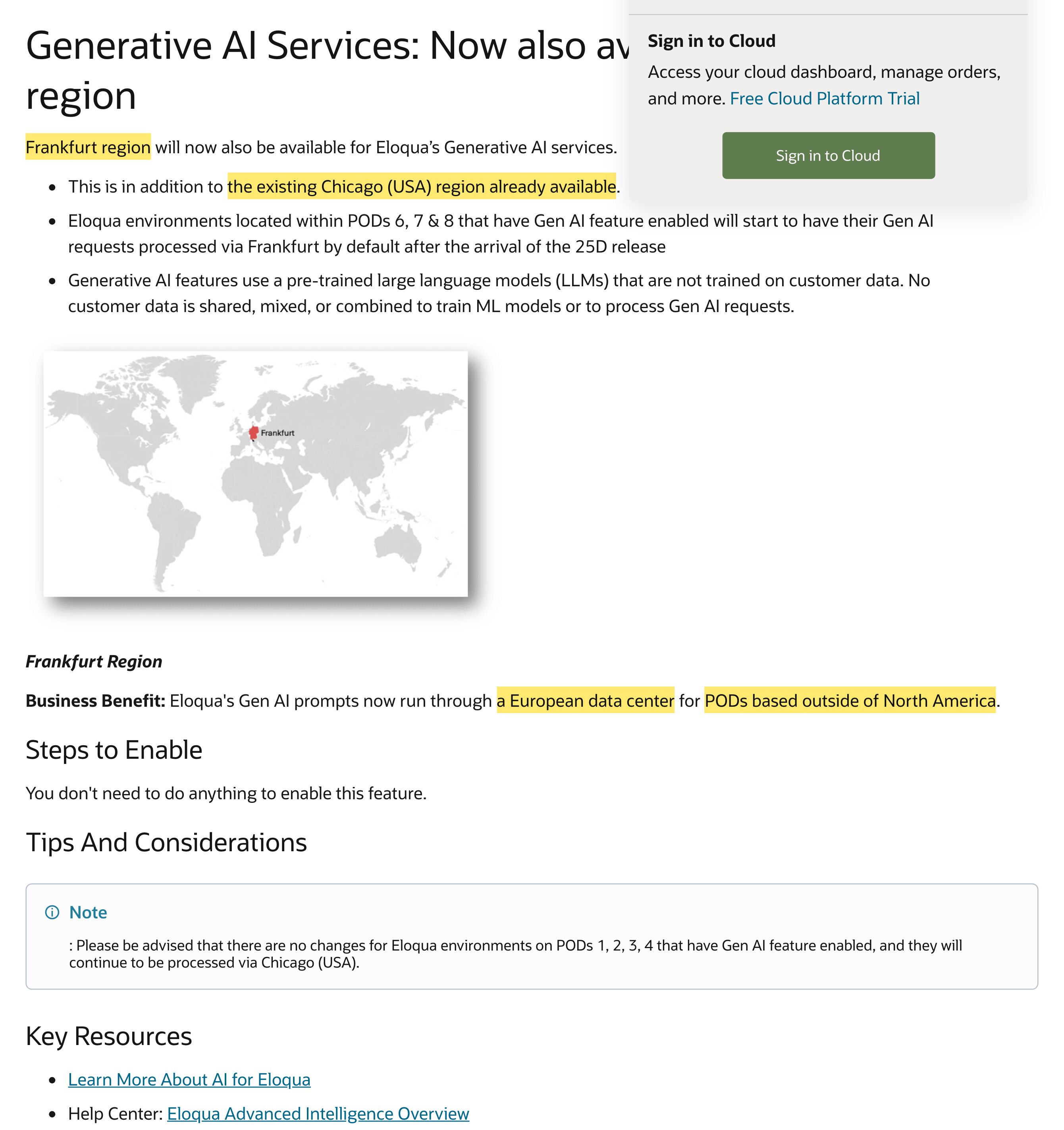
| Oracle names Eloqua's data-center regions as Chicago and Frankfurt — none in mainland China. In Oracle's own Eloqua 25D release note, the "Frankfurt region will now also be available for Eloqua's Generative AI services," "in addition to the existing Chicago (USA) region already available," with "PODs based outside of North America" routed through "a European data center." Oracle publishes no mainland-China region for the Eloqua service, so a Chinese contact's record is held offshore by design. | Oracle Eloqua 25D release notes (docs.oracle.com), retrieved 2026-10-07 |
| Eloqua builds a record of who your contacts are and what they do. Oracle's help docs: as people browse, Eloqua "uses cookies and the visitor's IP address to build a visitor record," and those cookies "remain in the browser until the visitor deletes them or for 13 months." Oracle holds that record as "customer data that is hosted by Oracle in the Oracle Cloud Services" — offshore. For your mainland contacts it is personal information, identity plus behavior, that leaves China: a cross-border transfer under PIPL (notice, separate consent and a transfer mechanism, Articles 38–43). | Oracle Eloqua — Asynchronous tracking scripts & Data privacy and security features (docs.oracle.com), retrieved 2026-10-07; PIPL Articles 38–43 |
| An offshore-only service cannot meet a China data-residency duty. Because Oracle hosts Eloqua only from its offshore regions, personal information it holds for your Chinese contacts cannot be kept in the mainland. If you are a critical information infrastructure operator or a large-volume handler, personal information collected in China must be stored in-country (PIPL Article 40; Cybersecurity Law Article 39 (formerly Article 37)) — a residency obligation no Eloqua region can satisfy. | Oracle Eloqua Data privacy and security features (docs.oracle.com), retrieved 2026-10-07; PIPL Article 40; Cybersecurity Law Article 39 (formerly Article 37) |
| Eloqua is an embedded layer, so the ICP filing rides on the site that hosts it. Eloqua's forms, landing pages and tracking scripts sit on your public pages. Oracle: "When you visit a website with the Oracle Eloqua asynchronous tracking scripts deployed, cookies are placed in your browser," and "the tracking scripts are executed after the entire Document Object Model (DOM) is loaded." A public site served to mainland visitors needs an ICP filing (State Council Order No. 292; MIIT Order No. 33) on that embedding site, and because the Eloqua assets load from offshore, whether they reach mainland visitors is a delivery question layered on top. | Oracle Eloqua — Asynchronous tracking scripts (docs.oracle.com), retrieved 2026-10-07; State Council Order No. 292; MIIT Order No. 33 |
Sources verified by the 21YunBox compliance team on 2026-10-07.
Ask whether Oracle Eloqua “works” in mainland China and the honest answer starts with data, not speed. Eloqua is a marketing-automation platform whose whole purpose is to hold your contacts and track what they do — and Oracle runs that service from data-center regions it names as Chicago and Frankfurt, with none inside mainland China. For the Chinese people in your database, that makes Eloqua a cross-border transfer of personal information the moment it records them; the forms and tracking scripts you embed on your public pages then raise a second, separate issue on the very site that carries your ICP filing. Reachability is real, but it is the least of what you are deciding.
Eloqua in China at a glance
| What decides it | In Eloqua's own terms |
|---|---|
| Where it runs | Oracle names Eloqua's regions as “the existing Chicago (USA) region” and the “Frankfurt region,” with “PODs based outside of North America” processed through “a European data center.” No region is inside mainland China. |
| What it holds | Eloqua “uses cookies and the visitor's IP address to build a visitor record” as people browse your site, and those cookies “remain in the browser until the visitor deletes them or for 13 months.” That is contact identity plus tracked behavior. |
| Where that data sits | Oracle holds it as “customer data that is hosted by Oracle in the Oracle Cloud Services” — offshore. For your Chinese contacts that is a cross-border transfer of personal information PIPL governs, with a localization duty offshore regions cannot meet. |
| On your public site | Eloqua's forms, landing pages and tracking scripts embed on your pages and call back to Oracle's offshore servers. The ICP filing attaches to that embedding site, not to Eloqua. |
| Is it reachable? | Those forms and trackers are served from offshore, so whether they render cleanly for mainland visitors is a delivery question — separate from whether you are cleared to use the service at all. |
Where Eloqua runs — and that settles the first question
Oracle runs Eloqua as a hosted service from its own cloud, and in its own release notes it names the regions: the “Frankfurt region” joining “the existing Chicago (USA) region already available,” with “PODs based outside of North America” sent to “a European data center.” There is no region inside mainland China. So wherever your instance sits, the contact and behavioral data Eloqua keeps for your Chinese users is held offshore — in the United States or Europe — not in the mainland. That single fact decides the compliance question before reachability is ever measured: this is not about whether a form paints in Shanghai, but about personal data leaving the country every time Eloqua records it.
Your China contacts’ data is a cross-border transfer
Eloqua’s job is to know your contacts, and Oracle’s own documentation describes how: as visitors browse, Eloqua “uses cookies and the visitor’s IP address to build a visitor record,” and those cookies “remain in the browser until the visitor deletes them or for 13 months.” Names, email addresses, company and a running history of behavior accumulate in that record — and Oracle holds it as “customer data that is hosted by Oracle in the Oracle Cloud Services,” offshore. For your mainland contacts, moving that personal information out of China engages the Personal Information Protection Law: the handler — you, not Oracle — must give notice, obtain separate consent, and clear one transfer mechanism (a CAC security assessment, the CAC standard contract, or certification). If you are a critical information infrastructure operator or a large-volume handler, personal information collected in China must be stored in the mainland (PIPL Article 40; Cybersecurity Law Article 39 (formerly Article 37)) — a residency duty an offshore-only Eloqua cannot satisfy. This is the spine of the question, and no amount of network tuning changes it.
The embedded layer — forms, trackers and your ICP filing
Eloqua is not where your website lives; it is a layer you embed into it. Its forms, landing pages and tracking scripts load onto your public pages — “when you visit a website with the Oracle Eloqua asynchronous tracking scripts deployed, cookies are placed in your browser” — and those scripts “are executed after the entire Document Object Model (DOM) is loaded,” calling back to Oracle’s servers to log each visit. Two consequences follow for China. First, the ICP filing a public mainland site requires (State Council Order No. 292; MIIT Order No. 33) attaches to the site that serves your visitors — the page embedding Eloqua — so the obligation is yours, on your own domain, not something Eloqua carries for you. Second, because those forms and scripts are delivered from offshore, whether they reach and render for mainland visitors is a delivery question sitting on top of the legal one. Reaching a Chinese audience and being cleared to collect their data are two different tests, and the embedded layer touches both.
This is a risk map, not a verdict: whether you owe notice and consent, a transfer mechanism, in-country storage, an ICP filing, or some combination depends on what you collect, how much of it, and who your contacts are — worth settling with counsel before you launch a China campaign.
Where 21YunBox fits — a compliant overlay, not a migration
You keep running Eloqua exactly as you do today. We add the piece a hosted, offshore marketing platform cannot: compliant, ICP-filed delivery from inside the mainland, placed in front of the pages that embed your Eloqua forms and trackers — no rebuild, no second codebase, and no move off Oracle. Our China team maps your PIPL cross-border and data-residency exposure against your entity, your data volumes and who your contacts are, then stands up the in-country delivery and the compliant handling a lawful China presence needs, while Eloqua stays the system of record it already is.
Related reading:
Frequently Asked Questions
Is it a problem that Eloqua has no data center in mainland China?
It is the core of the compliance question. Oracle hosts the Eloqua service from offshore regions it names as Chicago and Frankfurt, with no mainland-China region, so every contact record you hold for Chinese users sits outside the mainland. Under PIPL that is a cross-border transfer of personal information — you must give notice, obtain separate consent and satisfy a transfer mechanism — and if a data-localization duty applies to you as a CIIO or large-volume handler, an offshore region cannot meet it. Whether Eloqua loads quickly for your visitors is a separate, lesser question.
Does embedding Eloqua forms and tracking scripts affect our ICP filing?
The ICP filing attaches to the website that serves mainland visitors — your site, not Eloqua. Eloqua is an embedded layer: its forms, landing pages and tracking scripts load onto your public pages and call back to Oracle's offshore servers. So the ICP obligation (State Council Order No. 292; MIIT Order No. 33) sits on the page that embeds them, and because those assets are offshore, whether they render for mainland visitors is a delivery question on top. Treat the filing and the embedded offshore footprint as two things to confirm with counsel.
Can 21YunBox help us use Eloqua compliantly in China?
Yes. Our China team can map your PIPL cross-border and data-residency exposure for the contact and behavioral data Eloqua collects — against your entity, your data volumes and who your contacts are — and stand up the ICP-filed, in-country delivery a compliant China presence needs, in front of the pages that embed Eloqua, while Eloqua stays exactly where it runs. Get in touch to work through your specific case.