Does 6sense Work in China? Intent Data, PIPL Profiling & US Data Residency
6sense is a B2B account-intelligence engine — its tag captures IP addresses, cookie identifiers and web-behavior signals, de-anonymizes accounts, and scores buying stage with predictive models. 6sense's own privacy policy says it is a United States company that transfers and processes that data in the US, with no mainland-China region — so collecting it from visitors in China is a cross-border transfer of personal information under PIPL, the predictive scoring raises an automated-decision-making question, and neither the data nor the site that emits it has an ICP footing offshore. A compliance-first look at the data-residency, cross-border and profiling exposure, and the lawful in-country path.
Does 6sense work in China?
The question isn't whether the 6sense tag loads from China — it's whether you may lawfully collect those signals there, send them to the United States, and score them. 6sense is a B2B account-intelligence engine, and its own privacy policy settles the residency half.
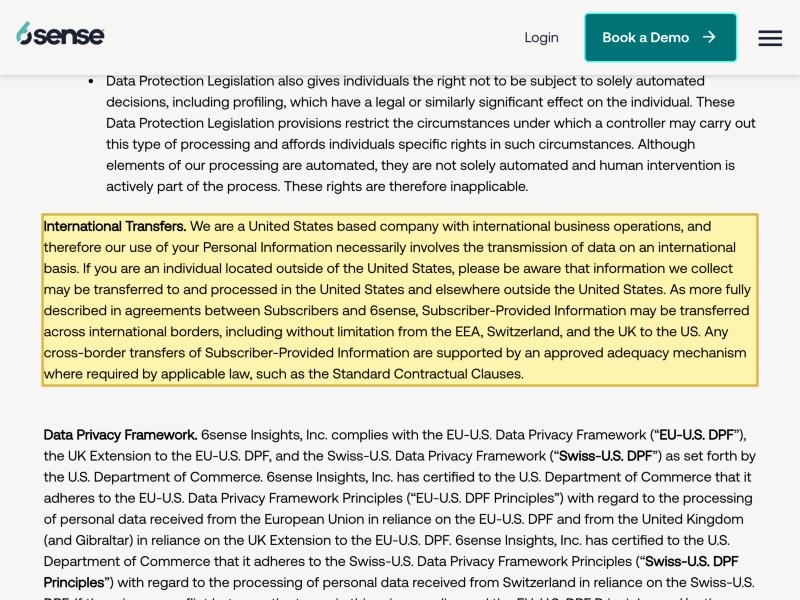
6sense states it is "a United States based company" whose platform is built on AWS, and that information it collects "may be transferred to and processed in the United States and elsewhere outside the United States" — with no mainland-China region. So the IP addresses, cookie identifiers and web-behavior signals its tag captures from your China visitors are personal information that comes to rest offshore, which makes their collection a cross-border transfer (数据出境) under PIPL (notice, a separate consent, and a transfer mechanism), and above thresholds may trigger China's data-export security assessment. Because 6sense profiles and predicts, PIPL's automated-decision-making rule (Article 24) is in play too, and for a critical information infrastructure operator the Cybersecurity Law's Article 39 (formerly Article 37) requires that data to stay in China.
21YunBox maps your cross-border, residency and profiling exposure, localizes the China intent and engagement data onto a consented, in-country setup, and delivers your China-facing site in-country on ICP-filed infrastructure — with no rebuild, and never any form of circumvention. Treat the specifics as a risk to confirm with counsel.
What 6sense's own documentation says about China
| Fact | Primary source |
|---|---|
| 6sense says it is a US company and processes personal information in the United States, with no mainland-China region. Its Privacy Policy states, under "International Transfers": "We are a United States based company with international business operations, and therefore our use of your Personal Information necessarily involves the transmission of data on an international basis," and that information it collects "may be transferred to and processed in the United States and elsewhere outside the United States." | 6sense, "Privacy Policy" — International Transfers (6sense.com), retrieved 2026-10-09 |
| 6sense's platform is built on AWS, and its cross-border mechanisms are all US-bound. Its Trust site states the platform "is built on AWS with redundant, multi-system architecture," and that 6sense is "compliant with GDPR, CCPA/CPRA, and participate[s] in the UK-US and Swiss-US Data Privacy Frameworks (DPF)" — frameworks for transferring personal data to the United States, with no mainland-China region named. | 6sense, "Trust Site" (6sense.com), retrieved 2026-10-09 |
| The signals 6sense collects are personal information under PIPL. Its Privacy Policy lists among the data it collects "IP address," "cookie identifiers and other identifiers that are automatically assigned to your computer or devices," "Online Activity" and "Geo-IP Information." Collected from people in mainland China and sent to a US-hosted 6sense, these are a cross-border transfer under PIPL Articles 38–40: notice, a separate consent, and one transfer mechanism — a CAC security assessment, the CAC standard contract, or certification. | 6sense Privacy Policy (6sense.com), retrieved 2026-10-09; PIPL Articles 38–40 |
| 6sense is a predictive engine, so automated decision-making is in scope. 6sense describes its product as "a business-to-business predictive intelligence engine for marketing and sales applications." Under PIPL Article 24, using personal information for automated decision-making carries transparency and fairness duties; 6sense's own policy notes its processing is "not solely automated and human intervention is actively part of the process" (its GDPR position), which does not by itself settle the PIPL question. | 6sense Trust Site and Privacy Policy (6sense.com), retrieved 2026-10-09; PIPL Article 24 |
Sources verified by the 21YunBox compliance team on 2026-10-09.
For a go-to-market team running 6sense against mainland China, the first instinct is to ask whether the tag even loads. That is the wrong place to start. 6sense is a B2B account-intelligence engine: its tag collects IP addresses, cookie identifiers and web-behavior signals from the people who touch your site, de-anonymizes them to accounts, and scores and predicts how close each account is to buying. Whether that tag reaches a given network in China is a delivery question. Whether you may lawfully collect those signals from people in China, send them to a United States platform, and feed them into a predictive model is a compliance one — and it is settled by China’s personal-information law, not by latency. 6sense answers the residency half in its own privacy policy.
6sense in China at a glance
| What decides it | In 6sense's own terms — and China's law |
|---|---|
| What it is | 6sense calls itself “a business-to-business predictive intelligence engine for marketing and sales applications.” Its tag collects IP addresses, cookie identifiers and web-behavior signals, de-anonymizes them to accounts, and scores and predicts each account's buying stage — so it continuously profiles identifiable activity. |
| Is reachability the question? | No. The 6sense tag is a third-party script; whether it loads cleanly from a given mainland network is a delivery matter. This page publishes no China latency figure — speed is not the axis, and the answer is never a network workaround. |
| Where the data lives | Offshore. 6sense states it is “a United States based company,” its platform is “built on AWS,” and information it collects “may be transferred to and processed in the United States and elsewhere outside the United States.” Its cross-border mechanisms (EU-U.S., UK, Swiss-U.S. Data Privacy Frameworks) are all US-bound. No mainland-China region. |
| Collecting China signals into it | IP addresses, cookie identifiers and behavior are personal information. Holding them in a US 6sense is a cross-border transfer (数据出境) under PIPL (Articles 38–40): notice, a separate consent, and one transfer mechanism. Tracking identifiable people needs its own PIPL consent, and a data-export security assessment may apply above thresholds. |
| Predictive scoring | Using personal information for automated decision-making engages PIPL Article 24's transparency and fairness duties. 6sense's position under European law is that its processing is “not solely automated” — which does not by itself settle the PIPL question. |
| Residency & serving the public | For a CIIO or large-volume handler, China-collected personal information must be stored in the mainland (PIPL Article 40; Cybersecurity Law Article 39 (formerly Article 37)) — which an offshore 6sense cannot meet. The China-facing site that carries the tag needs an ICP filing bound to a mainland hosting resource 6sense does not provide. |
Availability isn’t the axis — residency and consent are
6sense’s China posture is set by where its data lives, not by a load-time test, so this page publishes no first-party China latency or reachability figure for it: speed is not what decides the question. The tag that gathers account signals is a third-party script like any other, and whether it loads cleanly from a given mainland network is an operational, delivery-side matter. When a cross-border call is inconsistent, the temptation is to force it through some network workaround. 21YunBox neither uses nor suggests any such circumvention of China’s network rules — it is both a compliance risk and beside the point. The decision that actually governs 6sense in China sits upstream of delivery: may these signals be collected from people in China, and may they leave the country at all.
The signals are personal information — and they come to rest in the US
6sense’s inputs include, in its privacy policy’s own terms, “cookie identifiers and other identifiers that are automatically assigned to your computer or devices,” along with “IP address,” “Online Activity” and “Geo-IP Information.” Under China’s Personal Information Protection Law those identifiers and behavior records are personal information, whether or not 6sense then resolves them to a company rather than a named person. And 6sense states plainly where they go: it is “a United States based company,” its platform is “built on AWS,” and information it collects “may be transferred to and processed in the United States and elsewhere outside the United States.” There is no mainland-China region in that picture, and its own transfer frameworks all point to the US.
So the moment your 6sense tag captures those signals from a visitor in China and they land in a US 6sense, you have made a cross-border transfer (数据出境) of personal information. PIPL puts the duty on the handler — you, not 6sense the processor: Articles 38–40 require notice, a separate consent distinct from any general site agreement, and one transfer mechanism — a CAC security assessment, the CAC standard contract, or certification. Above certain thresholds, or where the data is “important data,” that transfer may also require China’s data-export security assessment (数据出境安全评估) before anything leaves. Which of these bite your specific deployment is a risk to confirm with counsel against what you actually collect.
Predictive scoring is automated decision-making — a PIPL question of its own
Residency is only half of it. 6sense describes itself as a “predictive intelligence engine,” and the heart of the product is scoring: it profiles accounts from their behavior and predicts a buying stage. Under PIPL, using personal information for automated decision-making engages Article 24, which requires transparency in the decision-making and fairness and impartiality in its results, and gives individuals rights where a decision significantly affects them. 6sense’s privacy policy answers the parallel European rule by stating that “although elements of our processing are automated, they are not solely automated and human intervention is actively part of the process” — its position under the GDPR. PIPL frames the duty around transparency and fairness rather than only whether a decision is “solely” automated, so whether your scoring triggers Article 24 obligations is a separate question to settle with counsel. The underlying collection carries its own consent duty as well: observing identifiable people’s behavior in China needs a lawful basis — in practice, informed consent before the tag begins collecting — and the cross-border transfer then needs a further, separate consent on top of that.
Residency and ICP: no mainland footing to store on or serve from
Two more obligations turn on the same missing region. First, residency: if you are a critical information infrastructure operator or a large-volume handler, personal information collected in China must be stored in the mainland (PIPL Article 40; Cybersecurity Law Article 39 (formerly Article 37 — the data-localization provision was renumbered by the 2025 amendment that took effect on January 1, 2026, with its substance unchanged)). A 6sense account hosted in the United States cannot meet that duty. Second, licensing: the China-facing site or app that carries the 6sense tag — the pages your users actually load — is a public internet service in the mainland, so serving it compliantly from inside China turns on an ICP filing (备案) bound to a mainland hosting resource. An offshore platform provides none, so there is nothing of 6sense’s to file against. “We already run 6sense” does not carry into China on either count.
None of this is a verdict that 6sense is “blocked” or “illegal.” It is a risk map: which obligations bite turns on your entity, the data your tag collects, your role under Chinese law, and who your users are — worth settling with counsel before your go-to-market stack depends on it.
The lawful path — map, localize, deliver
There is a lawful way to run account intelligence for a China-facing motion, and it has a shape. First, map: our China team works through your PIPL exposure on every front — the behavioral tracking, the cross-border transfer, and the predictive scoring — identifying which signals collected in China must stay in the country, what may lawfully leave, where a data-export security assessment or an Article 39 storage duty bites, whether your scoring engages Article 24, and what your consent and notice flow has to cover. The legal conclusions are settled with counsel; we build the technical picture that feeds them.
Then localize: we stand up and integrate a consented, in-country, PIPL-compliant setup for the China intent and engagement data — so the signals you gather from mainland visitors are captured and held on a China-resident footing, while you keep 6sense for the markets where it already serves you, fed only by what may lawfully leave. Where there is no clean domestic equivalent, the lawful in-country pattern — consented collection, in-country processing and storage — is the thing we build to, rather than a like-for-like swap.
Then deliver: the China-facing site or app that emits those signals is itself a public service in the mainland, so it carries an ICP filing duty and needs compliant, in-country delivery. 21YunBox delivers it in-country — the 21YunBox Optimizer — set in front of what you already run, with no rebuild and no re-platform. The result is account intelligence that runs legally and compliantly for your users in China. What we never do — and what no one lawfully can — is hand you a route around China’s data-export rules or around any network restriction: we map what must stay, localize it in-country, and deliver in-country, and we never move personal information out of China by stealth.
Related reading:
- Cross-border data transfers under PIPL
- China’s data-export security assessment
- China’s Cybersecurity Law (data localization, Article 39)
- How to get an ICP filing for China