Does Microsoft Dynamics 365 Customer Engagement Work in China? The 21Vianet Sovereign Cloud, Dataverse Residency & Cross-Border PII
Microsoft Dynamics 365 Customer Engagement — the Sales, Customer Service, Field Service and Marketing CRM apps and the Dataverse behind them — is available in mainland China, but through a separate, physically separated sovereign cloud operated by 21Vianet (Shanghai Blue Cloud Technology Co., Ltd), not the global, Microsoft-managed service most organizations sign in to. The real decision for a China CRM deployment isn't speed — it's data residency: a CRM is almost entirely personal information (contacts, leads, cases, the whole interaction history), and running the global service from the mainland puts those records in Microsoft's datacenters outside China, a PIPL cross-border transfer, while the data-resident lawful path is the 21Vianet-operated China cloud. A compliance-first look at the two clouds, the cross-border-data question, Cybersecurity Law Article 39 (formerly Article 37) residency, and the lawful in-country path.
Does Microsoft Dynamics 365 Customer Engagement work in China?
Yes — Dynamics 365 Customer Engagement is available in mainland China, but through a separate, physically separated sovereign cloud: the Power Platform and Dynamics 365 apps operated by 21Vianet (世纪互联), not the global, Microsoft-managed service most organizations sign in to. Microsoft documents the CRM apps — Sales, Customer Service, Field Service and Marketing — running inside the mainland on 21Vianet's cloud, with customer data stored at rest within China and new Dataverse environments created in-country.
Because a lawful in-country option exists, the real decision is data residency, not speed. Customer Engagement is a database of people — contacts, leads, cases and the whole interaction history — so almost all of it is personal information under Chinese law. Run it on the global service from the mainland and those records sit in Microsoft's datacenters offshore, a PIPL cross-border transfer (and, for a CII operator, a residency problem under Cybersecurity Law Article 39 (formerly Article 37)); larger or sensitive transfers can add a CAC data-export security assessment. The data-resident path is the 21Vianet-operated China cloud — subject to availability and feature parity, which Microsoft flags via a “China (21-V)” column and you confirm with Microsoft and 21Vianet.
21YunBox maps the cloud choice, localizes your CRM onto the data-resident China path, and delivers the customer-facing portals and forms that feed it in-country on ICP-filed infrastructure — so it runs legally in the mainland, with no circumvention of any kind. Treat the specifics as a risk to confirm with counsel.
What Microsoft Dynamics 365 Customer Engagement's own documentation says about China
| Fact | Primary source |
|---|---|
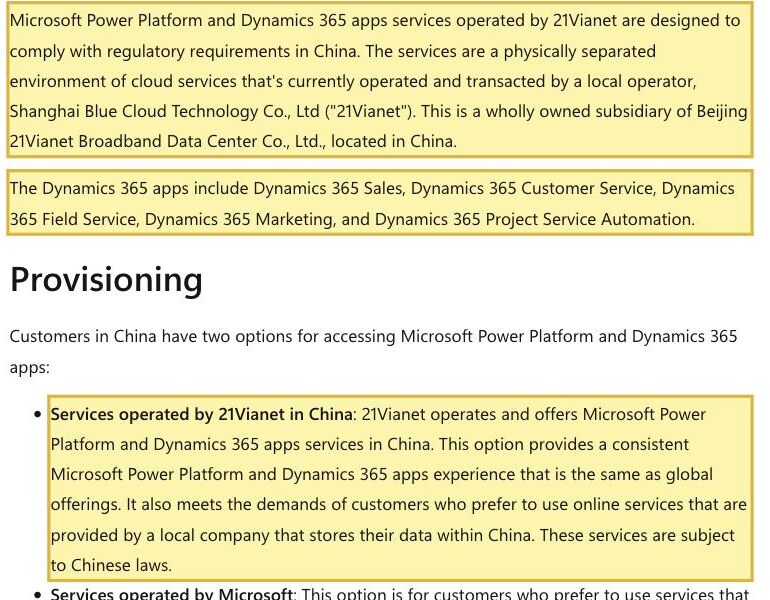
| Dynamics 365's CRM apps run in mainland China through a 21Vianet-operated sovereign cloud. Microsoft's overview states the Power Platform and Dynamics 365 apps operated by 21Vianet are “a physically separated environment of cloud services that's currently operated and transacted by a local operator, Shanghai Blue Cloud Technology Co., Ltd,” and that “The Dynamics 365 apps include Dynamics 365 Sales, Dynamics 365 Customer Service, Dynamics 365 Field Service, Dynamics 365 Marketing, and Dynamics 365 Project Service Automation.” | Microsoft Learn — Power Platform and Dynamics 365 apps operated by 21Vianet in China (learn.microsoft.com), updated 2026-08-14, retrieved 2026-10-09 |
| On the 21Vianet cloud, Microsoft says customer data is kept in-country. The same overview states the service “meets the demands of customers who prefer to use online services that are provided by a local company that stores their data within China,” that “These services are subject to Chinese laws,” and that new Power Platform environments with a Dataverse database are created in the in-country “China 3” datacenters. | Microsoft Learn — Power Platform and Dynamics 365 apps operated by 21Vianet in China (learn.microsoft.com), updated 2026-08-14, retrieved 2026-10-09 |
| Feature parity with the global service is not guaranteed. Microsoft writes that it “strives to maintain functional parity across our localized datacenter deployments” but that “there are exceptions that are affected by dependent service availability, market priorities, or compliance regulations,” and points customers to a “China (21-V)” column in its Product and Feature Availability document to plan around them. | Microsoft Learn — Power Platform and Dynamics 365 apps operated by 21Vianet in China (learn.microsoft.com), updated 2026-08-14, retrieved 2026-10-09 |
| Using the global service for China CRM data is a cross-border transfer. Sending a Chinese customer's personal information to Dynamics 365 hosted outside the mainland triggers PIPL Chapter III (Articles 38–43): notice, a separate consent, and one transfer mechanism — a CAC security assessment, the CAC standard contract, or certification — with in-country storage under Article 40 (and Cybersecurity Law Article 39, formerly Article 37) for CII operators. | Personal Information Protection Law of the PRC, Chapter III, Articles 38–43 (cac.gov.cn), retrieved 2026-10-09 |
Sources verified by the 21YunBox compliance team on 2026-10-09.
For a company running Microsoft Dynamics 365 Customer Engagement into mainland China, the question that matters first is not how quickly a lead form posts or a case record opens — it is which Dynamics 365 you are signed in to. Microsoft operates two separate things here: the global, Microsoft-managed service most organizations use, and a distinct, physically separated China cloud — the Power Platform and Dynamics 365 apps operated by 21Vianet (世纪互联) — run inside the mainland by a licensed local operator, Shanghai Blue Cloud Technology Co., Ltd, with customer data kept in-country. So the honest answer to “does Microsoft Dynamics 365 Customer Engagement work in China?” is yes — but on a specific cloud, under a specific body of law.
Because that in-country option already exists, the decision leaves the speed axis and lands on a data one. Customer Engagement is, by design, a record of people: the contacts and leads in your Sales pipeline, the accounts and named buyers behind them, the cases and conversations in Customer Service, the technician and site visits in Field Service, and the campaign and consent data in Marketing — nearly all of it personal information under Chinese law, and almost none of it anonymous. Keep that running on the global service from the mainland and the records sit in Microsoft’s datacenters outside China, which is a cross-border transfer under PIPL; run it on the 21Vianet-operated China cloud and Microsoft’s own documentation says the data is stored within China. Which cloud your CRM lives on — and how you deliver the portals and forms that feed it — is the compliance question, not the posting speed.
Dynamics 365 Customer Engagement in China at a glance
| What decides it | In Microsoft's own terms — and China's law |
|---|---|
| What it is | Microsoft Dynamics 365 Customer Engagement — the CRM apps Sales, Customer Service, Field Service and Marketing, and the Dataverse database behind them. Two clouds matter for China: the global, Microsoft-managed service, and a distinct China cloud, the Power Platform and Dynamics 365 apps operated by 21Vianet (世纪互联), run inside the mainland by Shanghai Blue Cloud Technology Co., Ltd. |
| Is it available in the mainland? | Yes — through the separate, physically separated China cloud. Microsoft documents the Dynamics 365 apps (Sales, Customer Service, Field Service, Marketing, Project Service Automation) operated by 21Vianet, licensed and transacted through the local operator rather than Microsoft directly. The global service is a different deployment and is not connected to it. |
| Where the data lives | On the 21Vianet-operated China cloud, Microsoft says customer data is stored at rest within China and new Dataverse environments are created in-country. On the global service, your contacts, leads, cases and interaction history — overwhelmingly personal information — sit in Microsoft's datacenters outside the mainland, which is the cross-border question for China users and China data. |
| Cross-border & residency | Pushing China personal information to the global service is a cross-border transfer under PIPL (Articles 38–43: notice, a separate consent, one transfer mechanism). For a critical information infrastructure operator, in-country storage is required under PIPL Article 40 and Cybersecurity Law Article 39 (formerly Article 37); larger-volume or sensitive transfers can add a CAC data-export security assessment. |
| Feature parity | Microsoft states it strives for parity but flags notable exceptions and a dedicated "China (21-V)" availability column; some capabilities — including Teams-dependent features and certain Dataverse integration and analytics paths — are not available in the 21Vianet service. Confirm the modules you depend on with Microsoft and 21Vianet. |
| The lawful path | Deploy on the 21Vianet-operated China cloud (or otherwise keep the CRM data in-country), and deliver the customer-facing portals, web-to-lead forms and self-service surfaces that feed it on ICP-filed, in-country infrastructure. 21YunBox maps the cloud choice, localizes your CRM onto the data-resident path, and delivers it in-country — subject to the China cloud's availability and feature parity, which you confirm with Microsoft and 21Vianet. |
Availability: a distinct China cloud, operated by 21Vianet
Dynamics 365 Customer Engagement’s presence in the mainland is set in Microsoft’s own documentation, not by a load-time test. Microsoft’s overview for the Power Platform and Dynamics 365 apps operated by 21Vianet describes “a physically separated environment of cloud services that’s currently operated and transacted by a local operator, Shanghai Blue Cloud Technology Co., Ltd” — a wholly owned subsidiary of Beijing 21Vianet Broadband Data Center Co., Ltd. — and lists the covered apps as “Dynamics 365 Sales, Dynamics 365 Customer Service, Dynamics 365 Field Service, Dynamics 365 Marketing, and Dynamics 365 Project Service Automation.” The option, Microsoft writes, “meets the demands of customers who prefer to use online services that are provided by a local company that stores their data within China,” and “These services are subject to Chinese laws.” This is a sovereign cloud: operated inside the mainland by a licensed local operator, physically separated, with the Dataverse data behind the CRM kept in-country.
Two things follow. First, the China cloud is a separate offering with its own licensing — customers transact it through 21Vianet rather than purchasing it from Microsoft directly — so adopting it is a procurement-and-deployment decision, not a region you switch on inside a global tenant; Microsoft notes that new Power Platform environments with a Dataverse database are created in the in-country “China 3” datacenters. Second, parity is not a given: Microsoft writes that it “strives to maintain functional parity” but that “there are exceptions that are affected by dependent service availability, market priorities, or compliance regulations,” points customers to a “China (21-V)” feature-availability column, and lists capabilities that are not available in the 21Vianet service — including features that depend on Microsoft Teams (not yet offered in China) and certain Dataverse integration and analytics paths. So which Customer Engagement modules and dependencies you rely on — Customer Service omnichannel, Field Service, or the Marketing and Customer Insights capabilities — is something to confirm directly with Microsoft and 21Vianet before you commit. For that reason this page publishes no first-party China latency figure for Dynamics 365: a lawful in-country cloud already exists, so speed is not the axis the decision turns on.
The cross-border-data story: a CRM is almost nothing but personal information
The gate that actually decides a China Customer Engagement deployment is the data, and a CRM makes that unusually stark. Where a finance ledger mixes figures with some personal records, Customer Engagement is personal information almost end to end: every contact and lead is a named individual, every account carries the people who work there, every case and activity records a conversation with a customer, and the Marketing tables hold consent state and behavioral history. A large majority of a Dataverse CRM is personal information under China’s Personal Information Protection Law. Served from the global service, those records rest in Microsoft’s datacenters outside the mainland, and moving them there is a cross-border transfer. PIPL puts the duty on the handler — you, not Microsoft: Chapter III (Articles 38–43) requires notice, a separate consent distinct from any ordinary terms of use, and one transfer mechanism — a CAC security assessment, the CAC standard contract, or certification. Where the CRM also drives marketing automation or lead scoring, the profiling and automated-decision rules add their own consent and transparency duties on top.
Beneath the transfer sits residency. A critical information infrastructure operator or a large-volume handler must store personal information collected in China inside the mainland — PIPL Article 40, read with Cybersecurity Law Article 39 (formerly Article 37), the data-localization article renumbered by the 2025 amendment that took effect on January 1, 2026 — a duty the global, offshore service structurally cannot satisfy. And once data volumes or sensitivity cross the regulatory thresholds, the transfer itself needs a CAC data-export security assessment before it may proceed. How much of this applies turns on your data, your sector and your role as handler, so treat each point as a risk to confirm with counsel against what you actually deploy — not a blanket assumption.
The data-resident path: the 21Vianet-operated China cloud
The lawful, in-country footing is the one Microsoft already publishes: the Dynamics 365 apps operated by 21Vianet, where customer data is “stored at rest within China” and new Dataverse environments are provisioned in-country. On that path the cross-border question does not arise in the same way, because the records do not leave. The work is to plan the move onto it. Because the China cloud is a separate offering licensed through 21Vianet rather than a region of a global tenant, environments, business units, security roles and the Dataverse schema are stood up there rather than switched over by a flag, and any migration from a global org needs its own plan. And because Microsoft flags features that are “not available,” the first step is an availability-and-parity check: confirming that the Sales, Customer Service, Field Service and Marketing capabilities — and any Customer Insights, Teams-linked or integration features — your organization depends on are offered in the China cloud as you need them. That check is not a formality; it is what tells you whether the data-resident path carries your CRM as-is or needs adjustment.
The lawful path — and where 21YunBox fits (map, localize, deliver)
There is a lawful way to run Dynamics 365 Customer Engagement for customers in China, and its shape is plain: the CRM data stays in-country on the 21Vianet-operated China cloud, and the customer-facing surfaces that feed and read it are themselves delivered compliantly inside the mainland. That second half is easy to miss, because a CRM feels like back-office software. But the things that make a CRM useful to the outside world — a customer or partner self-service portal, a Power Pages site, a web-to-lead or case-submission form, an embedded support chat — are public-facing services in China, so each carries an ICP filing (备案) duty and needs compliant in-country delivery like any other China property. A lead form that submits instantly but hangs off an unfiled, offshore front end has solved only half the problem.
That is the footing 21YunBox owns, and it is more than advice. Our China team works it in three moves. We map the cloud choice and your PIPL and residency exposure, so you know which Dynamics 365 Customer Engagement you should be on and what each option obliges. We localize your CRM onto the data-resident path — standing up and integrating the 21Vianet-operated China cloud, or otherwise keeping the records in-country, in place of a global service that cannot meet the residency duty. And we deliver the customer-facing portals, forms and integrations that surface your CRM in-country on ICP-filed infrastructure — the 21YunBox Optimizer — set in front of what you already run, with no rebuild and no re-platform. The result is a Dynamics 365 Customer Engagement deployment that runs legally and compliantly for your users in China. What we never do is route anyone around anyone’s terms or around China’s network controls: this is a lawful in-country deployment built on the China cloud Microsoft and 21Vianet already provide, and we neither use nor suggest circumvention of any kind.
Related reading:
- Cross-border data transfers under PIPL
- China’s Cybersecurity Law — Article 39 (formerly Article 37) and data localization
- China’s data-export security assessment measures
- How to get an ICP filing for China