Does Udemy Work in China? Data Residency, ICP & Cross-Border Rules
Udemy holds your China learners' identities, enrollments, progress and completion records — and, via Udemy Business, workforce learning data. Udemy's own documentation places its data-center vendors in the United States with no mainland-China region, so that data sits offshore: a PIPL cross-border and data-residency question, plus an ICP and licensed-payment door for a China-facing course site.
Does Udemy work in China?
Whether you can run Udemy for a China audience is a data-residency and licensing question, not a speed one. Udemy's course site loads from inside mainland China — the exposure is legal, not performance.
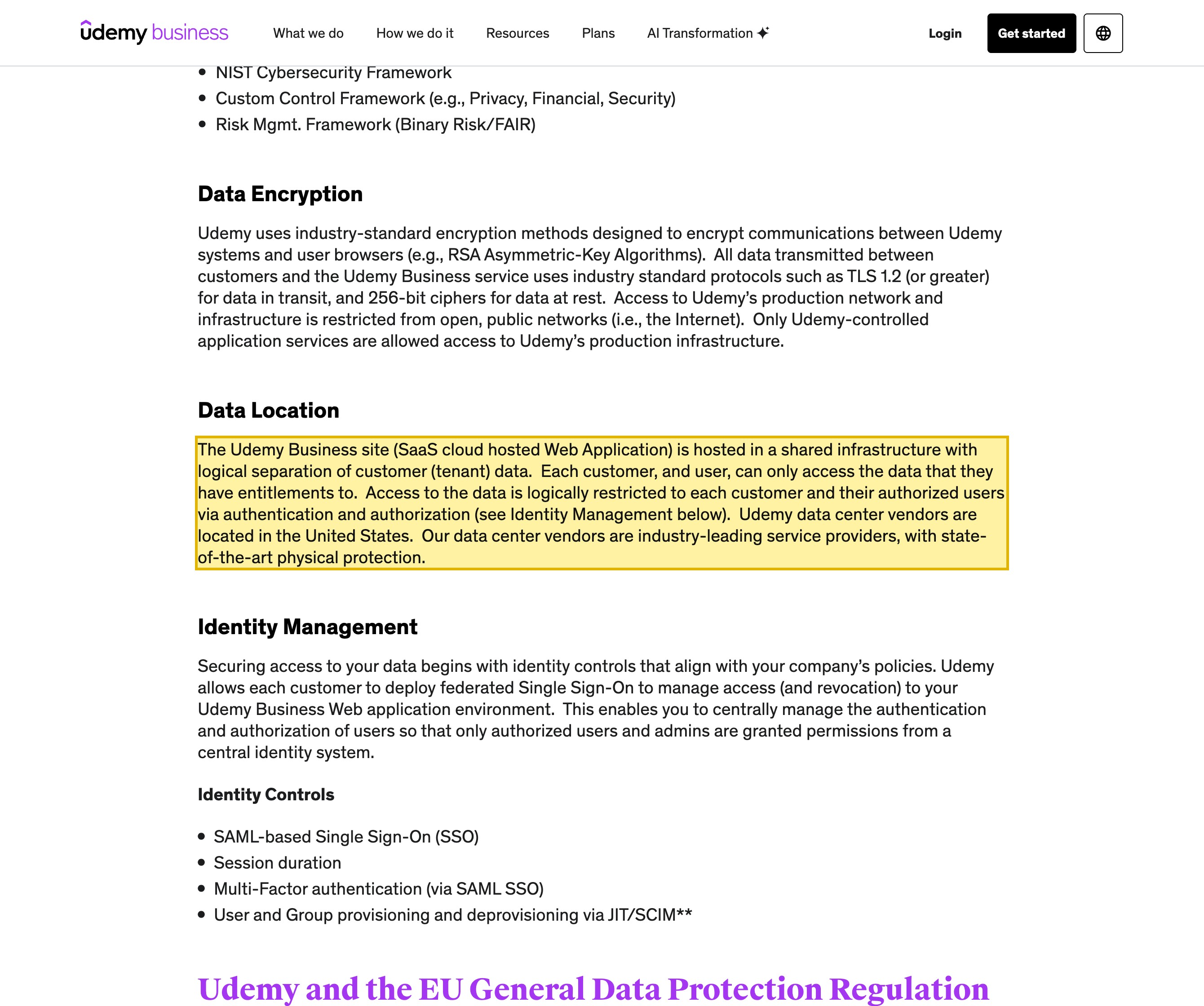
By Udemy's own Udemy Business Security FAQ, the service is a “SaaS cloud hosted Web Application” whose “data center vendors are located in the United States” — it names no mainland-China region. So the identities, enrollments, progress, quiz results and completion records of your China learners (and, for Udemy Business, your China employees' workforce learning data) sit offshore: a cross-border transfer of personal information that PIPL governs, needing notice, separate consent and a transfer mechanism, and for a CIIO or high-volume handler in-country storage. And if you run a China-facing course site that sells to learners in the mainland, that surface is an internet information service that needs an ICP filing and a licensed in-China payment channel.
This is a risk picture, not a verdict — your duties turn on your role, data volumes and whether you operate a China-facing storefront. Our China team can map your Udemy data exposure with you →
What Udemy's own documentation says about China
| Fact | Primary source |
|---|---|
| In Udemy's own words: its Udemy Business Security FAQ states the service “is hosted in a shared infrastructure with logical separation of customer (tenant) data” and that “Udemy data center vendors are located in the United States.” The page names no mainland-China region, so your China learners' and employees' records are held offshore. | Udemy — Udemy Business Security FAQ (Data Location), retrieved 2026-10-13 |
| Udemy's consumer Privacy Policy confirms the same offshore footing for the marketplace: it collects “Learning Data” — “which courses, assignments, labs, workspaces, and quizzes you've started and completed … completion certificates; badges” — and tells users outside the US, “we must transfer your data to the United States and process it there.” No mainland-China storage is offered. | Udemy — Privacy Policy, Sections 1 and 7.6, retrieved 2026-10-13 |
| Because Udemy holds the identities, enrollments, progress and completion records it collects from your China learners and stores them in the United States, data gathered in China is transferred abroad. PIPL Articles 38–40 govern that cross-border transfer: the handler (you, the Udemy customer — not Udemy) must give Article 13/23 notice, obtain separate consent, and satisfy a CAC security assessment, the CAC standard contract, or certification. | PIPL Articles 13, 23, 38–40 — Personal Information Protection Law |
| For a CIIO or high-volume handler, personal information collected in China must be stored in the mainland under Cybersecurity Law Article 39 (formerly Article 37). Separately, a China-facing course site served to mainland learners is an internet information service that needs an ICP filing, and selling courses to China learners requires a licensed in-China payment channel — neither of which a reachability check can see. | China Cybersecurity Law Article 39 (formerly Article 37); ICP filing (备案) requirement |
Sources verified by the 21YunBox compliance team on 2026-10-13.
For a company that trains staff or sells courses to learners in mainland China, “does Udemy work in China?” almost always gets answered the wrong way. Open a Udemy course from Shanghai and it plays. None of that is the question that decides whether you can run Udemy for a China audience. Udemy is an online course marketplace, and through Udemy Business a workforce learning platform — and either way it is a learner personal-data system. It holds the identities of your China learners, the courses they enrolled in, how far they progressed, the quizzes and assessments they took, the completion certificates and badges they earned, and — for paid courses — order and billing data. The decision isn’t whether the video player renders. It’s whether that learner personal information may lawfully sit where Udemy keeps it, and — if you run a course site facing mainland learners — whether that site is filed and its payments licensed. Those are compliance questions, and a reachability check answers none of them.
Udemy’s own documentation settles the hosting half plainly. Its Udemy Business Security FAQ, under the heading “Data Location,” describes the product as a “SaaS cloud hosted Web Application” and states that “Udemy data center vendors are located in the United States.” Its consumer Privacy Policy says the same for the marketplace: “we must transfer your data to the United States and process it there.” Neither names a mainland-China region. So your China learners’ records are kept offshore, and the thing that reaches China is the course content, not the regulated data.
Udemy in China at a glance
| What decides it | In Udemy's own terms — and China's law |
|---|---|
| What Udemy holds | A course platform is a learner personal-data system: your China learners' identities and logins, course enrollments, progress and completion records, quiz and assessment results, certificates and badges, and — for paid courses — order and billing data. For Udemy Business, that is your China employees' workforce learning data. This is personal information, not "can the video stream." |
| Where it is hosted | Udemy's Udemy Business Security FAQ lists it as a “SaaS cloud hosted Web Application” whose “data center vendors are located in the United States”; its consumer Privacy Policy says data is transferred to and processed in the United States. There is no mainland-China region — your China learners' records sit in an offshore region. |
| The China-facing course site — the distinctive second half | A course storefront or portal served to mainland learners is an internet information service, so it needs an ICP filing (备案). If you sell courses to China learners, the payment must run through a licensed in-China channel — an unlicensed offshore payment flow is not a lawful option. A reachability test never sees this door. |
| Crossing the border | Holding China learners' records on Udemy's offshore tenant is a cross-border transfer under PIPL Articles 38–40 (CAC security assessment, standard contract, or certification), with Article 13/23 notice and separate consent. For a CIIO or high-volume handler, Cybersecurity Law Article 39 (formerly Article 37) wants that data stored in the mainland. |
| Reachability is not the axis | Udemy loads in China, so “does it work?” is blind here. What decides it is where the learner records live, the consent and transfer basis, and whether a China-facing course site is filed and its payments licensed. 21YunBox keeps the regulated data in-country and ICP-files the surface — the 21YunBox Optimizer — in front of the Udemy setup you already run. |
What Udemy holds — and why it is learner personal information
Start with what the platform actually stores. To run a course, Udemy keeps a record of each learner: who they are, which courses they enrolled in, what they started and completed, how they scored on quizzes and assessments, and the certificates and badges they earned. Udemy’s own Privacy Policy spells out this “Learning Data” category — “which courses, assignments, labs, workspaces, and quizzes you’ve started and completed; content and subscription purchases and credits; subscriptions; completion certificates; badges” — alongside “Account Data” (email, password, account settings) and, for purchases, “Student Payment Data” such as name and billing address. For your China learners, every one of those records is personal information about an identifiable individual. For Udemy Business, it is also HR-adjacent: it ties to an employee, a role, and their development over time. That is a different kind of data from a static course video. When it lives in an offshore tenant, it is your China learners’ personal information sitting abroad — which is exactly what China’s cross-border and residency rules are about.
So the useful question is not whether Udemy answers from China. It is where the learner records are kept, and — if you operate a course site for mainland learners — whether that site is filed and its payments licensed.
Udemy’s own documentation places the data in the United States
Here is the part a reachability check cannot reach, and it is in Udemy’s own words. Udemy Business’s Security FAQ puts the product’s “Data Location” plainly: it “is hosted in a shared infrastructure with logical separation of customer (tenant) data,” and “Udemy data center vendors are located in the United States.” The consumer marketplace carries the same footing — Udemy’s Privacy Policy tells users outside the US that “we must transfer your data to the United States and process it there,” and relies on the EU-U.S. Data Privacy Framework and Standard Contractual Clauses to move EEA and UK data to the US. Read across both documents and the picture is consistent: the identities, enrollments, progress, assessments and completion records are held in the United States, and no document names a mainland-China region or in-country edition.
That is the whole trap. A speed or reachability test points a browser at a Udemy course, sees it play from Shanghai, and concludes Udemy “works in China.” It is measuring the content path. The regulated data — the learner personal information — is still in Udemy’s offshore US infrastructure, untouched by how fast the video loads. Making the content merely reachable is not the answer; keeping the learner records in-country is. 21YunBox never uses or suggests circumvention of any kind; the lawful path is to keep the regulated data where China’s law says it belongs, not to route around anything.
The second door: a China-facing course site needs ICP filing and licensed payment
Residency is only the first door. The second is one a reachability check cannot see at all. If you publish a course storefront, learning portal, or any course site to learners in mainland China, that site is an internet information service — and an internet information service served to mainland users carries an ICP filing (备案) duty bound to a mainland hosting resource. And if you sell courses to those learners, the payment cannot lawfully run on an unlicensed offshore flow: a China-facing commercial site has to route payment through a licensed in-China channel. Udemy itself collects “Student Payment Data” to process orders, so a China-facing paid course site built on that flow raises exactly this licensing question. “Did the course page open in Shanghai?” tells you nothing about whether the site is filed or whether its payments are licensed.
Crossing the border and consent
Two China-law duties follow from offshore hosting.
First, the border crossing. Holding your China learners’ records on Udemy’s offshore tenant is a cross-border transfer of personal information under PIPL Articles 38–40, which require one of the law’s transfer mechanisms — a CAC security assessment, the CAC standard contract, or certification — before the data may leave the country. PIPL Articles 13 and 23 sit on top: you need a lawful basis to process the data and specific, separate consent to transfer it abroad. A bundled “agree to the terms” click does not satisfy that.
Second, residency for the regulated handlers. For a critical information infrastructure operator — or, in practice, a high-volume handler caught by the thresholds — Cybersecurity Law Article 39 (formerly Article 37 — the 2025 Cybersecurity Law amendment, in force January 1, 2026, renumbered the data-localization article from 37 to 39, its substance unchanged) requires personal information generated in China to be stored in the mainland. An offshore-only learning tenant is squarely in tension with that.
This is a risk map, not a verdict that Udemy is “blocked” or “illegal” in China — it is neither. Which duties bite your case turns on your entity, your role under Chinese law, your data volumes, and whether you run a China-facing course site. Settle the specifics with counsel before your China learning program depends on them.
Why a “does it load?” check misses all of this
Udemy is not a platform that fails to open in China — its course pages load. That is exactly why a reachability or speed test is the wrong instrument. “Did the course player render in Shanghai?” tells you nothing about whether your China learners’ records just sat in an offshore US region, whether you had the Article 13/23 separate consent to transfer them, whether an Article 39 (formerly Article 37) residency duty applies to you, whether your China-facing course site is ICP-filed, or whether its payments run through a licensed in-China channel. The exposure is quiet and durable: it lives in where the data rests and the filing and licensing around the surface, not in a latency number.
The lawful path — map, localize, deliver
There is a compliant way to run course learning for a China audience, and it sits in front of the Udemy setup your team already uses — no rebuild, no second stack, no migration off Udemy.
First, map: our China team inventories exactly what your Udemy or Udemy Business deployment holds — which China learners and employees have records, which fields (identities, enrollments, progress, completions, assessments, certificates, and for paid courses order and billing data) are stored, where the tenant is hosted, the consent and transfer basis each flow relies on, and whether you operate a China-facing course site that needs filing and licensed payment. We build the technical picture; the legal conclusions are settled with counsel.
Then localize / govern: wherever your China learners’ data is involved, the compliant pattern is to keep the regulated learner records in-country — on a China-resident or in-country-deployed learning surface — rather than rely on an offshore tenant made merely reachable. We help you put the Article 13/23 notice and separate consent in front of the processing and transfer, and minimize what crosses the border. Localize means keeping the data in-country; it never means a route that quietly ships personal information across the border.
Then deliver: any China-facing course portal you publish to mainland learners is an internet information service, so it carries an ICP filing (备案) duty and, where you sell to those learners, a licensed in-China payment path. 21YunBox stands that up — the 21YunBox Optimizer — in front of what you already run. Making Udemy’s content merely reach China is not the answer; keeping the regulated learner data in-country, on a consented path, and filing and licensing the China-facing surface, is. 21YunBox is a compliance overlay and partner to your Udemy deployment, not a competitor to it.
Related reading:
- China’s Personal Information Protection Law (PIPL)
- Cross-border data transfers under PIPL
- China’s Cybersecurity Law
- How to get an ICP filing for China