Does Litmos (formerly SAP Litmos) Work in China? Data Residency, ICP & Cross-Border Rules
Litmos is a corporate LMS holding your China employees' learner identities, enrolments, completion and assessment records and skills profiles. Its own trust page lists hosting only in the EU, Australia or United States — no mainland-China region — so running it offshore is a PIPL cross-border transfer of workforce personal data. A compliance-first look.
Does Litmos work in China?
Reachability is not the question. Litmos keeps your China employees' learner identities, enrolments, completion and assessment records and skills profiles on offshore regions - its own trust page lists only the EU, Australia or United States, with no mainland-China region - so using it for a China workforce is a PIPL cross-border transfer of employee personal data before it is a training decision.
Because that workforce data is held offshore, moving it there engages the Personal Information Protection Law: notice and separate consent (Articles 13 and 23) and a cross-border transfer mechanism (Articles 38-40), and for a CIIO or high-volume handler the Cybersecurity Law Article 39 (formerly Article 37) wants that data stored in the mainland. Where Litmos scores skills or auto-assigns training, PIPL Article 24 adds a right to opt out of decisions made solely by automated processing - a question a reachability test never sees.
This is a risk map, not a verdict - what applies turns on your entity, your data volumes and whose records they are. Our China team can map your exposure with you ->
What Litmos's own documentation says about China
| Fact | Primary source |
|---|---|
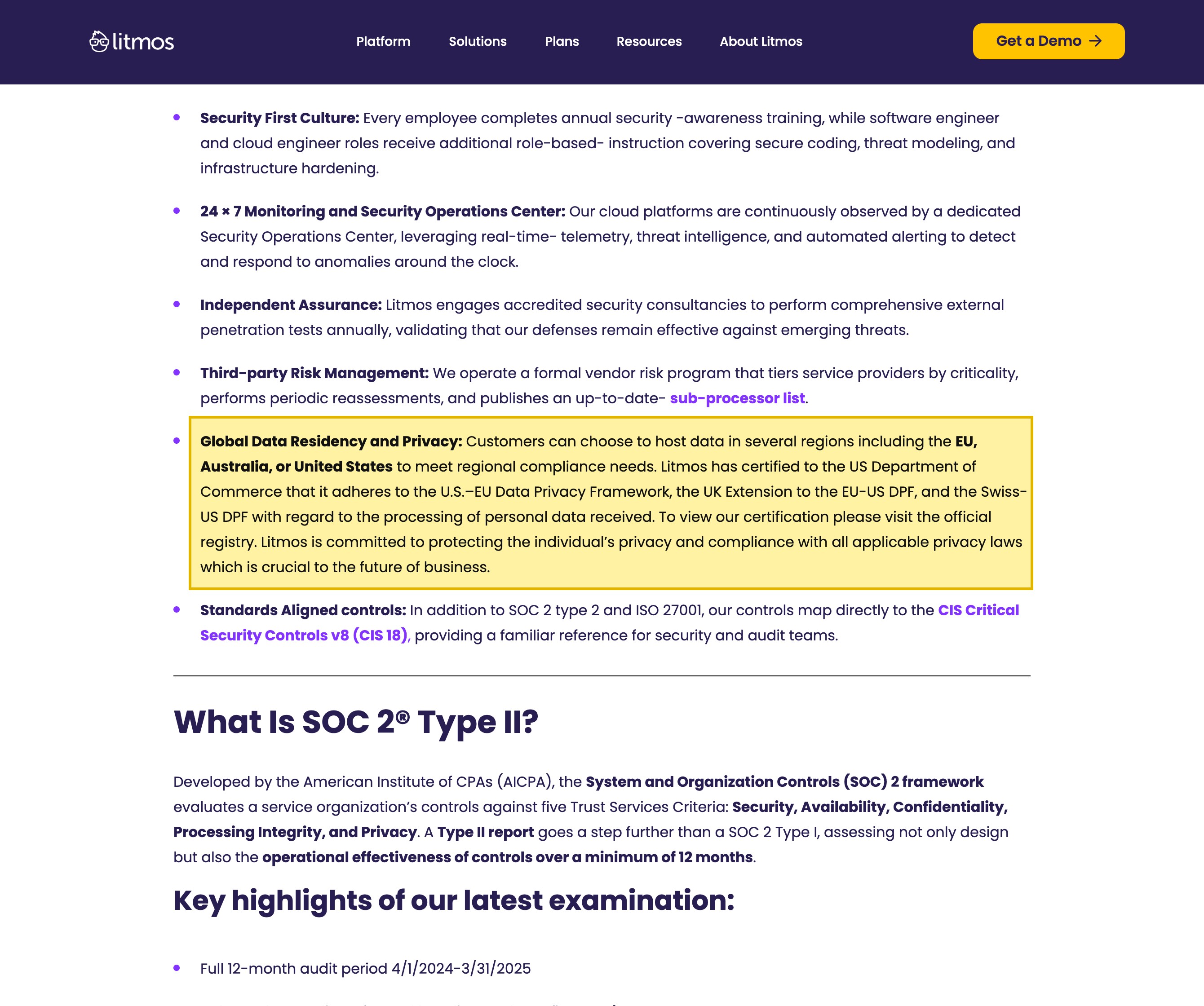
| Litmos names its hosting regions as the EU, Australia or United States - none in mainland China. On its Trust & Security page Litmos states: "Customers can choose to host data in several regions including the EU, Australia, or United States to meet regional compliance needs." No mainland-China region is offered, so a China employee's learning record is held offshore by design. | Litmos Trust & Security page (litmos.com), retrieved 2026-10-13 |
| Litmos processes the personal data it receives under US and EU frameworks. The same page states Litmos "has certified to the US Department of Commerce that it adheres to the U.S.-EU Data Privacy Framework, the UK Extension to the EU-US DPF, and the Swiss-US DPF with regard to the processing of personal data received" - an offshore, US/EU-centric data posture, with no mainland-China residency path. (Litmos has been independent of SAP since December 2022; confirm your tenant's region and contracting entity in writing.) | Litmos Trust & Security page (litmos.com), retrieved 2026-10-13 |
| Offshore workforce learning records are a PIPL cross-border transfer. Holding your China employees' identities, enrolments, assessment results and skills profiles outside the mainland engages the Personal Information Protection Law: the handler must give notice and obtain separate consent (Articles 13 and 23) and clear a transfer mechanism (Articles 38-40). PIPL Article 24 adds an opt-out where skills are scored or training is auto-assigned by automated processing. | PIPL - 21YunBox compliance reference, retrieved 2026-10-13 |
| A residency duty can require mainland storage. For a critical information infrastructure operator or a large-volume handler, personal information collected in China must be stored in the mainland (PIPL Article 40; Cybersecurity Law Article 39 (formerly Article 37)) - a duty an offshore-only Litmos tenant in the EU, Australia or US cannot satisfy. | China Cybersecurity Law - 21YunBox compliance reference, retrieved 2026-10-13 |
Sources verified by the 21YunBox compliance team on 2026-10-13.
Ask whether Litmos “works” in mainland China and the honest answer starts with your employees’ data, not with how fast a course video paints in Shanghai. Litmos — the corporate learning platform spun out of SAP as an independent company in December 2022 and now branded simply Litmos (you may still know it as SAP Litmos) — is a system of record for your workforce: who each learner is, the courses they are enrolled in, what they have completed, their quiz and assessment scores, and the skills and competencies mapped against them. Litmos runs that system as a hosted service from regions it names as the EU, Australia and the United States, with none inside mainland China. For the China-based people in it, that makes Litmos a cross-border transfer of employee personal information the moment it records them — and where the platform scores their skills or auto-assigns their training, a second question about automated decisions follows. Reachability is real, but it is the least of what you are deciding.
Litmos in China at a glance
| What decides it | In Litmos's own terms |
|---|---|
| Where it runs | Litmos's Trust & Security page says “Customers can choose to host data in several regions including the EU, Australia, or United States to meet regional compliance needs.” No region is inside mainland China. |
| What it holds | Learner identities, course enrolments, completion records, quiz and assessment results, and skills / competency profiles — often tied to manager and org relationships. That is a workforce personal-data system, not a video player. |
| Where that data sits | Offshore, in the EU, Australia or the US. Litmos states it “has certified to the US Department of Commerce that it adheres to the U.S.-EU Data Privacy Framework” for the personal data it receives. For your China employees that is a cross-border transfer PIPL governs. |
| Automated decisions | Where Litmos scores skills, ranks competencies or auto-recommends and assigns training, it is making automated decisions about employees — PIPL Article 24 gives each person a right not to be subject to a decision made solely by automated processing. |
| On your public portal | A China-facing learning or enrolment portal is a public site in the mainland; the ICP filing attaches to that site, not to Litmos. |
| Is it reachable? | Litmos is served from offshore, so whether the portal and course player render cleanly for mainland staff is a delivery question — separate from whether you are cleared to hold their data at all. |
Where Litmos runs - and that settles the first question
Litmos is a hosted SaaS learning platform, and on its own Trust & Security page it names where your data can live: “Customers can choose to host data in several regions including the EU, Australia, or United States to meet regional compliance needs.” There is no region inside mainland China — and Litmos adds that it “has certified to the US Department of Commerce that it adheres to the U.S.-EU Data Privacy Framework, the UK Extension to the EU-US DPF, and the Swiss-US DPF with regard to the processing of personal data received,” which places that personal data squarely under US and EU frameworks. So wherever your tenant sits, the learner records Litmos keeps for your China-based employees are held offshore. That single fact decides the first compliance question before reachability is ever measured: this is not about whether a lesson loads in Shanghai, but about workforce personal data leaving the country every time Litmos records it. (Note that Litmos became independent of SAP in December 2022, so SAP’s own data-center documentation does not govern where Litmos hosts; confirm your tenant’s region and contracting entity in writing rather than assuming an SAP footprint.)
Your China workforce’s learning records are a cross-border transfer
A corporate LMS exists to know your people, and Litmos is no exception: it holds each learner’s identity, their enrolments, the courses and modules they have completed, their quiz and assessment scores, and the skills and competencies mapped against them — frequently linked to their manager and place in the org. For your mainland employees, every one of those fields is personal information, and holding it in the EU, Australia or the US means moving it out of China. That engages the Personal Information Protection Law: as the handler — you, the employer, not Litmos — you must give notice and obtain separate consent (Articles 13 and 23), and clear one cross-border transfer mechanism (a CAC security assessment, the CAC standard contract, or certification) under Articles 38 to 40. If you are a critical information infrastructure operator or a large-volume handler, personal information collected in China must be stored in the mainland (PIPL Article 40; Cybersecurity Law Article 39 (formerly Article 37)) — a residency duty an offshore-only Litmos cannot satisfy. This is HCM-adjacent employee data, not “can the video stream,” and it is the spine of the question.
Skill scores and auto-assigned training are automated decisions
Modern learning platforms do not just store records; they act on them. Where Litmos scores an employee’s skills, ranks their competencies, or recommends and auto-assigns training based on their profile, it is making an automated decision about that person. PIPL Article 24 speaks to exactly this: individuals have the right to an explanation and the right not to be subject to a decision made solely through automated processing, including a way to opt out. A China workforce deployment that leans on automated skill-scoring or assignment has to honor those rights — a design question a reachability test never surfaces, because the SDK fires and the page loads whether or not the opt-out exists.
Why a reachability check misses all of this
It is tempting to “test” Litmos by opening the portal from a mainland connection and watching it load. But reachability answers the wrong question. Whether the course player paints quickly says nothing about where the learner records sit, whether you took separate consent for the cross-border transfer, whether a residency duty applies to your entity, or whether your automated skill-scoring honors an opt-out. Making an offshore LMS merely reachable leaves every one of those employee records exactly where it was — offshore. Keeping the regulated data in-country is what actually moves the compliance needle.
Map, localize, deliver - the compliant path
The way through is not a network trick; 21YunBox never uses or suggests circumvention of any kind. It is three deliberate steps:
- Map: inventory what your Litmos tenant holds (learner identities, enrolments, assessments, skills profiles, manager and org links), where it is hosted, the consent and residency basis you are relying on, and whether your skills-scoring or auto-assignment counts as automated decision-making.
- Localize and govern: keep the regulated employee learning data in-country — a China-resident or in-country-deployed learning footprint — with PIPL Article 13/23 notice and separate consent, a PIPL Article 24 opt-out honored for automated skills and training decisions, and data minimized to what the training actually needs.
- Deliver: ICP-file any China-facing learning or enrolment portal, and put compliant, in-country delivery in front of what you already run.
This is a risk map, not a verdict: whether you owe notice and consent, a transfer mechanism, in-country storage, an Article 24 opt-out, an ICP filing, or some combination depends on what you collect, how much of it, whose data it is, and your entity — worth settling with counsel before you roll Litmos out to a China workforce.
Where 21YunBox fits - a compliant overlay, not a migration
You keep running Litmos exactly as you do today. 21YunBox is a partner to the platform you already use, not a replacement for it: we add the piece a hosted, offshore LMS cannot — compliant, ICP-filed delivery from inside the mainland in front of your China-facing learning portal, plus the localization and data-residency advisory that keeps your employees’ learning records lawful where they need to be. No rebuild, no second LMS, and no move off Litmos. Our China team maps your PIPL cross-border, Article 24 and data-residency exposure against your entity and your data, then stands up the in-country delivery and compliant handling a lawful China presence needs, while Litmos stays the system of record it already is.
Get a compliance assessment ->
Related reading:
- How to get an ICP filing for China
- Cross-border data transfers under PIPL
- China’s Personal Information Protection Law