Does Docebo Work in China? Data Residency, ICP & Cross-Border Rules
Docebo is a corporate LMS holding China employees' identities, enrolments, completions, assessments and skills profiles. Its Learn platform runs on Amazon's global regions with no mainland-China region, so that workforce personal data sits offshore — a PIPL cross-border and data-residency question, not whether courses load.
Does Docebo work in China?
Reaching Docebo from China is not the question — where your China employees' learner records live is. Docebo hosts its Learn LMS on Amazon's global regions with no mainland-China data center, so the identities, enrolments, completion and assessment records and skills profiles of your China workforce sit offshore.
Held abroad, that employee personal information is a cross-border transfer under PIPL Articles 38–40, and for a CIIO or high-volume handler the Cybersecurity Law Article 39 (formerly Article 37) wants that data stored in the mainland. Where Docebo's AI scores skills or auto-assigns training, PIPL Article 24 adds automated-decision-making rights, including an opt-out.
Docebo's own "near-China CDN" speeds content delivery but, in its words, runs "without the complexities of in-country data replication" — so it does not bring the regulated learner data in-country. Keeping that data in-country does.
What Docebo's own documentation says about China
| Fact | Primary source |
|---|---|
| Docebo's current Service Descriptions list the core Learn LMS as “Global hosting and content delivery network (CDN) via Amazon” and name no mainland-China data center; Docebo Connect is “hosted on AWS Public Cloud with choice of region.” | Docebo — Service Descriptions (current as of January 2026; retrieved 2026-10-13) |
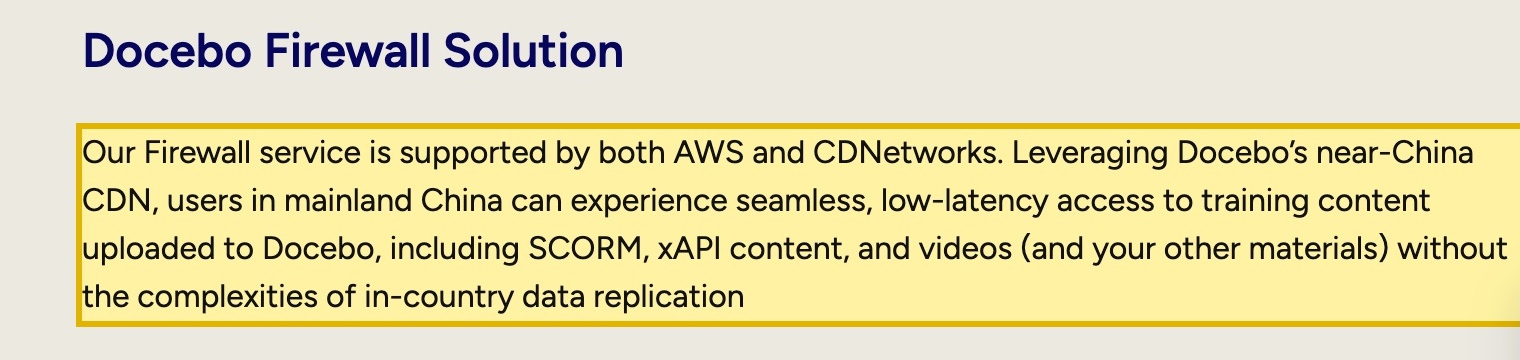
| Docebo's only mainland-China capability, the Firewall Solution, is a “near-China CDN” that gives users in mainland China low-latency access to training content “without the complexities of in-country data replication” — content delivery, not learner-data residency. | Docebo — Service Descriptions, Firewall Solution (retrieved 2026-10-13) |
| PIPL Articles 38–40 require a CAC security assessment, the CAC standard contract, or certification — plus Article 13/23 notice and separate consent — before personal information leaves China; China employees' learner records on an offshore tenant are such a transfer. | PIPL — cross-border transfer rules (21YunBox gov-doc summary) |
| For a CIIO or high-volume handler, Cybersecurity Law Article 39 (formerly Article 37) requires personal information generated in China to be stored in the mainland; PIPL Article 24 adds opt-out rights over automated skills and training decisions. | China Cybersecurity Law — data localization (21YunBox gov-doc summary) |
Sources verified by the 21YunBox compliance team on 2026-10-13.
For a company that trains staff in mainland China, “does Docebo work in China?” almost always gets answered the wrong way. Point a browser at your Docebo tenant and courses load; add Docebo’s China option and they load faster. None of that is the question that decides whether you can run Docebo for a China workforce. Docebo is a corporate learning platform, and a corporate learning platform is a workforce personal-data system: it holds the identities of your China employees, their course enrolments and completion records, quiz and assessment results, and — increasingly — AI-scored skills and competency profiles tied to their roles. The decision isn’t whether the course player renders. It’s whether that employee personal information may lawfully sit where Docebo keeps it, and whether the people it profiles have the rights China’s law gives them. Those are compliance questions, and a reachability check answers none of them.
Docebo’s own documentation settles the hosting half plainly. Its current Service Descriptions list the core Learn LMS as “Global hosting and content delivery network (CDN) via Amazon,” and name no mainland-China data center; Docebo Connect is “hosted on AWS Public Cloud with choice of region.” Docebo does offer a mainland-China capability — but read what it actually is. The Firewall Solution is described as a “near-China CDN” that gives users in mainland China low-latency access to training content “without the complexities of in-country data replication.” In Docebo’s own words, the China offering speeds up content delivery precisely by not moving the learner data in-country. So the employee learning records stay offshore, and the thing that reaches China is the content, not the regulated data.
Docebo in China at a glance
| What decides it | In Docebo's own terms — and China's law |
|---|---|
| What Docebo holds | A corporate LMS is a workforce personal-data system: China employees' identities and logins, course enrolments, completion records, quiz and assessment results, and AI-scored skills and competency profiles tied to roles and managers. This is HR-adjacent employee personal information, not "can the video stream." |
| Where it is hosted | Docebo's Service Descriptions list Learn as “Global hosting and content delivery network (CDN) via Amazon” with no mainland-China data center; Connect is “hosted on AWS Public Cloud with choice of region.” Your China learners' records sit in an offshore region. |
| The near-China CDN — the distinctive second half | Docebo's only China capability, the Firewall Solution, is a “near-China CDN” that delivers training content to mainland users “without the complexities of in-country data replication.” It is content delivery, not data residency — the learner records never come in-country. |
| Crossing the border | Holding China employees' learner records on Docebo's offshore tenant is a cross-border transfer under PIPL Articles 38–40 (CAC security assessment, standard contract, or certification), with Article 13/23 notice and separate consent. For a CIIO or high-volume handler, Cybersecurity Law Article 39 (formerly Article 37) wants that data stored in the mainland. |
| Automated skills & learning decisions | Where Docebo's AI scores skills, builds individualized learning paths, or auto-assigns training, it is making automated decisions about employees. PIPL Article 24 gives those employees transparency, fairness and an opt-out from decisions made solely by automated processing. |
| Reachability is not the axis | Docebo loads in China, and its near-China CDN makes it load fast — so “does it work?” is blind here. What decides it is where the learner records live, the consent and transfer basis, the Article 24 opt-out, and whether the China-facing portal is filed. 21YunBox keeps the regulated data in-country and ICP-files the surface — the 21YunBox Optimizer — in front of the Docebo setup you already run. |
What Docebo holds — and why it is employee personal information
Start with what the platform actually stores. To run corporate training, Docebo keeps a record of each learner: who they are, what they were enrolled in, what they completed, how they scored on quizzes and assessments, and — in the Skills part of the platform — a profile of the competencies they are deemed to have or to need. For your China workforce, every one of those records is personal information about an identifiable employee, and much of it is HR-adjacent: it maps to roles, to managers, and to an individual’s development over time. That is a different kind of data from a static course video. When it lives in an offshore tenant, it is your China employees’ personal information sitting abroad — which is exactly what China’s cross-border and residency rules are about.
So the useful question is not whether Docebo answers from China. It is where the learner records are kept and who decides about the people in them. Docebo’s own documentation answers the first; its AI features raise the second.
The near-China CDN speeds content — it does not localize the data
Here is the part a reachability check cannot reach, and it is the strongest evidence in Docebo’s own words. Docebo sells a mainland-China capability, the Firewall Solution, and it is easy to mistake it for a residency answer. It is not. Docebo describes it as a “near-China CDN” that lets “users in mainland China … experience seamless, low-latency access to training content uploaded to Docebo, including SCORM, xAPI content, and videos … without the complexities of in-country data replication.” Read the last clause carefully: the feature works by not replicating data in-country. It accelerates the delivery of course content to people in China; it does not bring the learner identities, enrolments, completion records, assessments or skills profiles into the mainland.
That is the whole trap. A speed or reachability test points at the near-China CDN, sees fast access from Shanghai, and concludes Docebo “works in China.” It is measuring the content path. The regulated data — the workforce personal information — is still in Docebo’s offshore AWS region, untouched by the CDN. Making the content reachable is not the answer; keeping the employee learning records in-country is. 21YunBox never uses or suggests circumvention of any kind; the lawful path is to keep the regulated data where China’s law says it belongs, not to route around anything.
Crossing the border, consent, and automated skills decisions
Two China-law duties follow from offshore hosting, and a third from Docebo’s AI.
First, the border crossing. Holding your China employees’ learner records on Docebo’s offshore tenant is a cross-border transfer of personal information under PIPL Articles 38–40, which require one of the law’s transfer mechanisms — a CAC security assessment, the CAC standard contract, or certification — before the data may leave the country. PIPL Articles 13 and 23 sit on top: you need a lawful basis to process the data and specific, separate consent to transfer it to a third party abroad. A bundled “agree to the HR system” click does not satisfy that.
Second, residency for the regulated handlers. For a critical information infrastructure operator — or, in practice, a high-volume handler caught by the thresholds — Cybersecurity Law Article 39 (formerly Article 37 — the 2025 Cybersecurity Law amendment, in force January 1, 2026, renumbered the data-localization article from 37 to 39, its substance unchanged) requires personal information generated in China to be stored in the mainland. An offshore-only learning tenant is squarely in tension with that.
Third, the automated decisions. Docebo markets AI that suggests and can auto-assign skills, labels content with competencies, and assembles individualized learning paths from each learner’s activity to narrow skill gaps. Where those features are switched on for a China workforce, the platform is making automated decisions about employees — and PIPL Article 24 gives each individual the right to transparency and fairness in that processing, and the right not to be subject to a decision made solely by automated means, i.e. a meaningful opt-out. How far this bites depends on how much of the automation is configured to act rather than merely suggest, which you should confirm against your tenant’s settings — but a China deployment has to be able to honor the opt-out.
This is a risk map, not a verdict that Docebo is “blocked” or “illegal” in China — it is neither. Which duties bite your case turns on your entity, your role under Chinese law, your data volumes, and which Docebo features you enable. Settle the specifics with counsel before your China training program depends on them.
Why a “does it load?” check misses all of this
Docebo is not a platform that fails to open in China. It loads, and its near-China CDN makes the content load quickly. That is exactly why a reachability or speed test is the wrong instrument. “Did the course player render in Shanghai?” tells you nothing about whether your China employees’ learner records just sat in an offshore region, whether you had the Article 13/23 separate consent to transfer them, whether an Article 39 (formerly Article 37) residency duty applies to you, or whether employees profiled by Docebo’s skills AI can exercise their Article 24 opt-out. The exposure is quiet and durable: it lives in where the data rests and the consent and rights around it, not in a latency number.
The lawful path — map, localize, deliver
There is a compliant way to run corporate learning for a China audience, and it sits in front of the Docebo setup your team already uses — no rebuild, no second stack, no migration off Docebo.
First, map: our China team inventories exactly what your Docebo deployment holds — which China employees and learners have records, which fields (identities, enrolments, completions, assessments, skills and competency profiles, manager/org links) are stored, where the tenant is hosted, the consent and transfer basis each flow relies on, and whether skills-scoring or auto-assignment is configured as automated decision-making. We build the technical picture; the legal conclusions are settled with counsel.
Then localize / govern: wherever your China workforce’s learning data is involved, the compliant pattern is to keep the regulated employee-learning records in-country — on a China-resident or in-country-deployed learning surface — rather than rely on an offshore tenant made merely reachable. We help you put the Article 13/23 notice and separate consent in front of the processing and transfer, honor the Article 24 opt-out wherever skills or training decisions are automated, and minimize what is held. Localize means keeping the data in-country; it never means a route that quietly ships personal information across the border.
Then deliver: any China-facing learning portal you publish to mainland users is an internet information service, so it carries an ICP filing (备案) duty bound to a mainland hosting resource and needs compliant, in-country delivery. 21YunBox stands that up — the 21YunBox Optimizer — in front of what you already run. Making Docebo’s content merely reach China is not the answer — the near-China CDN already does that, by Docebo’s own account without in-country data replication; keeping the regulated learner data in-country, on a consented, Article 24-respecting and (where needed) filed path, is. 21YunBox is a compliance overlay and partner to your Docebo deployment, not a competitor to it.
Related reading:
- China’s Personal Information Protection Law (PIPL)
- Cross-border data transfers under PIPL
- China’s Cybersecurity Law
- How to get an ICP filing for China