Does Thinkific Work in China? Data Residency, ICP & Cross-Border Rules
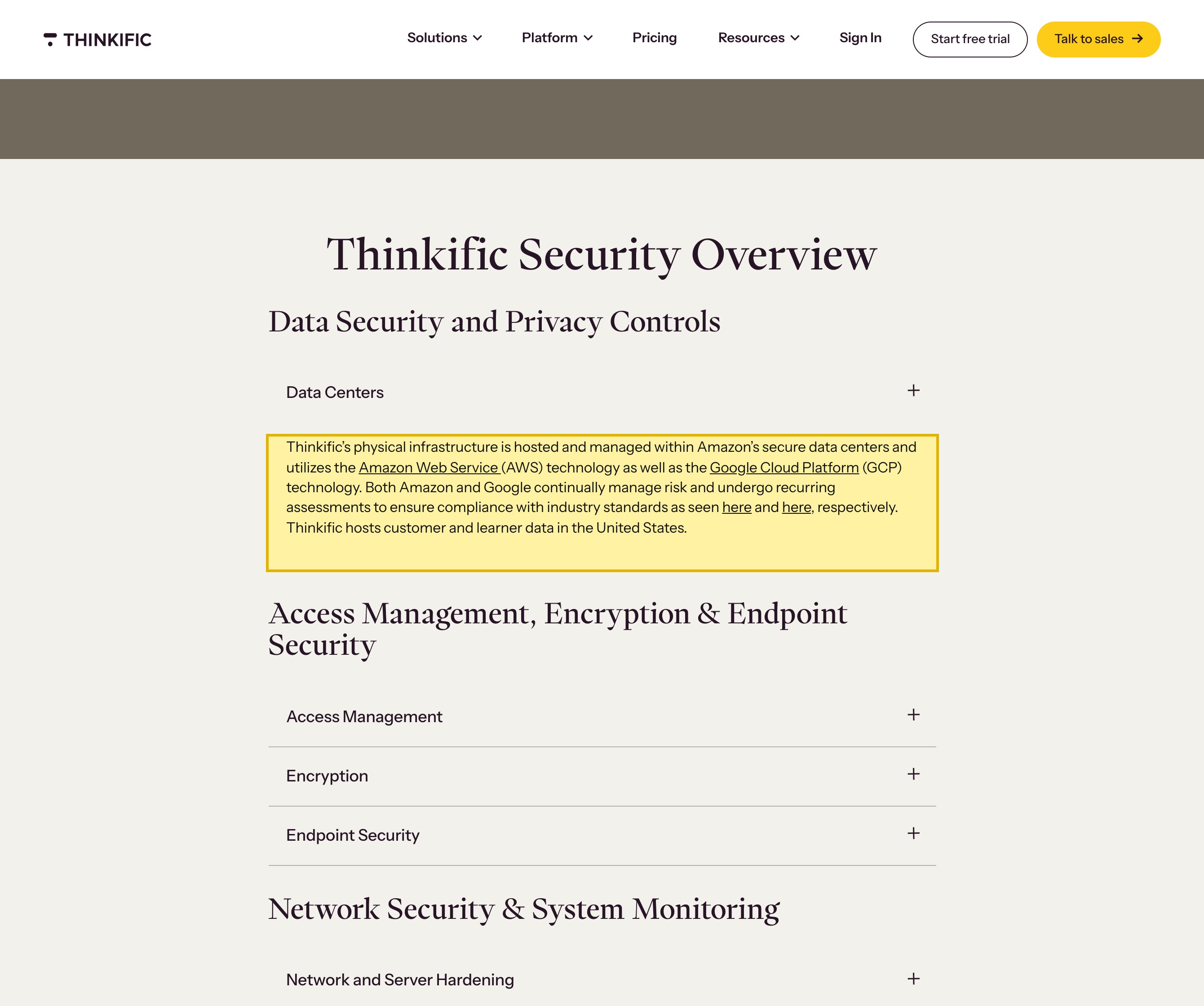
Thinkific's own security page says it hosts customer and learner data in the United States on AWS and Google Cloud, with no mainland-China region. Run a China-facing course storefront on it and your learners' identities, progress and order data sit offshore — a PIPL cross-border transfer — while a site that sells courses to China learners still needs ICP filing and a licensed in-China payment channel. That is the door a reachability check never sees.
Does Thinkific work in China?
A Thinkific course site will load in China — but "does it work" is the wrong question. Thinkific's own Security page says it "hosts customer and learner data in the United States," with no mainland-China region, so whether your storefront is compliant turns on where your learners' records rest and how the sales are taken, not on whether the player streams.
Run a China-facing course storefront on Thinkific and your learners' identities, enrollments, progress and — for paid courses — order and payment-adjacent data sit offshore: a cross-border transfer PIPL governs (Articles 38–40, plus Article 13/23 notice and separate consent). And the selling surface itself opens two more doors a speed test never sees — a public course site needs an ICP filing bound to mainland hosting, and taking money from China learners needs a licensed in-China payment channel, which an offshore card flow is not.
This is a risk map, not a verdict — which obligations bite depends on your entity, your learner data and who buys your courses. Our China team can map your exposure with you →
What Thinkific's own documentation says about China
| Fact | Primary source |
|---|---|
| Thinkific hosts learner and customer data in the United States, on AWS and Google Cloud. Thinkific's Security page states plainly, "Thinkific hosts customer and learner data in the United States," and describes its "physical infrastructure" as "hosted and managed within Amazon's secure data centers" using "the Amazon Web Service (AWS) technology as well as the Google Cloud Platform (GCP) technology." No mainland-China region is named, and there is none to select — so the China learner and order records come to rest offshore. | Thinkific — Security (thinkific.com/security), retrieved 2026-10-13 |
| Thinkific's own sub-processor list places production systems in the US — and card payments on an offshore processor. Thinkific's sub-processor disclosure states its "production systems for the Thinkific Platform are located in co-location facilities in the United States," with Amazon Web Services and Google both listed as US storage providers. For payments, the Security page says Thinkific "does not access or store any credit card information" and has "partnered with Stripe to securely handle credit card information" — an offshore card flow, not a China-licensed payment channel. | Thinkific — Sub-processors & Security (thinkific.com), retrieved 2026-10-13 |
| China learners' records held offshore are a cross-border transfer under PIPL. A Thinkific storefront's learner identities, enrollments, progress, assessment results and order data are personal information under China's PIPL. Hosting them in the United States is a cross-border transfer needing notice, separate consent and a transfer mechanism (PIPL Articles 13/23 and 38–40), with in-country storage required of high-volume handlers and CIIOs (Cybersecurity Law Article 39 (formerly Article 37)). | PIPL Articles 13/23 & 38–40; Cybersecurity Law Article 39 (formerly Article 37); grounded in Thinkific's US-hosting documentation, retrieved 2026-10-13 |
| A China-facing course storefront that sells needs an ICP filing and a licensed in-China payment channel. A course site served to the mainland public is an internet information service, so it needs an ICP filing (备案) bound to licensed hosting physically in the mainland — which an offshore Thinkific site has nothing to attach to — and a storefront that takes payment from China learners must route the money through a licensed in-China channel, not an offshore card flow. | State Council Order No. 292 and MIIT Order No. 33 (ICP filing); grounded in Thinkific's offshore-hosting and Stripe payment documentation, retrieved 2026-10-13 |
Sources verified by the 21YunBox compliance team on 2026-10-13.
For a creator or business running a Thinkific course storefront for learners in mainland China, the deciding question is not whether the course player loads quickly from Shanghai — it usually will. The question is what your Thinkific site holds about the people who sign up and buy, and where those records are allowed to come to rest. A Thinkific site is a branded course storefront: it keeps each learner’s identity, their enrollments, their progress and completion records, their quiz and assessment results, and — for paid courses — their orders and the payment-adjacent data that goes with a sale. That is a personal-data system wrapped around a commercial transaction, not a video stream. So “does Thinkific work in China?” is a compliance-risk question first: whose learner and order data is leaving the country, on what consent, whether the storefront that takes those sales is ICP-filed, and whether the money runs through a channel China licenses — not how fast a lesson plays.
Thinkific in China at a glance
| What decides it | In Thinkific's own terms — and China's law |
|---|---|
| What it holds | Your Thinkific site keeps, for each China learner, their identity, enrollments, progress and completion records, quiz and assessment results, and — for paid courses — their orders and payment-adjacent data. That is a personal-data system around a commercial sale, not a content stream. |
| Where it rests | Thinkific is offshore cloud SaaS. Its own Security page states plainly: “Thinkific hosts customer and learner data in the United States,” on AWS and Google Cloud, and its sub-processor list places production systems in US co-location facilities. No mainland-China region is named, and there is none to select, so the China learner and order records come to rest abroad. |
| Cross-border personal information | Sending a China learner's identity, enrollment, progress, assessment and order data to offshore servers is a cross-border transfer under PIPL Articles 38–40, on top of the Article 13/23 notice-and-separate-consent. For a critical information infrastructure operator or a high-volume handler, Cybersecurity Law Article 39 (formerly Article 37) requires personal information generated in China to be stored in the mainland. |
| A China-facing storefront that sells | A course site served to the mainland public is an internet information service, so it needs an ICP filing (ICP 备案) bound to licensed hosting physically in the mainland — which an offshore Thinkific site has nothing to attach to. And a site that sells to China learners must run the money through a licensed in-China payment channel; Thinkific's own page routes card payments through an offshore processor, not a China-licensed flow. |
| Reachable is not the axis | A Thinkific course page will usually load in China, so a reachability check reports that it “works.” That is operational, not the compliance question. What decides it is where the learner and order data lives, on what consent, whether the selling storefront is ICP-filed, and whether payment runs through a licensed channel. 21YunBox helps you keep the regulated data in-country and deliver an ICP-filed, licensed-payment storefront — the 21YunBox Optimizer — in front of what you already run. |
What the storefront actually holds — a commercial personal-data system
The trap is to picture a course platform as a library: videos that simply need to download fast. A Thinkific storefront is the opposite. To run a branded course business it must know who each learner is, enroll them, track what they started and finished, store their quiz and assessment scores, and — for every paid course — record the order and the payment-adjacent details that go with a sale. Every one of those records about a person in mainland China is that person’s personal information, and the order and payment data carries the extra weight that comes with handling money.
That is why the residency fact matters so much. Thinkific’s own Security page states it in one sentence — “Thinkific hosts customer and learner data in the United States” — and describes its “physical infrastructure” as “hosted and managed within Amazon’s secure data centers” using “the Amazon Web Service (AWS) technology as well as the Google Cloud Platform (GCP) technology.” Thinkific’s sub-processor disclosure adds that its “production systems for the Thinkific Platform are located in co-location facilities in the United States,” with AWS and Google both listed as US storage providers. Nowhere in Thinkific’s own hosting documentation is a mainland-China data region named, and there is none to choose. So the learner identities, progress history and order records your China customers generate come to rest on offshore servers.
The doors: cross-border transfer, residency, consent, ICP, and licensed payment
The first door is the cross-border transfer. The identities, enrollments, progress and completion records, assessment results and order data Thinkific holds about people in China are personal information under China’s Personal Information Protection Law, and moving them to an offshore Thinkific region is a cross-border transfer (数据出境). The duty lands on you, the business running the storefront, not on Thinkific: Articles 13 and 23 require notice and a lawful basis, with a separate, specific consent to send the data abroad, and Articles 38–40 require a transfer mechanism — a CAC security assessment, the CAC standard contract, or certification. And for a critical information infrastructure operator or a high-volume handler, the Cybersecurity Law’s Article 39 (formerly Article 37 — the 2025 Cybersecurity Law amendment, in force January 1, 2026, renumbered the data-localization article from 37 to 39, its substance unchanged) requires personal information generated in China to be stored in the mainland, which an offshore course platform cannot satisfy.
The second door is the one that separates a creator storefront from an internal training tool, and it is where a reachability check is most blind. A Thinkific site served to the mainland public is a public internet information service, so it carries an ICP filing (备案) obligation bound to licensed hosting physically inside the mainland — and an offshore-hosted storefront has no mainland footing to attach that filing to. On top of that, a storefront that sells courses to China learners is taking payment from the mainland public, and that money has to move through a licensed in-China payment channel. Thinkific’s own Security page says it “partnered with Stripe to securely handle credit card information” — an offshore card flow, not a China-licensed payment channel. A China-facing commercial course site cannot lawfully collect payment on an unlicensed offshore flow, and no speed test can see that door.
This is a risk map, not a verdict that Thinkific is “blocked” or “illegal” in China. Which duties bite your case turns on your entity, which learners buy and take your courses, what the storefront is configured to collect, your role under Chinese law, your data volumes, and whether you are a critical information infrastructure operator — worth settling the specifics with counsel before your China course business depends on it.
A reachability check never sees this
Thinkific is not the kind of service that refuses to load in China. That is exactly why a reachability check is the wrong instrument. Even with every lesson playing cleanly and every checkout page rendering, running a Thinkific storefront for China learners still places their identities, enrollments, progress and order records outside the country; it still relies on a consent and transfer basis that China’s law requires to be notified and, for the cross-border move, separate and specific; the public selling surface still carries an ICP filing obligation bound to mainland hosting; and the payments still run on an offshore flow where the mainland wants a licensed channel. A reachability test answers “did the course load?” — it is blind to whose learner and order data just crossed the border, to whether that person was given the notice and consent the law demands, to whether the storefront that took the sale is ICP-filed, and to whether the money moved through a licensed channel. Where the data lives, on what consent, under which filing, and through which payment path — not how fast a lesson plays — is what China’s law responds to.
The lawful path — map, localize, deliver
There is a compliant way to run a course storefront for China learners, and it sits in front of the Thinkific platform you already run — no rebuild, no migration off Thinkific.
First, map: our China team inventories what your Thinkific site actually holds — the learner identities, enrollments, progress and completion records, quiz results, and the order and payment-adjacent data from paid courses — where that data is hosted (an offshore Thinkific region in the United States, with no mainland-China option), the consent and residency basis each relies on, and whether you run a China-facing storefront that needs an ICP filing and a licensed in-China payment channel. We build the technical picture; the legal conclusions are settled with counsel.
Then localize/govern: we help you keep the regulated learner and order data — the identities, enrollments, progress, assessments and payment-adjacent records of your China learners — on a lawful in-country path, obtain the Article 13/23 notice and the separate, specific consent a cross-border transfer requires, ICP-file the China-facing storefront, route payment through a licensed in-China channel, and minimize what crosses the border. Localize means keeping the data in-country — never a route that quietly ships learner or order data across the border, and never any form of circumvention.
Then deliver: ICP-filed, in-country delivery with a licensed payment path in front of the course storefront you already run, so the regulated records and the sales sit on a lawful footing rather than defaulting offshore. 21YunBox stands that up — the 21YunBox Optimizer — around the stack you already use. 21YunBox never uses or suggests circumvention of any kind — we keep in-country what the law says must stay, deliver the rest compliantly from inside the mainland, and never move personal information across the border by stealth. Making an offshore course platform merely reachable is not the answer — the learner and order records are still offshore, the consent is still missing, and the selling storefront still needs ICP filing and a licensed payment channel; keeping that regulated data in-country and filing and licensing the China-facing site is. 21YunBox is a compliance overlay and partner to Thinkific, not a competitor to it.
Related reading:
- Cross-border data transfers under PIPL
- China’s Personal Information Protection Law (PIPL)
- China’s Cybersecurity Law
- How to get an ICP filing for China