Does LinkedIn Learning Work in China? Data Residency, ICP & Cross-Border Rules
LinkedIn Learning (Microsoft/LinkedIn) is US-hosted enterprise learning with no mainland-China region — by LinkedIn's own Data Processing Agreement its data centres are in the United States. Your China employees' learner identities, course activity and completion records sit offshore under PIPL's cross-border rules, and its profile-based course recommendations add a PIPL Article 24 automated-decision duty.
Does LinkedIn Learning work in China?
Not as an offshore service. LinkedIn Learning (Microsoft/LinkedIn) is enterprise learning hosted in US data centres with no mainland-China region, so your China employees' learner identities, course activity and completion records — personal information tied to their LinkedIn profile — sit offshore.
Held abroad, that workforce data is a cross-border transfer under PIPL Articles 38–40 (notice, a separate consent, and a transfer mechanism), and for a critical information infrastructure operator or high-volume handler the Cybersecurity Law's Article 39 (formerly Article 37) wants it stored in the mainland. Because LinkedIn Learning also personalizes and recommends courses from the learner's LinkedIn profile and activity, that is automated decision-making under PIPL Article 24, which gives each employee a right to opt out.
The fix is not to make the offshore platform load faster — the learner records are still abroad. 21YunBox maps your residency, consent and automated-decision exposure, helps keep the regulated employee-learning data in-country on a consented, ICP-filed footing, and delivers any China-facing learning portal in-country in front of what you already run — never through circumvention of any kind. Confirm the specifics with counsel.
What LinkedIn Learning's own documentation says about China
| Fact | Primary source |
|---|---|
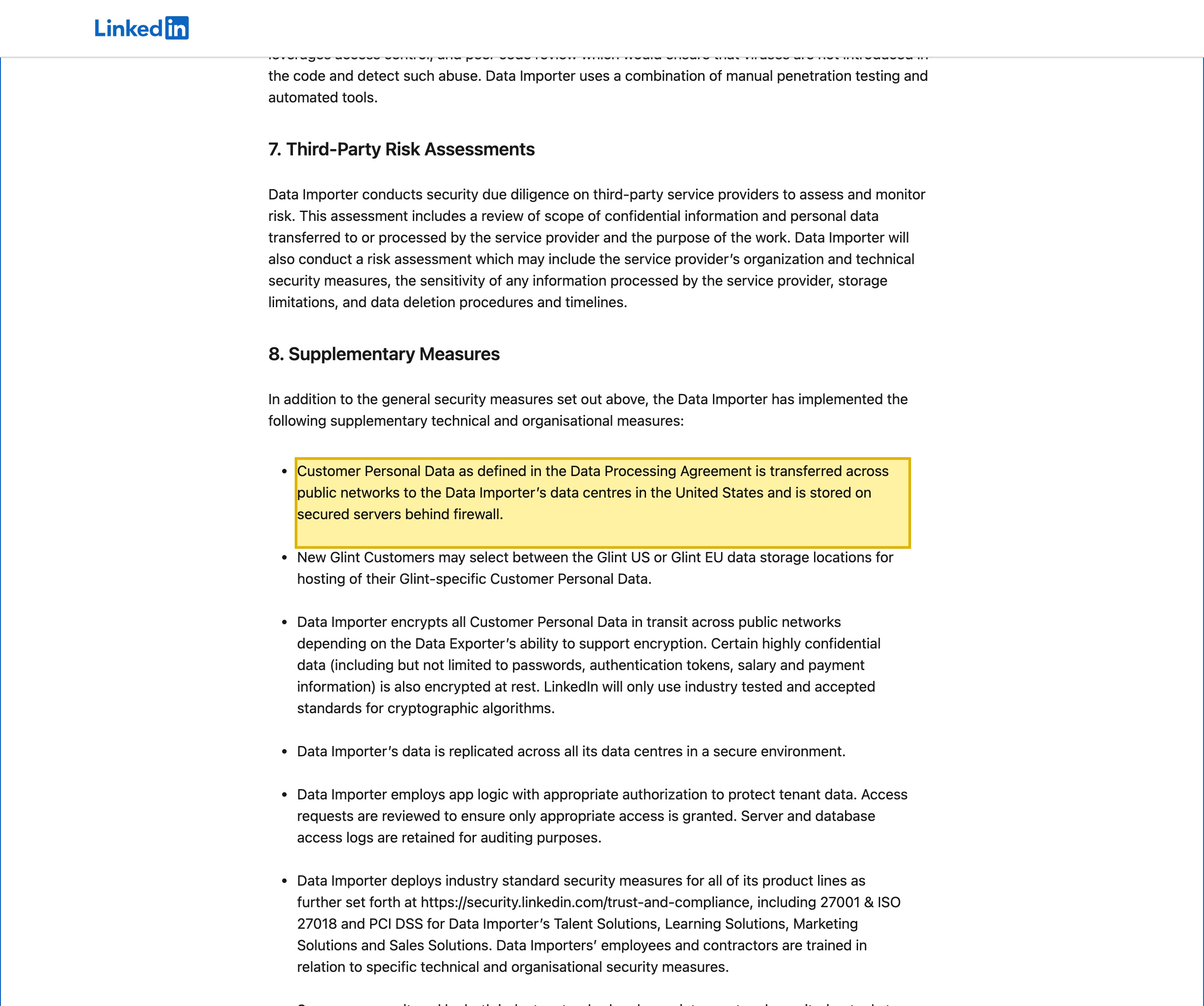
| LinkedIn's enterprise data centres — for the services it sells to organizations, which include LinkedIn Learning Solutions — are in the United States. Its Data Processing Agreement (Schedule D, “Supplementary Measures”) states that Customer Personal Data “is transferred across public networks to the Data Importer's data centres in the United States and is stored on secured servers behind firewall.” No mainland-China hosting location is named; new Glint customers may select only “the Glint US or Glint EU data storage locations.” | LinkedIn Data Processing Agreement, dated December 12, 2022, Schedule D §8 (linkedin.com/legal/l/dpa), retrieved 2026-10-13 |
| Because LinkedIn Learning ties each learner to their LinkedIn identity, the learner's data follows LinkedIn's global privacy regime — which stores and processes it offshore. LinkedIn's Privacy Policy (§5.2, “Cross-Border Data Transfers”) states: “We store and use your data outside your country,” and “We process data both inside and outside of the United States.” It names no mainland-China storage location. | LinkedIn Privacy Policy, §5.2 “Cross-Border Data Transfers” (linkedin.com/legal/privacy-policy), retrieved 2026-10-13 |
| Sending your China employees' learner records offshore is a cross-border transfer of personal information. Moving the identities, course activity and completion records of learners in mainland China to a US-hosted platform triggers PIPL Articles 38–40 — notice, a separate consent (Articles 13 and 23), and one transfer mechanism: a CAC security assessment, the CAC standard contract, or certification. | China's cross-border data transfer rules under PIPL (Articles 38–40) — 21YunBox compliance summary, retrieved 2026-10-13 |
| A CIIO or high-volume handler must store China-collected personal information in the mainland, and automated learning decisions carry extra duties. The Cybersecurity Law's Article 39 (formerly Article 37, renumbered by the 2025 amendment in force January 1, 2026) requires in-country storage an offshore LinkedIn Learning region cannot meet; and PIPL Article 24 gives employees a right not to be subject to decisions made solely by automated processing, such as profile-based skills and course recommendations. | China Cybersecurity Law Article 39 (formerly Article 37); PIPL Article 24 — 21YunBox compliance summary, retrieved 2026-10-13 |
Sources verified by the 21YunBox compliance team on 2026-10-13.
For an enterprise running employee training through LinkedIn Learning into mainland China, the decision is not a performance benchmark — it is a question about where your workforce’s personal data lives. LinkedIn Learning is Microsoft and LinkedIn’s corporate learning service, and it is not something you host: LinkedIn hosts it for you, and it ties every learner to their LinkedIn identity. That means the service holds a workforce personal-data system — each China employee’s identity, the courses they enroll in, their activity and completion records, assessment results, and the skills and interests tied to their LinkedIn profile. By LinkedIn’s own enterprise Data Processing Agreement, the data for the services it sells to organizations is transferred to data centres in the United States; none of it is in mainland China. That single fact sets a cross-border-data floor under everything you do — and it sits next to a second question a speed test never asks: LinkedIn Learning personalizes and recommends training from that profile, which is an automated decision about an employee. LinkedIn Learning is an excellent platform, and nothing here asks you to leave it; this is about the China-residency and compliance layer it was never built to provide. 21YunBox never uses or suggests circumvention of any kind.
LinkedIn Learning in China at a glance
| What decides it | In LinkedIn's own words — and China's own law |
|---|---|
| What it is | Enterprise learning (LMS / LXP) from Microsoft and LinkedIn. It holds your employees' learner identities, enrolments, activity and completion records, assessment results, and the skills and interests tied to their LinkedIn profile — LinkedIn hosts all of it for you; you do not host it. |
| A mainland-China region? | No. LinkedIn's enterprise Data Processing Agreement places its data centres in the United States, and its Privacy Policy says your data is stored and used “outside your country” and processed “both inside and outside of the United States.” No mainland-China hosting location is named; new Glint customers may choose only US or EU storage. |
| Workforce PII residency (the floor) | The learner identities, course activity, completion and assessment records of your China employees are personal information. Held offshore they are a cross-border transfer under PIPL — notice, a separate consent, and a transfer mechanism (Articles 38–40; consent in Articles 13 and 23). CIIOs and high-volume handlers must store that data in-country (PIPL Article 40; Cybersecurity Law Article 39 (formerly Article 37)). |
| Automated learning decisions | Profile-based course recommendations, skills suggestions and auto-assigned training are automated decision-making about employees. PIPL Article 24 requires transparency and fairness and gives each individual a right not to be subject to a decision made solely by automated processing — including an opt-out a China workforce deployment must honor. |
| Tied to the LinkedIn identity | A learner's LinkedIn Learning activity follows their LinkedIn profile, governed by LinkedIn's global privacy regime. In 2021 LinkedIn announced it was sunsetting its localized consumer LinkedIn in mainland China; LinkedIn Learning is a separate enterprise service, still hosted offshore. |
| A China-facing learning portal | Any China-facing learning site or sign-in landing you stand up for employees is a public internet information service in its own right — it needs an ICP filing (备案) on mainland hosting held by a mainland legal entity. Offshore SaaS gives a filing nothing to attach to. |
No mainland region — your employees’ learner records sit offshore
LinkedIn Learning is not something you host; LinkedIn hosts it for you, and LinkedIn publishes where. Its enterprise Data Processing Agreement (Schedule D, “Supplementary Measures”) is explicit: the Customer Personal Data you provide “is transferred across public networks to the Data Importer’s data centres in the United States and is stored on secured servers behind firewall.” The only alternative it offers is for its Glint product, where “New Glint Customers may select between the Glint US or Glint EU data storage locations” — US or EU, never mainland China. LinkedIn’s own Privacy Policy carries the same geography for the individual learner: “We store and use your data outside your country,” and “We process data both inside and outside of the United States.” Mainland China does not appear as a storage location anywhere.
That matters because of what LinkedIn Learning holds. A corporate learning platform is a workforce personal-information store: each learner’s identity, the courses they take, their progress and completion history, their assessment and quiz results, and the skills and interests inferred from their LinkedIn profile all flow into LinkedIn and come to rest in those US data centres. For your mainland-China employees, that data is offshore the moment it is collected — which turns the China question into a legal one before it is ever a performance one. This is HCM-adjacent employee data, not “can the video stream.”
Profile-tied learning is automated decision-making
Here is the half a speed test never sees. LinkedIn Learning does not just store courses; it personalizes them. It recommends training, surfaces skills, and lets administrators auto-assign learning paths — all computed from the learner’s LinkedIn profile, role, skills and activity. When a platform ranks a person’s competencies or decides what training to put in front of them, it is making an automated decision about an employee, and China’s Personal Information Protection Law treats that specifically. PIPL Article 24 requires transparency and fairness in automated decision-making and gives the individual rights — including the right not to be subject to a decision made solely through automated processing, and a way to opt out. A China workforce deployment has to be able to honor that, which an offshore learning engine was never built to do.
The data at the border: PIPL consent and cross-border rules
Every China employee you enroll hands over personal information — an identity, a learning history, assessment results, an inferred skills profile — and because LinkedIn Learning stores it only in offshore regions, it crosses the border the moment it is collected. China’s cross-border data transfer rules treat that as a cross-border transfer, and the handler — you, the employer, not LinkedIn — must give notice, obtain a separate consent (not a bundled, take-it-or-leave-it consent), and clear one transfer mechanism: a CAC security assessment, the CAC standard contract, or certification (PIPL Articles 38–40, with the consent duty in Articles 13 and 23).
If you are a critical information infrastructure operator, or you process personal information above the regulated volumes, that employee data has to be stored inside the mainland in the first place (PIPL Article 40; Cybersecurity Law Article 39 (formerly Article 37, renumbered by the 2025 amendment in force January 1, 2026)) — an in-country storage duty no US region can satisfy.
Any China-facing learning portal still needs an ICP filing
LinkedIn Learning is a hosted platform, not your website — but the moment you stand up a public surface for your mainland workforce (a China-facing learning portal, a training landing page, a single-sign-on gateway for employees), that surface is a public internet information service in its own right. It needs an ICP filing (备案) attached to a hosting resource inside the mainland, held by a mainland legal entity. Offshore SaaS gives a filing nothing to attach to; being reachable from China is a network fact, while being cleared to publish there is a licensing one.
Why a reachability check misses this
This is why a speed test or an uptime check answers the wrong question. A probe can tell you a course page paints for a learner in Shanghai; it cannot tell you that your employees’ learner records just crossed the border without a lawful basis, that the separate consent these transfers require was never obtained, that in-country storage may be owed, that any China-facing learning portal is unfiled, or that profile-based course recommendations are automated decisions your workforce can opt out of. The things that decide whether you may operate live in filings, consents, transfer mechanisms and the PIPL Article 24 opt-out — not in milliseconds. Making an offshore platform merely load faster changes none of them, and 21YunBox never uses or suggests circumvention of any kind.
The lawful path — map, localize, deliver
Map. We inventory what your LinkedIn Learning setup actually holds — learner identities, enrolments, activity and completion records, assessment results, and the skills profiles tied to each LinkedIn identity — where each sits today, the consent and residency basis for every flow out of China, whether skills-scoring and auto-assignment are automated decision-making, and the ICP status of any China-facing portal.
Localize and govern. We keep the regulated China employee-learning data on a China-resident, in-country-deployed footing; stand up the Article 13/23 notice and the separate consent these transfers require; honor the PIPL Article 24 opt-out for automated skills and learning decisions; and minimize what is collected — never through circumvention of any kind.
Deliver. We ICP-file the China-facing learning portal and serve it in-country with the 21YunBox Optimizer, set in front of the stack you already run — no rebuild, no re-platform, no second codebase.
The rule underneath all three: making an offshore platform merely reachable from China is not the answer, because the employees’ learner records are still offshore, the consent is still missing, any portal is still unfiled, and the automated-decision opt-out is still unhonored. Keeping the regulated employee-learning data in-country, on a consented and (where needed) ICP-filed path, is.
Whether you owe in-country storage, a separate consent, an ICP filing, an Article 24 opt-out, or all of them depends on how much employee data you hold, your role, and which workforce you serve — so settle it with counsel before you build. Tell us your China headcount and your learning stack, and we’ll map the path and deliver any China-facing portal in-country. Reach out for a compliance assessment and a quote.
Related reading:
- Cross-border data transfers under PIPL
- China’s Personal Information Protection Law (PIPL)
- China’s Cybersecurity Law — data localization (Article 39, formerly Article 37)
- What is the China ICP license, and how do you get one?