Does Blackboard Work in China? Student Data Residency, PIPL & ICP
Blackboard Learn (Blackboard by Anthology) is a cloud LMS hosted on AWS with no mainland-China region, so a China-facing deployment serves students offshore — their personal data under PIPL and no ICP-filing path. A compliance-first look at the two doors.
Does Blackboard Learn work in China?
Blackboard Learn opens in mainland China — but it's a cloud LMS hosted on AWS with no mainland region, so your students' records live offshore. That, not the network, is the compliance problem.
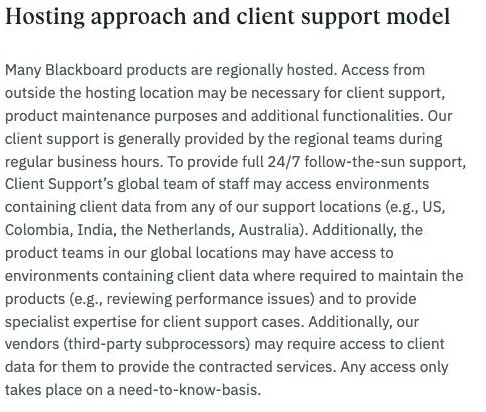
Blackboard's own Trust Center says "Many Blackboard products are regionally hosted," and its sub-processor list names "Amazon Web Services - AWS" as the "Hosting provider for cloud-based products" for Blackboard LMS — across AWS regions in the US, Canada, Europe, Singapore and Sydney, none inside mainland China. Serve mainland students from it and their personal information — names, grades, submissions, identity records — sits outside the mainland: a cross-border transfer PIPL governs, on infrastructure a public course site cannot ICP-file. The table below is Blackboard's own wording and the rule each line triggers.
This is a risk map, not a verdict — what applies turns on your institution, how much student data you hold and whether any users are minors. Our China compliance team can map your student-data exposure with you →
What Blackboard's own documentation says about China
| Fact | Primary source |
|---|---|
| Blackboard Learn is a cloud LMS hosted on AWS, with no mainland-China region. Blackboard's own sub-processor disclosure names "Amazon Web Services - AWS" as the "Hosting provider for cloud-based products" behind Blackboard LMS, and its Trust Center states that "Many Blackboard products are regionally hosted." Those regions run in the United States, Canada, Europe (Frankfurt), Singapore and Sydney, with later deployments in Cape Town and the UAE — none inside mainland China. | Blackboard (Anthology) Trust Center — Sub-processors & Hosting and Data Transfers, retrieved 2026-10-07 |
| Your students' data has a "usual hosting location" — and for a mainland institution it is never inside China. Blackboard states that "Many Blackboard products are regionally hosted," and that processing "outside the usual hosting location only takes place in accordance with applicable data privacy laws & regulations." With no in-country region to be that location, mainland students' records stay offshore — the trigger for a cross-border transfer under PIPL (Articles 38–43). | Blackboard (Anthology) Trust Center — Hosting and Data Transfers, retrieved 2026-10-07; PIPL Articles 38–43 |
| Student data is reached from outside its region by design. Blackboard's Trust Center says its support team "may access environments containing client data from any of our support locations (e.g., US, Colombia, India, the Netherlands, Australia)," and that "Access from outside the hosting location may be necessary for client support." For mainland learners' personal information, each such access is itself a cross-border transfer PIPL governs — notice, separate consent and a transfer mechanism (Articles 38–43). | Blackboard (Anthology) Trust Center — Hosting and Data Transfers, retrieved 2026-10-07; PIPL Articles 38–43 |
| A public, mainland-facing course site has nothing on Blackboard to ICP-file. Blackboard runs no region inside mainland China, and a site serving mainland visitors from inside China needs an ICP filing bound to a mainland hosting resource (State Council Order No. 292; MIIT Order No. 33). Student records raise the bar further: where they include minors' or other sensitive personal information, PIPL demands stricter handling, and a CIIO or large-volume handler must store the data in China (PIPL Article 40; Cybersecurity Law Article 39 (formerly Article 37)). | Blackboard (Anthology) Trust Center, retrieved 2026-10-07; State Council Order No. 292; MIIT Order No. 33; PIPL Article 40; Cybersecurity Law Article 39 (formerly Article 37) |
Sources verified by the 21YunBox compliance team on 2026-10-07.
For a mainland-China audience, the deciding question about Blackboard Learn is not whether students can open it — it is where their coursework, grades and identity records are allowed to live, and whether the course site may be operated inside China at all. Blackboard by Anthology answers the first half in its own documentation: Blackboard Learn is a cloud LMS hosted regionally on AWS, with no region inside mainland China. A China-facing Blackboard deployment is therefore reachable but entirely offshore — which leaves your students’ personal data sitting outside the mainland under PIPL, and a public course site with no mainland footing for the ICP filing it would need. The reachability is real; the data residency and the license are the exposure.
Blackboard Learn in China at a glance
| What decides it | In Blackboard's own terms |
|---|---|
| Where it runs | A cloud LMS on AWS. Blackboard's sub-processor list names “Amazon Web Services - AWS” as the “Hosting provider for cloud-based products” for Blackboard LMS; its regions span the US, Canada, Europe (Frankfurt), Singapore and Sydney, with later deployments in Cape Town and the UAE. None is inside mainland China. |
| Where your data lives | “Many Blackboard products are regionally hosted,” each tied to a “usual hosting location.” For a mainland institution there is no in-country region, so student records are stored offshore. |
| Cross-border access | Support staff “may access environments containing client data from any of our support locations (e.g., US, Colombia, India, the Netherlands, Australia)” — personal data moving across the border by design. |
| Serving the public | A public course site reaching mainland visitors from inside China needs an ICP filing bound to a mainland host. Blackboard runs no mainland region to file against. |
| The data itself | Grades, submissions and identity records — sometimes minors' — are personal information PIPL protects, raising the bar on consent, transfer and localization. |
No mainland region, so your students’ data stays offshore
Blackboard Learn is delivered as a cloud service on AWS. Blackboard’s sub-processor disclosure lists “Amazon Web Services - AWS” as the “Hosting provider for cloud-based products” behind Blackboard LMS, and its Trust Center states that “Many Blackboard products are regionally hosted.” Those regions sit in the United States, Canada, Europe (Frankfurt), Singapore and the Asia-Pacific (Sydney), with later deployments in Cape Town and the UAE — and not one of them is inside mainland China. For an institution teaching mainland students, that settles the data-residency question before performance ever enters it: there is no in-country region for the coursework, grades and identity records to live in, so they live abroad. Under China’s Personal Information Protection Law that offshore storage is a cross-border transfer, and the handler — your institution, not Blackboard — must give notice, obtain separate consent, and clear one transfer mechanism (a CAC security assessment, the CAC standard contract, or certification) under Articles 38–43.
Reachable, but nothing to file against
Students can open Blackboard Learn from the mainland; reachability is not where this breaks. It breaks at the license. A public-facing site served to mainland visitors from inside China turns on an ICP filing (ICP 备案) under State Council Order No. 292 and MIIT Order No. 33, and that filing has to attach to a hosting resource physically located in the mainland. Because Blackboard runs no mainland region, there is nothing on the platform to bind a filing to — the same wall implied when Blackboard’s own Trust Center frames every environment as having a “usual hosting location” abroad. “We already run Blackboard” does not clear this door: reaching China and being cleared to operate inside it are two different things, and tuning the LMS creates neither the mainland footing a filing needs nor the in-country home the data needs.
Student records raise the bar, not lower it
An LMS is not a brochure — it holds names, grades, submissions, disciplinary notes and, in K-12 and some higher-ed settings, the data of minors. Blackboard’s Trust Center acknowledges this movement directly: its support staff “may access environments containing client data from any of our support locations (e.g., US, Colombia, India, the Netherlands, Australia),” and “Access from outside the hosting location may be necessary for client support.” For mainland students, each such access is a cross-border flow of personal information. Where that information includes sensitive categories or minors’ data, PIPL demands stricter consent and handling, and for a critical information infrastructure operator or a large-volume handler the data must be stored in China (PIPL Article 40; Cybersecurity Law Article 39 (formerly Article 37)) — a localization duty no offshore AWS region can meet.
This is a risk map, not a verdict: whether you owe an ICP filing, in-country storage, or both turns on what you serve, how much student data you hold, and whether any of your users are minors — worth settling with counsel before you build.
Where 21YunBox fits — a compliant overlay, not a migration
Your institution keeps running Blackboard Learn exactly as it does today. We add the single piece a globally hosted LMS cannot supply on its own: lawful, ICP-filed delivery from inside the mainland, set in front of your existing Blackboard origin — no rebuild, no second codebase, and no move off Anthology’s platform. Our China team weighs your PIPL cross-border and data-residency obligations against your entity, your student-data volumes and who your learners are, then stands up the in-country delivery and storage a compliant China presence requires, while your courses, grades and rosters stay right where they already live.
Related reading: