Does Taboola Work in China? PIPL Cross-Border, Profiling Consent & Data Transfer
When the Taboola Pixel fires on a mainland-China visitor, it exports that person's behavioral personal information — page visits, purchases, cookie and device IDs, IP — to Taboola's offshore servers, building targeted-ad profiles. That is a PIPL cross-border transfer, Article 24 profiling, and a separate-consent gap. A compliance-first look at Taboola, the behavioral-data export, and the lawful path.
Does Taboola work in China?
Taboola generally resolves from mainland China, so the Taboola Pixel doesn't fail quietly — it fires and exports each mainland visitor's behavioral personal information to Taboola's offshore servers in real time.
The pixel is JavaScript you place on your own site; Taboola says it “gathers data about users behavior and actions on your website, like page visits, account creation, purchases,” alongside cookie IDs, IP addresses, and mobile advertising IDs. Taboola's own privacy policy states that personal information about individuals in the PRC “is collected by a server in Hong Kong” and that it “does not store any Personal Information in the PRC,” keeping it in data centers in Israel and the United States. That makes every fire a PIPL cross-border transfer (Articles 38–40: notice, a separate consent, a transfer mechanism) and — because the data builds targeted-ad “personalized interest profiles” — an Article 24 profiling mechanism that needs separate, informed consent. The lawful lever is to gate or suppress the offshore pixel for mainland visitors and use a licensed in-country advertising-and-analytics alternative, not to make the offshore pixel load.
Treat this as a risk map to settle with counsel, not a verdict. Our China team can map your exposure →
What Taboola's own documentation says about China
| Fact | Primary source |
|---|---|
| Taboola's own help center says the pixel collects on-site behavior and reports it to Taboola. Taboola describes the Taboola Pixel as “a javascript code that you implement on your website” that “gathers data about users behavior and actions on your website, like page visits, account creation, purchases, time per session, and many more,” and confirms the data path when it checks that “tracking data is accurately sent to Realize.” | Taboola / Realize Advertiser Help Center, “Realize Tracking Set Up Overview” (The Taboola pixel and more), dated July 23, 2026, retrieved 2026-10-10 |
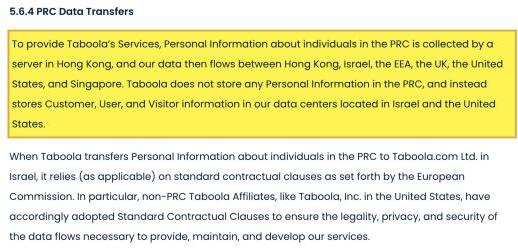
| Taboola collects mainland visitors' data via a Hong Kong server and stores nothing in the PRC. Taboola's privacy policy states: “Personal Information about individuals in the PRC is collected by a server in Hong Kong, and our data then flows between Hong Kong, Israel, the EEA, the UK, the United States, and Singapore. Taboola does not store any Personal Information in the PRC, and instead stores Customer, User, and Visitor information in our data centers located in Israel and the United States.” | Taboola Privacy Policy, §5.6.4 PRC Data Transfers (policies.taboola.com), Last Update October 7, 2026, retrieved 2026-10-10 |
| Taboola uses the data to profile and target — the Article 24 trigger. Its privacy policy says Taboola serves ads “based on your recent browsing behavior across different Customer websites, browsers, or devices,” can “recommend ads that are tailored to your interests,” and may “create personalized interest profiles.” Building and acting on such profiles for targeted advertising is automated decision-making governed by PIPL Article 24. | Taboola Privacy Policy, §§2.5–2.9 (policies.taboola.com), Last Update October 7, 2026, retrieved 2026-10-10 |
| Exporting China behavioral data to an offshore ad platform is a PIPL cross-border transfer needing separate consent. Moving personal information collected from users in mainland China to servers outside the mainland triggers PIPL Articles 38–40 — notice, a separate consent, and one transfer mechanism (a CAC security assessment, the CAC standard contract, or certification) — and non-essential tracking needs its own consent under Articles 13/23, on top of the Article 24 profiling duties. | Personal Information Protection Law of the PRC, Articles 13, 23, 24, 38–40 (cac.gov.cn), retrieved 2026-10-10 |
Sources verified by the 21YunBox compliance team on 2026-10-10.
For a site or app with visitors in mainland China, the real question about Taboola is not whether you can add its tag — you can. It is what happens the moment that tag fires on a visitor physically in China. The Taboola Pixel is JavaScript you place on your own site, and Taboola describes it plainly: it “gathers data about users behavior and actions on your website, like page visits, account creation, purchases,” then reports that activity — with cookie IDs, IP addresses, and mobile advertising IDs — back to Taboola to build audiences and target ads. Taboola generally resolves from the mainland, so this is not dead weight: it actively exports each mainland visitor’s behavioral personal information to offshore servers in real time. That raises three questions at once under China’s Personal Information Protection Law (PIPL): a cross-border transfer, automated decision-making and profiling, and separate, informed consent.
Taboola in China at a glance
| What decides it | In Taboola's own terms — and China's law |
|---|---|
| What the pixel collects | The Taboola Pixel is JavaScript on your own site that, in Taboola's words, "gathers data about users behavior and actions on your website, like page visits, account creation, purchases," together with cookie IDs, IP addresses, and mobile advertising IDs. Under PIPL that is personal information about an identifiable visitor. |
| Where it goes | To Taboola, offshore. Taboola's policy says PRC individuals' data "is collected by a server in Hong Kong" and that it "does not store any Personal Information in the PRC," keeping it in data centers in Israel and the United States — so each fire is a cross-border transfer (数据出境) under PIPL (Articles 38–40): notice, a separate consent, and one transfer mechanism. |
| Targeted ads = profiling | Taboola uses the data to serve ads "based on your recent browsing behavior" and to "create personalized interest profiles." Building and acting on those profiles is automated decision-making under PIPL Article 24, which requires transparency, fairness, and a real way to refuse profiling-based targeting. |
| Consent | Setting non-essential tracking cookies and identifiers, then exporting what they capture, needs a lawful basis. Under PIPL that is consent (Articles 13/23) — clear and informed before the tag collects — and the cross-border leg needs its own separate consent, not a buried "by using this site you agree." |
| Reachability isn't the axis | Whether the pixel loads fast is not the question; that it exports behavioral personal information without a lawful basis is. The lawful path is to gate or suppress the offshore pixel for mainland visitors, honor consent and the Article 24 right to refuse, use a licensed in-country advertising-and-analytics alternative where you still need to reach Chinese users, and deliver the China-facing site itself in-country on ICP-filed infrastructure. |
What the pixel actually sends — and where
Taboola’s position in China is not set by a speed test; it is set by what the pixel does. The Taboola Pixel — documented in Taboola’s help center under its Realize advertising platform — is, in Taboola’s words, “a javascript code that you implement on your website” that “gathers data about users behavior and actions on your website, like page visits, account creation, purchases, time per session, and many more.” It can “create and track customer audiences based on page visits, engagement, or actions,” and Taboola confirms the data path in its own diagnostics: a correctly installed pixel is one whose “tracking data is accurately sent to Realize,” and the tag is “installed and connected to Realize.” Alongside those events, Taboola’s privacy policy says it processes “digital identifiers such as cookie IDs, IP addresses, mobile advertising IDs on your device, Taboola network browsing history and associated preferences, and in some limited circumstances, your hashed email address.”
Where does that data go? Offshore, and Taboola is specific about it. For the mainland in particular, its privacy policy states that “Personal Information about individuals in the PRC is collected by a server in Hong Kong, and our data then flows between Hong Kong, Israel, the EEA, the UK, the United States, and Singapore,” and that “Taboola does not store any Personal Information in the PRC, and instead stores Customer, User, and Visitor information in our data centers located in Israel and the United States.” Because Taboola generally resolves from the mainland, the pixel is not a broken third-party call that merely slows your page — it is a live export: on every mainland visitor it fires on, the behavioral record leaves the mainland (a Hong Kong collection server) and comes to rest in Israel and the United States. This page publishes no mainland latency or match-rate figure for Taboola, because speed is not the axis this decision turns on.
It’s a cross-border transfer and a profiling mechanism — under PIPL
Three bodies of rule bite at once, all under the Personal Information Protection Law.
First, cross-border transfer. Behavioral data collected from people in mainland China and sent to an ad platform’s offshore servers is a cross-border transfer of personal information (数据出境) under PIPL Articles 38–40. That requires notice to the individual, a separate consent for the transfer, and one lawful transfer mechanism — a CAC security assessment, the CAC standard contract, or certification. Taboola’s own PRC statement — Hong Kong collection, storage in Israel and the United States, “does not store any Personal Information in the PRC” — means this transfer is not a hypothetical edge case; it is how the pixel works for mainland visitors by design. Above certain volumes, or where the data qualifies as “important data,” the transfer may also require China’s data-export security assessment (数据出境安全评估) before anything leaves.
Second, profiling. Taboola uses the data to serve ads “based on your recent browsing behavior across different Customer websites, browsers, or devices,” to “recommend ads that are tailored to your interests,” and to “create personalized interest profiles.” That is automated decision-making under PIPL Article 24, which requires transparency and fairness in how the profiling works and — for marketing and push based on profiling — a genuine option for the individual to refuse being targeted. A vendor stating, as Taboola does, that it “does not profile in furtherance of decisions that produce legal or similarly significant effects” answers a European test; it does not by itself satisfy Article 24, which governs commercial targeting built on profiling whether or not the decision is legally significant.
Third, consent. Setting non-essential tracking cookies and identifiers, and then exporting what they capture, needs a lawful basis. Under PIPL Articles 13 and 23 that basis is consent — clear and informed before the tag collects — and the cross-border leg needs its own separate consent, distinct from a user’s general agreement to use your site. A buried “by using this site you agree” does not carry it.
One more duty can sit on top. If your organization is a critical information infrastructure operator or a high-volume handler, the Cybersecurity Law’s Article 39 (formerly Article 37) — the 2025 Cybersecurity Law amendment, in force January 1, 2026, renumbered the data-localization article from 37 to 39, substance unchanged — requires personal information collected in China to be stored in China, a duty that a pixel which “does not store any Personal Information in the PRC” structurally cannot meet.
Making the offshore pixel reachable is the wrong fix — what actually works
The instinct, when a third-party tag behaves inconsistently in China, is to make it load more reliably. For an offshore ad pixel that is precisely the wrong fix. The exposure is not that the Taboola Pixel sometimes fails to fire; it is that when it does fire on a mainland visitor, it exports that person’s behavioral personal information offshore and feeds it into ad profiles without a PIPL lawful basis. Making that call more reliable does not cure the problem — it industrializes it.
What actually works runs the other way. For mainland visitors, gate or suppress the offshore pixel — serve it only to consented, out-of-scope audiences — and honor both consent and the Article 24 right to refuse profiling-based targeting. Where you still need measurement or advertising to reach Chinese users, route it through a licensed in-country advertising-and-analytics alternative — a domestic platform operating lawfully inside China — rather than the offshore Taboola tag. You cannot localize Taboola itself: its own policy says it stores nothing in the PRC, so there is no in-country Taboola to switch to. The compliant move is to stop the unconsented offshore export and replace it with a lawful in-country path, not to make the offshore endpoint reachable. Whether, and exactly how, each PIPL duty applies to your specific pixels and audiences is a risk to settle with counsel against what you actually collect and where it goes.
The lawful path — map, localize, deliver
There is a lawful way to run advertising and measurement for a China-facing product, and it has a shape.
First, map: our China team inventories which ad and tracking pixels actually fire on your mainland-facing pages, what behavioral personal information each one sends offshore, and where you lack a lawful basis — a separate consent, Article 24 transparency and an opt-out, a transfer mechanism. The legal conclusions settle with counsel; we frame the technical picture that feeds them.
Then localize / govern: gate, suppress, or defer the offshore pixels for mainland visitors so they fire only for consented, out-of-scope audiences; honor consent and the Article 24 right to refuse; and where you still need to reach Chinese users, stand up a licensed in-country advertising-and-analytics alternative rather than the offshore tag. Localizing here means stopping the unconsented offshore behavioral export and replacing it with a compliant in-country path — never a tunnel that makes the offshore pixel fire anyway.
Then deliver: the site or app that carries these tags is itself a public internet service in the mainland, so it has an ICP filing (备案) duty and needs compliant, in-country delivery. 21YunBox delivers it in-country — the 21YunBox Optimizer — in front of the stack you already run, with no rebuild and no re-platform. The result is advertising and a site that run legally and compliantly for your users in China. 21YunBox never uses or suggests circumvention of any kind. We are a compliance overlay and partner, not a competitor to Taboola.
Related reading:
- Cross-border data transfers under PIPL
- China’s Cybersecurity Law (data localization, Article 39)
- China’s data-export security assessment
- How to get an ICP filing for China