Does Bitly Work in China? Reachability, Short Links & Cross-Border Click Data
Bitly runs no presence inside mainland China, so bit.ly short links resolve through offshore infrastructure that is slow and unreliable from inside the mainland — bitly.com failed to finish loading within 60 seconds on every China test — and every click Bitly records collects the visitor's IP, location and device and may move it to the US, a PIPL cross-border wrinkle. A compliance-first look at the two doors.
Does Bitly work in China?
Whether Bitly works for a mainland-China audience is first a reachability-and-data question, not a speed one. bit.ly short links resolve through Bitly's offshore infrastructure, which is slow and unreliable from inside mainland China — and every click Bitly records collects the visitor's personal data and may move it abroad.
Measured from inside the mainland — an Alibaba Cloud probe in cn-zhangjiakou on 2026-08-28 and a residential broadband line in Beijing on 2026-08-30 — bitly.com answered in under a second and then failed to finish loading within 60 seconds on every run, so a short link embedded in a China-facing page, SMS or email can stall or fail to redirect for mainland users. Separately, Bitly's own privacy policy says every click collects the clicker's IP address, IP-derived location, referrer and device, and that personal data “may be transferred outside the European Union and the European Economic Area, including … the United States of America” — a cross-border transfer of personal information PIPL governs when the clicker is in China. The table below is Bitly's own words and the China rules they trigger.
This is a risk map, not a legal verdict — your exposure turns on who clicks your links and what you store. Our China team can map the reachability and cross-border-data path with you →
What Bitly's documentation says, and what we measured from inside China
| Fact | Primary source |
|---|---|
Requested from a probe inside mainland China (Alibaba Cloud cn-zhangjiakou) on 2026-08-28, bitly.com returned a first byte in a median of 876 ms but did not finish loading in any of 3 attempts within a 60-second ceiling, with a largest-contentful-paint of 6.0 s on the runs that painted. The connection opens fast and then stalls — the worst shape of failure for a link you have already published. | 21YunBox — China delivery census, measured from inside mainland China |
| Measured again on 2026-08-30 from a residential broadband line in Beijing, bitly.com had a median first byte of 731 ms but hit the 60-second navigation timeout on all 3 of 3 runs without ever firing a largest-contentful-paint; of 74 requests, one third-party host on the page (Optimizely's CDN) returned no response before the measurement ended. The first byte is quick and the page still never completes — a bit.ly link cannot be assumed to work for mainland users. | 21YunBox — paired measurement from a mainland-China residential broadband line |
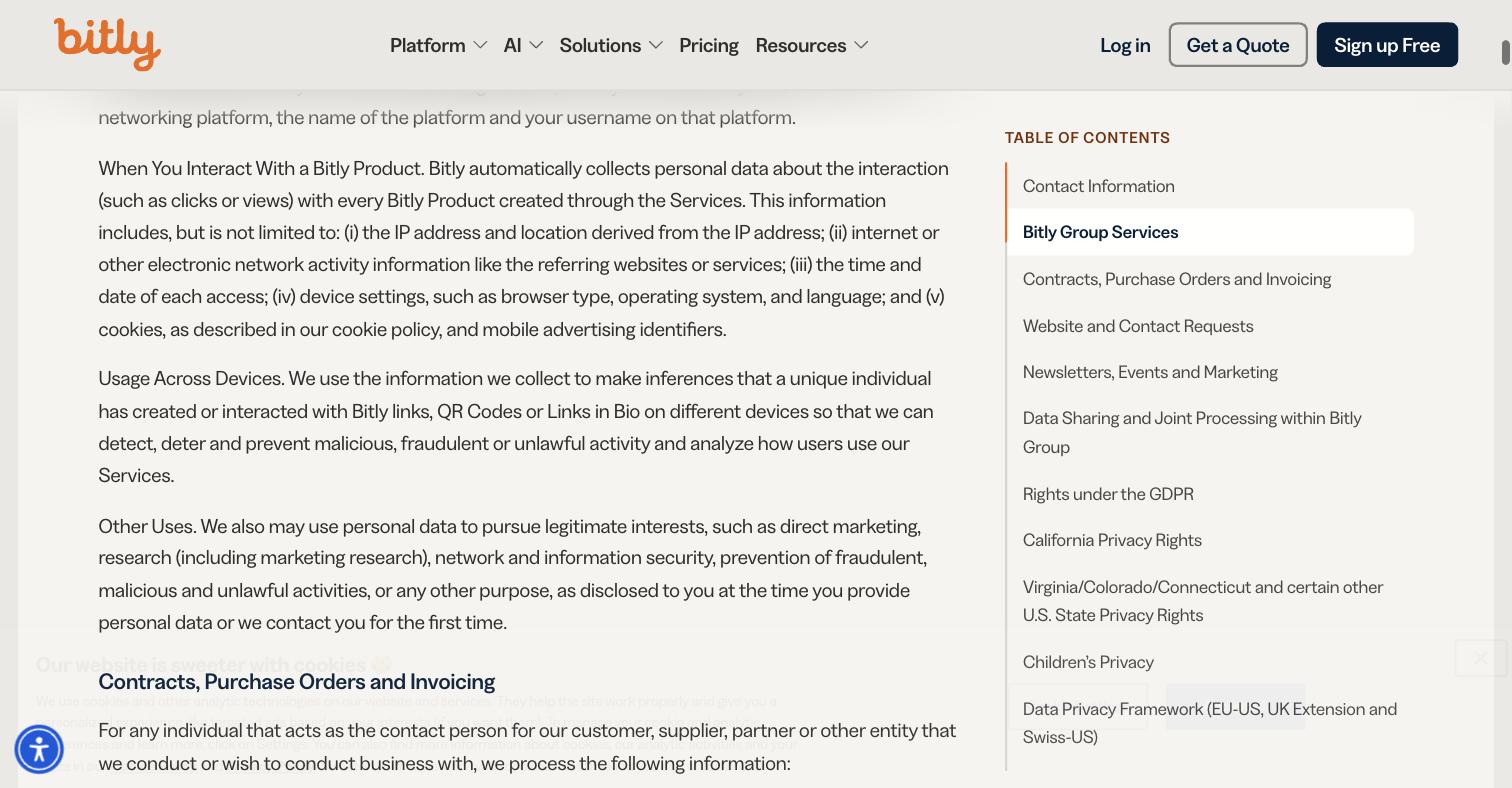
| In Bitly's own privacy policy, Bitly "automatically collects personal data about the interaction (such as clicks or views) with every Bitly Product created through the Services," and that information "includes, but is not limited to: (i) the IP address and location derived from the IP address; (ii) ... the referring websites or services; (iii) the time and date of each access; (iv) device settings, such as browser type, operating system, and language; and (v) cookies." When the person clicking a bit.ly link is in mainland China, that is personal information collected from inside China. | Bitly Privacy Policy — "When You Interact With a Bitly Product," retrieved 2026-10-07 |
| Bitly's privacy policy states that "[p]ersonal data may be transferred outside the European Union and the European Economic Area, including, but is not limited to, the United States of America as well as other locations and jurisdictions in which we conduct our business or our service providers are located." So the IP, location and device data a China visitor's click generates is processed offshore — a cross-border transfer of personal information, not data kept inside the mainland. | Bitly Privacy Policy — "Data Sharing and Joint Processing within Bitly Group," retrieved 2026-10-07 |
| Sending the personal information of mainland-China users offshore is a cross-border transfer under PIPL: the handler must give notice, obtain separate consent, and meet a transfer mechanism — a CAC security assessment, the CAC standard contract, or certification (PIPL Chapter III, Articles 38–39). A bit.ly link that tracks clicks by mainland users puts that duty on you, the handler — not on Bitly. | PIPL Chapter III, Articles 38–43 (cross-border provision of personal information) |
Sources verified by the 21YunBox compliance team on 2026-10-07.
For a mainland-China audience, the deciding question about Bitly is not how clever the short link is — it is whether that link actually reaches your users, and what China’s law makes of the data each click sends abroad. Bitly runs no presence inside mainland China: bit.ly and bitly.com resolve through its offshore infrastructure, and measured from inside the mainland that infrastructure answers in under a second and then fails to finish. Meanwhile Bitly’s own privacy policy says every click collects the clicker’s IP address, location and device and may move that data to the United States. The reachability is shaky; the cross-border data is the quieter exposure.
Bitly in China at a glance
| What decides it | In Bitly's own terms (and measured) |
|---|---|
| Where links are served | Bitly operates no mainland-China presence; bit.ly and bitly.com resolve through its offshore infrastructure. Reachable in principle — but measured from inside the mainland, the full experience did not finish loading within 60 seconds. |
| Reliability of the redirect | A short link embedded in a China-facing page, SMS or email rides that same offshore path, so the redirect can stall or fail for mainland users — the worst shape of failure for a link you have already published and cannot recall. |
| What a click collects | Per Bitly's privacy policy, every click automatically collects the clicker's IP address and IP-derived location, the referring site, the time of access, device settings (browser, OS, language) and cookies. |
| Where that data goes | Bitly states personal data “may be transferred … [to] the United States of America” and other jurisdictions — offshore from China. |
| China-law trigger | A mainland clicker's personal data leaving the country is a cross-border transfer under PIPL (notice, separate consent, a transfer mechanism). ICP filing and in-country delivery apply to the destination you control, not to bit.ly itself. |
A link that answers fast, then stalls
Bitly is not on a government block list, and a bit.ly hostname will usually resolve — so it is tempting to assume the link “works.” The measurements say otherwise. From an Alibaba Cloud probe in cn-zhangjiakou on 2026-08-28, bitly.com returned a first byte in a median 876 ms and then completed none of three runs inside a 60-second ceiling. A residential line in Beijing on 2026-08-30 behaved the same way: first byte in 731 ms, then all three runs ran out the 60-second clock without the page ever painting. A bare redirect is a single HTTP request and may still slip through, but every heavier thing Bitly leans on — branded-domain assets, interstitials, the dashboard you read clicks in, the third-party scripts embedded on bitly.com — travels the same offshore path, and from inside China that path stalls. The practical rule: a bit.ly link dropped into a China-facing page, an SMS, or an email cannot be assumed to redirect reliably for mainland users. Test it from inside China before you ship it.
Every click is a small cross-border data transfer
The second door is quieter and does not go away even when a link happens to resolve. Measurement is the point of Bitly, and its privacy policy is explicit about what that means: it “automatically collects personal data about the interaction (such as clicks or views) with every Bitly Product,” including “the IP address and location derived from the IP address,” the referring site, the time of access, and “device settings, such as browser type, operating system, and language.” Bitly also states that personal data “may be transferred outside the European Union and the European Economic Area, including … the United States of America.” Put those together for a China-facing link and the shape is clear: when a mainland user clicks, their personal information is collected inside China and processed offshore. Under China’s Personal Information Protection Law that is a cross-border transfer, and the obligation lands on you — the handler — to give notice, obtain separate consent, and clear a transfer mechanism (a CAC security assessment, the CAC standard contract, or certification), not on Bitly.
A short link is only a redirector, so the licensing question lives one hop away, at the destination. If the page your bit.ly link points to is a public site served to mainland visitors, that destination is what needs an ICP filing and in-country delivery — the short link does not create that obligation, but it is the front door to a page that carries it.
A risk map, not a verdict
Whether any of this applies to you depends on specifics: how your links are used, whether they carry campaign tracking, how many mainland users click them, and what you do with the analytics. None of it is a blanket prohibition, and none of it is a speed problem a faster network would quietly fix — the reachability is a delivery fact and the data transfer is a legal one. Both are worth settling with counsel before a China campaign goes out.
Where 21YunBox fits — a compliant overlay, not a migration
You keep using Bitly where it earns its place. We add the one piece an offshore link service cannot: reliable, ICP-filed delivery from inside the mainland for the destination your links point to, so a mainland user who taps a short link lands on a page served from inside China instead of stalling on an offshore hop. Our China team maps your reachability and cross-border-data exposure against your entity and data volumes, then stands up the in-country delivery and storage a lawful China presence needs — while your links, your campaigns, and your analytics stay where they already run.
Related reading: