Does Adobe Audience Manager Work in China? Data Residency, PIPL Profiling & Cross-Border Audience Data
Adobe Audience Manager is a data management platform whose Data Collection Servers run in eight regions — none in mainland China — so the cookies, device IDs, authenticated profile IDs and audience segments it builds from your China users rest on Adobe's offshore demdex.net edges. That makes their collection a cross-border transfer of personal information under PIPL, while building and syncing those segments for ad targeting is automated decision-making the law regulates in its own right, with an in-country storage duty for a critical information infrastructure operator. A compliance-first look at the data-residency, cross-border, consent and profiling questions — and the lawful in-country path.
Does Adobe Audience Manager work in China?
The answer isn't about speed — it's a compliance-risk question. Adobe Audience Manager is a data management platform, and what decides the China question is the personal data it builds from your users and where that data lives.
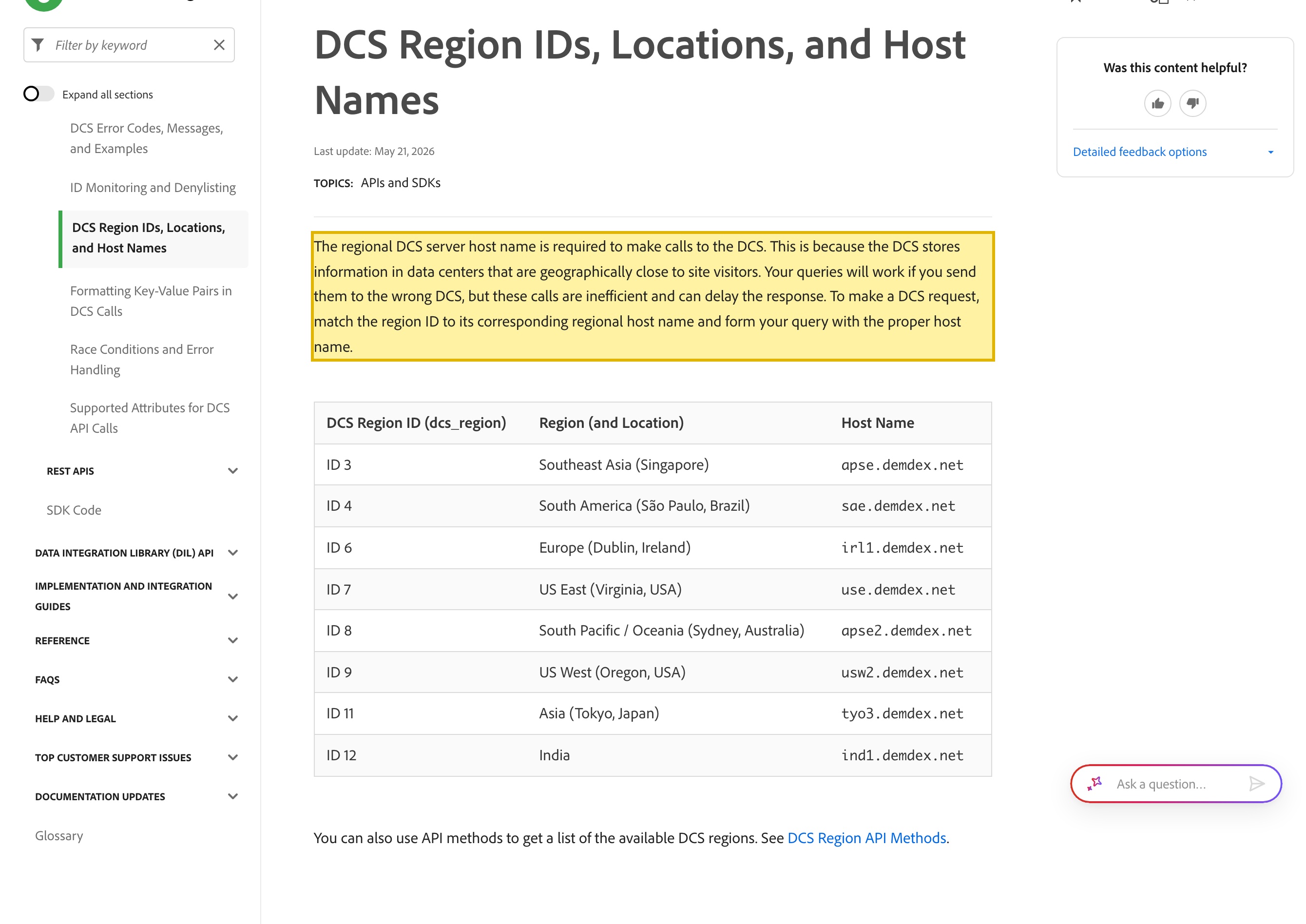
Adobe's own documentation lists eight Data Collection Server regions on demdex.net hosts — Singapore, São Paulo, Dublin, Virginia, Sydney, Oregon, Tokyo and India — and none is in mainland China, so the cookies, device IDs, authenticated profile IDs and audience segments it builds from your China users come to rest offshore. That makes their collection a cross-border transfer (数据出境) under PIPL (notice, a separate consent and a transfer mechanism), while building and syncing those segments for ad targeting is automated decision-making the law regulates in its own right (Article 24), and tracking identifiable people needs consent (Article 13) on top. For a critical information infrastructure operator, the Cybersecurity Law's Article 39 (formerly Article 37) adds an in-country storage duty no offshore region can meet.
Adobe itself now steers Audience Manager customers toward Real-Time CDP — one more reason to put your China audience data on a lawful, in-country footing. 21YunBox maps your cross-border, profiling and residency exposure, localizes the China audience data in-country, and delivers the site that fires the tags on ICP-filed infrastructure — with no rebuild, and never any form of circumvention. Treat the specifics as a risk to confirm with counsel.
What Adobe Audience Manager's own documentation says about China
| Fact | Primary source |
|---|---|
| Audience Manager's collection servers run in eight regions — none in mainland China. Adobe's own “DCS Region IDs, Locations, and Host Names” documentation states, “This is because the DCS stores information in data centers that are geographically close to site visitors,” and lists exactly eight Data Collection Server regions on demdex.net hosts — Singapore, São Paulo, Dublin, Virginia, Sydney, Oregon, Tokyo and India. None is in the mainland, so the cookies, device IDs and segments built from your China users rest offshore — a cross-border transfer of personal information under PIPL. | Adobe Experience League — DCS Region IDs, Locations, and Host Names (experienceleague.adobe.com), retrieved 2026-10-09 |
| What the platform collects is, by Adobe's own description, personal information. Adobe's data-collection component docs describe on-page code — “DIL is code you place on the page for data collection” — that “creates and manages device IDs and authenticated profile IDs,” feeding a profile store whose data “consists of device IDs, authenticated profile IDs, and their associated traits.” Cookies, device and profile IDs and the segments derived from them are personal information under China's law, so tracking China users this way carries a PIPL consent duty (Article 13). | Adobe Experience League — Data Collection Components (experienceleague.adobe.com), retrieved 2026-10-09 |
| Adobe itself now steers Audience Manager customers toward Real-Time CDP. On Audience Manager's own product page, Adobe writes that “Adobe Audience Manager has been crucial for connecting data and creating marketing opportunities” — in the past tense — before pointing customers to “Adobe Real-Time CDP” as the path forward “into a third-party cookieless tomorrow.” Adobe has published no product-wide end-of-life date for Audience Manager as of this review, but a platform its vendor is moving past is one more reason to build a China path on durable, lawful in-country footing. | Adobe — Adobe Audience Manager product page (business.adobe.com), retrieved 2026-10-09 |
| Profiling and cross-border transfer are each regulated in their own right. Moving China-collected audience data to an offshore Adobe region triggers PIPL Articles 38–40 (notice, a separate consent, and a transfer mechanism), while building audience segments and syncing them for ad targeting is automated decision-making under PIPL Article 24, which requires transparency and fairness and a way to decline targeted push. For a critical information infrastructure operator, the Cybersecurity Law's Article 39 (formerly Article 37) adds an in-country storage duty an offshore region cannot meet. | Personal Information Protection Law of the PRC, Articles 13, 24, 38–40 (cac.gov.cn); Cybersecurity Law Article 39 (formerly Article 37), retrieved 2026-10-09 |
Sources verified by the 21YunBox compliance team on 2026-10-09.
For a brand measuring and targeting audiences in mainland China, the question about Adobe Audience Manager is not whether its collection tags can reach the browser — it is a compliance question about the personal data a data management platform exists to build. Audience Manager’s job is to assemble a cross-device picture of your users — cookies, device IDs, authenticated profile IDs, and the traits and segments derived from them — and to push those segments out for ad targeting. That graph is precisely the kind of personal information China’s law governs most closely, and it is held on Adobe collection servers outside the mainland. So the decision turns on where that audience data comes to rest, whether you had a lawful basis to build and move it, and whether profiling people this way is permitted — each of which sits upstream of how fast a pixel fires. Adobe settles the first of those questions in its own documentation.
Adobe Audience Manager in China at a glance
| What decides it | In Adobe's own terms — and China's law |
|---|---|
| What it is | Adobe Audience Manager is a data management platform (DMP). Adobe's own component docs describe collection code “you place on the page” that “creates and manages device IDs and authenticated profile IDs,” feeding a profile store whose data “consists of device IDs, authenticated profile IDs, and their associated traits.” It holds a continuous, cross-device record of identifiable people and the segments built from it. |
| Where the collected data lives | Offshore. Adobe lists eight Data Collection Server regions — Singapore, São Paulo, Dublin, Virginia, Sydney, Oregon, Tokyo and India, on demdex.net hosts — and none is in mainland China. Traffic from the mainland is routed to the nearest of these (Singapore, Tokyo or India), each still outside the country. Whether those edges load quickly, slowly or intermittently is an operational matter, not the China question — and the answer is never a network workaround. |
| Collecting China audience data into it | The cookies, device IDs, profile IDs and segments are personal information. Holding them on an offshore Adobe region is a cross-border transfer (数据出境) under PIPL (Articles 38–40): notice, a separate consent, and one transfer mechanism — with a possible data-export security assessment above thresholds. |
| Tracking and acting on individuals | Observing identifiable people to collect their behavior needs its own PIPL lawful basis — informed consent and notice before the tag fires (Article 13). Building audience segments and syncing them to ad platforms to decide what each person sees is automated decision-making under PIPL Article 24, which requires transparency and fairness and a way to decline targeted push. |
| Residency & serving the public | For a critical information infrastructure operator, personal information collected in China must be stored in the mainland (Cybersecurity Law Article 39 (formerly Article 37); PIPL Article 40) — which an offshore DCS cannot do. And a public site actually served from inside China needs an ICP filing bound to a mainland hosting resource a DMP does not provide. |
| The lawful path | Keep the China audience data in a consented, in-country setup, send offshore only what may lawfully leave, and deliver the China-facing site that fires the tags in-country on ICP-filed infrastructure. 21YunBox maps, localizes and delivers; it never uses or suggests circumvention. |
No mainland-China collection region — the audience graph rests offshore
Adobe is explicit about where Audience Manager keeps what it collects. Its Data Collection Server reference states that “the DCS stores information in data centers that are geographically close to site visitors,” then lists exactly eight such regions — Southeast Asia (Singapore), South America (São Paulo), Europe (Dublin), US East (Virginia), South Pacific/Oceania (Sydney), US West (Oregon), Asia (Tokyo) and India — every one of them on a demdex.net host, and not one inside mainland China. For a visitor in Shanghai or Shenzhen, the “geographically close” region is Singapore, Tokyo or India: close, but still across the border.
That geography settles the first legal question before performance enters the picture. The cookies, device identifiers and audience segments Audience Manager gathers from your China users are personal information, and the moment they land on an offshore Adobe region you have made a cross-border transfer (数据出境) of personal information under China’s Personal Information Protection Law. The duty falls on the handler — you, the brand, not Adobe the processor: PIPL Articles 38–40 require notice, a separate consent distinct from any general product agreement, and one transfer mechanism (a CAC security assessment, the CAC standard contract, or certification). Above certain thresholds, or where the data qualifies as “important data,” that transfer may also require China’s data-export security assessment (数据出境安全评估) before anything leaves. And if your organization is a critical information infrastructure operator, the Cybersecurity Law’s Article 39 (formerly Article 37; the data-localization clause was renumbered by the 2025 amendment in force since 1 January 2026, its wording unchanged) requires personal information generated in China to be stored in China — an in-country storage duty an offshore DCS region cannot satisfy no matter how routing is tuned.
A DMP’s raw material is personal information — and tracking it needs consent
The exposure is structural to what a DMP does. In Adobe’s own component documentation, “DIL is code you place on the page for data collection,” the servers behind it “create and manage device IDs and authenticated profile IDs,” and the profile store’s data “consists of device IDs, authenticated profile IDs, and their associated traits.” Under China’s law those identifiers and the traits attached to them are personal information, so the act of observing an identifiable person to build that profile is itself processing that needs a lawful basis — in practice, informed consent obtained, with clear notice, before the tag begins collecting (PIPL Article 13). The cross-border move to an offshore Adobe region then needs a further, separate consent on top of that.
Adobe does provide governance controls — opt-out signals, and guidance that cookie information is not written to the log file once a user has opted out. Controls like these can genuinely narrow the exposure, but they do not discharge the consent and notice duties, which sit with you as the handler. Whether a given identifier counts as personal information, whether any trait is sensitive, and exactly what your consent flow must disclose are questions to settle with counsel against what you actually collect.
Building audience segments is automated decision-making under PIPL
There is a second gate most adtech plans miss, and it is specific to a DMP. The point of Audience Manager is not merely to store behavior — it is to score and sort people into segments and then act on those segments, deciding which audience sees which message. Under PIPL, that is automated decision-making (自动化决策), and Article 24 regulates it in its own right: the processing must be transparent and fair, must not unreasonably differentiate between individuals on transaction terms, and — where it is used to push information or marketing to someone — must offer an option that is not targeted to their characteristics, or an easy way to refuse. In other words, the very mechanism that makes a DMP valuable is one China’s law attaches its own set of obligations to, separate from residency and separate from the cross-border transfer. Which of those obligations bite your specific use is, again, a risk to confirm with counsel.
A platform its own vendor is moving past
Continuity belongs in the risk map, not as a footnote to it. Adobe’s own Audience Manager product page no longer sells the product so much as redirect from it: it tells visitors that “Adobe Audience Manager has been crucial for connecting data and creating marketing opportunities” — in the past tense — and points them to “Adobe Real-Time CDP” as the way forward “into a third-party cookieless tomorrow.” Adobe has published no product-wide end-of-life date for Audience Manager as of this review, so this is a direction of travel, not a shutdown notice. But a third-party-cookie DMP that its own vendor is steering customers away from is one more reason not to anchor a China delivery plan to it. Whichever platform you land on, the China compliance questions — residency, cross-border transfer, consent and profiling — do not change, so the durable move is to put the China audience data on a lawful, in-country footing now rather than rebuild it twice.
None of this is a verdict that Audience Manager is “blocked” or “illegal.” It is a risk-and-continuity map: which obligations apply turns on your entity, the identifiers and traits your tags collect, your role under Chinese law, and who your users are — worth settling with counsel before your audience data depends on it.
The lawful path — map, localize, deliver
There is a compliant way to run audience data for a China-facing brand, and it has a shape. First, map: our China team works through your PIPL exposure on every front a DMP opens — the tracking, the segment-building and targeting, and the transfer — identifying which identifiers and audience data collected in China must stay in the country, what may lawfully leave, where a data-export security assessment or an Article 39 storage duty applies, what your consent and notice flow has to cover, and what Article 24 requires of your profiling and targeted push. The legal conclusions are settled with counsel; we build the technical picture that feeds them.
Then localize: rather than naming a single drop-in replacement, we stand up the lawful in-country pattern for the China audience data — consented collection and segmentation processed and stored inside the mainland — so the measurement and activation you depend on keep working while that personal data stops leaving the country by default. You keep your offshore audience platform for the markets where it already serves you, and send it only what may lawfully leave.
Then deliver: the China-facing site or app that fires those tags is itself a public service in the mainland, so it carries an ICP filing (备案) duty and needs compliant, in-country delivery. 21YunBox delivers it in-country — the 21YunBox Optimizer — set in front of what you already run, with no rebuild and no re-platform. The result is audience data and a China-facing experience that run legally and compliantly for your users in China. What 21YunBox never does — and what no one can do lawfully — is move personal information out of China by stealth or route around any network restriction: we localize what must stay and deliver in-country, and the circumvention route is off the table on principle.
Related reading:
- Cross-border data transfers under PIPL
- China’s data-export security assessment
- China’s Cybersecurity Law (data localization, Article 39)
- How to get an ICP filing for China