Does Google Tag Manager Work in China? Reachability, Blocked Scripts & Cross-Border Data
Google Tag Manager runs by injecting a container script from googletagmanager.com — a Google-operated endpoint that is unreliable to unreachable from inside mainland China, so GTM and every tag it fires can fail to load. And the tags it does fire report visitor IP and behavior to Google endpoints outside the mainland, a cross-border transfer under PIPL. A compliance-first, reachability-first look.
Does Google Tag Manager work in China?
Whether Google Tag Manager works in China is first a reachability question, and then a cross-border-data one — not a speed problem. GTM runs by injecting a container script that it loads from googletagmanager.com, a Google-operated endpoint, and from inside mainland China that endpoint is unreliable to unreachable.
In our own paired measurements on 2026-08-30, www.googletagmanager.com answered every time from a mainland datacenter probe (72 of 72, 118 ms) but returned no response on 112 of 112 requests over a Beijing residential line — and when the container can't load, every tag it manages (analytics, ad pixels, conversion tracking) fails with it. Even where the tags do fire, Google's own documentation says they "make requests to other origins" — Google analytics and ads endpoints that sit outside the mainland — so the visitor data they carry (IP, behavior) is a transfer under PIPL. The table below separates the loading question from the data question.
This is an exposure picture, not a verdict — how much applies depends on which tags you load and how much personal data they collect. Our China team can map your exposure with you →
Compliance snapshot
- ✕ GTM's container loads from googletagmanager.com, a Google endpoint that returned no response on a Beijing home line (112/112, 2026-08-30)
- ✕ When the container can't load, every tag it fires fails with it — analytics, ad pixels and conversion tracking go dark
- ! The tags GTM deploys report visitor IP and behavior to Google analytics/ads endpoints outside mainland China — a PIPL cross-border question
- ! A mainland datacenter probe looked healthy (72/72, 118 ms) — cloud vantage points can mask what a real visitor can't reach
- ✓ Both are fixable — but with a compliant in-country measurement path, not just a faster CDN
What Google Tag Manager's documentation says, and what we measured from inside China
| Fact | Primary source |
|---|---|
GTM runs by injecting a script that loads from Google's own domain. In Google's Content Security Policy guide for Tag Manager, the install code "is built as inline JavaScript code that injects the gtm.js script," and the guide lists https://www.googletagmanager.com among the domains a site must allow Tag Manager to load from. If that Google-operated endpoint can't be reached, the container never initializes — and nothing it manages runs. | Google Tag Platform — Use Tag Manager with a Content Security Policy, retrieved 2026-10-07 |
From a real mainland line, the GTM endpoint did not respond. In 21YunBox paired measurements on 2026-08-30, www.googletagmanager.com answered 72 of 72 requests at 118 ms from an Alibaba Cloud datacenter probe in cn-zhangjiakou — but over a Beijing China Mobile residential line it returned no response on 112 of 112 requests. That gap is the honest part: a datacenter vantage point can look healthy because mainland clouds sometimes carry local copies of upstream resources an ordinary visitor can't reach, which is why the residential-line result is the one that reflects real users. | 21YunBox — China delivery census, paired datacenter vs. residential measurement from inside mainland China |
The tags GTM fires call Google endpoints outside the mainland. The same Google guide states that "certain tags load content from or make requests to other origins," and names those origins — including *.google-analytics.com, *.g.doubleclick.net and www.googleadservices.com. Any such request carries the visitor's IP, and analytics and ads tags are built to report behavior. [Inference: Google operates no infrastructure in mainland China, so these endpoints resolve outside the mainland — making the visitor data they receive a cross-border transfer.] | Google Tag Platform — Use Tag Manager with a Content Security Policy, retrieved 2026-10-07 |
| Visitor data leaving China for Google's servers is governed as a cross-border transfer. Sending mainland visitors' personal information — IP and behavioral data are personal information under Chinese law — to Google analytics/ads endpoints abroad is a cross-border transfer under PIPL Chapter III, which calls for notice, separate consent, and one statutory transfer mechanism. Exposure scales with role and volume: since the CAC's March 2024 cross-border rules, a non-CIIO moving fewer than 100,000 individuals' non-sensitive personal information in a calendar year is exempt from the security assessment, standard contract and certification. [Confirm your classification and threshold with counsel — this is a risk map, not legal advice.] | PIPL Chapter III, Articles 38–43; CAC — Provisions on Promoting and Regulating Cross-border Data Flows, March 2024 |
| GTM is a loader, so "does it work" depends on what rides on it. Tag Manager's job is to manage and fire other tags; Google's CSP guide shows those can include Google Analytics, Google Ads and Floodlight/DoubleClick, each making its own requests. Two things follow for China: the whole chain depends on reaching Google-operated domains that a mainland visitor may not, and every Google tag in it points at servers outside the mainland. Which tags you deploy decides how much loading risk and how much cross-border exposure you actually carry. | Google Tag Platform — Use Tag Manager with a Content Security Policy, retrieved 2026-10-07 |
Sources verified by the 21YunBox compliance team on 2026-10-07.
For a mainland-China audience, “does Google Tag Manager work?” is really two questions, and neither of them is about speed. The first is whether it loads at all: GTM runs by injecting a container script that it fetches from googletagmanager.com, a Google-operated domain, and from inside the mainland that domain is unreliable to unreachable — so the container, and every tag riding on it, can simply fail to initialize. The second surfaces only where the tags do run: the analytics and ad tags GTM fires report each visitor’s IP and behavior to Google endpoints that sit outside China, which turns ordinary measurement into a cross-border transfer the law governs. This page takes the loading question and the data question in turn, and starts with what Google itself documents.
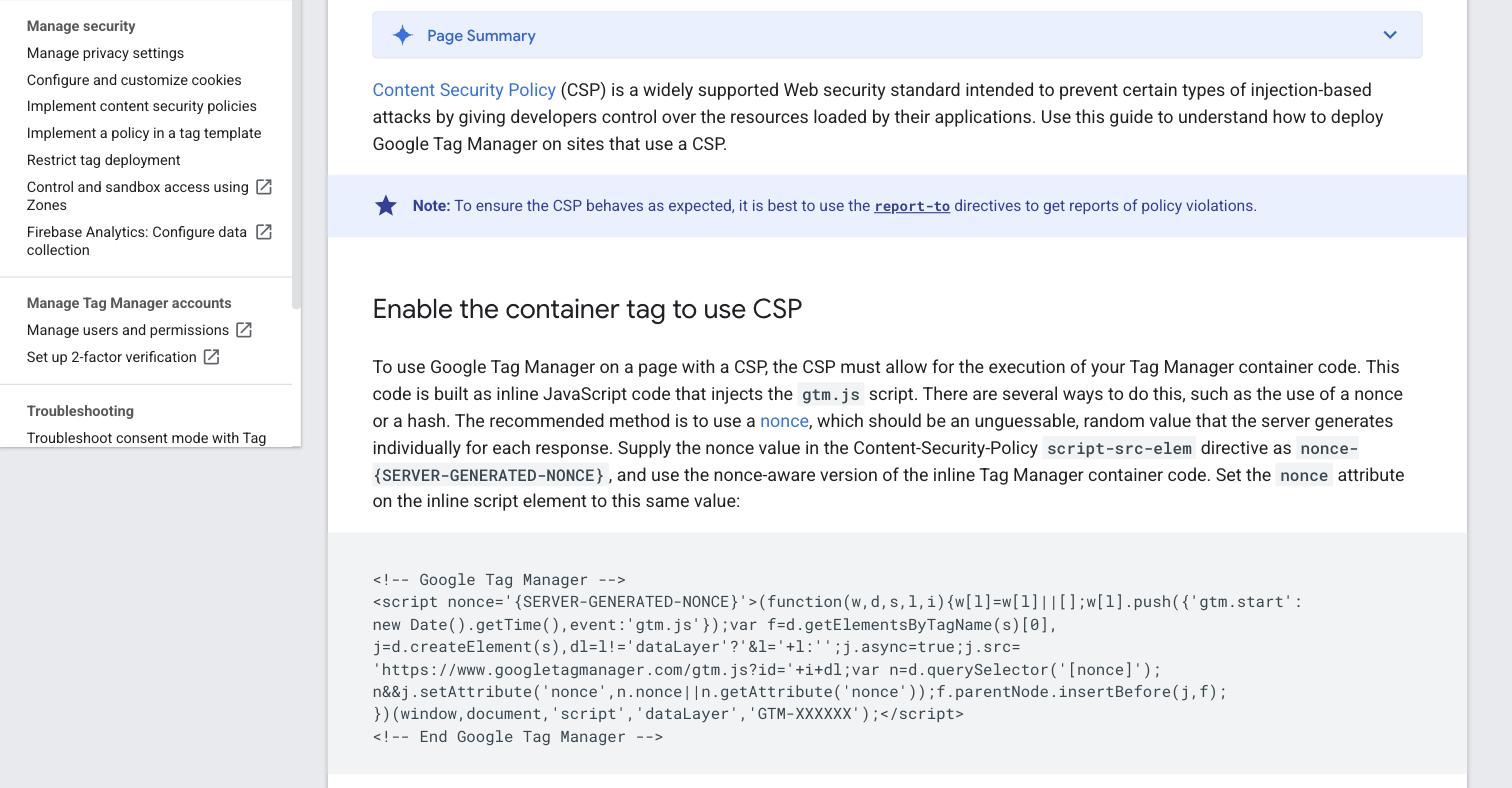
www.googletagmanager.com among the domains Tag Manager must be allowed to load from — alongside *.google-analytics.com and *.g.doubleclick.net, the endpoints its tags call. All are Google-operated and sit outside mainland China. Source: developers.google.com/tag-platform/security/guides/cspGoogle Tag Manager in China at a glance
| What decides it | What happens for a user inside mainland China |
|---|---|
| The container script | GTM works by injecting gtm.js, which it loads from googletagmanager.com — a Google-operated domain. Reaching it from inside the mainland is unreliable to impossible, so the container may never initialize in the first place. |
| If the container can't load | Every tag GTM manages fails with it: analytics, ad pixels and conversion tracking stop reporting — often silently, because the page still renders while the measurement quietly goes dark. |
| Datacenter vs. a real visitor | Our probes split sharply: www.googletagmanager.com answered 72 of 72 requests from a mainland datacenter but 0 of 112 over a Beijing home line (2026-08-30). The home line is what actual users have. |
| The tags it fires | Google Analytics, Google Ads and Floodlight/DoubleClick tags each call their own Google endpoints — *.google-analytics.com, *.g.doubleclick.net, www.googleadservices.com — none of which run inside the mainland. |
| The data those tags carry | Every request to those endpoints carries the visitor's IP, and analytics/ads tags report behavior — a transfer of personal information out of China, governed by PIPL Chapter III. |
| Is it a speed problem? | No. A faster delivery network does not make an unreachable Google endpoint reachable, and it does not keep the visitor data in-country. Both gaps are compliance and reachability facts, not latency. |
The container has to load from googletagmanager.com — and that is the part that stalls
Google Tag Manager is not something that lives on your own server. It works by placing a small inline snippet on your pages that then reaches out to Google to fetch the real container. In Google’s own Content Security Policy guide for Tag Manager, that snippet “is built as inline JavaScript code that injects the gtm.js script,” and the same guide lists https://www.googletagmanager.com among the domains a site must be allowed to load from for Tag Manager to function. That single dependency is the hinge: if the browser cannot reach googletagmanager.com, there is no container, and everything downstream of it never starts.
From inside mainland China, reaching Google-operated domains is exactly the thing that does not hold. So the first honest answer about GTM is not “it is slow” — it is that the script the whole system depends on may not arrive at all. That is a reachability fact about where the code is served from, and tuning the network around it does not change where the code is served from.
When the container can’t load, none of your tags fire
Because GTM is a loader, a blocked container is not a cosmetic problem — it is a measurement blackout. Analytics stop recording sessions, remarketing and conversion pixels stop firing, consent and A/B tags never initialize. The page itself still paints, which is what makes this failure quiet and easy to miss: a marketing team can watch mainland traffic look “fine” in the browser while the numbers behind it simply flatten, because the tags that produce those numbers never ran. Anything you deployed through GTM inherits the container’s fate, so one unreachable Google domain can take your entire tagging layer offline for Chinese users without a single visible error.
Reachable from a datacenter, not from a phone — which is the whole trap
It is tempting to test GTM from a server in China and conclude it works. We did, and it is misleading. In paired measurements on 2026-08-30, www.googletagmanager.com answered 72 of 72 requests at 118 ms from an Alibaba Cloud datacenter probe in cn-zhangjiakou — a clean pass. The same endpoint, measured over a Beijing China Mobile residential line, returned no response on 112 of 112 requests. Not slow: nothing.
That gap is the point, and it is the honest part of the picture. Mainland clouds sometimes carry local copies or adaptations of upstream resources an ordinary visitor cannot reach, so a datacenter vantage point can paint a far rosier result than a real phone on a home connection. We report both numbers precisely because the residential-line result is the one that reflects your actual users — and it did not get through. The sample here is the paired census described in our third-party request measurements from inside China; the methodology, dates and vantage points travel with the figure so you can re-test it yourself.
The data the tags do send leaves China
Where the tags do load, a second, independent question opens — and it is a data one. Google’s guide notes that “certain tags load content from or make requests to other origins,” and names them: Google Analytics talks to *.google-analytics.com, Google Ads and DoubleClick to www.googleadservices.com and *.g.doubleclick.net. Every one of those requests necessarily carries the visitor’s IP address, and analytics and advertising tags exist precisely to report behavior. Google operates no infrastructure in mainland China, so the reasonable inference is that all of these endpoints resolve outside the mainland — which means the personal data your tags collect is leaving the country the moment it is sent.
Under China’s Personal Information Protection Law, moving a mainland visitor’s personal information — and IP plus behavioral data is personal information — to servers abroad is a cross-border transfer governed by PIPL Chapter III: it calls for notice, separate consent, and one statutory transfer mechanism. How heavy that duty is scales with your role and your volumes. Since the CAC’s March 2024 cross-border rules, a non-CIIO moving fewer than 100,000 individuals’ non-sensitive personal information in a calendar year is exempt from the security assessment, the standard contract and certification — but a high-traffic site firing analytics on every visitor can cross that line quickly, and some of what ad and analytics tags collect may be treated as sensitive. This is a risk map, not a verdict: which tags you run, how much personal data they collect, and who your users are decide where you land — worth settling with counsel before you rely on the exemption.
Where 21YunBox fits — a compliant overlay, not a migration
Be clear about what breaks and what we fix. The consumer-facing failure — googletagmanager.com not loading on a mainland line — is Google’s endpoint, and no product makes Google’s own domain reliably reachable from inside China. What we do sits one step in: when you run a site whose analytics, pixels and conversion tracking have to keep working for users inside the mainland, we stand up a compliant, in-country measurement path in front of your existing stack — no rebuild, no second codebase, and no move off the tools you already use. Our China team maps which of your tags still reach mainland users, assesses the cross-border-data exposure of what the ones that fire collect, and keeps your measurement working without shipping visitor data offshore unmanaged. Where part of that delivery has to be served legally from inside the mainland, that in-country footing is the piece that triggers an ICP filing — and we set that up with you, around the stack you already run.
Get a China access & exposure review →
Related reading:
- Cross-border data transfers under PIPL — the law that governs the visitor data GTM’s tags send to Google
- How to get an ICP filing for China — relevant if you also run a site that must be served from inside the mainland
Frequently Asked Questions
Does Google Tag Manager work in China?
Not reliably. GTM runs by injecting a container script from googletagmanager.com, and in our 2026-08-30 measurements that endpoint returned no response on 112 of 112 requests over a Beijing residential line (while a datacenter probe saw 72/72 — the vantage point that misleads). When the container can't load, every tag it manages fails with it. And where the tags do fire, they report visitor IP and behavior to Google analytics and ads endpoints outside the mainland. So it is a reachability and cross-border-data question, not a speed one.
Is this a loading problem or a data-residency problem?
Both, and they're separate. Loading: the container and its tags depend on Google-operated domains that are unreliable to unreachable from real mainland lines, so analytics and pixels can silently stop firing. Data: even where a tag loads, Google's own docs show it "make[s] requests to other origins" — Google endpoints outside China — carrying the visitor's IP and behavior, which PIPL treats as a cross-border transfer. A faster CDN addresses neither cleanly; both need a compliant in-country path.
Can 21YunBox help?
Yes. Our China team can map which of your tags still reach mainland users, assess the cross-border exposure of the data they collect, and stand up a compliant in-country measurement path so analytics and pixels keep working without shipping visitor data offshore unmanaged. Where part of that delivery must be served legally from inside the mainland, that in-country footing is what triggers an ICP filing, and we set it up around the stack you already run. Get in touch to work through your case.