Does Adobe Dynamic Tag Management Work in China? A Retired Tag Manager, Offshore Delivery & PIPL
Adobe Dynamic Tag Management is a legacy product Adobe no longer supports — it directs new work to Tags in Adobe Experience Platform. For a China audience, its library loads cross-border from offshore and the tags it fires can send visitor data abroad under PIPL. A compliance-first look at a retired tag manager.
Does Adobe Dynamic Tag Management work in China?
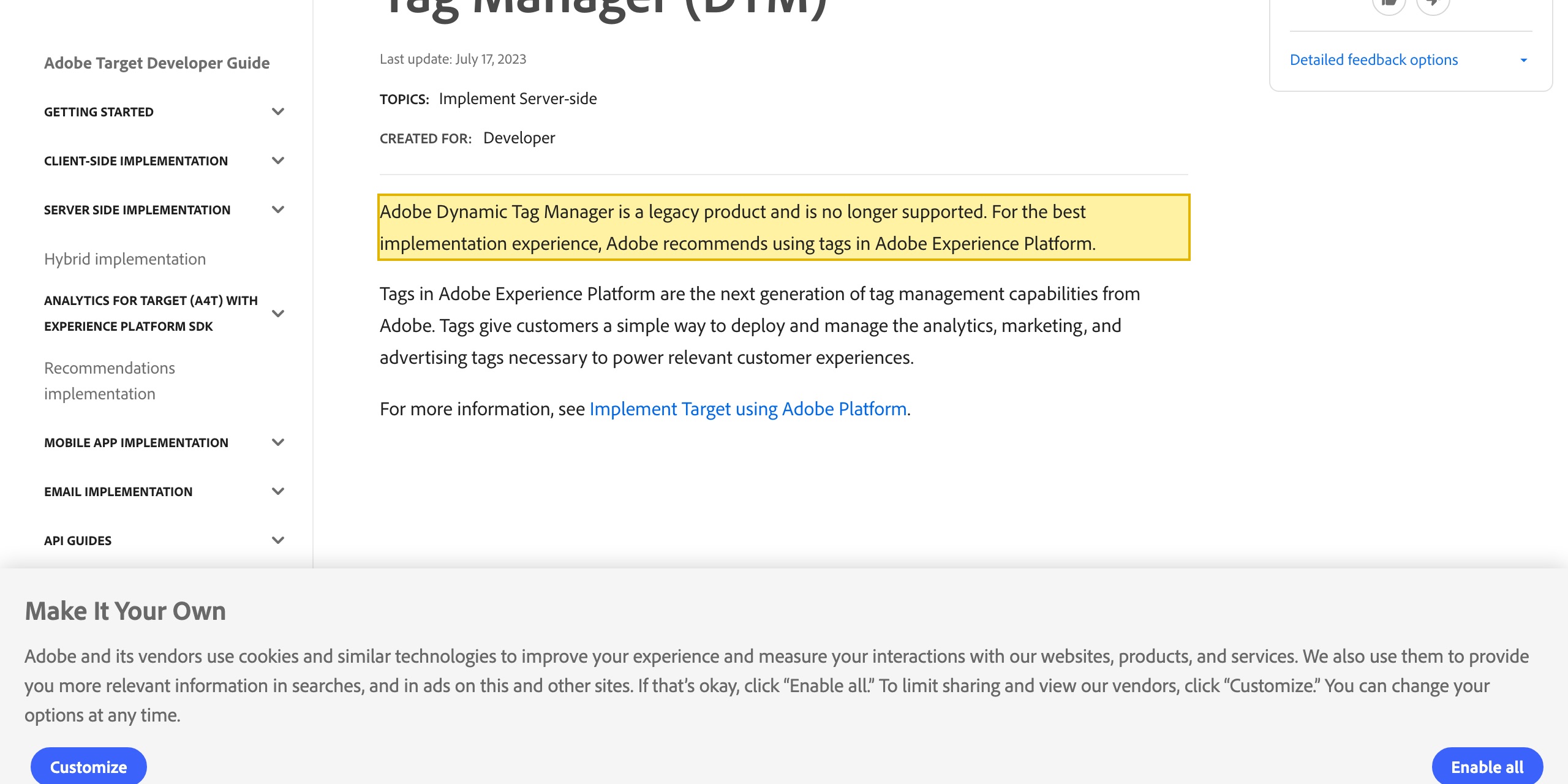
Whether Adobe Dynamic Tag Management "works" in China is really two questions, and the first has nothing to do with China: DTM is a retired product. In Adobe's own documentation it is "a legacy product and is no longer supported," with new work directed to Tags in Adobe Experience Platform (formerly Launch).
If you are still running DTM for a mainland-China audience, two things decide what it does to you. First, it is a client-side tag manager — one hosted library, embedded in every page and fetched from Adobe's infrastructure outside mainland China, that every other tag waits on; that cross-border dependency is a delivery matter, not a legal one. Second, the tags DTM fires — analytics, advertising, marketing — collect your visitors' data and send it to offshore endpoints, and that cross-border transfer of personal information is what PIPL governs. The compliance weight rides on the tags, not on the manager. The table below sets out Adobe's own wording and the rules it triggers.
This is a risk picture, not a verdict — your obligations turn on which tags you run, your data volumes and your role. Our China team can map your tag-and-data exposure with you →
What Adobe Dynamic Tag Management's own documentation says about China
| Fact | Primary source |
|---|---|
| In Adobe's own words: "Adobe Dynamic Tag Manager is a legacy product and is no longer supported." For new implementations, "Adobe recommends using tags in Adobe Experience Platform," which "are the next generation of tag management capabilities from Adobe" (the product formerly called Launch). So before any China question, running DTM means running a retired, unsupported product. | Adobe Experience League — Implement Target using Dynamic Tag Manager (DTM), retrieved 2026-10-07 |
| DTM is a client-side tag manager: a single hosted library, embedded in every page, that loads and fires your analytics, advertising and marketing tags. That library and the tags it orchestrates are served from Adobe's infrastructure outside mainland China, so each is a cross-border fetch from a visitor's browser — and because every tag waits on the manager loading first, a slow or blocked offshore fetch degrades the whole measurement layer at once. This is a delivery fact, not the compliance question. | Adobe — Tag management (product overview), retrieved 2026-10-07 |
| The tags DTM injects collect personal information — identifiers, page and click behavior, device and network data — and send it to endpoints outside mainland China. PIPL governs that cross-border transfer: the personal-information handler (you, the site operator — not Adobe) must give notice, obtain separate consent, and satisfy one transfer mechanism — a CAC security assessment, the CAC standard contract, or certification. | PIPL Chapter III, Articles 38–43 |
| The exposure scales with volume and role, not merely with using a tag manager: under the CAC's March 2024 cross-border rules, a non-CIIO transferring fewer than 100,000 individuals' non-sensitive personal information in a calendar year is exempt from the security assessment, standard contract and certification. | CAC — Regulations on Promoting and Regulating Cross-border Data Flows, March 2024 |
| For a CIIO or large-volume handler, personal information collected in China must be stored inside mainland China (Cybersecurity Law Article 39 (formerly Article 37); PIPL Article 40). Offshore tag endpoints cannot satisfy that, so keeping your China users' data on Chinese soil means collecting and storing it on infrastructure inside the mainland — not on tags that report to endpoints abroad. | PIPL Article 40; Cybersecurity Law Article 39 (formerly Article 37) |
Sources verified by the 21YunBox compliance team on 2026-10-07.
For a mainland-China audience, the first thing to know about Adobe Dynamic Tag Management is that it is a retired product. In Adobe’s own documentation it is “a legacy product and is no longer supported,” and new work is pointed to tags in Adobe Experience Platform (the successor formerly called Launch). So “does DTM work in China” splits into two honest questions — should you still be running it at all, and, if you are, what does a tag manager served from offshore and firing third-party tags do to your China compliance. Reachability is a delivery matter; the data those tags carry is the compliance one; and the product underneath both is one Adobe has already sunset.
Adobe Dynamic Tag Management in China at a glance
| What decides it | In Adobe's own terms — and what it triggers |
|---|---|
| Is it still supported? | No. Adobe calls DTM “a legacy product” that “is no longer supported,” and directs new work to tags in Adobe Experience Platform (formerly Launch). Running DTM means running a retired product. |
| How it's delivered | A client-side tag manager — one hosted library, embedded in every page and served from Adobe's infrastructure outside mainland China, that loads and fires your other tags. Every tag on the page waits on that offshore library first. |
| Is it reachable? | It is not China-specific delivery; the library and its tags are fetched across the border. If that offshore fetch is slow or fails, the tags it orchestrates slow or fail with it. That is a reachability matter, not the compliance question. |
| What the tags carry | The analytics, advertising and marketing tags DTM fires collect visitor data and send it to offshore endpoints — a cross-border transfer of personal information PIPL governs. The weight rides on the tags, not the manager. |
| Data residency | For a CIIO or large-volume handler, personal information collected in China must stay in the mainland (CSL Article 39 (formerly Article 37); PIPL Article 40). Offshore tag endpoints cannot meet that. |
A retired product before it is a China question
Set China aside for a moment and the decision is already made for you. On Adobe’s own implementation documentation, “Adobe Dynamic Tag Manager is a legacy product and is no longer supported,” and “Adobe recommends using tags in Adobe Experience Platform,” which it describes as “the next generation of tag management capabilities from Adobe.” That successor is the product Adobe first shipped as Launch and now runs inside Adobe Experience Platform Data Collection.
A tag manager that is no longer supported is not a neutral thing to leave in your pages: there are no fixes, no new integrations, and no vendor-side maintenance behind the library every one of your pages loads. For a China audience that is the opening fact, not a footnote — any plan to “make DTM work in China” is a plan built on a stack Adobe has already end-of-lifed.
A single offshore dependency every tag rides on
DTM is a client-side tag manager, which means its whole shape is one hosted library embedded in your pages that loads, orders and fires every other tag — analytics, advertising, consent, marketing. That library is served from Adobe’s infrastructure outside mainland China, so for a visitor in Shanghai or Shenzhen it is a cross-border fetch, and because the individual tags wait on the manager loading first, one slow or unreachable offshore request can hold up the entire measurement and marketing layer at once.
This is a delivery characteristic, not a legal one, and it is honest to keep the two apart: reaching the library is about the network path, while whether you may use what the library does is about the data it moves. We do not publish a DTM-specific reachability measurement, so there is no number to quote here — only the structural point that a single offshore dependency in front of every tag is a fragile place to stand for a mainland audience.
The compliance weight is in the tags it fires, not the manager
A tag manager does not, by itself, carry much personal information — its job is to inject the tags that do. Those tags collect identifiers, page and click behavior, device and network data from your visitors and report them to endpoints outside mainland China. Under China’s Personal Information Protection Law that is a cross-border transfer, and the personal-information handler — you, the site operator, not Adobe and not the tag vendors — has to give notice, obtain separate consent, and clear one transfer mechanism: a CAC security assessment, the CAC standard contract, or certification.
How far that reaches depends on volume and role rather than on merely having a tag manager installed. For a critical information infrastructure operator or a large-volume handler, personal information collected in China must be stored inside the mainland (PIPL Article 40; Cybersecurity Law Article 39 (formerly Article 37)) — a residency duty offshore tag endpoints cannot satisfy. Below the CAC’s volume thresholds, lighter obligations apply. The through-line is that the exposure lives in which tags you run and what they collect, and DTM is the thing that decides when each of them fires.
This is a risk map, not a verdict: whether you need consent flows, a transfer mechanism, in-country storage, or simply a migration off a retired tag manager depends on your tags, your data volumes and your role — worth settling with counsel before you build.
Where 21YunBox fits — a compliant overlay, not a migration
You keep your site and your measurement stack where they are. We add the piece a retired, offshore tag manager cannot: compliant, ICP-filed delivery from inside the mainland, placed in front of your existing origin — no rebuild, no second codebase, and no forced switch of analytics vendor. Our China team maps which of your tags carry personal data across the border, assesses your PIPL cross-border and data-residency exposure for your entity and data volumes, and stands up the in-country delivery and storage a lawful China presence needs — whether you stay on DTM for now or move to tags in Adobe Experience Platform.
Related reading:
- Cross-border data transfers under PIPL
- China’s Personal Information Protection Law (PIPL), in full
- How to get an ICP filing for China