Does LinkedIn Insight Tag Work in China? PIPL Cross-Border, Profiling Consent & Data Transfer
The LinkedIn Insight Tag fires a conversion and retargeting pixel that sends each mainland visitor's URL, IP address, device and browser characteristics and a timestamp to LinkedIn offshore — yet LinkedIn's platform left mainland China in 2021. A compliance-first look at the PIPL cross-border transfer, Article 24 profiling and separate-consent exposure, and the lawful in-country path.
Does LinkedIn Insight Tag work in China?
The real question isn't whether you can add LinkedIn's Insight Tag — it's what happens when it fires on a visitor in mainland China, where LinkedIn's own platform no longer operates: the tag is dead weight that still exports behavioral personal information.
LinkedIn sunset its localized China service in 2021 and shut its jobs-only successor (InJobs, later InCareer) on August 9, 2023, so there is essentially no mainland LinkedIn audience to retarget — yet wherever the tag resolves it still collects the URL, referrer, IP address, device and browser characteristics and a timestamp and sends them to LinkedIn offshore. That makes it a PIPL cross-border transfer of personal information (Articles 38–40) and an Article 24 profiling mechanism for professional-demographic ad targeting, each needing separate, informed consent (Articles 13/23) you almost never have. The lawful lever is not to make the offshore tag load — it is to gate or suppress it for mainland visitors and, where you still need measurement or advertising to reach Chinese users, route it through a licensed in-country alternative, with the China-facing site itself on ICP-filed in-country delivery.
This is a risk map, not a verdict — which duties bite turns on what the tag collects, your data volumes, your role as handler and who your users are, so settle the specifics with counsel. Our China team can map your exposure →
What LinkedIn Insight Tag's own documentation says about China
| Fact | Primary source |
|---|---|
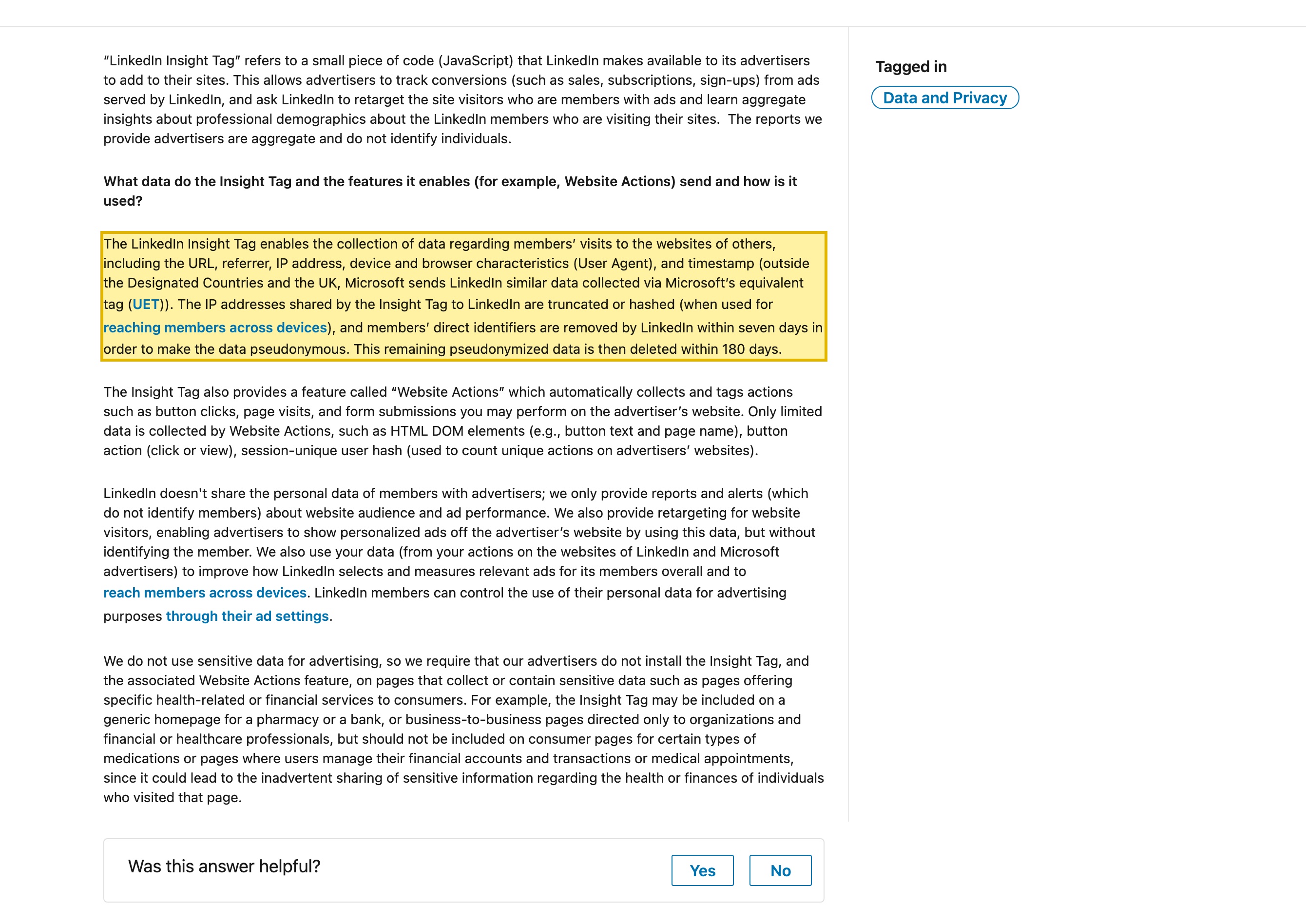
| LinkedIn's own help page lists what the Insight Tag collects — and it is personal information. LinkedIn states the tag "enables the collection of data regarding members' visits to the websites of others, including the URL, referrer, IP address, device and browser characteristics (User Agent), and timestamp," shared to LinkedIn. Under PIPL an IP address, a device and browser fingerprint and online identifiers are personal information, so firing the tag on a mainland visitor is personal-information processing — not an anonymous count. | LinkedIn Help — Data from others: LinkedIn Insight Tag and Website Actions, retrieved 2026-10-10 |
| LinkedIn's platform no longer operates in mainland China, so for a mainland audience the tag is dead weight. LinkedIn sunset its localized China service in 2021 and replaced it with a jobs-only app, InJobs (later InCareer); it then discontinued that successor "effective August 9, 2023." With no mainland LinkedIn audience to retarget or match against — and a third-party call you do not control that can stall the page — the tag delivers no value in the mainland while still exporting behavioral data wherever it resolves. | LinkedIn Help — InCareer Discontinuation: Important Information, retrieved 2026-10-10 |
| Sending the tag's data to LinkedIn offshore is a cross-border transfer under PIPL. Because LinkedIn processes the data outside the mainland, collecting mainland visitors' behavioral data into it is a cross-border transfer (数据出境) governed by PIPL Articles 38–40 — notice, a separate consent, and one transfer mechanism (a CAC security assessment, the CAC standard contract, or certification). Above volume or sensitivity thresholds a data-export security assessment may apply before anything leaves. | PIPL Articles 38–40; CAC data-export measures |
| Retargeting and demographic reporting are automated profiling that needs separate consent. Building audience profiles to decide which ad follows which visitor is automated decision-making for commercial marketing under PIPL Article 24, which requires transparency, fairness, and an option not based on the individual's characteristics or an easy way to refuse. Setting the tracking cookies needs consent before the tag fires (Article 13), providing the data to LinkedIn needs its own separate consent (Article 23), and the offshore transfer needs a further one — a single cookie banner does not discharge all three. | PIPL Articles 13, 23, 24 |
Sources verified by the 21YunBox compliance team on 2026-10-10.
The question teams ask about the LinkedIn Insight Tag in China is usually whether it still fires — whether the conversion and retargeting pixel loads. For a mainland audience that is the wrong test. LinkedIn sunset its localized China service in 2021 and shut its jobs-only successor — InJobs, later renamed InCareer — on August 9, 2023, so its consumer platform no longer operates in the mainland. That makes the tag two things at once: dead weight, because there is essentially no mainland LinkedIn audience to retarget or match against, and a third-party call you do not control that can stall a page for visitors in China; and, wherever it does resolve, a latent export of behavioral personal information. In LinkedIn’s own words the tag collects the URL, referrer, IP address, device and browser characteristics and a timestamp, and sends them to LinkedIn offshore. The decision is a compliance one, on three prongs: a cross-border transfer of personal information, Article 24 profiling, and the separate consent that behavioral tracking requires.
LinkedIn Insight Tag in China at a glance
| What decides it | In LinkedIn Insight Tag's own terms — and China's law |
|---|---|
| What the tag collects | LinkedIn's own help page says the Insight Tag "enables the collection of data regarding members' visits to the websites of others, including the URL, referrer, IP address, device and browser characteristics (User Agent), and timestamp." Under PIPL an IP address, a device and browser fingerprint and online identifiers are personal information — so firing it on a mainland visitor is personal-information processing, not an anonymous count. |
| Where that data goes | The data is shared to LinkedIn — a US company (Microsoft) whose consumer platform withdrew from the mainland — so it comes to rest offshore. Collecting mainland visitors' data into it is a cross-border transfer (数据出境) under PIPL: notice, a separate consent, and one transfer mechanism (Articles 38–40). The handler on the hook is you, the site operator — not LinkedIn. |
| Profiling for ads | The tag exists to retarget visitors and report "aggregate insights about categories of members interacting with your ads" — professional-demographic profiling used for commercial marketing. PIPL Article 24 adds transparency and fairness duties and requires an option not based on the individual's characteristics, or an easy way to refuse. |
| Consent, three times over | Setting the tag's tracking cookies and identifiers needs a lawful basis — for non-essential tracking, consent before it fires (Article 13); providing the data to LinkedIn is a provision to a third party needing its own separate consent (Article 23); and the offshore transfer needs a further separate consent (Articles 38–40). A single cookie banner does not discharge all three. |
| Is it reachable? | Treat reachability as the delivery half, not the question. Because LinkedIn's platform left the mainland, the tag is dead weight for a mainland audience — and a call you do not control that can stall the page — while still exporting behavioral data wherever it resolves. The lawful lever is to gate or suppress it for mainland visitors and use a licensed in-country alternative, never to make the offshore tag load; the China-facing site itself earns an ICP filing bound to in-country hosting. |
What the pixel actually sends — and where
The Insight Tag is not an anonymous counter. On its member-facing help page, LinkedIn describes it in its own words: it “enables the collection of data regarding members’ visits to the websites of others, including the URL, referrer, IP address, device and browser characteristics (User Agent), and timestamp.” LinkedIn adds that the IP addresses it receives are “truncated or hashed” and that “members’ direct identifiers are removed by LinkedIn within seven days” to make the data pseudonymous — but that is handling after the fact. At the moment the tag fires on a visitor in China, an IP address, a device-and-browser fingerprint, the page they are on and a timestamp are collected and sent to LinkedIn, and under PIPL those online identifiers are personal information from the instant of collection. Cookies let LinkedIn link visits to member accounts, and if you enable enhanced matching you can also send hashed email addresses — richer identifiers, the same direction of travel.
Where it goes is the heart of it. The recipient is LinkedIn, a US company owned by Microsoft, and LinkedIn’s consumer platform no longer operates in mainland China: it sunset the localized service (cn.linkedin.com) in 2021, replaced it with a jobs-only app — InJobs, later renamed InCareer — stripped of the social feed, and then discontinued that successor on August 9, 2023. So there is no mainland LinkedIn data region to send to, and essentially no mainland LinkedIn member audience to retarget or match against. That is the sub-type that makes this page different from a data-residency case: the tag is dead weight for a mainland audience — it buys you nothing, and the third-party resource it loads is one you do not control, so a stalled or failed call can degrade the page for visitors in China. Yet none of that makes it harmless. Dead weight for your campaign, it is still a live export for your compliance posture: wherever the call does resolve, it ships the behavioral data offshore all the same.
It’s a cross-border transfer and a profiling mechanism — under PIPL
Because LinkedIn processes the tag’s data outside the mainland, collecting your China visitors’ behavioral data into it is a cross-border transfer (数据出境) under China’s Personal Information Protection Law. The handler — you, the site operator, not LinkedIn — owes notice, a separate consent for the overseas transfer, and one transfer mechanism: a CAC security assessment, the CAC standard contract, or certification (Articles 38–40). Above certain volumes, or where the data is “important data,” China’s data-export security assessment (数据出境安全评估) may apply before anything lawfully leaves. For a critical information infrastructure operator or high-volume handler there is a storage duty on top: personal information generated in the mainland must stay in the mainland — PIPL Article 40; Cybersecurity Law Article 39 (formerly Article 37) — the 2025 Cybersecurity Law amendment, in force January 1, 2026, renumbered the data-localization article from 37 to 39, substance unchanged — a duty an offshore ad platform cannot meet.
The transfer is only half the exposure. The Insight Tag exists to build audience profiles — to retarget visitors and report demographic insights about who interacted with your ads — and deciding which ad follows which visitor on the strength of a profile is the textbook case PIPL Article 24 governs: automated decision-making used for commercial marketing. The article requires the process to be transparent and its outcomes fair, and — for marketing aimed at individuals — that you offer an option not based on their personal characteristics, or a convenient way to refuse. A China-facing flow that only knows how to target by profile does not meet that on its own. And none of the three consents the law expects — consent before the cookie is set (Article 13), a separate consent to provide the data to LinkedIn (Article 23), a further separate consent for the offshore transfer — is captured by a buried “by using this site…” notice.
Making the offshore pixel reachable is the wrong fix — what actually works
The instinct to “just make the tag reach LinkedIn from the mainland” gets the problem backwards. Reachability was never the compliance question, and forcing the offshore call to complete would cure none of the exposure above — not the missing consent, not the Article 24 profiling duty, not the cross-border transfer. It would do the opposite: turn a tag that fails intermittently into one that exports your mainland visitors’ behavioral personal information reliably, every time, without a lawful basis. That is more liability, not less.
What actually works runs the other way. Inventory which ad and tracking pixels fire on your mainland-facing pages and what each one sends offshore; then gate, suppress or defer the LinkedIn Insight Tag for visitors in China, so it serves only to consented, out-of-scope audiences, and honor the Article 24 right to refuse. Where you still need measurement or advertising to reach Chinese users, route it through a lawful, licensed in-country advertising-and-analytics alternative — a domestic platform — rather than the offshore tag, so the China-side data is collected and kept in the mainland on a lawful basis. That is localization in the real sense: stopping the unconsented offshore export and replacing it with a compliant in-country path, not tunneling the offshore tag back to life. This is a risk map, not a verdict — which duties actually bite turns on what your tag collects, your data volumes, your role under Chinese law, and who your users are, so settle the specifics with counsel before a China campaign relies on any of it.
The lawful path — map, localize, deliver
You do not have to drop the LinkedIn Insight Tag from your global site to run compliantly for mainland China. 21YunBox is a compliant overlay, not a migration — and, for the markets where LinkedIn serves you, a partner alongside your stack, not a competitor to the platform. There are three moves, and they fit together.
Map. Our China compliance team inventories which ad and tracking pixels fire on your mainland-facing pages, what behavioral personal information each sends offshore — for the Insight Tag, the URL, referrer, IP address, device and browser characteristics and timestamp — and where you lack a lawful basis: the consent your flow must capture before anything fires, the separate consent that provision to LinkedIn and the cross-border transfer each need, and the Article 24 options you owe on profiled marketing. The legal conclusions are settled with your counsel; we build the technical picture that feeds them.
Localize. Because you cannot localize a third-party ad network, we gate or suppress the offshore Insight Tag for mainland visitors behind consent, and where you still need measurement or advertising to reach Chinese users we stand up a lawful, licensed in-country alternative so the China-side data stays in the mainland on a lawful basis — while you keep LinkedIn for the markets where it already works. 21YunBox never uses or suggests circumvention of any kind. The point is to end the unconsented offshore export, not to make the offshore tag load anyway.
Deliver. The China-facing site that carries your tags is a public internet information service in the mainland, so it needs an ICP filing and compliant, in-country delivery. The 21YunBox Optimizer delivers it in-country, set in front of what you already run, with no rebuild and no re-platform. The result is a site that runs legally and compliantly for your users in China.
Related reading:
- Cross-border data transfers under PIPL
- China’s Cybersecurity Law and data localization (Article 39)
- China’s data-export security assessment measures
- How to get an ICP filing for China