Does Square Work in China? Supported Countries, the Payment License & Cross-Border Seller Data
Square — Block, Inc.'s payments, point-of-sale and commerce platform — is not available to businesses in mainland China. Square's own International Availability page confirms card payment acceptance only in eight markets (the US, Canada, Australia, Japan, the UK, Republic of Ireland, France and Spain), the mainland is not one of them, and even Square's POS hardware is not approved for use there. But availability was never the real question: acquiring payments from the public in the mainland is a licensed activity under State Council Order No. 768 (in force May 1, 2024), and every payer, seller and customer record Square holds offshore is a PIPL cross-border transfer. A compliance-first look at the supported-countries list, the payment-license gate, the cross-border data duties, and the lawful China-facing path.
Does Square work in China?
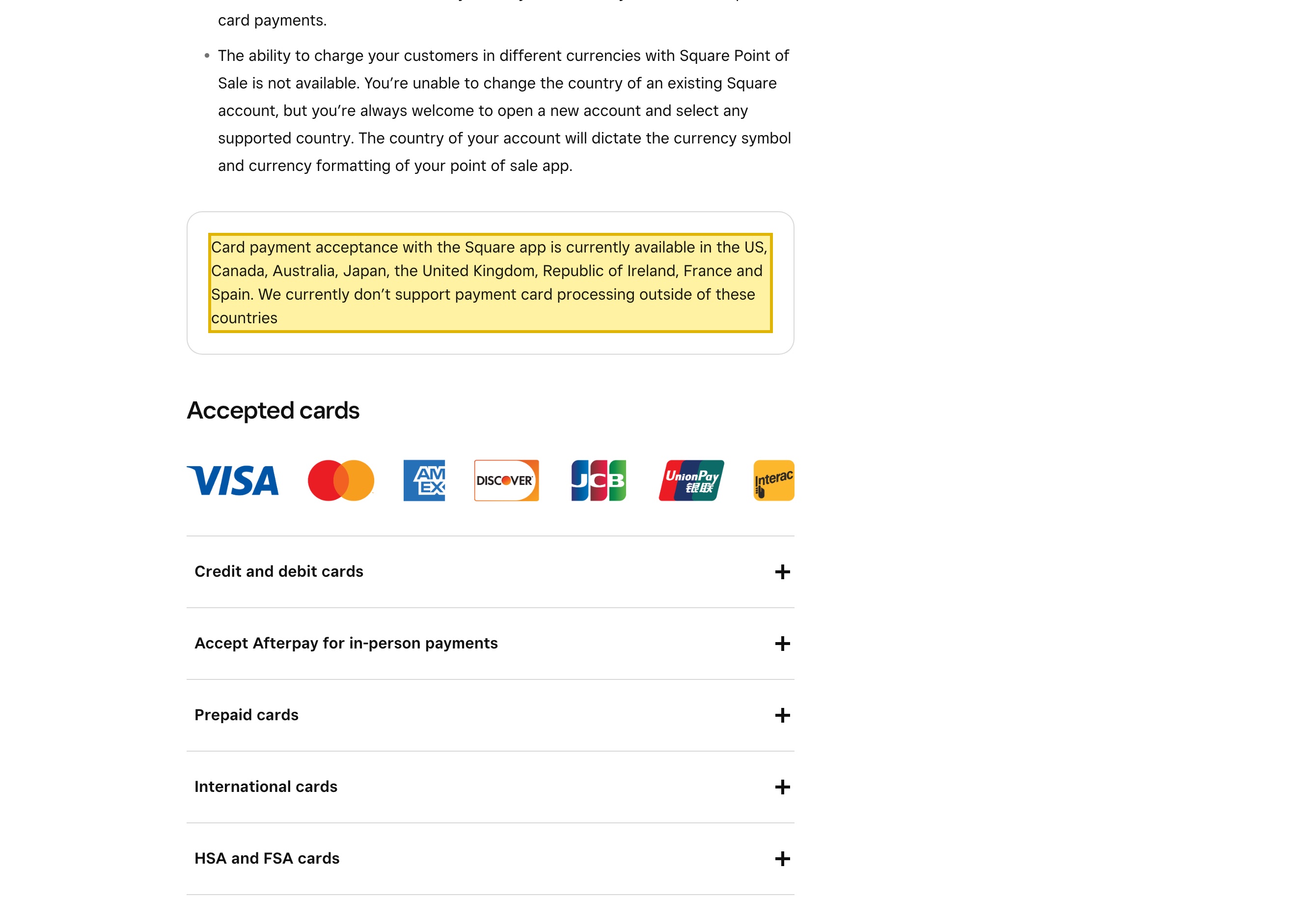
Square does not support businesses based in mainland China, so the first answer is simply that it is not available to a mainland merchant. Square's own International Availability page limits card payment acceptance with the Square app to eight markets — the US, Canada, Australia, Japan, the United Kingdom, Republic of Ireland, France and Spain — and the mainland is not among them; even Square's point-of-sale hardware is not approved for use outside those countries. A mainland-based business cannot open a Square account to accept card payments there.
Because availability is settled, the real question for a China-facing checkout is a licensing one, not a speed one. Accepting payments from the public in the mainland is a licensed activity: under the Regulations on the Supervision and Administration of Non-Bank Payment Institutions (State Council Order No. 768, in force May 1, 2024), a foreign non-bank provider that wants to serve mainland users with cross-border payments must first establish a licensed non-bank payment institution inside China. On top of that, a payer's card details and the seller and customer records a Square account holds, once sent offshore, are a PIPL cross-border transfer, with domestic settlement and data-residency duties under Order No. 768 and the Cybersecurity Law Article 39 (formerly Article 37). The lawful route runs through a licensed China payment institution and domestic methods — never around a block.
On payments our role is lighter and advisory: 21YunBox does not issue or hold a China payment license and is not a payment institution. We map the licensed-local path and your PIPL and licensing exposure, help you localize the checkout onto a compliant collection option, and deliver the China-facing storefront in-country on ICP-filed infrastructure. We never use or suggest circumvention. Treat the specifics as a risk to confirm with counsel.
What Square's own documentation says about China
| Fact | Primary source |
|---|---|
| Square does not support mainland-China businesses. Square's International Availability help article states: “Card payment acceptance with the Square app is currently available in the US, Canada, Australia, Japan, the United Kingdom, Republic of Ireland, France and Spain,” and that Square does not “support payment card processing outside of these countries.” Mainland China is not among the eight supported markets, and Square adds that hardware “sold or intended for sale in the United States is not approved for use in” the other markets — so a mainland-based business can neither open a Square account nor deploy Square hardware to accept payments there. | Square, “International Availability” help article (squareup.com), retrieved 2026-10-09 |
| A foreign provider needs a China payment license to acquire mainland payments. China's Regulations on the Supervision and Administration of Non-Bank Payment Institutions (非银行支付机构监督管理条例, State Council Order No. 768, in force May 1, 2024) provide in Article 2 that a non-bank institution outside China that intends to provide cross-border payment services to users within the mainland must establish a non-bank payment institution within China — i.e., hold a payment business license (支付业务许可 / 支付牌照) approved by the People's Bank of China. | Regulations on the Supervision and Administration of Non-Bank Payment Institutions, State Council Order No. 768, Art. 2 (gov.cn), promulgated 2023-12-09, in force 2024-05-01 |
| Settlement and data storage for domestic transactions must stay in China, and localization bites for big or critical handlers. Order No. 768 requires that transaction processing, fund settlement, and data storage for domestic transactions be completed within China (Article 19); and where a payment institution is a critical information infrastructure operator or processes personal information above the state threshold, that personal information must be handled within China (Article 33). | Regulations on the Supervision and Administration of Non-Bank Payment Institutions, State Council Order No. 768, Arts. 19 and 33 (gov.cn), in force 2024-05-01 |
| A payer's card and personal data sent offshore is a PIPL cross-border transfer. Sending a mainland payer's name, card or account identifiers, and order records — or the seller and customer records tied to a Square account — to infrastructure outside China triggers PIPL Articles 38–40: notice, a separate consent distinct from the agreement to buy, and one transfer mechanism — a CAC security assessment, the CAC standard contract, or certification. | Personal Information Protection Law of the PRC, Articles 38–40 (cac.gov.cn), retrieved 2026-10-09 |
Sources verified by the 21YunBox compliance team on 2026-10-09.
For a mainland-China audience, the first question about Square is not how fast its checkout renders or how quickly its card reader taps through — it is that Square is not available to businesses in mainland China at all. Square is Block, Inc.’s payments, point-of-sale and commerce platform: card and tap-to-pay acceptance, online checkout, POS hardware, and the seller and customer records that sit behind them. But Square’s own International Availability page limits card payment acceptance with the Square app to eight markets — the US, Canada, Australia, Japan, the United Kingdom, Republic of Ireland, France and Spain — and the mainland is not one of them. A business in mainland China cannot open a Square account to accept card payments there, and Square’s readers and terminals are not approved for use outside those same markets either. So for a China-facing product the starting point is plain: Square is not a way to take money from mainland customers as the merchant on record there.
Because availability is already settled, the decision moves to a different axis — a regulatory one, and specifically a licensing one. Accepting payments from the public in mainland China is a licensed activity, not a technical integration, and none of the gates that decide it is measured in milliseconds: whether a foreign provider may acquire mainland payments at all without a China payment license; whether the payer’s card details — and the seller and customer personal information a Square account holds — once sent to infrastructure outside the mainland, make a lawful cross-border transfer under PIPL; and, underneath both, whether the China-facing checkout or storefront that carries the payment is itself licensed (ICP-filed) and served in-country. The lawful way to take money from Chinese customers runs through those gates — never around a block, and never through circumvention of any kind.
Square in China at a glance
| What decides it | In Square's own terms — and China's law |
|---|---|
| What it is | Square is Block, Inc.'s payments, point-of-sale and commerce platform — card and tap-to-pay acceptance, online checkout, POS hardware, and the seller and customer records behind them. It is operated from outside the mainland; there is no Square payment entity or China payment license inside mainland China. |
| Can a mainland-China business use it? | No. Square's own International Availability page limits card payment acceptance to eight markets — the US, Canada, Australia, Japan, the United Kingdom, Republic of Ireland, France and Spain — and the mainland is absent. Square hardware is not approved for use outside those markets, and you must be in the country where the account was activated to process cards. A mainland business cannot open a Square account to accept payments there. |
| The payment-license gate (支付牌照) | Acquiring and settling payments as an institution inside the mainland needs a payment business license. Under the Regulations on the Supervision and Administration of Non-Bank Payment Institutions (State Council Order No. 768, in force May 1, 2024), a non-bank institution outside China that intends to provide cross-border payment services to users within the mainland must establish a non-bank payment institution within China (Article 2). A foreign provider without one cannot acquire mainland payments directly. |
| Payer, seller & customer data | A checkout — and a Square account — carries payer card details plus seller and customer personal information. Sent to infrastructure offshore, that is a PIPL cross-border transfer (Articles 38–40): notice, a separate consent, and one transfer mechanism. Order No. 768 also requires domestic transaction processing, settlement and data storage (Article 19), with in-China storage for CII operators and large-volume handlers (Article 33; Cybersecurity Law Article 39 (formerly Article 37)). |
| The lawful path | Collect through a licensed China payment institution and the domestic payment methods your customers use, with the China-facing storefront delivered in-country on an ICP-filed footing. 21YunBox maps that path and delivers the storefront — on payments its role is advisory, not a license: we do not issue or hold a payment license, and we never use or suggest circumvention. |
Availability: Square does not support mainland-China businesses
Square’s position is set on its own International Availability page, not by a load-time test. Card payment acceptance with the Square app is confined to eight markets — “the US, Canada, Australia, Japan, the United Kingdom, Republic of Ireland, France and Spain” — and mainland China is not among them. The page is explicit that this is the whole list, not a sample: Square does not “support payment card processing outside of these countries.” A business based in the mainland therefore cannot open a Square account to acquire card payments there.
Square is also a point-of-sale company, and the hardware is tied to the same geography. Square states that its readers and terminals are country-bound — hardware “sold or intended for sale in the United States is not approved for use in” the other markets — and that “You must be located in the country where you activated your account to process card payments.” There is no mainland-China entry on either list, so neither the software nor the terminals reach a mainland seller as a compliant acquirer.
That makes the usual “does the checkout load from Shanghai?” framing beside the point. Whether a page happens to render on a given day is not the question — Square does not support a mainland-based business as the merchant of record, so there is no compliant acquiring relationship to speak of for collecting mainland payments through Square in the first place. For that reason this page publishes no first-party China latency figure for Square: speed is the wrong axis for a service that is not available to a mainland business at all. And to be unambiguous — there is no lawful route around that, and 21YunBox neither provides nor suggests circumvention of any kind. The productive question is a different one: how to take payments from Chinese customers lawfully.
The licensing gate: a foreign provider cannot acquire mainland payments directly
Suppose you do want to charge customers in mainland China. The first gate is not which reader or SDK you wire in — it is whether a foreign provider may acquire mainland payments at all. Accepting payments from the public is a licensed activity in China, governed at the top level by the Regulations on the Supervision and Administration of Non-Bank Payment Institutions (非银行支付机构监督管理条例, State Council Order No. 768, promulgated December 9, 2023 and in force since May 1, 2024). These Regulations establish the payment business license (支付业务许可, commonly a 支付牌照) that every non-bank payment institution must hold, approved by the People’s Bank of China — and, decisively for an overseas provider, Article 2 provides that a non-bank institution outside the territory of China that intends to provide cross-border payment services to users within the mainland must establish a non-bank payment institution within China, unless the State provides otherwise.
In plain terms: a foreign payment platform that has not established a licensed non-bank payment institution inside the mainland cannot lawfully acquire payments from mainland users on its own. That is the structural reason a supported-countries list stops where Square’s does, and it is a gate no account setting or integration flag clears. Whether and how Order No. 768 applies to your specific flow — where your merchant entity sits, where funds are acquired and settled, which rails you use — and whether any exception fits your structure, is a risk to confirm with qualified counsel against what you actually ship. One thing is clear up front: 21YunBox is not a payment institution and holds no China payment license, so this door is one we help you map, not one we walk through for you.
The cross-border data story: card, seller and customer records are personal information
The second gate is the data, and Square holds more of it than a bare authorization. A payment is never just an amount — it carries the cardholder’s name, card or account identifiers, billing details, and an order record tied to a real person. A Square account also holds seller and customer records: directories, receipts, loyalty and the rest of the commerce ledger. Collected from a user in the mainland and sent to infrastructure outside China, all of that is a cross-border transfer of personal information under China’s Personal Information Protection Law. PIPL puts the duty on the handler — the merchant, not only the processor: Articles 38–40 require notice, a separate consent distinct from the customer’s agreement to buy, and one transfer mechanism — a CAC security assessment, the CAC standard contract, or certification.
Payment law layers its own residency duties on top. Order No. 768 requires that, where a non-bank payment institution provides payment services for domestic transactions, transaction processing, fund settlement, and data storage be completed within China (Article 19); and for an operator whose systems are designated critical information infrastructure, or that processes personal information above the state-set threshold, the personal information collected and generated in the mainland must be handled within the mainland (Article 33). The same data-localization logic runs through the Cybersecurity Law, whose in-country storage duty for critical information infrastructure now sits at Article 39 (formerly Article 37, renumbered by the 2025 amendment in force January 1, 2026, with its substance unchanged). None of this turns on how fast an authorization returns; it turns on whether the data had a lawful basis to leave the country, and whether it had to stay in the first place. Which of these bite your specific case is a risk to confirm with counsel against what you actually collect and store.
The lawful path — map, localize, deliver (advisory on the license)
There is a lawful way to take money from Chinese customers, and it has a shape: payments are collected through a licensed China payment institution and the domestic methods customers actually use, settlement and data stay on a compliant footing, and the storefront that carries the checkout is licensed and served in-country. The common pattern is to route the China-facing checkout to a licensed local payment institution and the mainland’s dominant domestic payment methods — rather than to acquire directly as a foreign merchant — while Square keeps its place for the markets where it already serves you. Which arrangement fits depends on your entity, your volumes, and your data; settle it with counsel and a licensed local payment partner before you build.
Underneath that choice sits the part 21YunBox owns, and it is worth being honest about how much of it is ours. On payments specifically, our role is lighter and advisory than it is for delivery. 21YunBox does not issue or hold a China payment license and is not a payment institution; the license, and the acquiring relationship, sit with a licensed China payment institution and your counsel, not with us. What we do on that footing is three things. We map the lawful path — a licensed local payment institution and domestic methods — alongside your PIPL, data-residency and licensing exposure, so you know exactly what counsel and a local partner need to confirm before anything ships. We help you localize the China-facing checkout onto it — adopting and integrating that compliant, China-legal collection option in place of a Square flow that cannot be acquired in the mainland — while the payer, seller and customer data that must stay in China is kept on a China-resident footing. And we deliver the China-facing storefront or app in-country on ICP-filed infrastructure — the 21YunBox Optimizer, in front of the stack you already run, with no rebuild and no re-platform. What we never do — and what no one lawfully can — is give you a way to acquire mainland payments through a service that is not available there, or route traffic around any block: we map a lawful collection path and deliver the storefront, and we never use or suggest circumvention of any kind. The result is a China-facing checkout that runs legally and compliantly for your users in China.
Related reading:
- China’s Regulations on the Supervision and Administration of Non-Bank Payment Institutions (Order No. 768)
- Cross-border data transfers under PIPL
- China’s Cybersecurity Law — data localization (Article 39, formerly Article 37)
- How to get an ICP filing for China