Does PayPal Work in China? The Payment License, the GoPay Route & Cross-Border Data
PayPal is the notable exception among foreign payment providers in China: through its GoPay (Guofubao) entity it became the first foreign payments platform licensed to provide online payment services in the mainland. But for a foreign merchant collecting from mainland users, that is a licensing and data-residency story, not a drop-in integration — China's Regulations on the Supervision and Administration of Non-Bank Payment Institutions (State Council Order No. 768) require an offshore provider to operate through a licensed in-China payment institution, with transaction processing, settlement, and data storage kept in-country. A compliance-first look at the payment license, the GoPay route, transaction-data residency, and the lawful way to put a China-facing checkout in front of mainland users.
Does PayPal work in China?
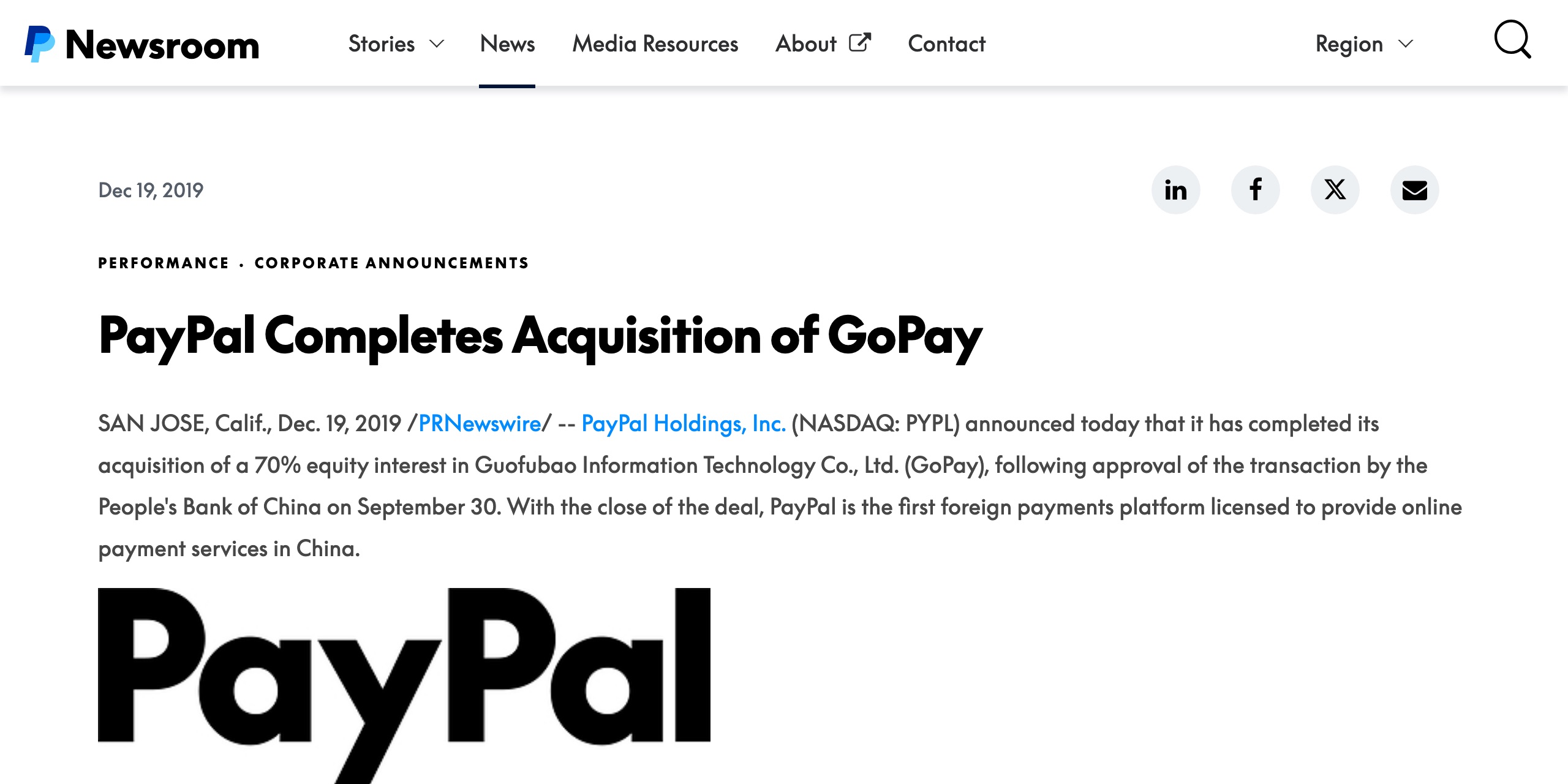
PayPal is the notable exception among foreign payment providers: it has a licensed in-China route. Through its GoPay (Guofubao) entity it became, in its own words, "the first foreign payments platform licensed to provide online payment services in China" (PayPal Newsroom, Dec 19, 2019) — so unlike most offshore providers, which hold no mainland payment license, PayPal has a licensed domestic footing.
But for a foreign merchant that wants to collect from mainland users, that is a licensing and data-residency story, not a drop-in integration. China's Regulations on the Supervision and Administration of Non-Bank Payment Institutions (State Council Order No. 768, effective May 1, 2024) require an offshore provider to operate through a licensed in-China payment institution (Article 2), with domestic transactions' processing, settlement, and data storage kept in China (Article 19). Any user or transaction data that leaves the mainland is a PIPL cross-border transfer, and where a critical information infrastructure operator is involved, data-localization under the Cybersecurity Law, Article 39 (formerly Article 37), applies. PayPal's current China product is oriented to cross-border flows, not domestic consumer collection.
21YunBox maps the lawful payment path, localizes your China-facing checkout onto a compliant route, and delivers the storefront in-country on ICP-filed infrastructure — so your China checkout runs legally. We are not a payment institution and do not issue or hold a payment license; that sits with the licensed in-China entity you contract with. Treat the specifics as a risk to confirm with counsel, and we never use or suggest circumvention of any kind.
What PayPal's own documentation says about China
| Fact | Primary source |
|---|---|
| PayPal holds a licensed in-China route through GoPay. PayPal's newsroom states: "With the close of the deal, PayPal is the first foreign payments platform licensed to provide online payment services in China." It followed People's Bank of China approval on September 30 (2019) and completed PayPal's acquisition of a 70% equity interest in Guofubao Information Technology Co., Ltd. (GoPay); registry records reported in January 2021 indicate PayPal later reached full ownership. | PayPal Newsroom, "PayPal Completes Acquisition of GoPay," Dec 19, 2019 (newsroom.paypal-corp.com), retrieved 2026-10-08 |
| An offshore provider must operate through a licensed in-China payment institution. China's Regulations on the Supervision and Administration of Non-Bank Payment Institutions (非银行支付机构监督管理条例, State Council Order No. 768, effective May 1, 2024) provide in Article 2 that a non-bank institution outside China that intends to provide cross-border payment services to users within China shall establish a non-bank payment institution within China, unless the State provides otherwise. | Regulations on the Supervision and Administration of Non-Bank Payment Institutions, State Council Order No. 768, Article 2 (gov.cn), retrieved 2026-10-08 |
| Transaction processing, settlement, and data must stay in China. Under Article 19 of State Council Order No. 768, where a non-bank payment institution provides payment services for domestic transactions it shall complete transaction processing, fund settlement, and data storage within China; cross-border transactions must follow the rules on cross-border payment, cross-border RMB, foreign-exchange administration, and cross-border data flow. | Regulations on the Supervision and Administration of Non-Bank Payment Institutions, State Council Order No. 768, Article 19 (gov.cn), retrieved 2026-10-08 |
| Data sent offshore is a PIPL cross-border transfer. Moving a mainland user's personal information — payer identity, contact, order, or transaction records — outside China triggers PIPL Articles 38–40: notice, a separate consent, and one transfer mechanism (a CAC security assessment, the CAC standard contract, or certification). | Personal Information Protection Law of the PRC, Articles 38–40 (cac.gov.cn), retrieved 2026-10-08 |
Sources verified by the 21YunBox compliance team on 2026-10-08.
For a mainland-China audience, the first thing to settle about PayPal is not how fast a checkout page renders — it is a licensing question, and on that question PayPal is unusual. Most foreign payment providers hold no payment license inside mainland China; PayPal is the notable exception. Through its GoPay entity — Guofubao Information Technology Co., Ltd. — PayPal became, in its own words, “the first foreign payments platform licensed to provide online payment services in China” after the People’s Bank of China approved its acquisition of a controlling stake in 2019, and registry records reported in January 2021 indicate it later reached full ownership. So unlike most offshore providers, PayPal has a licensed domestic footing in the mainland.
That makes the honest answer a two-part one. A licensed in-China route exists — but for a foreign merchant that wants to collect from mainland users, using it is a licensing and data-residency story, not a drop-in integration. Three things decide it, and none of them is latency: whether the collection runs through a licensed in-China payment institution as China’s payment statute requires; where the transaction data has to live; and whether the China-facing checkout that surfaces the payment is itself filed and delivered in-country. The lawful way to take payments from Chinese users runs through those gates — never around them, and never through circumvention of any kind.
PayPal in China at a glance
| What decides it | In PayPal's own terms — and China's law |
|---|---|
| What it is | PayPal — a global online-payments platform. Inside mainland China it operates through GoPay (Guofubao Information Technology Co., Ltd.), the licensed non-bank payment institution PayPal acquired. PayPal itself, offshore, is not a China payment-license holder; the mainland license sits with the domestic GoPay entity. |
| Is there a licensed route? | Yes — PayPal is the foreign exception. Via GoPay it became “the first foreign payments platform licensed to provide online payment services in China” (PayPal Newsroom, Dec 19, 2019). Most offshore providers — Stripe among them — hold no mainland payment license; PayPal has a licensed domestic footing. |
| Collecting from mainland users | Runs through China's Regulations on the Supervision and Administration of Non-Bank Payment Institutions (非银行支付机构监督管理条例, State Council Order No. 768, effective May 1, 2024). Article 2 requires an offshore provider that intends to serve users in China to operate through a licensed in-China payment institution — a licensing structure, not a drop-in integration. |
| Transaction data | Article 19 keeps domestic transactions' processing, fund settlement, and data storage within China; cross-border transactions must follow the cross-border-payment and cross-border-data-flow rules. Data that leaves the mainland is a PIPL cross-border transfer (Articles 38–40), and a critical information infrastructure operator also faces data-localization under the Cybersecurity Law, Article 39 (formerly Article 37). |
| What its China product does today | PayPal's current China offering is oriented to cross-border flows — Chinese sellers collecting from overseas buyers (PayPal Complete Payments, brought to China in late 2024) and inbound-traveler Weixin Pay through PayPal World — not domestic consumer collection. PayPal's own help pages state that cross-border payments cannot currently be directed to mainland-registered accounts (retrieved 2026-10-08). |
| The lawful path | Collect through the licensed in-China entity and domestic methods, keep the transaction data in-country, and deliver the China-facing checkout on ICP-filed infrastructure. 21YunBox maps that path, localizes your checkout onto a compliant option, and delivers it in-country — it is not a payment institution and does not issue a payment license. |
The licensed route: PayPal is the foreign exception
It is worth being precise about what PayPal does and does not hold, because the usual shorthand — “PayPal works in China” — hides the mechanism. PayPal the offshore platform does not hold a mainland payment license. What it holds is a controlling interest in a Chinese company that does: GoPay (Guofubao Information Technology Co., Ltd.), a licensed non-bank payment institution. The People’s Bank of China approved PayPal’s acquisition of a 70% equity interest in GoPay on September 30, 2019, the deal closed that December, and registry records reported in January 2021 indicate PayPal later took the company to full ownership. That is what lets PayPal say, in its own newsroom, that it became “the first foreign payments platform licensed to provide online payment services in China.”
Most foreign payment providers — Stripe among them — have no equivalent. They serve China-facing businesses through cross-border arrangements but hold no mainland payment-institution license of their own. PayPal’s distinctive position is exactly that it took the licensed-domestic route. For a buyer, the practical consequence is that the license question has an answer — but the answer points at a domestic, regulated entity and the statute that governs it, not at a cross-border call you can wire up from offshore.
The payment-license gate: Order No. 768
The statute that decides how any non-bank payment provider may serve mainland users is the Regulations on the Supervision and Administration of Non-Bank Payment Institutions (非银行支付机构监督管理条例, State Council Order No. 768), promulgated December 9, 2023 and in effect since May 1, 2024. It is the top-level administrative rule for the payment business license (支付业务许可), administered by the People’s Bank of China. Its Article 2 is the gate for offshore players: a non-bank institution outside China that intends to provide cross-border payment services to users within China “shall, in accordance with these Regulations, establish a non-bank payment institution within China, unless the State provides otherwise.”
That is precisely the structure PayPal built: the in-China entity is GoPay, and the license sits there. So the lawful route for collecting from mainland users is not a cross-border PayPal integration dropped onto your existing checkout — it is a licensed in-China payment institution standing behind the transaction. Whether your specific collection flow needs that structure, and how your contract with the licensed entity should be framed, is a risk to confirm with qualified counsel against what you actually ship.
Transaction-data residency and the cross-border-data story
The second gate is where the data lives. Article 19 of Order No. 768 requires that, for domestic transactions, a non-bank payment institution “complete transaction processing, fund settlement, and data storage within China”; for cross-border transactions, it must comply with the rules on cross-border payment, cross-border RMB, foreign-exchange administration, and cross-border data flow. In other words, a payment is not just money moving — it is a stream of payer identity, contact details, order records, and transaction logs, and that stream is held in-country by design.
Layered on top is China’s general data regime. Any personal information moved out of the mainland is a cross-border transfer under the Personal Information Protection Law: PIPL Articles 38–40 require notice, a separate consent distinct from the user’s agreement to pay, and one transfer mechanism — a CAC security assessment, the CAC standard contract, or certification. And where a critical information infrastructure operator is involved, the Cybersecurity Law adds an in-country storage duty for personal information and important data under Article 39 (formerly Article 37, renumbered by the 2025 amendment that took effect January 1, 2026). None of this turns on how fast the checkout confirms; it turns on whether the data had a lawful basis to leave the country at all. Order No. 768 itself routes personal-information and data violations back to PIPL, the Cybersecurity Law, and the Data Security Law (Article 52).
What PayPal’s China product actually does today
Having a licensed entity is not the same as having a drop-in way for a foreign merchant to collect renminbi from mainland consumers the way the leading local wallets do. PayPal’s current China offering is oriented to cross-border flows. The merchant-facing product it brought to China in late 2024 is built for Chinese sellers collecting from overseas buyers — settlement, reporting, and cross-border support — rather than for an offshore brand acquiring from mainland shoppers. More recently, PayPal’s inbound-traveler feature lets overseas PayPal users pay at Weixin Pay merchants across China, routed through the PayPal World network and its local partner, again a cross-border bridge rather than a domestic acquiring rail.
On the consumer side there are real limits. PayPal’s own help pages state that cross-border payments cannot currently be directed to accounts registered in mainland China, and that it does not offer payments between two mainland accounts (retrieved 2026-10-08); PayPal has also published changes to its Chinese Mainland user agreement that rework personal-account features. The honest reading for a China-facing product is therefore this: a licensed route exists through the domestic entity, but whether it fits how you want to collect — and what it obliges you to do about licensing and data residency — is the real question, and one to settle with counsel and the licensed operator before you build.
The lawful path — and where 21YunBox fits (map, localize, deliver — not a payment license)
There is a lawful way to put a China-facing checkout in front of mainland users, and it has a shape: the collection runs through a licensed in-China payment institution, the transaction data stays on a compliant footing, and the storefront that surfaces the payment is filed and delivered in-country. That is three jobs, and 21YunBox owns two of them honestly while being clear about the one it does not.
We map the lawful payment path — which licensed in-China route and domestic methods fit your model, and your PIPL and transaction-data-residency exposure under Order No. 768 and the Cybersecurity Law — so you know the obligations before you build. We localize the China-facing checkout onto a compliant, China-legal option, integrating the licensed in-China payment route and domestic methods in place of a cross-border call that cannot serve mainland consumers as a domestic rail. And we deliver the storefront in-country: the checkout page, the app, the account flow all carry an ICP filing (备案) duty and need compliant in-country delivery like any other China-facing property, which we provide on ICP-filed infrastructure — the 21YunBox Optimizer — in front of the app you already run, with no rebuild and no re-platform.
What we do not do, and are careful to be plain about, is hold or issue a payment license. 21YunBox is not a payment institution. The payment license sits with the licensed in-China entity you contract with — PayPal’s own GoPay entity, or another licensed domestic acquirer — and the money and the regulated payment activity run there. We map the path to it and we deliver the China-facing app that sits in front of it; we never route you around the license, and we never use or suggest circumvention of any kind.
Related reading:
- China’s Regulations on the Supervision and Administration of Non-Bank Payment Institutions (Order No. 768)
- Cross-border data transfers under PIPL
- China’s Cybersecurity Law (data localization, Article 39)
- How to get an ICP filing for China