Does Checkout.com Work in China? Chinese Payment Methods, Cross-Border Acquiring & the Payment License
Checkout.com is a global enterprise payment platform that supports the methods Chinese shoppers use — Alipay, WeChat Pay and UnionPay — but on its own product pages the eligible merchant locations sit outside the mainland (Hong Kong, Singapore, the UK and the Crown Dependencies), with China listed only as a buyer country, and its Country Terms name no People's Bank of China payment license. Reachability was never the real question: acquiring or settling payments as an institution inside mainland China turns on a China payment business license under State Council Order No. 768 (in force May 1, 2024), and every payer's card and personal data sent offshore is a PIPL cross-border transfer. A compliance-first look at the payment-license door, the cross-border-data door, and the lawful China-facing path.
Does Checkout.com work in China?
Yes and no: Checkout.com supports the payment methods Chinese shoppers use — Alipay, WeChat Pay, and UnionPay — but mainly so merchants outside the mainland can accept payment from Chinese customers. On its own product pages the eligible business (merchant) countries for those methods sit outside the mainland, and China is listed only as a consumer country; acquiring or settling payments as an institution inside mainland China is a different matter entirely.
That second thing is the real decision, and it is a compliance one, not a speed one. In-country payment-institution activity turns on a China payment business license: under the Regulations on the Supervision and Administration of Non-Bank Payment Institutions (State Council Order No. 768, effective May 1, 2024), an offshore provider that wants to serve mainland users cross-border must establish a non-bank payment institution within China — and Checkout.com's own Country Terms name no mainland-China entity and no People's Bank of China payment license. Underneath that, a China checkout carries payer and cardholder data — a PIPL cross-border transfer with in-China storage duties (Cybersecurity Law Article 39, formerly Article 37).
21YunBox is not a payment institution and holds no China payment license — the licensing question is one we map with you and your counsel. What we do is help localize your checkout onto a licensed China payment path and deliver the China-facing checkout in-country on ICP-filed infrastructure, with your existing Checkout.com integration left where it serves you, and never any form of circumvention. Treat the specifics as a risk to confirm with counsel.
What Checkout.com's own documentation says about China
| Fact | Primary source |
|---|---|
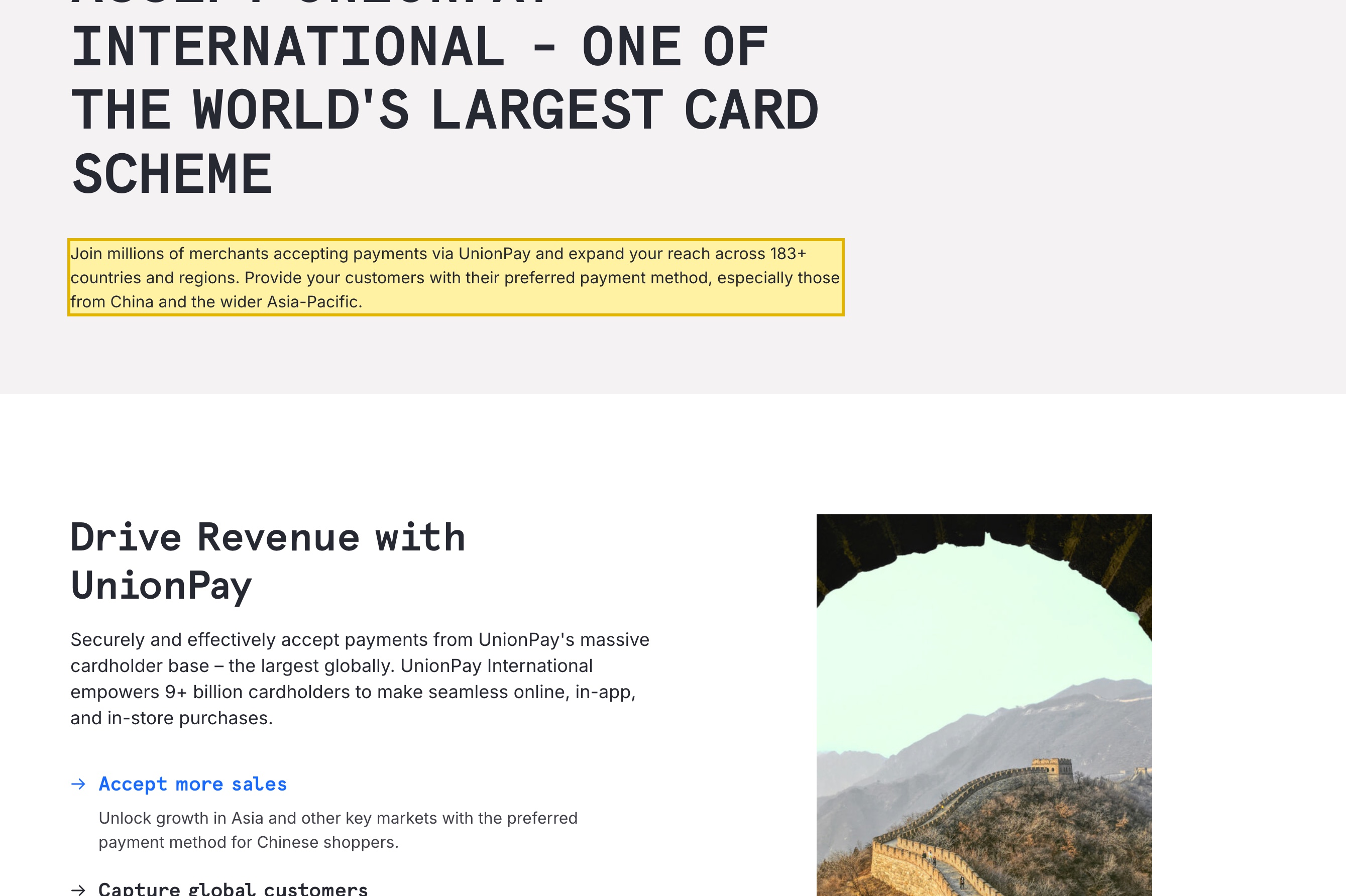
| Checkout.com's Chinese-method support is built for cross-border merchants. On its UnionPay International page, Checkout.com positions the method to “Provide your customers with their preferred payment method, especially those from China and the wider Asia-Pacific,” and lists the eligible business (merchant) countries as “Hong Kong, Singapore,” while China appears only among the consumer (buyer) countries — acceptance from Chinese shoppers, not acquiring inside the mainland. | Checkout.com, “UnionPay International” payment-method page (checkout.com), retrieved 2026-10-09 |
| The same pattern holds for WeChat Pay. Checkout.com's WeChat Pay page invites merchants to “gain access to 1.1 billion WeChat active users in and out of Mainland China,” and lists the eligible business (merchant) countries as “Hong Kong, United Kingdom, Switzerland, Gibraltar, Guernsey, Isle of Man, Jersey” — none inside the mainland — with China and Hong Kong shown only as consumer countries. | Checkout.com, “WeChat Pay” payment-method page (checkout.com), retrieved 2026-10-09 |
| Checkout.com's own Country Terms name no mainland-China license. They list licensed entities across the UK (FCA-authorized electronic money institution, no. 900816), the EEA (Checkout SAS, ACPR), Singapore (Checkout APAC Pte. Ltd., a MAS Major Payment Institution), Hong Kong (a Customs & Excise money-service-operator license), the United States (including a Georgia “Merchant Acquirer Limited Purpose Bank” charter) and the UAE — but no mainland-China entity and no People's Bank of China payment business license. | Checkout.com, “Country Terms” (checkout.com/legal/country-terms), retrieved 2026-10-09 |
| In-country payment activity needs a China payment business license, and the data carries cross-border and residency duties. Under the Regulations on the Supervision and Administration of Non-Bank Payment Institutions (非银行支付机构监督管理条例, State Council Order No. 768, promulgated December 9, 2023, effective May 1, 2024), every non-bank payment institution must hold a payment business license (Article 6), and an offshore institution serving mainland users cross-border must establish a non-bank payment institution within China (Article 2). Order No. 768 also requires domestic processing, settlement, and storage (Article 19), with in-China storage for CII operators and large-volume handlers (Article 33); sending payer or cardholder data offshore is a PIPL cross-border transfer (Articles 38–40). | Regulations on the Supervision and Administration of Non-Bank Payment Institutions, State Council Order No. 768, Arts. 2, 6, 19 & 33; Personal Information Protection Law, Arts. 38–40 (gov.cn), retrieved 2026-10-09 |
Sources verified by the 21YunBox compliance team on 2026-10-09.
For a mainland-China audience, the first question about Checkout.com is not how quickly its checkout renders from Shanghai. Checkout.com is a global enterprise payment platform and acquirer, and it genuinely supports the methods Chinese shoppers reach for — Alipay, WeChat Pay, and UnionPay — through a single integration. A business can use it to take money from Chinese customers. But “accept Chinese payment methods from cross-border shoppers” is a different thing from “acquire and settle payments as a licensed institution inside mainland China,” and that distinction is the whole decision.
Checkout.com itself draws the line on its own product pages. For each Chinese method it names the business (merchant) locations that may switch it on — Hong Kong and Singapore for UnionPay International, and Hong Kong, the United Kingdom, Switzerland and the Crown Dependencies for WeChat Pay — none of them inside the mainland, while China appears only among the consumer (buyer) countries. Its own Country Terms list licensed entities in the UK, the EEA, Singapore, Hong Kong, the United States and elsewhere, and name no mainland-China entity and no People’s Bank of China payment license. So for a China-facing product the real axis is a compliance one, on two doors: a payment-license door (支付牌照), and a cross-border-data door beneath it. Neither is about milliseconds, and neither is answered by a network workaround — 21YunBox never uses or suggests circumvention of any kind.
Checkout.com in China at a glance
| What decides it | In Checkout.com's own terms — and China's law |
|---|---|
| What it is | Checkout.com is a global enterprise payment platform and acquirer, operated from outside the mainland. By its own Country Terms it is licensed through local entities in the UK (FCA), the EEA (France, ACPR), Singapore (MAS), Hong Kong (a Customs & Excise money-service-operator license), the United States and elsewhere. It supports the methods Chinese shoppers use — Alipay, WeChat Pay, and UnionPay — through one integration. |
| Can a merchant in mainland China use it? | Not for acquiring inside the mainland. On Checkout.com's own product pages the eligible business (merchant) countries for the Chinese methods sit outside it — “Hong Kong, Singapore” for UnionPay International; “Hong Kong, United Kingdom, Switzerland, Gibraltar, Guernsey, Isle of Man, Jersey” for WeChat Pay — while China is listed only as a consumer (buyer) country. Its Country Terms name no mainland-China entity and no People's Bank of China payment license. |
| The payment-license door (支付牌照) | Acquiring and settling payments as an institution inside the mainland needs a payment business license. Under the Regulations on the Supervision and Administration of Non-Bank Payment Institutions (State Council Order No. 768, effective May 1, 2024), every non-bank payment institution must hold a payment business license approved by the People's Bank of China (Article 6), and an offshore provider that intends to serve mainland users cross-border must establish a non-bank payment institution within China (Article 2). |
| Transaction & cardholder data | A China checkout carries payer and cardholder personal information. Sending it offshore is a PIPL cross-border transfer (notice, a separate consent, a transfer mechanism; Articles 38–40), and Order No. 768 requires domestic processing, settlement, and storage (Article 19), with in-China storage for CII operators and large-volume handlers (Article 33; Cybersecurity Law Article 39, formerly Article 37). |
| The lawful path | Keep Checkout.com where it serves you — for cross-border acceptance and your other markets — put a lawful, licensed payment path in front of your China-facing checkout, then file and deliver that checkout in-country. 21YunBox maps the licensing and data exposure with you and your counsel, helps localize onto a licensed China payment path, and delivers it in-country. We are not a payment institution; the license sits with the licensed provider. |
What Checkout.com actually does: Chinese payment methods, cross-border
Begin with what Checkout.com does well, because it is real. A single Checkout.com integration can present the wallets and cards Chinese consumers expect — Alipay (including AlipayCN), WeChat Pay, and UnionPay — so a merchant can be paid in the method a shopper already trusts. On its UnionPay International page Checkout.com frames the value as reaching “your customers … especially those from China and the wider Asia-Pacific,” and it describes WeChat Pay as a way to “gain access to 1.1 billion WeChat active users in and out of Mainland China.” The center of gravity in both lines is the shopper, not the acquiring entity.
What those pages also make explicit is where the merchant has to sit. Checkout.com lists the business (merchant) countries that may enable each method, and for the Chinese wallets they are outside the mainland: Hong Kong and Singapore for UnionPay International; Hong Kong, the United Kingdom, Switzerland and the Crown Dependencies for WeChat Pay. China shows up only as a consumer country — the shopper’s location, not the merchant’s. Even the Alipay page, which markets the ability to “expand in and out of Mainland China and Hong Kong,” qualifies eligibility as “subject to service agreements, legal entity location and presence, and company compliance approval,” and the reach runs through Alipay’s own partner network rather than a Checkout.com license inside China.
That is cross-border acceptance, and it is a genuine capability: Checkout.com can help you take money from Chinese shoppers while your merchant entity sits abroad. What it is not is a license to operate as a payment institution inside mainland China. Which door you actually need turns on where your merchant entity is incorporated and where the payment is acquired and settled — and that is the first thing to settle with counsel, not a setting you toggle in a dashboard.
The first door: the China payment license (支付牌照)
Acquiring and settling payments as an institution inside the mainland is a licensed activity. The governing rule is the Regulations on the Supervision and Administration of Non-Bank Payment Institutions (非银行支付机构监督管理条例, State Council Order No. 768), promulgated December 9, 2023 and in force since May 1, 2024. They establish the payment business license (支付业务许可) that every non-bank payment institution must hold, approved by the People’s Bank of China (Article 6) — and, decisive for a foreign platform, Article 2 provides that an offshore non-bank institution that intends to provide cross-border payment services to users within China “shall … establish a non-bank payment institution within China, unless the State provides otherwise.”
Checkout.com’s own Country Terms are consistent with the offshore position: they enumerate licensed entities across the UK, the EEA, Singapore, Hong Kong, the United States, the UAE and more, but none inside the mainland, and none holding a PBOC payment license. The Hong Kong authorization is a Hong Kong money-service-operator license — a Hong Kong instrument, not a mainland one — and “UnionPay International” appears there only as a card-scheme membership, not as a China acquiring license. A provider operating from offshore, without an in-China structure and license, is positioned for cross-border acceptance, not for in-country acquiring and settlement. Whether your specific flow falls inside or outside the licensing requirement is a risk to confirm with counsel against what you actually ship. One thing is clear up front: 21YunBox is not a payment institution and holds no China payment license, so this is a door we help you map, not one we walk through for you.
The second door: cross-border transaction data and residency
Beneath the license sits the data. A checkout is rarely just an amount — it carries payer identity, contact details, order records, and cardholder information, which is sensitive financial personal information. Collected from a user in China and sent to payment infrastructure outside the mainland, that is a cross-border transfer of personal information under China’s Personal Information Protection Law: PIPL Articles 38–40 require notice, a separate consent distinct from the customer’s agreement to pay, and one transfer mechanism — a CAC security assessment, the CAC standard contract, or certification.
Payment law stacks a residency duty on top. Order No. 768 requires a payment institution serving domestic transactions to complete transaction processing, fund settlement, and data storage within China (Article 19), and requires in-China storage of personal information for institutions deemed critical information infrastructure operators or handling personal information above the state-set threshold (Article 33). The same localization logic runs through the Cybersecurity Law, whose in-country storage duty for critical information infrastructure operators now sits at Article 39 (formerly Article 37, renumbered by the 2025 amendment in force January 1, 2026). None of this turns on how fast an authorization returns; it turns on whether the payer’s data had a lawful basis to leave the country at all — and whether it was permitted to leave in the first place.
The lawful path — map, localize, deliver (advise, not acquire)
There is a lawful way to take payments from customers in mainland China, and it has a definite shape: a licensed payment path acquires and settles the transaction, the payer data stays on a compliant footing, and the China-facing checkout that carries it is filed and served in-country. Checkout.com keeps its seat in that picture — for cross-border acceptance and for your other markets — rather than being torn out.
Here is the honest division of labor, and it is deliberately narrow on payments. The license is not ours to hold or to grant: we map the licensing question together with your PIPL and data-residency exposure, with you and your counsel, so you know which door your flow needs before you build. We help localize your China-facing checkout onto a licensed China payment path — integrating a China-licensed collection route in front of the checkout, in place of a flow that cannot be acquired in the mainland — while your Checkout.com integration stays where it earns its keep. And we deliver that checkout in-country: a checkout page or app served to mainland users is itself a public service there, so it carries an ICP filing (备案) duty and needs compliant, in-country delivery like any other China-facing property — the 21YunBox Optimizer, set in front of the stack you already run, with no rebuild and no re-platform.
What we do not do — and what no one lawfully can — is route you around China’s payment-licensing or data rules. We map the path, localize your checkout onto a licensed one, and deliver it in-country; the licensing and the acquiring relationship sit with the licensed provider and your counsel, and the specifics remain a risk to confirm with them.
Related reading:
- China’s Regulations on the Supervision and Administration of Non-Bank Payment Institutions (Order No. 768)
- Cross-border data transfers under PIPL
- China’s Cybersecurity Law — data localization (Article 39, formerly Article 37)
- How to get an ICP filing for China