
What the game-publishing rules actually require
| Fact | Primary source |
|---|---|
| Article 10: Sino-foreign joint ventures, cooperative ventures and wholly foreign-owned enterprises may not engage in online publishing services — a foreign studio is prohibited from holding the licence, which is why a Chinese publisher is structural and not a market convention. | Provisions on the Administration of Online Publishing Services (Order No. 5), Article 10 |
| Article 27: an online game must be approved before it is published — provincial authority first, then the national administration. It is a prior approval, not a filing completed after launch. | Provisions on the Administration of Online Publishing Services, Article 27 |
| Articles 2 and 7: a game is an online publication, so publishing it requires an Online Publishing Service Licence from the press-and-publication regulator — separate from, and in addition to, the ICP filing every app needs from the telecoms regulator. | Provisions on the Administration of Online Publishing Services, Articles 2 and 7 |
| Article 51: publishing without approval — expressly including games licensed by overseas copyright holders — is banned outright, the site is ordered closed, and the fine is five to ten times unlawful revenue (or up to RMB 50,000 where revenue is under RMB 10,000). | Provisions on the Administration of Online Publishing Services, Article 51 |
| Online gaming sits inside China's restricted value-added telecom regime, so the publishing licence is layered on top of, not instead of, the ordinary internet-business licensing that applies to any commercial site or app. | Harris Sliwoski — China Online Gaming Laws |
| In-country delivery — the only arrangement that removes the cross-border round trip — carries the regulatory gate with it: "ICP filing applies only to servers located in the Chinese mainland", and the filing binds to the access provider, not only the domain. | Alibaba Cloud — ICP filing prerequisites |
Sources verified by the 21YunBox compliance team on 2026-08-28.
Publishing an iOS or Android mobile game in China is a venture that demands a strategic approach beyond the routine steps of uploading to the Apple App Store or Google Play. In China, the absence of Google Play necessitates navigating a diverse ecosystem comprising 400+ android app stores, each with its distinct submission protocol.
However, gaining entry into this lucrative market involves more than just store submissions. Before your game can see the light of day, it must secure a unique “game license” through a rigorous government approval process—a stage that might appear intimidating to those unfamiliar with the landscape. Thankfully, there are entities like ours that specialize in simplifying this procedure.
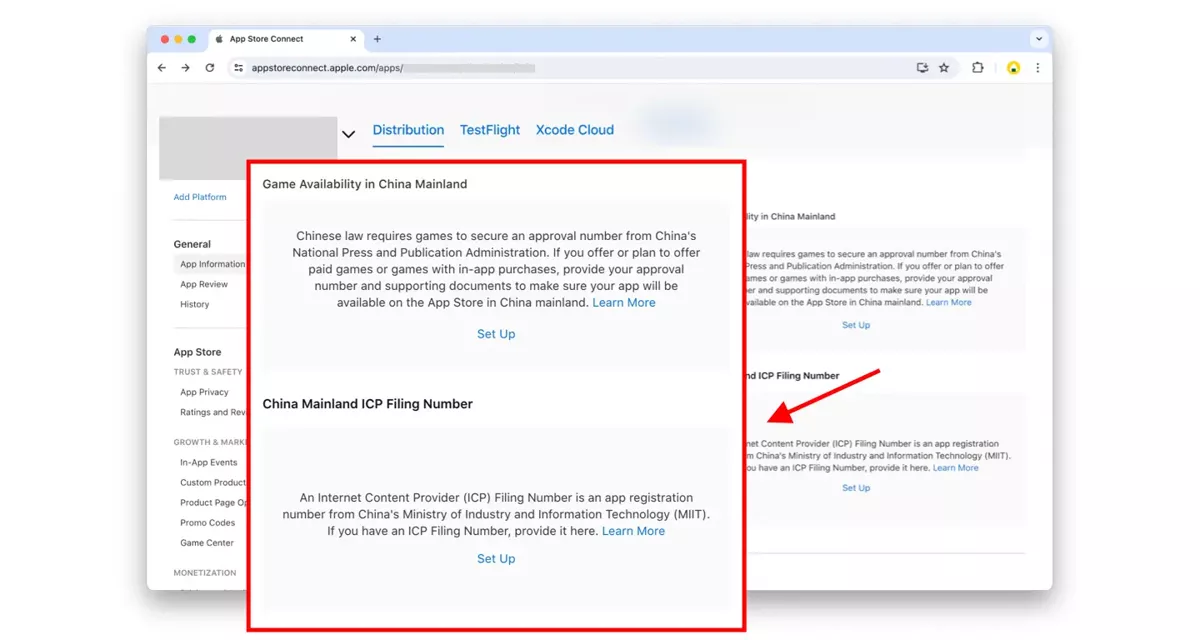
Chinese regulations mandate that all games, ranging from PC and mobile to HTML5 and Mini-games within other apps like WeChat and Douyin, must obtain this licensing. As of now, the government’s focal point seems to be on games that are monetized through either upfront payments or in-app purchases.
Despite the intricacies, the potential gains make the journey worthwhile. China presents an immense market, boasting a staggering $90 billion in revenue with a player base of over 668 million enthusiasts. In this article, we provide a concise guide on how you can tap into this expansive market.
Supercharge Your App's Success in China - Claim Your FREE Tailored Report Now?
Book a call with our legal experts to receive a personalized report outlining the essential licenses and step-by-step operations required to launch your software in China successfully.
Secure Your Free ConsultationWhat the regulation actually says
Most guidance on publishing a game in China describes the practice — find a Chinese publisher, get an ISBN, wait. The practice follows from one instrument, and reading it explains why each step exists rather than only that it does.
Instrument: 《网络出版服务管理规定》 — Provisions on the Administration of Online Publishing Services, Order No. 5 of the State Administration of Press, Publication, Radio, Film and Television and MIIT, in force since 10 March 2016. Games are online publications under it, not software.
A game is a publication, and publishing requires a licence
第二条 ……本规定所称网络出版物,是指通过信息网络向公众提供的,具有编辑、制作、加工等出版特征的数字化作品,范围主要包括:(一)文学、艺术、科学等领域内具有知识性、思想性的文字、图片、地图、游戏、动漫、音视频读物等原创数字化作品……
第七条 从事网络出版服务,必须依法经过出版行政主管部门批准,取得《网络出版服务许可证》。
Article 2. “Online publications” means digitised works provided to the public over information networks bearing publishing characteristics such as editing, production and processing, principally including original digitised works in literature, art and science — text, images, maps, games, animation, and audio-visual readers. Article 7. To engage in online publishing services one must be approved by the publishing administration authority and obtain an Online Publishing Service Licence.
In practice: this is why a game is not treated like an ordinary app. It is classed as a publication, which puts it under the press-and-publication regulator in addition to the ICP filing that every app needs from the telecoms regulator. Two regulators, two separate permissions.
And a foreign-invested company cannot hold that licence
第十条 中外合资经营、中外合作经营和外资经营的单位不得从事网络出版服务。
网络出版服务单位与境内中外合资经营、中外合作经营、外资经营企业或境外组织及个人进行网络出版服务业务的项目合作,应当事前报国家新闻出版广电总局审批。
Article 10. Sino-foreign equity joint ventures, Sino-foreign cooperative ventures and wholly foreign-owned enterprises may not engage in online publishing services. Where an online publishing service unit undertakes project cooperation with a domestic Sino-foreign joint venture, cooperative or wholly foreign-owned enterprise, or with an overseas organisation or individual, it shall obtain prior approval from the administration.
In practice: this is the single most consequential sentence for a foreign studio, and most English write-ups render it as market practice — “you will need a local publisher”. It is not practice. A foreign-invested entity is prohibited from holding the licence at all, including a wholly foreign-owned enterprise you set up yourself. That is why the publisher relationship is structural rather than optional, and the second paragraph is why the cooperation itself needs prior approval.
The ISBN is an approval before publication, not a registration after it
第二十七条 网络游戏上网出版前,必须向所在地省、自治区、直辖市出版行政主管部门提出申请,经审核同意后,报国家新闻出版广电总局审批。
Article 27. Before an online game is published online, an application must be made to the provincial publishing administration authority; after its review and consent, it is submitted to the national administration for approval.
In practice: the approval — the 版号 people refer to as the ISBN — is a prior approval with two tiers, provincial then national. It is not a filing you complete after launch the way the ICP filing works. A game cannot be lawfully published while the application is pending, which is why approval timing, not engineering, usually sets a China launch date.
And publishing without it is not a fine you budget for
第五十一条 未经批准,擅自从事网络出版服务,或者擅自上网出版网络游戏(含境外著作权人授权的网络游戏),……由出版行政主管部门、工商行政管理部门依照法定职权予以取缔,并由所在地省级电信主管部门……给予责令关闭网站等处罚;……违法经营额1万元以上的,并处违法经营额5倍以上10倍以下的罚款;违法经营额不足1万元的,可以处5万元以下的罚款……
Article 51. Engaging in online publishing services without approval, or publishing an online game online without approval (including a game licensed by an overseas copyright holder), shall be banned by the publishing administration and market regulation authorities within their statutory powers, and the provincial telecommunications authority shall order closure of the website … where unlawful business revenue is RMB 10,000 or more, a fine of five to ten times that revenue; where it is under RMB 10,000, a fine of up to RMB 50,000 …
In practice: 予以取缔 — banned outright — plus closure of the site, plus a fine calculated as a multiple of revenue rather than a fixed cap. The parenthesis matters too: it names games licensed by overseas copyright holders explicitly, so a foreign title published through a partner without approval is squarely inside this article rather than in a grey area.
Primary source: 《网络出版服务管理规定》(国家新闻出版广电总局、工业和信息化部令第5号), full text published by the State Council: gov.cn. Translations are ours and for orientation only; where the English and the Chinese differ, the Chinese governs. This page is not legal advice.
Basic Requirements
Fulfilling the Basic Business Prerequisites:
1. Establish a Chinese Corporation or Business Entity
The establishment of a Chinese corporation or business entity is a fundamental requirement. Foreign and foreign-invested companies are legally prohibited from directly publishing or operating online PC or mobile games in China, rendering them ineligible for a game license.
However, exceptions exist, with two U.S. publishers—Apple’s App Store and Steam—being rare cases allowed to operate in China without a Chinese partner.
Yet, for foreign companies to distribute their games in China and align with Chinese law, they must seek a Chinese partner to register and publish the game on their behalf. The partner will handle marketing and distribution, typically receiving a share of profits after the app store’s cut. Despite this practice, it remains a common choice for foreign companies seeking access to China’s vast and highly profitable market.
2. Get a Software Copyright Certificate (SCC) Filing (for Android Apps)
An SCC serves as evidence of registered Chinese copyright for any software. Both domestic and foreign entities, whether individuals or companies, can apply for one. Nevertheless, when it comes to games, only a Chinese corporation, business entity, or individual may publish a game in China.
During the submission process, both the Apple App Store and all independent Android app stores will request a valid SCC number, although presently the Apple App Store does not validate submitted SCCs.
Link: Guide To Software Copyright Certificates In China
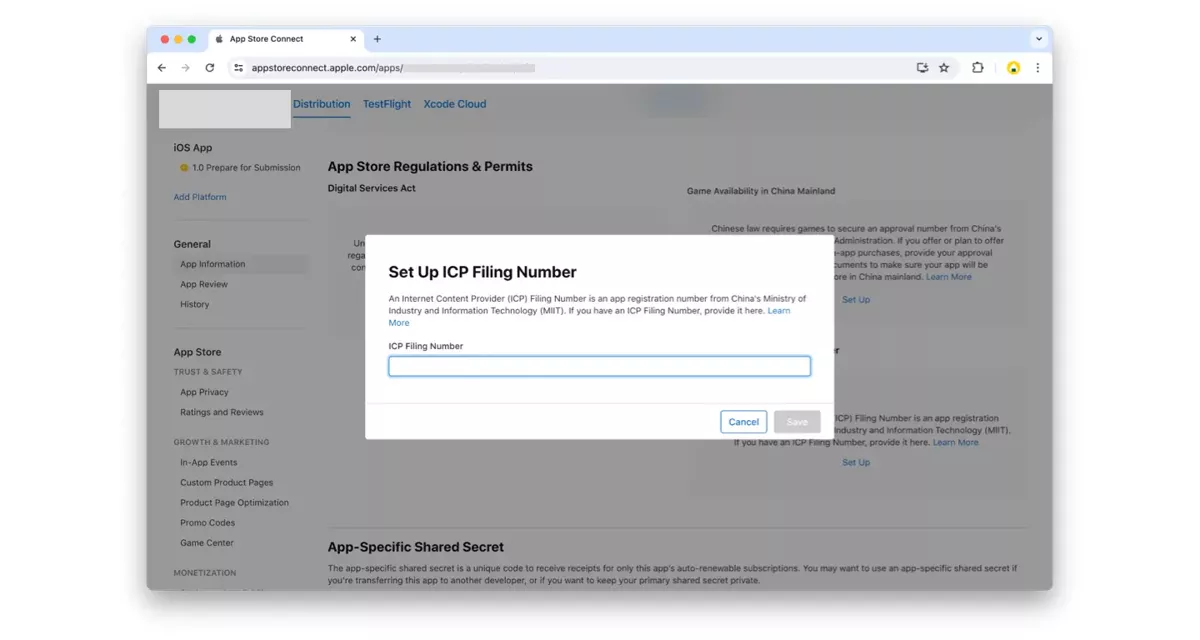
3. Get a China Mainland ICP Filing Number
Starting from September 1, 2023, all new apps must undergo the ICP Filing process before they can be published on app stores in China. This rule applies to Apple App stores, as well as all Android app stores and mini-program app stores in China.
For Existing Apps: Existing apps must provide a valid ICP Filing Number before March 31, 2024, or face removal from app stores in China. This gives app owners and companies a 10-month timeframe to obtain the necessary ICP Filing number and required licenses to operate in China.
Link: Guide To Get Mobile App ICP Filing Number in China
4. Get a Game Registration Number (GRN / ISBN)
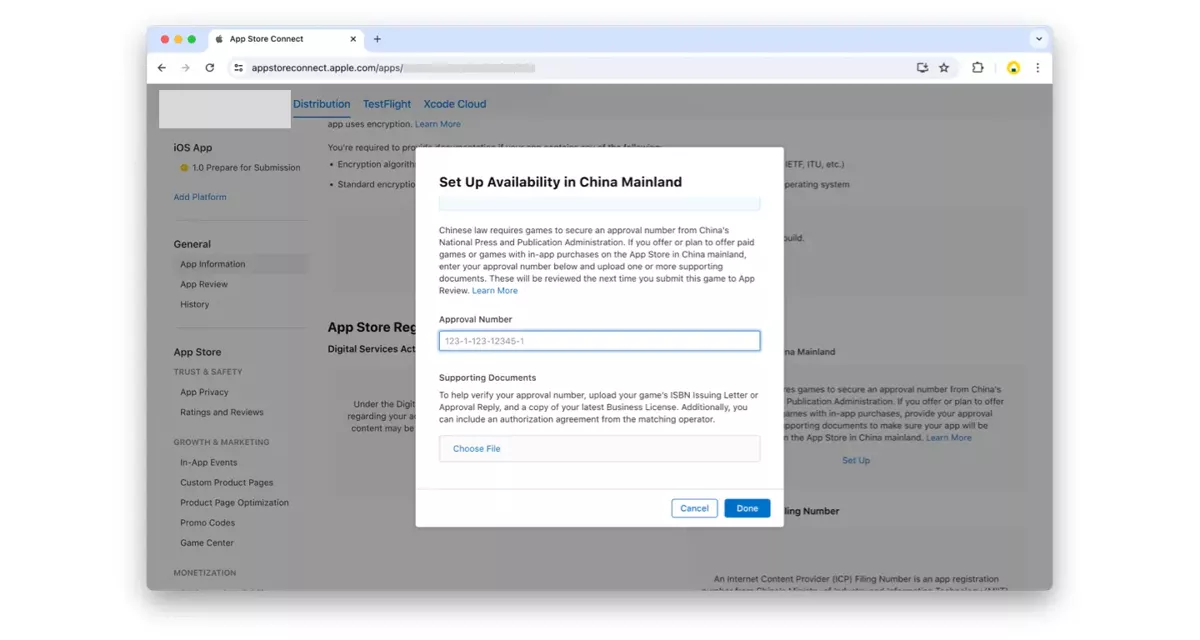
Administered by China’s National Press and Publication Administration (NPPA, 国家新闻出版署), the GRN or ISBN is essential once your game has successfully navigated the content approval process. This number, a 13-digit International Standard Book Number (ISBN), also referred to as the “Game Approval Number” by Apple, is crucial for this purpose.
“Chinese law requires games to secure an approval number from China’s National Press and Publication Administration. If you offer or plan to offer paid games or games with in-app purchases on the App Store in China mainland, enter your approval number below and upload one or more supporting documents. These will be reviewed the next time you submit this game to App Review.”
“Supporting Documents To help verify your approval number, upload your game’s ISBN Issuing Letter or Approval Reply, and a copy of your latest Business License. Additionally, you can include an authorization agreement from the matching operator.”
Link: Guide to Get The “Approval Number” in China
Game Content Requirements & Limitations
To enable revenue generation, your game must gain approval from the NPPA, adhering to a detailed list of content restrictions. Overseas game developers and publishers often find themselves modifying their games to comply with the requirements set by Chinese censors.
Link: Content Restrictions for Games and Apps in China
In 2019, several additional clarifications were issued alongside a new submission process:
1. Elimination of Mahjong or Poker Games
For the time being, the market is flooded with these games, often associated with gambling and hence not allowed.
2. Restrictions on Depicting Corpses, Skeletons, Zombies, Vampires, and Blood
Characters or players should disappear upon death, and any depiction of blood, regardless of color, is prohibited.
3. Prohibition of Collecting Concubines and Wives
This restriction applies even in historically accurate contexts, such as feudal China games.
4. Emphasizing Cultural Sensitivity
In a bid to enhance game quality, the government encourages developers to reflect China’s core social values and traditional history and culture in their games. Games should impart “correct” information on politics, law, and history, as interpreted by the authorizing agency.
5. Implement a Security Assessment Form
In adherence to the Chinese government’s restrictions on speech that may “disrupt public order,” games, while not typical platforms for political activism, require a structured process for reporting and handling potential violations in any social aspects where players can communicate. A Security Assessment Form must be on file with the appropriate government agency, detailing your system and process.
Technical Requirements
1. Real Name Verification
In compliance with Chinese regulations, it is mandatory for users to register accounts with their real names, even if they can create onscreen usernames. Typically, this is achieved by verifying the user’s phone number and linking it to their account. Many apps implement this by sending a temporary login code via text message that expires within 15 minutes.
2. Anti-Addiction Plan and Measures
China places significant emphasis on addressing youth gaming addiction and myopia since 2008. If your game has a complex online login component, measures need to be in place to restrict playtime, duration, and manner for users under 18, unless it’s a simple game like chess or a puzzle/matching game.
Link: Six measures in the “Notice on Preventing Minors from Addiction to Online Games”
3. Working Within The Great Firewall of China
Due to restrictions and performance issues with popular cloud services and dependencies like AWS, Google Cloud, and Firebase in China, it’s crucial to use services that function effectively within the country. Our Acceleration solutions bridge this gap, ensuring smooth integration and data synchronization.
Localization
To publish your game in China, thorough localization is essential. This includes translating all text into Mandarin Chinese (simplified) and recording voiceovers in Mandarin Chinese. Additionally, modifying artwork with English text and adapting character designs, stories, and maps to align with the local culture is crucial.
Various localized SDKs must be integrated to meet technical, content, and app store requirements.
App Stores In China
1. Third-Party Android App Stores
Each independent Android app store in China has its focus, with some specifically dedicated to games. Tailoring your game to the right store can enhance visibility and success. However, since integrating the store’s SDK requires a separate version for each, targeting the most promising stores minimizes maintenance efforts.
Keep in mind that Google services aren’t accessible in China, making publishing on Google Play ineffective for reaching Mainland Chinese consumers.
2. Apple App Store In China
Apple operates a distinct Apple App Store in China. Publishing your iOS game in China necessitates direct submission to this version via Apple’s developer console. The submission process is relatively straightforward, with an English interface.
3. Mobile Game Revenue Share Models In China
Chinese Android app stores typically claim a 50% share of all revenues, including purchases and ads due to mandatory SDK integrations. The Apple App Store, on the other hand, takes a 30% revenue share. Additionally, Chinese publishing partners usually retain around 70% of the remaining amount.
Despite higher fees and revenue shares, the vast Chinese market and number of Daily Active Users (DAUs) present immense profit potential for moderately popular games.
Publishing and Approval Process
1. Submission to NPPA
To initiate the licensing approval process for your game, you will need to compile and submit the following documents to the NPPA:
-
Basic Information about the Game: This includes details such as the game’s name, description, developer, and publisher.
-
Application Form
-
Publisher’s Business License
-
ICP Certificate (if required)
-
Printed Screenshots: Provide a minimum of 10 color pictures showcasing the core content and basic appearance of the game. Include at least one picture of the main menu displaying the game name.
-
Full Text of the Game: Submit the complete Chinese text that appears in the game. This encompasses system prompts, NPC dialogues, mission story descriptions, inventory item names, and more. Ensure it is provided in electronic form.
-
Explanation of the Game’s Anti-Addiction Features: Detail how the game’s anti-addiction features function. If the game doesn’t require such features, provide a rationale for their absence.
-
Administrator Accounts: Furnish adult accounts categorized into high, medium, and low access levels. These will be used to assess the game’s anti-addiction features and review content.
-
Game Installation Package: This can be submitted physically, involving three copies on three CDs or a USB flash disk. Alternatively, provide a link for downloading the game installation package.
-
Demo CD-ROM: Include a CD (3 copies) featuring a game demo video lasting at least 10 minutes. The video should showcase the game’s health warning/advice screen, game title screen, main interface and menu, all character images, accessible scenes, and systems that players can experience. For games with combat systems, ensure the actual combat demo is at least 2 minutes long. If an anti-addiction system is integrated, demonstrate anti-addiction tips and benefits at key time points.
Link: Game License Registration Procedure (SAPPRFT / NPPA)
2. Approval Times
Officially states 80+ days by NPPA. However, Approval times vary based on game complexity, ranging from simple games (less than a month) to more intricate foreign games (6-8+ months). Multiple rounds of feedback, adjustments, and re-reviews might be necessary.
Once approved, you’ll receive a Game Registration Number (GRN), signifying approval for distribution in China. This number is required for submission to both the Chinese Apple App Store and any Chinese Android app stores.
3. Publish Strategically
Strategically publishing your game involves individual submissions to each app store, ensuring alignment with their specific requirements and focus. Prioritize the top 5 Android app stores in China and the Chinese Apple App Store for iOS versions.
Note that the Apple App Store now requires a valid game registration approval number (GRN / ISBN) as of February 24, 2020.
The 21YunBox Advantage
Publishing your mobile game in China necessitates a reliable Chinese partner. 21YunBox stands as a trusted app and game publisher in the Chinese app market, offering generous revenue-sharing models that benefit developers, regardless of their game’s scale. Leveraging our expertise, your game can achieve significant success in the expansive Chinese market.
Contact our English-speaking team today to simplify this challenging process and reap the rewards.