Does Genesys Cloud CX Work in China? Contact-Center Records, Voice Licensing & Data Residency
Genesys Cloud CX runs on AWS core and satellite regions across the Americas, Europe, the Middle East, and Asia Pacific — none in mainland China — so call recordings, transcripts, and caller PII rest offshore as a PIPL cross-border transfer, while carrying mainland voice is a licensed value-added telecom activity. A compliance-first look at the two-door residency and telecom-licensing picture and the lawful China path.
Does Genesys Cloud CX work in China?
Reaching Genesys Cloud CX is never the question for mainland China — where the records it holds are allowed to come to rest, and whether the voice may lawfully be carried, is.
Genesys Cloud CX is a multitenant SaaS on AWS whose published core and satellite regions span the Americas, Europe, the Middle East, and Asia Pacific — Mumbai, Tokyo, Seoul, Osaka, Singapore, Sydney, and a Hong Kong satellite that stores call recordings — with no mainland-China region to select. So a mainland contact center's call recordings, voice transcripts, screen recordings, and case histories — much of it PIPL Article 28 sensitive personal information such as voiceprints and card or health details read aloud — come to rest offshore, which is a PIPL cross-border transfer (Articles 38–40) and can trigger in-country storage duties (Cybersecurity Law Article 39, formerly Article 37). Carrying interactive voice to and from the mainland is a second door: it is a value-added telecom service needing a Chinese Value-Added Telecommunications Business License (增值电信业务经营许可证, VATS) a foreign provider cannot hold directly, so mainland calling is best-effort through a licensed local carrier.
This is a risk map, not a verdict — settle specifics with counsel. Our China team can map your exposure →
What Genesys Cloud CX's own documentation says about China
| Fact | Primary source |
|---|---|
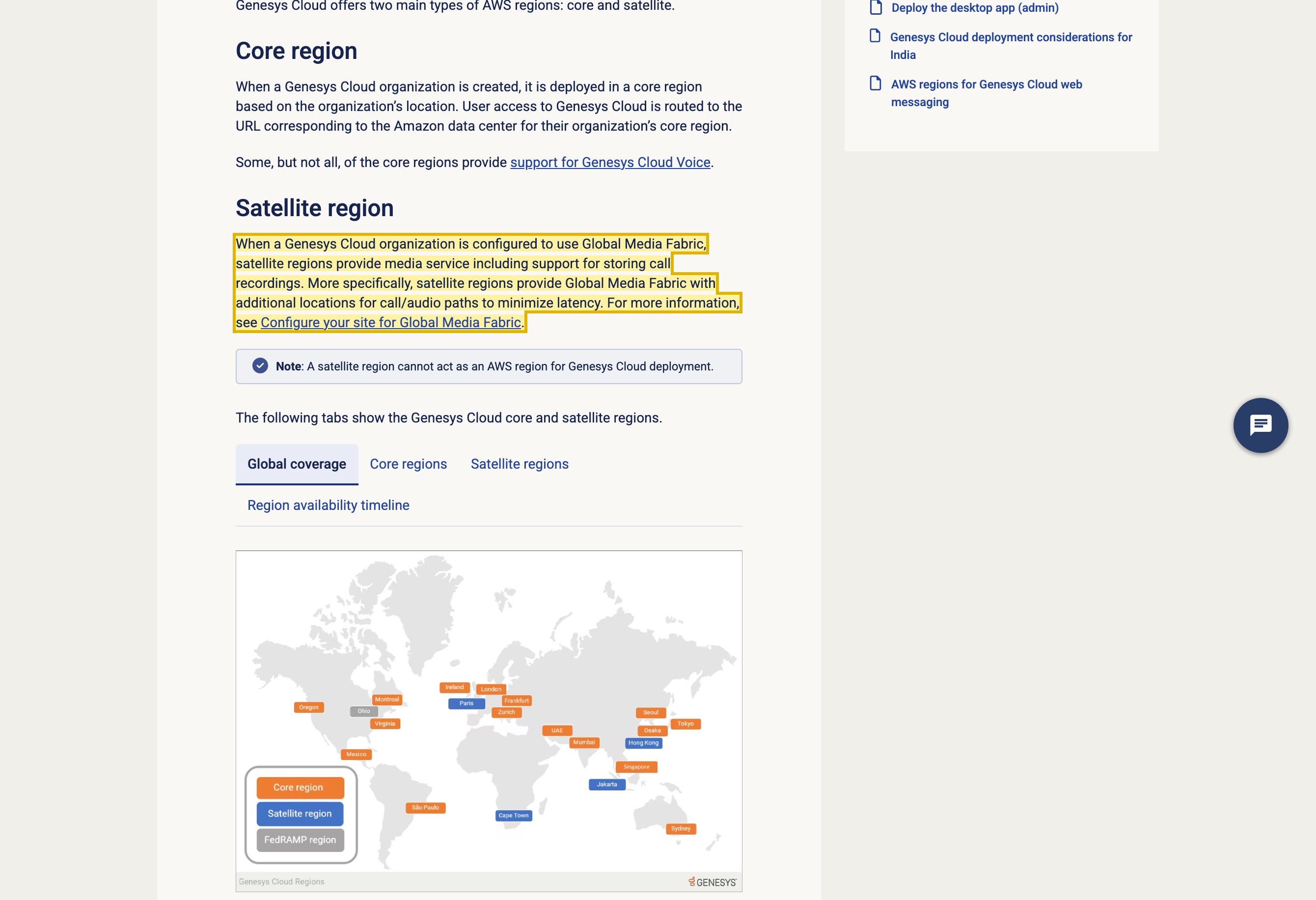
| Genesys Cloud CX has no mainland-China region, and its satellite regions are where call recordings are stored. Genesys's Resource Center states the platform “offers two main types of AWS regions: core and satellite,” that an organization “is deployed in a core region based on the organization's location,” and that “satellite regions provide media service including support for storing call recordings.” The published core regions (Americas; Europe and the Middle East; and Asia Pacific — Mumbai, Tokyo, Seoul, Osaka, Singapore, Sydney) and satellite regions (Cape Town, Paris, Jakarta, Hong Kong) include none in mainland China; the nearest is Asia Pacific (Hong Kong), a separate jurisdiction. | Genesys, “AWS regions for Genesys Cloud” (help.genesys.cloud), retrieved 2026-10-10 |
| Genesys Cloud Voice does not list mainland China among its supported countries. Genesys's “Genesys Cloud Voice global coverage requirements and restrictions” documents coverage country by country; its APAC coverage is Australia, Hong Kong, Indonesia, Japan, New Zealand, Singapore, South Korea, and Thailand — mainland China is not among them. Carrying interactive voice to and from the mainland therefore runs best-effort through a licensed local carrier rather than as a Genesys-operated, China-licensed service, and delivery is not guaranteed. | Genesys, “Genesys Cloud Voice global coverage requirements and restrictions” (help.genesys.cloud), retrieved 2026-10-10 |
| Records from mainland callers are a PIPL cross-border transfer, and much of the content is sensitive personal information. Personal information collected from mainland users and hosted offshore triggers PIPL Articles 38–40 — notice, a separate consent, and one transfer mechanism (a CAC security assessment, the CAC standard contract, or certification). Voiceprints in recordings, together with financial-account and medical information read aloud, are sensitive personal information under Article 28, which carries a higher bar of specific purpose, strict necessity, and separate consent. | Personal Information Protection Law of the PRC, Articles 28 and 38–40 (cac.gov.cn), retrieved 2026-10-10 |
| Operating interactive voice for mainland users is a licensed value-added telecom activity. China's Measures for the Administration of Telecommunications Business Licensing (电信业务经营许可管理办法, MIIT Order No. 42, in force September 1, 2017) require a business to obtain a Telecommunications Business Operating License and to operate only within the service type and coverage area it states (Articles 4 and 16); a value-added telecom operator must hold the Value-Added Telecommunications Business License (增值电信业务经营许可证, VATS), which a foreign provider cannot hold directly. In-country storage can also be required under Cybersecurity Law Article 39 (formerly Article 37). | Measures for the Administration of Telecommunications Business Licensing, MIIT Order No. 42, Arts. 4 and 16 (gov.cn), promulgated 2017-07-03, in force 2017-09-01 |
Sources verified by the 21YunBox compliance team on 2026-10-10.
For a contact center that serves mainland China, the first thing to settle about Genesys Cloud CX is not whether an agent can open the desktop or whether a call happens to connect — it is where the record of every interaction is allowed to come to rest. Genesys Cloud CX is a multitenant SaaS that runs on Amazon Web Services, and it holds the most revealing data a company keeps about its customers: call recordings, voice transcripts, chat and email logs, screen recordings, and the full case and ticket history, each tied to a named caller and a named agent. Genesys publishes the AWS regions the platform runs in — core regions across the Americas, Europe, the Middle East, and Asia Pacific, plus satellite media regions that store call recordings — and none of them is in mainland China. So for a mainland audience the interaction records are generated in China but come to rest offshore, which is exactly where China’s law begins to apply — and alongside that residency question sits a second one: whether the voice may lawfully be carried at all.
Genesys Cloud CX in China at a glance
| What decides it | In Genesys Cloud CX's own terms — and China's law |
|---|---|
| Where the records live | Genesys Cloud CX is a multitenant SaaS on AWS. It "offers two main types of AWS regions: core and satellite," with core regions across the Americas, Europe, the Middle East, and Asia Pacific (Mumbai, Tokyo, Seoul, Osaka, Singapore, Sydney), and satellite media regions that "provide media service including support for storing call recordings" (Cape Town, Paris, Jakarta, Hong Kong). None is in mainland China; the nearest is the Asia Pacific (Hong Kong) satellite, a separate jurisdiction. |
| What it holds, and why it's personal information | Call recordings, voice transcripts, chat and email logs, screen recordings, and full case and ticket histories, each tied to a named caller and agent. Voiceprints in recordings, together with card, health, or financial details read aloud and identity-verification answers, are sensitive personal information under PIPL Article 28 — a higher bar of specific purpose, strict necessity, and separate consent. |
| Carrying mainland voice | Inbound/outbound calling and PSTN termination to and from mainland China is a value-added telecom service. Operating one for mainland users needs a Value-Added Telecommunications Business License (增值电信业务经营许可证, VATS) under the Telecommunications Business Licensing Measures (MIIT Order No. 42) that a foreign provider cannot hold directly. Genesys Cloud Voice does not list mainland China among its countries, so mainland calling is best-effort through a licensed local carrier — delivery is not guaranteed. |
| Your China callers' and agents' data crosses the border | Collected in the mainland and hosted in an offshore Genesys region, the interaction data is a cross-border transfer under PIPL (Articles 38–40): notice, a separate consent, and one transfer mechanism. A data-localization duty can require data collected in the mainland to stay there — Cybersecurity Law Article 39 (formerly Article 37); the 2025 Cybersecurity Law amendment, in force January 1, 2026, renumbered the data-localization article from 37 to 39 (substance unchanged), with PIPL Article 40 for large-volume and CII handlers. |
| Reachability is not the axis | Whether an agent can open the desktop or a call connects is not the question; where the recordings and transcripts come to rest, and whether the voice may lawfully be carried, is. A China-facing surface — agent desktop, self-service portal, callback or intake form — also needs its own ICP filing to be served lawfully in-country. |
No mainland-China region, so the interaction records leave the country
Genesys documents its footprint plainly: Genesys Cloud “offers two main types of AWS regions: core and satellite,” and “when a Genesys Cloud organization is created, it is deployed in a core region based on the organization’s location.” The core regions sit in the Americas (N. Virginia, Ohio, Oregon, Canada Central, São Paulo, Mexico Central), in Europe and the Middle East (Frankfurt, Ireland, London, Zurich, a European Sovereign Region in Brandenburg, and the UAE), and in Asia Pacific (Mumbai, Tokyo, Seoul, Osaka, Singapore, and Sydney). Satellite regions — which, in Genesys’s words, “provide media service including support for storing call recordings” — add Cape Town, Paris, Jakarta, and Hong Kong. Read the whole list and the omission is the point: there is no mainland-China region to select, and the nearest node is the Hong Kong satellite, which is a separate legal jurisdiction. A mainland deployment therefore has its recordings, transcripts, and interaction history generated by callers and agents inside China but hosted in one of these offshore regions. Under China’s Personal Information Protection Law that is a cross-border transfer of personal information, and where volumes are high it can require a CAC security assessment before the data may lawfully leave.
What Genesys Cloud CX holds is personal information — and much of it is sensitive
A contact-center platform is a concentrated store of personal information. Every recording carries a caller’s voiceprint; transcripts and screen recordings capture names, account numbers, and whatever a customer reads aloud — card numbers, health complaints, financial details, identity-verification answers. Under PIPL, biometric characteristics such as voiceprints, along with financial accounts and medical information, are sensitive personal information (Article 28), which carries a higher bar: a specific purpose, strict necessity, and a separate consent. The agent-side data — names, logins, and quality-monitoring and performance records — is personal information too. Hosted in an offshore Genesys region, all of it is in scope for the cross-border rules above.
For Genesys Cloud CX the data-residency door is not the only one. Carrying interactive voice to and from mainland China — inbound and outbound calling, PSTN termination — is itself a value-added telecom service, and operating one for mainland users is a licensed activity under China’s Measures for the Administration of Telecommunications Business Licensing (电信业务经营许可管理办法, MIIT Order No. 42). It requires a Value-Added Telecommunications Business License (增值电信业务经营许可证, VATS) that a foreign provider cannot hold directly. Genesys’s own Cloud Voice coverage reflects this: its listed APAC countries are Australia, Hong Kong, Indonesia, Japan, New Zealand, Singapore, South Korea, and Thailand — mainland China is not among them. Reaching mainland numbers therefore runs on a best-effort basis through a licensed local carrier, and delivery is not guaranteed. Genesys Cloud CX is not blocked; it simply is not a China-licensed, in-country voice carrier that you operate as.
Narrowing what crosses doesn’t close the door
There are real levers to reduce what leaves the country, and they are worth using — but they change what crosses, not that it crosses. You can turn off or redact recording for sensitive queues, keep transcripts out of certain flows, choose the core region nearest your users, and tighten retention so less data persists. Each of these shrinks the volume and sensitivity of the personal information that ends up in an offshore region. None of them puts a mainland-China region under the platform, because there isn’t one to choose; the interaction data that is still recorded comes to rest outside the country, and the residency and transfer duties attach to that fact. A China-facing surface — an agent desktop, a customer self-service portal, a callback or intake form served to users in the mainland — additionally needs its own ICP filing to be served lawfully in-country, and the data-localization duty can bite for a critical-information-infrastructure or large-volume handler: personal information collected and generated in the mainland must be stored there under the Cybersecurity Law Article 39 (formerly Article 37). This page maps exposure; it does not issue a verdict. Which obligations apply to your entity, your interaction volumes, and your users is a determination to settle with qualified counsel against what you actually run.
The lawful path — map, localize, deliver
There is a lawful way to run a China-facing contact center, and it does not involve operating Genesys Cloud CX as if a mainland region existed. It has a shape: the records that must stay on mainland soil are stored and processed in-country on a consented, lawful footing; the mainland voice leg runs through a China-licensed carrier; and any China-facing surface is served from inside the country on filed infrastructure. 21YunBox is a compliant overlay, not a migration — and for an enterprise platform like Genesys Cloud CX, a partner to the vendor, not a competitor. We do three things. We map your exposure — reading the PIPL cross-border, sensitive-personal-information, data-residency, and ICP obligations, plus the value-added telecom-licence gate, against your entity, your interaction volumes, and who your callers and agents are, so you know exactly what counsel and a licensed local carrier need to confirm. We localize — standing up consented, in-country processing and storage for the recordings, transcripts, and interaction records that must remain on mainland soil, and routing the mainland voice leg onto a China-licensed carrier, while you keep Genesys Cloud CX for the markets it already serves. And we deliver any China-facing surface — the agent desktop, a self-service portal, an intake or callback form — over ICP-filed, in-country infrastructure (the 21YunBox Optimizer), in front of the stack you already run, with no rebuild and no second codebase. On the telecom leg our role is advisory and lighter: 21YunBox does not hold a China telecom license, and the license and carrier relationship sit with a licensed local provider and your counsel. The result is a contact center that runs legally and compliantly for your users in China. 21YunBox never uses or suggests circumvention of any kind.
Related reading:
- Cross-border data transfers under PIPL
- China’s Data Export Security Assessment Measures
- China’s Cybersecurity Law — data localization (Article 39, formerly Article 37)
- How to get an ICP filing for China
- China’s Measures for the Administration of Telecommunications Business Licensing (MIIT Order No. 42)