Does NICE CXone Work in China? Voice Licensing, Call Recordings & PIPL Data Residency
NICE CXone operates no mainland-China region — its own footprint spans North America, Europe, the UK, APAC, Latin America, South Africa, and the UAE — so a China deployment's call recordings, voiceprints, transcripts, and caller and agent PII come to rest offshore as a PIPL cross-border transfer. A compliance-first look at the value-added telecom-licensing gate, the sensitive-data residency duty, and the lawful China path.
Does NICE CXone work in China?
NICE CXone runs no mainland-China region, so a China deployment's call recordings, voiceprints, transcripts, and caller and agent PII come to rest offshore — and that, not reachability, is the question.
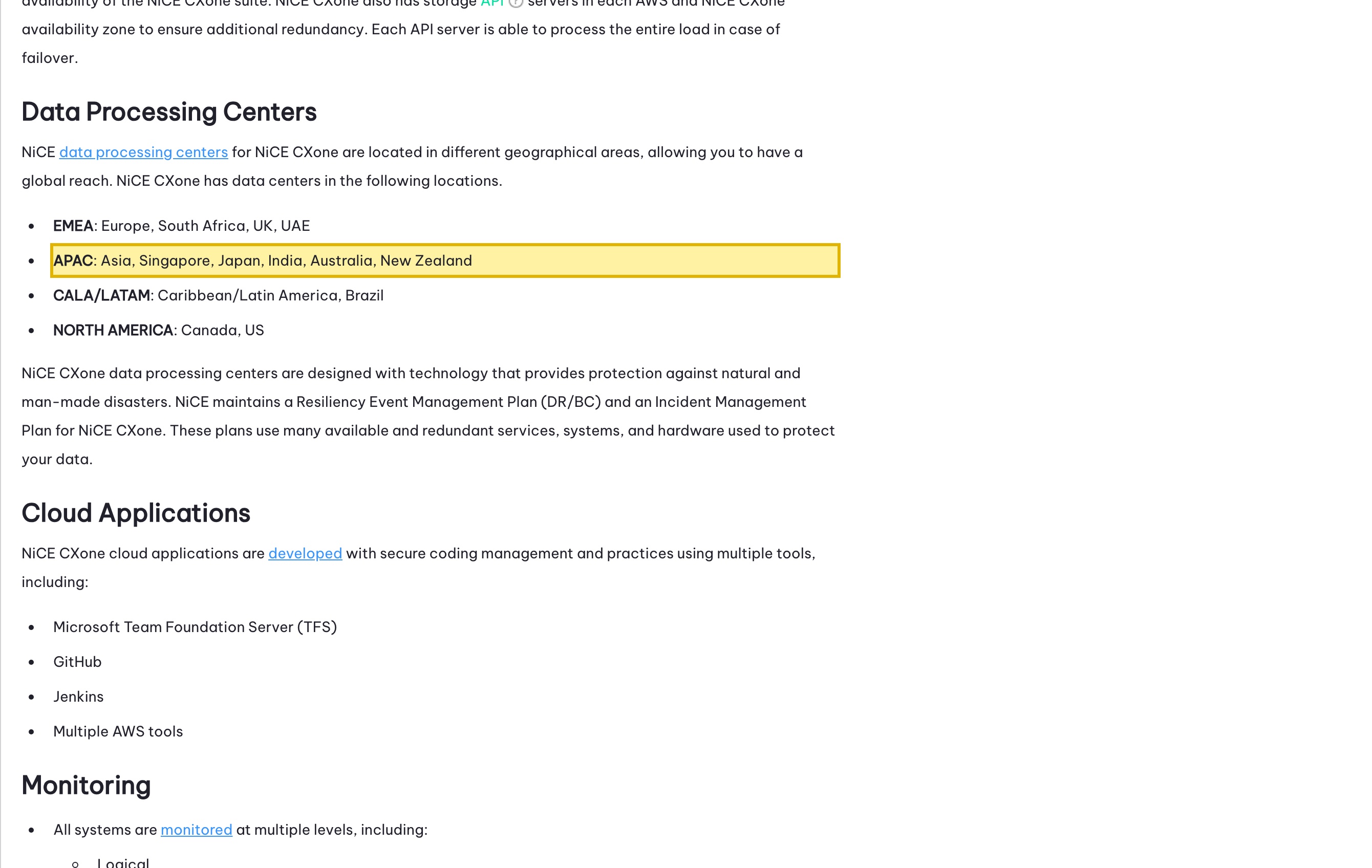
NICE's own documentation lists data centers across EMEA, APAC, CALA/LATAM, and North America — plus an EU Sovereign Cloud and a dedicated South African instance — but none in the mainland. A contact center captures the interaction itself: recordings and the voiceprints inside them, transcripts, screen recordings, chat and case histories, and agent PII — much of it sensitive personal information under PIPL Article 28. Collected from mainland callers and hosted offshore, it is a PIPL cross-border transfer, and mainland-collected personal information may have to stay in-country under PIPL Article 40 and Cybersecurity Law Article 39 (formerly Article 37). Separately, carrying interactive voice to and from the mainland is a value-added telecom activity that needs a Value-Added Telecommunications Business License a foreign provider cannot hold directly, so cross-border voice is best-effort.
21YunBox maps your exposure, localizes consented in-country storage for the records that must stay, routes mainland voice to a China-licensed carrier (we do not hold a telecom license), and delivers your China-facing surfaces on ICP-filed infrastructure — a compliant overlay, not a migration. Treat the specifics as a risk to confirm with counsel. Our China team can map your exposure →
What NICE CXone's own documentation says about China
| Fact | Primary source |
|---|---|
| NICE CXone's documented data-center footprint contains no mainland-China region. Its "Data Processing Centers" list places data centers in EMEA (Europe, South Africa, UK, UAE), APAC (Asia, Singapore, Japan, India, Australia, New Zealand), CALA/LATAM (Caribbean/Latin America, Brazil), and North America (Canada, US) — with no mainland-China location among them, so a China tenant's interaction records come to rest outside the mainland. | NiCE CXone, "General Platform and Data Protections" (help.nicecxone.com), retrieved 2026-10-10 |
| CXone's voice "super-sites" and AWS availability zones are all offshore. NICE's "AWS Data Regions and Centers" page lists paired processing centers in Dallas/Los Angeles, Culpeper/Miami, Frankfurt/Munich, Melbourne/Sydney, Rio/São Paulo, Montreal, Slough/Manchester and London, and Singapore/Tokyo, on AWS availability zones in Oregon, US East, Frankfurt, London, Montreal, Sydney, and Osaka — none in mainland China. | NiCE CXone, "AWS Data Regions and Centers" (help.nicecxone.com), retrieved 2026-10-10 |
| Interaction records from mainland callers hosted offshore are a PIPL cross-border transfer — and often of sensitive data. Call recordings, voiceprints, transcripts, and case histories are personal information; voiceprints are biometric and calls capture payment, ID, and health details, making much of it sensitive personal information under PIPL Article 28. Transfer offshore triggers Articles 38–40: notice, a separate consent, and a CAC security assessment, the standard contract, or certification. | Personal Information Protection Law of the PRC, Articles 28 and 38–40 (cac.gov.cn), retrieved 2026-10-10 |
| Carrying interactive voice to and from the mainland is a licensed value-added telecom activity a foreign provider cannot hold. China's Measures for the Administration of Telecommunications Business Licensing (电信业务经营许可管理办法, MIIT Order No. 42, in force September 1, 2017) require a Value-Added Telecommunications Business License (增值电信业务经营许可证) to operate a value-added telecom service, so cross-border voice is best-effort and the lawful route runs through a China-licensed domestic carrier. | Measures for the Administration of Telecommunications Business Licensing, MIIT Order No. 42 (gov.cn), promulgated 2017-07-03, in force 2017-09-01 |
Sources verified by the 21YunBox compliance team on 2026-10-10.
For a mainland-China audience, the question to ask about NICE CXone (now styled NiCE CXone, its AI-bundled edition marketed as CXone Mpower) is not whether an agent in Shanghai can open the console — it is where everything the platform records is allowed to come to rest. A cloud contact center exists to capture and keep the interaction itself: call recordings and the voiceprints inside them, transcripts, screen recordings, chat and email threads, IVR inputs, and the case history tied to a named caller, alongside each agent’s own PII. All of that is personal information, and much of it is sensitive. NICE documents its hosting plainly — data centers across North America, Europe, the UK, APAC, Latin America, South Africa, and the UAE, plus an EU Sovereign Cloud and a dedicated South African instance — but no mainland-China region. So for a China deployment, those records rest offshore, and that is where the compliance question begins.
NICE CXone in China at a glance
| What decides it | In NICE CXone's own terms — and China's law |
|---|---|
| Where the interaction records live | NICE CXone's own "Data Processing Centers" list places its data centers across EMEA (Europe, South Africa, UK, UAE), APAC (Asia, Singapore, Japan, India, Australia, New Zealand), CALA/LATAM (Caribbean/Latin America, Brazil), and North America (Canada, US), on AWS availability zones in Oregon, US East, Frankfurt, London, Montreal, Sydney, and Osaka. NICE also offers an EU Sovereign Cloud and a dedicated South African instance — but there is no mainland-China region or voice "super-site" to select. |
| What it holds, and why it is personal — often sensitive — information | A contact center retains the interaction: call recordings and the voiceprints inside them, voice-to-text transcripts, screen recordings, chat and email threads, IVR inputs, and case and contact history, plus the caller's and agent's PII. Voiceprints are biometric data, and calls routinely capture payment-card numbers read aloud, ID numbers, and health or financial disclosures — sensitive personal information under PIPL Article 28. |
| Your China callers' and agents' data crosses the border | Collected from callers and agents in the mainland and processed by a platform operated offshore, that interaction data is a cross-border transfer of personal information under PIPL (Articles 38–40): notice, a separate consent distinct from the service agreement, and one transfer mechanism — a CAC security assessment, the CAC standard contract, or certification. |
| In-country storage duty | Where the operator is a critical information infrastructure operator or processes personal information above the state-set threshold, the personal information collected and generated in the mainland must be stored in the mainland — PIPL Article 40 and the data-localization duty in Cybersecurity Law Article 39 (formerly Article 37; the 2025 Cybersecurity Law amendment, in force January 1, 2026, renumbered the data-localization article from 37 to 39, substance unchanged). |
| Reachability is not the axis — and voice adds a telecom gate | That an agent can open the CXone console from Shanghai decides nothing. Carrying interactive inbound/outbound voice to and from the mainland is a licensed value-added telecom activity requiring a Value-Added Telecommunications Business License (增值电信业务经营许可证) under the Measures for the Administration of Telecommunications Business Licensing (MIIT Order No. 42) — one a foreign provider cannot hold directly, so cross-border voice is best-effort and not guaranteed. The China-facing agent and self-service surface also needs its own ICP filing. |
No mainland region, so the recordings and transcripts leave the country
NICE CXone’s hosting is documented, not guessed. Its “Data Processing Centers” page lists data centers across EMEA, APAC, CALA/LATAM, and North America, and its “AWS Data Regions and Centers” page details paired “voice super-sites” — Dallas and Los Angeles, Culpeper and Miami, Frankfurt and Munich, Melbourne and Sydney, Rio and São Paulo, Montreal, Slough/Manchester and London, and Singapore/Tokyo — running on AWS availability zones in Oregon, US East, Frankfurt, London, Montreal, Sydney, and Osaka. NICE can clearly localize when it decides to build a region: it markets an EU Sovereign Cloud and, as of late 2025, a dedicated South African instance with sites in Cape Town and Johannesburg. What that same documentation does not contain is any mainland-China region, availability zone, or voice super-site.
So for a tenant serving mainland callers, the call recordings, transcripts, screen recordings, and case histories come to rest in one of those offshore regions. Carried out of the mainland to a US, EU, UK, APAC, or other offshore region, that interaction data is a cross-border transfer of personal information under the Personal Information Protection Law — and where volumes are high or the operator is designated critical information infrastructure, it may require a CAC security assessment before it may lawfully leave at all. Pinning a tenant to the nearest region — Singapore or Tokyo rather than Virginia — shortens the trip, but it does not keep the data in China: Singapore and Tokyo are as much “offshore” as Oregon, for the purposes of China’s law.
Call recordings, voiceprints, and transcripts are personal information — often sensitive
The records a contact center holds are not metadata about a conversation — they are the conversation. CXone retains call recordings and the voiceprints inside them, voice-to-text transcripts, screen recordings of the agent desktop, chat and email threads, IVR keypad and speech inputs, and the case and contact history that ties them to a named person. A voiceprint is biometric information; and because callers routinely read out payment-card numbers, account and ID numbers, and health or financial circumstances, recordings and transcripts regularly capture sensitive personal information as PIPL Article 28 defines it — information whose leakage or misuse could readily harm a person’s dignity or safety. Sensitive personal information carries heightened duties: a specific purpose and strict necessity, a separate and specific consent, and, for cross-border transfer, the stricter end of the Article 38–40 regime. The agents are data subjects too — their names, logins, and quality-monitoring and performance records are employee personal information sitting on the same offshore platform.
Voice adds a second, separate gate that has nothing to do with data residency. Carrying interactive inbound and outbound calling — PSTN origination and termination — to and from users in the mainland is a value-added telecom service in its own right. Under China’s Measures for the Administration of Telecommunications Business Licensing (电信业务经营许可管理办法, Ministry of Industry and Information Technology Order No. 42, in force September 1, 2017), operating a value-added telecom business requires a Value-Added Telecommunications Business License (增值电信业务经营许可证) — a license a foreign contact-center provider cannot hold directly. The practical consequence is the one the value-added telecom regime imposes on any foreign-operated voice service: cross-border voice to and from China is best-effort, delivery is not guaranteed, and the lawful way to carry it runs through a China-licensed domestic carrier or provider — never around any restriction. NICE CXone is not blocked; it is simply not a China-licensed, in-country voice carrier you can operate as.
Narrowing the exposure doesn’t close the door
There are real levers in CXone to reduce how much sensitive data is exposed, and they are worth using — but it matters to see what they do and do not change. You can mask or pause recording around payment capture (PCI DTMF suppression), redact card and ID numbers out of transcripts, restrict who may replay a recording, shorten retention, and pin a tenant to the nearest region. Where a deployment supports a more isolated or self-managed footprint, that narrows the blast radius further. Each of these reduces what leaves the mainland, and who can see it. None of them changes that it leaves: Singapore, Tokyo, Frankfurt, and Virginia are all outside China, so pointing a mainland tenant at any of them is still a cross-border transfer, and none of them satisfies a duty to store mainland-collected personal information in-country. Redaction lowers the sensitivity of what crosses; it does not make the crossing not happen, and it does not create the ICP filing that a China-facing agent desktop or self-service surface needs to be served lawfully from inside the country.
Whether your specific entity, data volumes, and caller base trigger a CAC security assessment, the standard contract, or an in-country storage duty — and exactly how CXone’s redaction, retention, and region controls map onto them — is a determination to settle with qualified counsel against what you actually deploy. This page maps the exposure; it does not deliver a ruling.
The lawful path — map, localize, deliver
There is a lawful way to run a cloud contact center for mainland users, and it does not require ripping out NICE CXone. It has three parts. We map the obligations: we read your PIPL cross-border, data-residency, sensitive-personal-information, and ICP duties against your actual entity, your call and recording volumes, and whether your callers and agents sit in the mainland — including whether you are a critical information infrastructure operator or an over-threshold handler who owes an in-country storage duty at all. We localize what must stay: we stand up consented, in-country processing and storage for the interaction records that have to remain on mainland soil — recordings, voiceprints, transcripts, and case data — and, on the voice leg, we route mainland inbound/outbound calling to a China-licensed domestic carrier or provider, because the Value-Added Telecommunications Business License sits with them, not with us: 21YunBox does not hold a China telecom license. And we deliver the China-facing surfaces — the agent desktop, supervisor and analytics dashboards, IVR self-service, or an intake form — over ICP-filed, in-country delivery, the 21YunBox Optimizer, in front of the NICE CXone you already run, with no rebuild and no second codebase.
21YunBox is a compliant overlay, not a migration, and a partner to NICE, not a competitor: you keep CXone for every market where it is licensed and compliant to run, and we make the China leg lawful. The result is a contact-center operation that runs legally and compliantly for your users in China. There is no lawful shortcut around the licensing or the residency duty, and to be unambiguous: 21YunBox never uses or suggests circumvention of any kind.
Related reading:
- Cross-border data transfers under PIPL
- China’s Measures on Security Assessment for Cross-Border Data Transfers
- China’s Cybersecurity Law — data localization (Article 39, formerly Article 37)
- How to get an ICP filing for China
- China’s Measures for the Administration of Telecommunications Business Licensing (MIIT Order No. 42)