Does Verint Work in China? Recordings, Voiceprints, PIPL & Data Residency
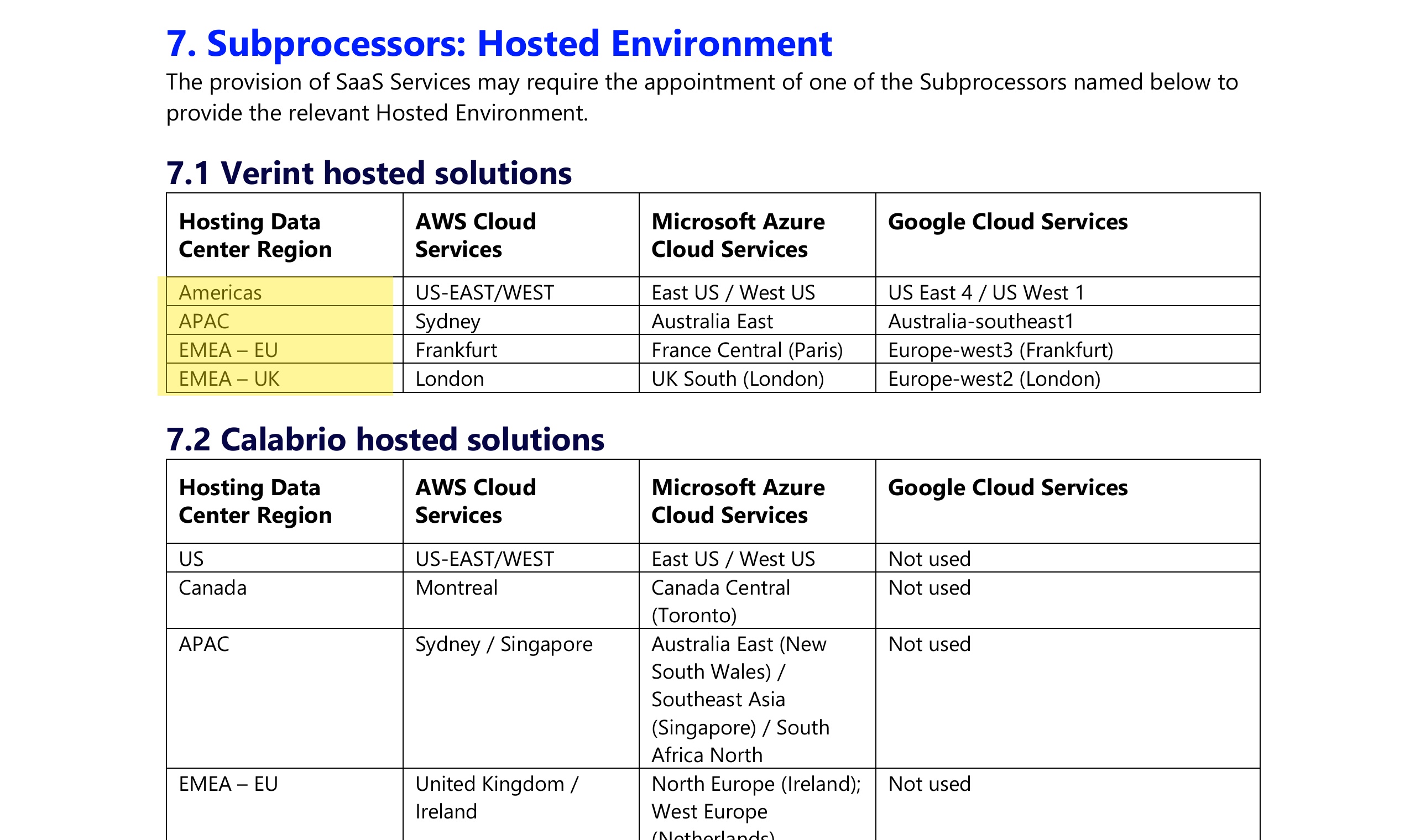
Verint's own Data Processing Agreement hosts its cloud in the Americas, APAC (Sydney) and EMEA (Frankfurt, London) — with no mainland-China region. Because Verint records, transcribes and analyzes interactions, including voiceprints, moving that data offshore is a PIPL cross-border transfer of often-sensitive personal information. A compliance-first look at the data-residency, Article 28 and ICP questions.
Does Verint work in China?
Whether Verint “works” in China is a data-residency question about sensitive recordings, not a speed one.
Verint records, transcribes and analyzes contact-center interactions — call and screen recordings, voice-to-text transcripts, quality and performance data, and the voiceprints behind its identity-authentication services — and its own Data Processing Agreement hosts “Verint hosted solutions” only in the Americas, APAC (Sydney) and EMEA (Frankfurt and London), with no mainland-China region. So interaction data from your China users and agents rests offshore: a PIPL cross-border transfer of personal information — much of it the biometric category Article 28 treats as sensitive, and subject to an in-country storage duty for a CIIO or large-volume handler.
Which obligations actually bite depends on your entity, data volumes and users — a risk map to settle with counsel. Our China team can map your exposure →
What Verint's own documentation says about China
| Fact | Primary source |
|---|---|
| Verint's own Data Processing Agreement names no mainland-China hosting region. Its “Subprocessors: Hosted Environment” table lists the hosting data center regions for “Verint hosted solutions” as the Americas (US-EAST/WEST), APAC (Sydney), EMEA – EU (Frankfurt) and EMEA – UK (London), on AWS, Microsoft Azure or Google Cloud — so interaction data generated in China comes to rest offshore. | Verint Data Processing Instructions (DPA exhibit), §7 Subprocessors: Hosted Environment — retrieved 2026-10-10 |
| Verint records and transcribes customer interactions, and can process biometric data. The same DPA lists “Recording” among its processing activities, has sub-processors “create voice-to-text transcription” and store “redacted customer interaction transcripts,” and names “biometric data for the purpose of uniquely identifying a natural person” among the special categories it may process on a customer's instruction — the raw material of voice biometrics. | Verint Data Processing Instructions (DPA exhibit), §2.1, §4 & §7 — retrieved 2026-10-10 |
| Voiceprints and other biometrics are “sensitive personal information” under China's PIPL. Article 28 classifies biometric data as sensitive, so handling it needs a specific purpose, demonstrated necessity and separate consent; sending it abroad triggers PIPL's cross-border rules (Articles 38–40) — notice, separate consent and a transfer mechanism such as a CAC security assessment, the standard contract, or certification. | PIPL (Personal Information Protection Law), Articles 28–29 & 38–40 — retrieved 2026-10-10 |
| A critical information infrastructure operator or large-volume handler must store China personal information in China. PIPL Article 40 and the Cybersecurity Law Article 39 (formerly Article 37) impose in-country storage that an offshore hosting region cannot meet, and any China-facing Verint surface also carries an ICP filing (备案) duty. | PIPL Article 40; Cybersecurity Law Article 39 (formerly Article 37) — retrieved 2026-10-10 |
Sources verified by the 21YunBox compliance team on 2026-10-10.
Whether Verint “works” in mainland China is a data-residency question, not a connectivity one. Verint’s customer-engagement and workforce-engagement platform exists to capture and interpret what happens in a contact center: full call recordings, screen recordings, voice-to-text transcripts, case history, and — through its identity-authentication services — the voiceprints that verify a caller by voice. Almost all of that is personal information, and a voiceprint is biometric data, which PIPL singles out as sensitive. So the decision does not turn on whether an agent can open the Verint console from Shanghai; it turns on where those recordings and transcripts are allowed to come to rest. In its own Data Processing Agreement, Verint hosts its cloud in the Americas, APAC (Sydney) and EMEA (Frankfurt and London) — with no region inside mainland China. (Verint spun off its cyber-intelligence arm as Cognyte in 2021; the Verint here is the customer-engagement company.)
Verint in China at a glance
| What decides it | In Verint's own terms — and China's law |
|---|---|
| Where the records live | Verint's Data Processing Agreement lists the hosting data center regions for “Verint hosted solutions” as the Americas (US-EAST/WEST), APAC (Sydney), EMEA – EU (Frankfurt) and EMEA – UK (London), across AWS, Microsoft Azure or Google Cloud. None is in mainland China. There is no in-country residency option to select on Verint's own terms. |
| What it holds, and why it's personal information | Verint's job is to record and interpret interactions, so the China surface is the content itself: call and screen recordings, voice-to-text transcripts, quality and performance data, case history, and agent and customer PII. The DPA lists “Recording” among its processing activities and “biometric data for the purpose of uniquely identifying a natural person” among the categories it may process — and the voiceprints behind its identity-authentication services are exactly that: the category PIPL Article 28 treats as sensitive. |
| Your China users' and agents' data crossing the border | When the callers or agents are on the mainland and the Verint cloud sits in Sydney, Frankfurt, London or the US, the recordings and transcripts those interactions produce leave China by design — a cross-border transfer under PIPL (Articles 38–40): notice, a separate consent, and one transfer mechanism. Sensitive categories such as voiceprints raise the bar further. |
| In-country storage duty | For a critical information infrastructure operator or large-volume handler, personal information generated in China must be stored in China (PIPL Article 40; Cybersecurity Law Article 39 (formerly Article 37) — the 2025 Cybersecurity Law amendment, in force January 1, 2026, renumbered the data-localization article from 37 to 39, substance unchanged). An offshore hosting region cannot meet that duty; choosing a different offshore region only relocates the transfer. |
| Reachability is not the axis | An agent desktop loading from inside China proves nothing about residency — a tool can open and still be unlawful to use for the data it records. And any China-facing surface Verint feeds — an agent workspace, a customer portal, a feedback or intake form — is an internet service in China, so it carries an ICP filing (备案) duty on top. |
No mainland region, so the recordings leave the country
Verint is a cloud platform with a managed control plane and the stores that hold your interaction data, and China’s law reaches both. In its own Data Processing Agreement, the hosting data center regions for “Verint hosted solutions” are the Americas (US-EAST/WEST), APAC (Sydney), EMEA – EU (Frankfurt) and EMEA – UK (London), delivered on AWS, Microsoft Azure or Google Cloud; its Calabrio-branded workforce solutions add US and Canada (Montreal). Not one region sits in mainland China. So “we already run Verint” does not carry into the country on the platform’s own terms: when a contact center’s callers and agents are on the mainland and the tenant is hosted in Sydney, Frankfurt, London or the US, every recording, screen capture and transcript those interactions generate is written to storage outside China, and the metadata, analytics results and audit logs Verint keeps about them are held offshore as well.
What Verint records is personal information — and often sensitive
This is the part most teams underestimate. A workforce-engagement platform exists to capture and analyze what customers and agents say and do — so its payload is not a tidy set of form fields but the raw interaction: a recording of a caller reading out a card number, a transcript that mentions a medical claim, a screen capture of an account page, the agent’s own identifiers and performance record. Much of that is ordinary personal information; some of it is the category PIPL Article 28 treats as sensitive — financial accounts, health disclosures, and above all the voiceprints Verint’s identity-authentication services build to verify a caller, which are biometric data. Under China’s Personal Information Protection Law the transfer obligation lands on you, the personal-information handler, not on Verint the processor: Articles 38–40 require notice, a separate consent for the overseas transfer, and one transfer mechanism — a CAC security assessment, the CAC standard contract, or certification — and sensitive categories demand a specific purpose and demonstrated necessity on top. Above the regulated thresholds, or where the data is “important data,” China’s data-export security assessment (数据出境安全评估) may have to clear before anything leaves.
Narrowing the exposure doesn’t close the door
Verint’s architecture does offer genuine levers, and they are worth using. You can redact transcripts and recordings, and the DPA notes that a customer “controls ingested recordings using the pause/resume configuration,” so a card number or a health disclosure need never be captured in the first place. You can choose which offshore region hosts a tenant, and — where the product supports a self-managed or on-premises deployment — keep the recording store on infrastructure you control inside the mainland. All of that narrows what crosses the border. None of it, on its own, changes that a transfer happens: a hosted tenant still writes interaction data and analytics to a region outside China, and pointing a tenant at a “different region” only moves the transfer from Sydney to Frankfurt — it does not end it. Which obligations actually bite — a transfer mechanism, a data-export security assessment, in-country storage under Cybersecurity Law Article 39 (formerly Article 37), an ICP filing, or some combination — turns on your entity, your data volumes and who your users are. This is a risk map, not a verdict: settle the specifics with your counsel before your China contact center depends on the answer.
The lawful path — map, localize, deliver
There is a compliant way to run Verint for a China-facing contact center, and it has a shape. First, map: our China compliance team works through your PIPL exposure interaction by interaction — which recordings, transcripts and voiceprints carry personal information out of China, which touch the sensitive categories, what may lawfully leave, where a data-export security assessment or an Article 40 storage duty applies, and what your notice and consent must cover. We build the technical picture; the legal conclusions are settled with your counsel.
Then localize: we stand up consented, in-country processing and storage for the interaction records that must stay on mainland soil — running Verint’s own redaction and pause/resume controls, and a self-managed or on-premises deployment where the product supports it — so the sensitive China data stays resident, and only what may lawfully leave flows out to the rest of your estate, with the Verint tenant that serves your other markets left exactly where it is.
Then deliver: any China-facing surface Verint feeds — an agent workspace, a customer portal, a feedback or intake form — is an internet service in China, so it carries an ICP filing (备案) duty and needs compliant, in-country delivery. 21YunBox delivers it in-country — the 21YunBox Optimizer — set in front of the stack you already run, with no rebuild and no second codebase. 21YunBox is a compliant overlay, not a migration, and a partner to the platforms you already license, not a competitor. 21YunBox never uses or suggests circumvention of any kind. The result is a Verint estate that runs legally and compliantly for your users in China.
Related reading:
- Cross-border data transfers under PIPL
- China’s data-export security assessment
- China’s Cybersecurity Law (data localization, Article 39)
- How to get an ICP filing for China