
Does Salesforce Commerce Cloud work in China?
Salesforce Commerce Cloud is reachable from China, but it has no mainland-China home: it runs as Salesforce-hosted SaaS on offshore points of delivery, so a China-facing storefront is served from outside the mainland — a compliance question long before it is a speed one.
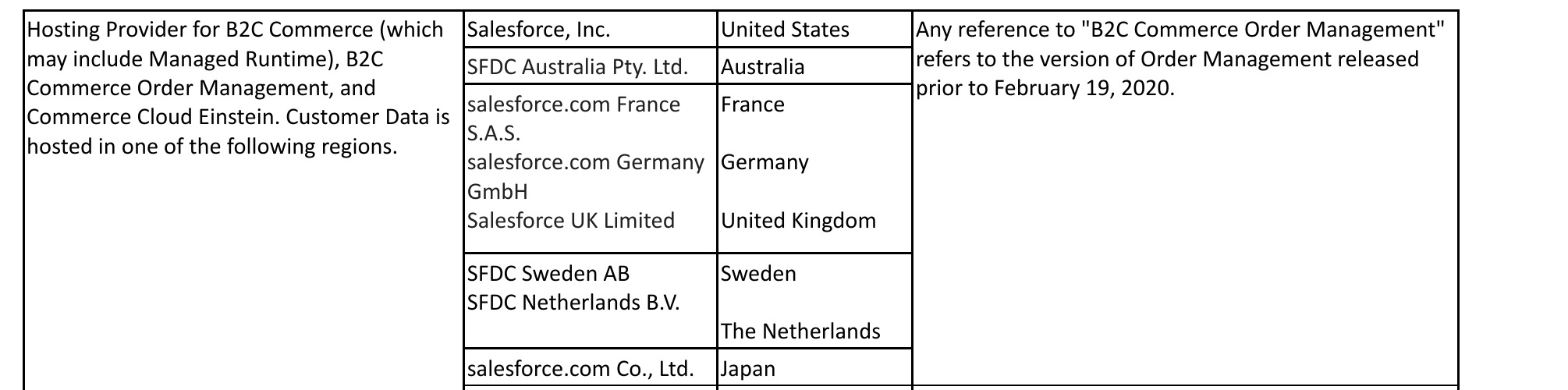
Salesforce's own Infrastructure and Sub-processors document (published October 2, 2026) states that for "Commerce Cloud/B2C Commerce," "Customer Data is hosted in one of the following regions" — the United States, Australia, France, Germany, the United Kingdom, Sweden, the Netherlands and Japan, with none in mainland China. Salesforce's separate mainland route on Alibaba Cloud covers "Sales Cloud, Service Cloud, Salesforce Platform" and related gateways — not Commerce Cloud — and warns that "Global customers can no longer use global services within mainland China." So a public storefront is served offshore, where it has no mainland host to carry an ICP filing, and every shopper's order, address and payment identifier becomes a cross-border transfer of personal information PIPL governs. The table below pairs Salesforce's own words with the rule each one triggers.
This is a risk map, not a verdict — which obligations bite turns on your entity, your data volumes and who your shoppers are. Our China team can map your exposure with you →
Compliance snapshot
- ! Commerce Cloud is Salesforce-hosted SaaS — your storefront data sits on offshore points of delivery, not in the mainland
- ✕ A storefront served from offshore PODs has no mainland host to carry an ICP filing
- ! Shoppers' orders, addresses and payment identifiers cross the border — PIPL applies
- ✕ Salesforce's own mainland route on Alibaba Cloud covers core CRM, not Commerce Cloud
- ! A CIIO or large-handler residency duty can't be met from offshore PODs
What actually decides whether Salesforce Commerce Cloud works for you in mainland China
| Fact | Primary source |
|---|---|
| Salesforce Commerce Cloud is Salesforce-hosted SaaS, and every hosting region is offshore. Salesforce's Infrastructure and Sub-processors document names Amazon Web Services and Salesforce's own entities as the hosting providers for "Commerce Cloud/B2C Commerce," and states "Customer Data is hosted in one of the following regions": the United States, Australia, France, Germany, the United Kingdom, Sweden, the Netherlands and Japan. Across the whole document mainland China is never named — there is no in-country region to host a storefront on. | Salesforce Infrastructure and Sub-processors (salesforce.com), published October 2, 2026, retrieved 2026-10-07 |
| Salesforce's own mainland-China route does not include Commerce Cloud. On its Salesforce on Alibaba Cloud page, Salesforce says "All Salesforce products in the Greater China region are sold and operated exclusively by Alibaba Cloud," lists the clouds that arrangement covers as "Sales Cloud, Service Cloud, Salesforce Platform" and related gateways — Commerce Cloud is not among them — and warns that "Global customers can no longer use global services within mainland China." The one in-country option Salesforce operates is a different product line from the storefront you already run. | Salesforce — Salesforce on Alibaba Cloud (salesforce.com/partners/alibaba), retrieved 2026-10-07 |
| A public storefront served from offshore cannot hold an ICP filing. Salesforce discloses only "the country, state and outgoing IP addresses" of its B2C Commerce points of delivery, and every disclosed location is outside the mainland. A website shown to mainland visitors needs an ICP filing bound to a hosting resource physically inside China — the regime under State Council Order No. 292 and MIIT Order No. 33 — and offshore PODs give nothing to file against. | Salesforce Help — B2C Commerce POD location disclosure (help.salesforce.com), retrieved 2026-10-07; State Council Order No. 292; MIIT Order No. 33 |
| Your shoppers' personal data leaves the mainland by design. Because Commerce Cloud hosts customer data only in offshore regions, the orders, addresses and payment identifiers a Chinese shopper enters are stored outside China — a cross-border transfer under PIPL that requires notice, separate consent and a transfer mechanism (Articles 38–43). For a critical information infrastructure operator or a large-volume handler, that data must instead be stored in the mainland (PIPL Article 40; Cybersecurity Law Article 39 (formerly Article 37)) — a residency duty no offshore POD can meet. | Salesforce Infrastructure and Sub-processors (salesforce.com), published October 2, 2026, retrieved 2026-10-07; PIPL Articles 38–43 & 40; Cybersecurity Law Article 39 (formerly Article 37) |
Sources verified by the 21YunBox compliance team on 2026-10-07.
For a mainland-China audience, the question about Salesforce Commerce Cloud is not how quickly a storefront paints — it is whether you are allowed to operate it there at all, and where your shoppers’ data is allowed to live. Salesforce Commerce Cloud (formerly Demandware) is Salesforce-hosted SaaS: your store runs on Salesforce’s own “points of delivery,” and Salesforce documents where those sit. None of them is inside mainland China. A China-facing store is therefore reachable but served entirely offshore — which leaves it with no footing for the ICP filing a public mainland storefront requires, and turns every order a Chinese shopper places into a cross-border transfer of personal information under Chinese law. Salesforce is an excellent commerce platform, and nothing here asks you to leave it; this is about the one layer it was never built to provide.
Salesforce Commerce Cloud in China at a glance
| What decides it | In Salesforce's own words — and China's own law |
|---|---|
| What it is | Salesforce-hosted SaaS commerce (formerly Demandware), running on Salesforce “points of delivery.” Salesforce shares only “the country, state and outgoing IP addresses” of its B2C Commerce PODs — and every one it discloses is offshore. |
| A mainland-China region? | No. Salesforce's Infrastructure and Sub-processors document (October 2, 2026) hosts “Commerce Cloud/B2C Commerce” customer data in the US, Australia, France, Germany, the UK, Sweden, the Netherlands and Japan — and never names mainland China. |
| The China-via-partner route | Salesforce's mainland offering on Alibaba Cloud covers “Sales Cloud, Service Cloud, Salesforce Platform” and related gateways — not Commerce Cloud — and notes that “Global customers can no longer use global services within mainland China.” |
| Serving the public in China | A storefront shown to mainland visitors needs an ICP filing tied to a hosting resource inside China (State Council Order No. 292; MIIT Order No. 33). Offshore PODs give nothing to file against. |
| Shopper data at the border | Orders, addresses and payment identifiers stored on offshore PODs are a cross-border transfer PIPL governs (Articles 38–43); a CIIO or large-volume handler must keep that data in-country (PIPL Article 40; Cybersecurity Law Article 39 (formerly Article 37)). |
A Salesforce-hosted platform with no mainland footing
Salesforce Commerce Cloud is not something you host; Salesforce hosts it for you, on shared “points of delivery” whose locations Salesforce publishes only down to “the country, state and outgoing IP addresses.” Its current Infrastructure and Sub-processors document settles where those regions are: customer data for “Commerce Cloud/B2C Commerce” is hosted, in Salesforce’s words, in “one of the following regions” — the United States, Australia, France, Germany, the United Kingdom, Sweden, the Netherlands and Japan — with Amazon Web Services and Salesforce’s own entities named as the hosting providers. Across the whole document, mainland China does not appear once.
That geography decides the licensing question before a single page ever loads. There is a mainland route in the Salesforce world, but it is a different one: Salesforce’s offering on Alibaba Cloud, which it describes as how “All Salesforce products in the Greater China region are sold and operated exclusively by Alibaba Cloud.” Read the fine print and two things stand out for a commerce team. The clouds that arrangement covers are “Sales Cloud, Service Cloud, Salesforce Platform” and related gateways — Commerce Cloud is not on the list — and Salesforce is blunt that “Global customers can no longer use global services within mainland China.” So the one in-country home Salesforce operates is a separate product line, not the B2C Commerce storefront you already run.
The ICP door an offshore storefront can’t hold
Showing a public storefront to people in mainland China turns on a permission that has nothing to do with performance: an ICP filing (备案). Under State Council Order No. 292 and MIIT Order No. 33, that filing has to attach to a hosting resource that physically sits inside the mainland, held by a mainland legal entity. Salesforce Commerce Cloud’s points of delivery are, by Salesforce’s own disclosure, all offshore — so there is nothing on the platform to anchor a filing to. This is the hard stop behind “but our store already runs on Salesforce”: being reachable from China is not the same as being cleared to operate there, and no amount of front-end tuning conjures the in-country host an ICP filing demands.
Your shoppers’ data leaves the mainland the moment they check out
A storefront is a personal-data machine. Every Chinese shopper who creates an account or places an order hands over a name, an address, a phone number and payment identifiers — and because Commerce Cloud stores that data only in offshore regions, it crosses the border the instant it is saved. Under China’s Personal Information Protection Law that is a cross-border transfer, and the handler — you, the merchant, not Salesforce — has to give notice, obtain separate consent, and clear one transfer mechanism: a CAC security assessment, the CAC standard contract, or certification (Articles 38–43). If you are a critical information infrastructure operator, or you move personal data above the regulated volumes, that information has to be stored in the mainland in the first place (PIPL Article 40; Cybersecurity Law Article 39 (formerly Article 37)) — a residency duty no offshore POD can satisfy.
This is a risk map, not a verdict: whether you owe an ICP filing, in-country storage, or both depends on what you sell, how much personal data you hold and who your shoppers are — and it is worth settling with counsel before you build.
Where 21YunBox fits — a compliant overlay, not a migration
You keep selling on Salesforce Commerce Cloud exactly as you do today — same catalog, same storefront, same Salesforce-run origin. 21YunBox adds the single layer an offshore SaaS platform cannot: compliant, ICP-filed delivery from inside the mainland, set in front of your existing Commerce Cloud origin — no rebuild, no second codebase, and no move off Salesforce. Our China team works out which obligations apply to your entity and your data volumes, handles the ICP filing, and stands up the in-country entry your mainland shoppers reach, while Salesforce stays your system of record.
Related reading:
Frequently Asked Questions
Is Salesforce Commerce Cloud blocked in mainland China?
Treat reachability and compliance as two separate questions. Salesforce Commerce Cloud is not a blocked service the way some foreign platforms are, but it runs entirely on offshore points of delivery, so performance for mainland shoppers varies and leans on third-party resources that may be slow or unreachable. The point that actually decides whether you may operate is not whether the page loads — it is that an offshore storefront has no ICP filing and sends shopper data across the border, which are compliance questions, not speed ones.
Does Salesforce's Alibaba Cloud partnership let us run our Commerce Cloud storefront in China?
No. Salesforce's mainland arrangement on Alibaba Cloud is a separate product line — it covers Sales Cloud, Service Cloud and the Platform, and Commerce Cloud is not listed among the clouds it offers. Salesforce also states that global customers "can no longer use global services within mainland China," so you cannot simply point your existing global storefront at the mainland through that route. For a B2C Commerce storefront specifically, there is no Salesforce-operated in-country home.
Can 21YunBox help make our Salesforce Commerce Cloud storefront work in China?
Yes. Your storefront stays on Salesforce Commerce Cloud; we add the piece Salesforce's offshore PODs cannot — compliant, ICP-filed delivery from inside the mainland, placed in front of your existing origin, with no rebuild and no second codebase. Our China team assesses your PIPL cross-border and data-residency exposure for your entity, data volumes and shoppers, and handles the ICP filing. Get in touch to work through your specific case.
