Does TomTom Work in China? Data Residency, ICP & Cross-Border Rules
Offering map, navigation or location content in mainland China needs a Chinese surveying-and-mapping qualification a foreign platform like TomTom cannot hold, and TomTom's own docs don't list mainland China as a covered market — while a user's precise location sent to its API is a PIPL cross-border transfer. A compliance-first look.
Does TomTom work in China?
Not as a foreign-direct map service. Offering map, navigation or location content to mainland China requires a Chinese surveying-and-mapping qualification (测绘资质) that a foreign platform like TomTom cannot hold, so TomTom cannot be the lawful basis for a China-facing map — and TomTom's own documentation does not list mainland China as a covered market.
Under China's Surveying and Mapping Law and Map Management Regulations, public map data must come from a licensed domestic provider and use the state GCJ-02 coordinate system, and foreign platforms reach the mainland only through a licensed Chinese mapping partner. Separately, the precise location, search and navigation your users hand to the TomTom API is personal information — and precise location can be sensitive personal information — so sending it to TomTom's offshore backends is a cross-border transfer governed by PIPL (Articles 38–40) that needs notice, separate consent and a transfer mechanism.
This is a risk map, not a verdict — the lawful path is a licensed in-China map provider with user-location kept in-country. Our China team can map your exposure with you →
What TomTom's own documentation says about China
| Fact | Primary source |
|---|---|
| TomTom's own coverage documentation does not list mainland China as a covered market. Its Orbis Maps market-coverage tables enumerate the markets TomTom provides across Asia Pacific, and mainland China is not among the listed markets — so TomTom is not documented as a provider of mainland-China map data, and offering a mainland map service on it would also require a surveying-and-mapping qualification a foreign platform cannot hold. | TomTom Developer — Orbis Maps Market Coverage (docs.tomtom.com), last edit 2026.07.17, retrieved 2026-10-13 |
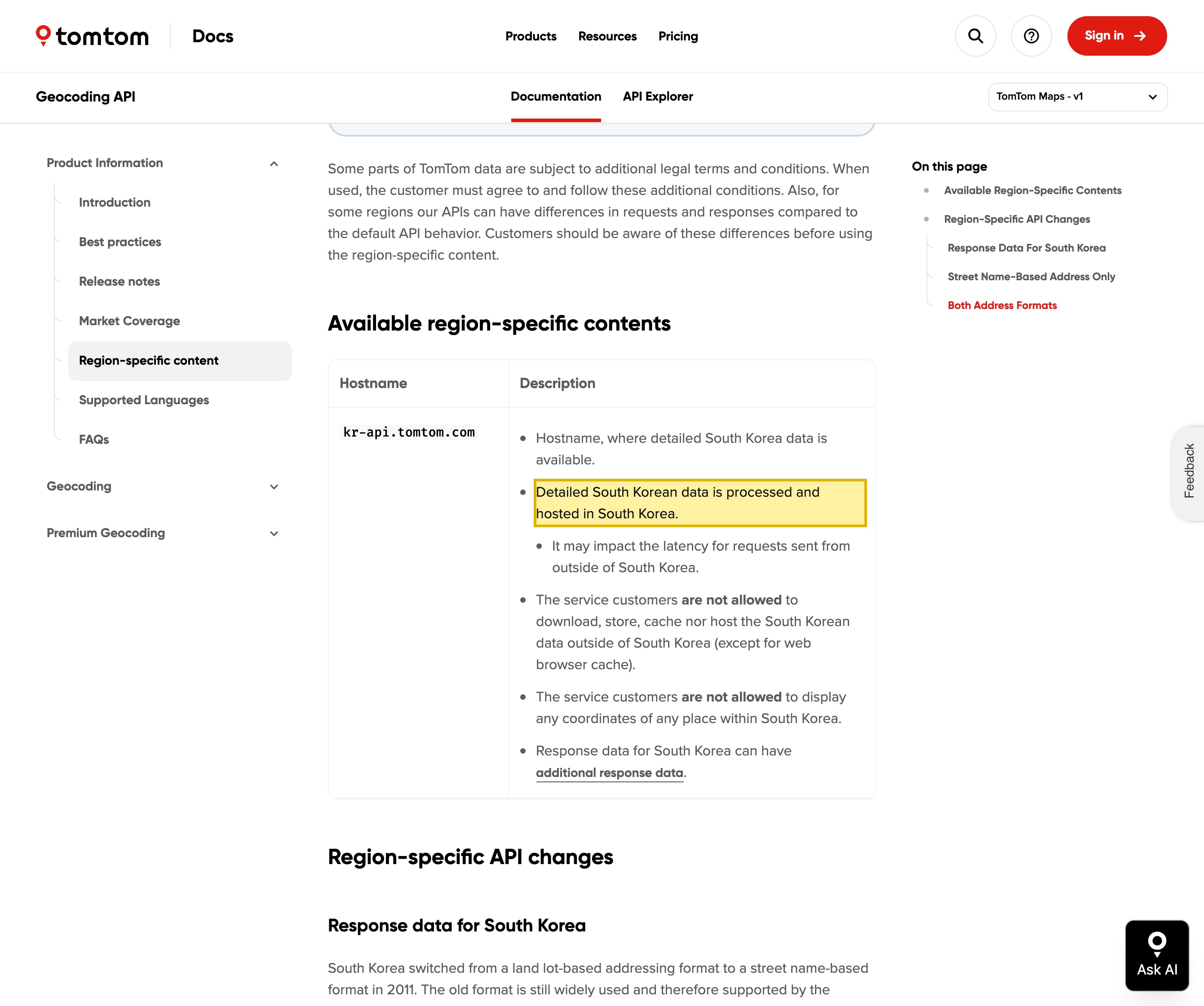
| TomTom hosts data in-country only where a market specifically requires it — with no mainland-China arrangement. TomTom documents a dedicated in-country data-residency setup for a single market, stating that "Detailed South Korean data is processed and hosted in South Korea," and notes that "Some parts of TomTom data are subject to additional legal terms and conditions." There is no equivalent mainland-China endpoint, so requests involving China users are served from TomTom's offshore backends. | TomTom Developer — Region-specific content (docs.tomtom.com), retrieved 2026-10-13 |
| A user's precise location is personal information, and sending it abroad is a regulated cross-border transfer. Under the Personal Information Protection Law, location tied to a person is personal information — precise location can be sensitive personal information requiring separate consent — so passing China users' coordinates to TomTom's offshore API is a cross-border transfer needing notice, separate consent and one transfer mechanism (Articles 38–40; Articles 13 and 23). | PIPL Articles 13, 23, 28–29 and 38–40, retrieved 2026-10-13 |
| In-country data storage and an ICP filing govern any China-facing surface. For critical information infrastructure and high-volume handlers, personal information collected in China must be stored in the mainland under the Cybersecurity Law, Article 39 (formerly Article 37), and the website carrying any map still needs its own ICP filing to be served lawfully from inside China. | Cybersecurity Law Article 39 (formerly Article 37); ICP filing requirement, retrieved 2026-10-13 |
Sources verified by the 21YunBox compliance team on 2026-10-13.
For a mainland-China audience, whether TomTom “works” is a compliance question before it is a loading one. Providing map, navigation or location-based-service content inside the mainland is a licensed activity: under China’s Surveying and Mapping Law and the Map Management Regulations, offering that content requires a surveying-and-mapping qualification (测绘资质 — for navigation electronic maps, the Grade-A 导航电子地图制作 qualification), and foreign-invested entities cannot hold it directly. A foreign map platform therefore cannot be the lawful basis for a China-facing map service, no matter how well its tiles render. On top of that licensing door sits a data door: the precise location, search and navigation your users hand to the API is personal information that, sent to TomTom’s offshore backends, leaves the country. The axis here is licensing and residency — not speed.
TomTom in mainland China at a glance
| What decides it | For TomTom in mainland China — and China's law |
|---|---|
| Permitted to offer the map service? | Offering map, navigation or LBS content to the mainland requires a Chinese surveying-and-mapping qualification (测绘资质; for navigation maps the Grade-A 导航电子地图制作 qualification) under the Surveying and Mapping Law and Map Management Regulations. Foreign-invested entities cannot hold it, so TomTom cannot be the lawful basis for a China-facing map. |
| A covered market? | TomTom's own Orbis Maps market-coverage documentation enumerates the markets it provides across Asia Pacific, and mainland China is not among the listed markets — TomTom is not documented as a provider of mainland-China map data. |
| The map data | China requires public map data to come from a licensed domestic provider and use the state GCJ-02 coordinate system; a foreign platform's WGS-84 data is neither licensed nor GCJ-02-approved. In practice foreign platforms reach the mainland only through a licensed Chinese mapping partner. |
| Where location data is processed | TomTom documents in-country data residency only where a market specifically requires it (a single market today) and has no mainland-China endpoint, so requests involving China users are served from its offshore backends. |
| Your users' location | Precise coordinates, search and navigation tied to a person are personal information — and precise location can be sensitive personal information — so passing them to TomTom offshore is a cross-border transfer PIPL governs. |
A licensing door before a loading one
China treats cartography as a licensed activity, not an open API surface. Under the Surveying and Mapping Law and the Map Management Regulations, anyone offering public map, navigation or location content in the mainland must hold a surveying-and-mapping qualification — the 测绘资质, and specifically the Grade-A 导航电子地图制作 qualification for navigation electronic maps. That qualification is restricted to qualified Chinese entities; a foreign-invested platform cannot hold it directly. So the first question is not whether TomTom’s endpoints respond from Shanghai — it is whether you are permitted to offer the map service at all. As a foreign-direct map provider you are not, because the lawful basis you would need is one TomTom cannot carry on your behalf.
This is why the mainland map ecosystem relies on licensed domestic providers, and why foreign map platforms serve the mainland only through a licensed Chinese mapping partner rather than as the primary map source themselves.
China regulates the map itself — licensed provider and GCJ-02
Even where a map paints, China regulates the cartography. Public map data served in the mainland must come from a provider holding the surveying-and-mapping qualification and must use the state-mandated GCJ-02 coordinate system — a deliberately offset datum. A foreign platform’s standard maps use the global WGS-84 system, so they render visibly displaced against GCJ-02, and a foreign platform is not itself a licensed Chinese map operator. The regulations also expect internet map data to be served from inside China — a residency expectation an offshore map backend does not meet. The compliant path is not to tune the offshore service; it is a licensed in-China map source.
Your users’ location is personal data
A map is also a personal-data surface. A precise latitude and longitude tied to an individual is personal information under China’s Personal Information Protection Law, and an embedded map resolves tiles, geocodes addresses and — with the browser’s permission — reads the visitor’s position against the API’s servers abroad. That hand-off is a cross-border transfer of personal information: the handler (you, not TomTom) must give notice, obtain separate consent and satisfy one transfer mechanism under Articles 38–40, and precise location can be sensitive personal information needing its own separate consent (Articles 13 and 23). For a critical information infrastructure operator or a large-volume handler, personal information collected in China must be stored in the mainland (PIPL Article 40; Cybersecurity Law Article 39 (formerly Article 37)), and the website carrying the map still needs its own ICP filing to be served lawfully from inside China.
Why a reachability check misses this
A reachability test answers the wrong question. Even if tiles rendered cleanly for a visitor in Shenzhen, two exposures remain untouched. First, the licensing door: you would still lack the surveying-and-mapping qualification that China requires to offer a map service, and that qualification is not something a foreign platform can hold or lend you. Second, the residency door: your users’ precise location would still cross the border to TomTom’s offshore backends, a PIPL-governed transfer. A latency probe sees neither the 测绘 qualification nor the cross-border duty — which is exactly why “it loads” is not the same as “it is lawful.”
Where 21YunBox fits — a compliant overlay, not a migration
You keep the stack you already run; 21YunBox is a compliance overlay and partner to it, never a replacement and never a route around any control. We work the exposure in three moves. Map: we inventory what the service receives — user coordinates, search, navigation — where it is processed, and whether the map is being offered in a way that needs a qualification you cannot hold. Localize and govern: for the map itself, the lawful path is a licensed Chinese map provider (which holds the 测绘 qualification and serves GCJ-02 data), wired in behind your existing application; for the location data, we keep your users’ coordinates in-country, treat precise location as sensitive personal information, and put notice and separate consent on the collection. Deliver: we add ICP-filed, in-country delivery in front of what you already have — no rebuild, no second codebase, no move off your platform, and never through circumvention of any kind. Our China team maps the whole picture — the surveying-and-mapping qualification, the GCJ-02 licensed-provider requirement, and the PIPL treatment of your visitors’ location — and stands up the licensed mapping route and compliant delivery a lawful China presence needs.
This is a risk map, not a verdict: whether the qualification rules, the map-data residency expectation, or a PIPL obligation over location bites depends on what you display, how precise it is, and who your users are — worth settling with counsel before you ship.
Related reading:
- How to get an ICP filing for China
- Cross-border data transfers under PIPL
- China’s Personal Information Protection Law


