Does Apple MapKit JS Work in China? Data Residency, ICP & Cross-Border Rules
Apple MapKit JS is a foreign-run, Apple-hosted web maps API. Offering map or navigation content to mainland China needs a Chinese surveying qualification (测绘资质) foreign-invested entities cannot hold directly, and the user-location data it sends offshore is a PIPL cross-border transfer.
Does Apple MapKit JS work in China?
Not as a foreign-run map service — the compliance axis is a licensing door a reachability test never sees. Offering map, navigation or location content to mainland users requires a Chinese surveying-and-mapping qualification (测绘资质) under the Surveying and Mapping Law, and foreign-invested entities cannot hold it directly, so Apple MapKit JS cannot be the lawful basis for a China-facing map service.
On top of that, the coordinates, searches and navigation a China visitor sends to MapKit JS are personal information served by Apple's offshore maps service — precise location can be sensitive personal information — so routing it abroad is a cross-border transfer under PIPL Articles 38–40.
The compliant path: localize to a licensed Chinese map provider that holds the qualification and keep user-location data in-country, with 21YunBox as a partner to your Apple stack — never a way around the rules.
What Apple MapKit JS's own documentation says about China
| Fact | Primary source |
|---|---|
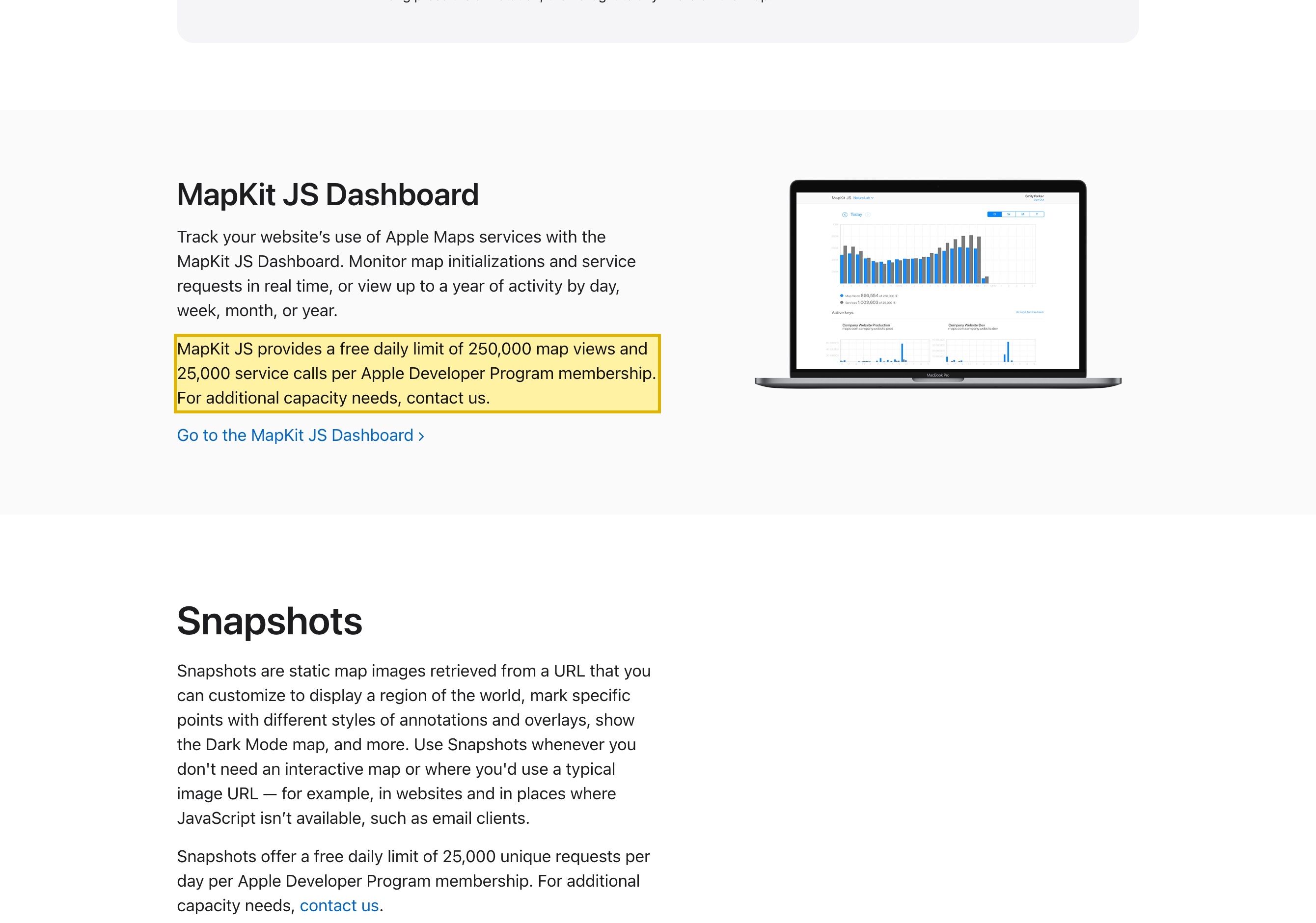
| Apple's MapKit JS is a hosted Apple service: Apple's own product page states it provides “a free daily limit of 250,000 map views and 25,000 service calls per Apple Developer Program membership,” and the library loads from Apple's CDN — so each China visitor's map views, searches and geocoding are requests served by Apple's offshore maps service. | Apple Developer — MapKit JS (Maps for the web), retrieved 2026-10-13 |
| Apple's feature-availability page lists Maps features country by country and notes “Some features may not be available in all regions or languages.” China mainland appears as its own, separately treated Maps market, while Apple's imagery-rich Look Around and Detailed City Experience are not listed for China mainland — consistent with mainland map coverage running on a licensed domestic basis rather than directly on a foreign platform. | Apple — iOS feature availability (Maps section), retrieved 2026-10-13 |
| Sending a China user's precise coordinates, searches or navigation to an offshore map service is a cross-border transfer of personal information; precise location can be sensitive personal information requiring separate consent (PIPL Art. 13, 23, 28–29), and the transfer needs a lawful mechanism — a CAC security assessment, the CAC standard contract, or certification (Art. 38–40). | PIPL Articles 13, 23, 28–29 and 38–40 — 21YunBox cross-border summary, retrieved 2026-10-13 |
| For a critical information infrastructure operator or high-volume handler, China's Cybersecurity Law Article 39 (formerly Article 37) requires personal information generated in the mainland to be stored there; any China-facing map surface is also an internet information service carrying an ICP filing (备案) duty. | China Cybersecurity Law, Art. 39 (formerly Art. 37) — 21YunBox summary, retrieved 2026-10-13 |
Sources verified by the 21YunBox compliance team on 2026-10-13.
For a website or app that puts a map in front of users in mainland China, “does Apple MapKit JS work in China?” is the wrong question to stop on — because the thing that decides it has nothing to do with how fast the tiles draw. MapKit JS is Apple’s hosted web maps API: you embed it, the library loads from Apple’s servers, and the searches, geocoding and directions your visitors trigger are answered by Apple’s maps service. In China, a map is not merely content — it is regulated geographic information, and two doors open the moment you offer it to mainland users. The first is a licensing door: producing or publishing map and navigation content for the mainland requires a Chinese surveying-and-mapping qualification that foreign-invested entities cannot hold directly. The second is a data door: the coordinates and searches your users send to an offshore map service are personal information leaving the country. Neither is something a reachability check can see, and both are compliance questions, not speed ones.
Apple MapKit JS in China at a glance
| What decides it | In Apple's own terms — and China's law |
|---|---|
| Whether you may offer the map service at all | In China, producing or publishing map and navigation content is a surveying-and-mapping activity that requires a surveying qualification (测绘资质) under the Surveying and Mapping Law (测绘法) and the Map Management Regulations (地图管理条例). For navigation electronic maps that is the Grade-A navigation-electronic-map production qualification (导航电子地图制作), issued only to qualified Chinese entities — foreign-invested entities cannot hold it directly. So a foreign web maps API cannot be the lawful basis for a China-facing map service, no matter whether its tiles render. |
| Who operates the map service | MapKit JS is a hosted Apple service. By Apple's own product page the library loads from Apple's CDN and meters “map views” and “service calls” — the searches, geocoding and directions a visitor triggers are answered by Apple's offshore maps service, not by a China-licensed domestic provider. |
| User location crossing the border | The coordinates, search terms and navigation a China visitor sends to MapKit JS are personal information about a person in China. Shipping them to Apple's offshore service is a cross-border transfer under PIPL Articles 38–40, which needs a lawful mechanism — a CAC security assessment, the CAC standard contract, or certification. |
| Precise location as sensitive PI | Precise location can rise to sensitive personal information under PIPL Articles 28–29, and Articles 13 and 23 require specific, separate consent before collection and sharing — not a single bundled (一揽子) take-it-or-leave-it prompt. |
| Localization & filing | For a critical information infrastructure operator or high-volume handler, Cybersecurity Law Article 39 (formerly Article 37) requires China-generated personal information to be stored in the mainland. Any China-facing map surface is also an internet information service carrying an ICP filing (备案) duty. |
| Reachability is not the axis | Whether the endpoint answers tells you nothing about the qualification you must hold to offer a map service, or whether the location data may lawfully leave the country. 21YunBox localizes the map layer to a licensed Chinese provider, keeps user-location data in-country, and ICP-files and delivers the China-facing surface — the 21YunBox Optimizer — in front of the Apple stack you already run. |
The licensing door a reachability check never sees
Start with the door that has nothing to do with latency. In China, a map is not just content — it is regulated geographic information. Under the Surveying and Mapping Law (测绘法) and the Map Management Regulations (地图管理条例), producing or publishing map and navigation content for mainland users is a surveying-and-mapping activity that requires a surveying qualification (测绘资质). For navigation electronic maps specifically, that is the navigation-electronic-map production qualification (导航电子地图制作) — a Grade-A (甲级) qualification issued only to qualified Chinese entities, and foreign-invested entities cannot hold it directly. That is the structural fact a “do the tiles load?” test can never surface: even if MapKit JS rendered perfectly from a mainland network, a foreign provider still could not be the lawful basis for offering a map service to mainland users, because it cannot hold the qualification the activity requires.
This is also why mainland map data looks the way it does. Public map and navigation data in the mainland is published in the GCJ-02 coordinate system — an official, deliberately offset coordinate standard — and the licensed domestic providers who hold the surveying qualification are the ones permitted to publish it. In practice, foreign map platforms reach mainland users only through a licensed Chinese mapping partner that carries the qualification; the foreign API is not itself the licensed operator. We do not assert any particular arrangement for Apple’s own products here — the point is structural: offering the map service yourself, as a foreign provider on a foreign API, is not the lawful path, regardless of whether the endpoint answers. Apple’s own feature-availability page is a useful tell — it lists China mainland as its own, separately treated Maps market and does not list its imagery-rich Look Around and Detailed City Experience there, consistent with mainland map coverage running on a licensed domestic basis rather than directly on a foreign platform.
Your users’ location is the second regulated flow
The licensing door is the half competitors rarely mention; the data door is the half a speed test still cannot see. MapKit JS is a hosted Apple service: by Apple’s own product page it meters “map views” and “service calls,” the library loads from Apple’s CDN, and the searches, geocoding and directions a visitor triggers are requests answered by Apple’s maps service. When that visitor is in mainland China, the coordinates, the places they search for, and the routes they request are personal information about a person in China — and precise location can rise to sensitive personal information. Sending it to an offshore map service is a cross-border transfer of personal information under PIPL Articles 38–40, which requires one of the law’s transfer mechanisms — a CAC security assessment, the CAC standard contract, or certification — and, under PIPL Articles 13 and 23, specific and separate consent rather than a single bundled (一揽子) opt-in. Articles 28–29 add a specific-purpose, necessity and separate-consent test wherever precise location is treated as sensitive.
For a critical information infrastructure operator or a high-volume handler, Cybersecurity Law Article 39 (formerly Article 37 — the 2025 Cybersecurity Law amendment, in force January 1, 2026, renumbered the data-localization article from 37 to 39, its substance unchanged) requires personal information generated in the mainland to be stored there. None of these turn on how fast the map draws.
Why “do the tiles load?” misses all of this
A reachability check answers one question: did the endpoint respond. It cannot tell you whether you hold the surveying qualification that offering a map service to mainland users requires — you do not, as a foreign provider — or whether the location data the map collects may lawfully leave the country. Both remain true whether the tiles render in fifty milliseconds or never. The exposure is quiet and structural: it lives in the qualification you cannot hold and the user-location data the API exports by default, not in a latency number.
This is a risk map, not a verdict that Apple MapKit JS is “blocked” or “illegal.” Which duties bite depends on your entity, what your map surface actually collects and sends, your role under Chinese law, and your data volumes — worth settling with counsel before a China-facing map feature goes live.
The lawful path — map, localize, deliver
There is a compliant way to put maps in front of a China audience, and it sits alongside the Apple stack your team already uses — no rebuild, no second front end.
First, map: our China team inventories what your map integration receives and sends — the coordinates, search terms and navigation a visitor triggers, where those calls are answered and transferred, and the consent basis each relies on — along with the filing status of the China-facing surface that embeds it. We build the technical picture; the legal conclusions are settled with counsel.
Then localize / govern: for the map layer itself, the lawful basis is a licensed Chinese map provider that holds the surveying qualification — not a foreign API offered directly — with user-location data (coordinates, search, navigation) resolved and kept in-country, the Article 13/23 consent these flows need, and sensitive-PI treatment where precise location calls for it. Localize means keeping the regulated data in-country; it never means a route that quietly ships personal information across the border.
Then deliver: any China-facing site or app that shows maps to mainland users is an internet information service, so it carries an ICP filing (备案) duty bound to a mainland hosting resource and needs compliant, in-country delivery. 21YunBox stands that up — the 21YunBox Optimizer — in front of what you already run. 21YunBox never uses or suggests circumvention of any kind — we keep in-country what the law says must stay and deliver the China-facing surface compliantly from inside the mainland. Making an offshore map API merely reachable is not the answer — you would still lack the qualification and still be exporting user-location data; localizing the map layer to a licensed provider and keeping that data in-country is. 21YunBox is a compliance overlay and partner to your Apple stack, not a competitor to it.
Related reading:
- China’s Personal Information Protection Law (PIPL)
- Cross-border data transfers under PIPL
- China’s Cybersecurity Law
- How to get an ICP filing for China


