Does OpenWeather Work in China? Data Residency, ICP & Cross-Border Rules
OpenWeather is a hosted weather API you call with each user's precise coordinates. Fetching weather for a user in mainland China sends their precise location to a UK-based service with no China region — a PIPL cross-border transfer of personal data, a residency question, not a speed one. A compliance-first look.
Does OpenWeather work in China?
Whether you can use OpenWeather for mainland China is first a data-residency and cross-border question, not a speed one. OpenWeather is a hosted weather API you call with each user's precise coordinates (lat/lon) — so the moment you fetch weather for someone in China, you are sending that person's precise location to a UK-based service offshore.
A China user's precise location, tied to them, is personal information under China's law, and precise or continuous location can be sensitive personal information carrying stricter necessity and separate-consent duties. Exporting those coordinates to OpenWeather is a cross-border transfer PIPL governs (notice, separate consent and a transfer mechanism, Articles 38–40). OpenWeather is a "London-based weather intelligence company" that names no mainland-China region; its own China endpoints exist "to reduce latency and improve reliability for users connecting from China" — a performance accommodation, with the request and your coordinates unchanged, not an in-country data-residency path (and we could not verify where those servers physically sit).
This is a risk map, not a verdict — what you owe turns on how precise and continuous your location use is, your data volumes and your role as handler, and it's worth settling with counsel. Our China team can map your exposure with you →
What OpenWeather's own documentation says about China
| Fact | Primary source |
|---|---|
OpenWeather is a hosted API keyed by coordinates. Its documentation states, "Requesting API calls by geographical coordinates is the most accurate way to specify any location," and marks lat, lon and appid as required for a current-weather call to api.openweathermap.org. Each lookup therefore sends a user's precise latitude and longitude to OpenWeather — so fetching weather for someone in mainland China means sending that person's precise location. | OpenWeather — Current weather data API docs (openweathermap.org), retrieved 2026-10-13 |
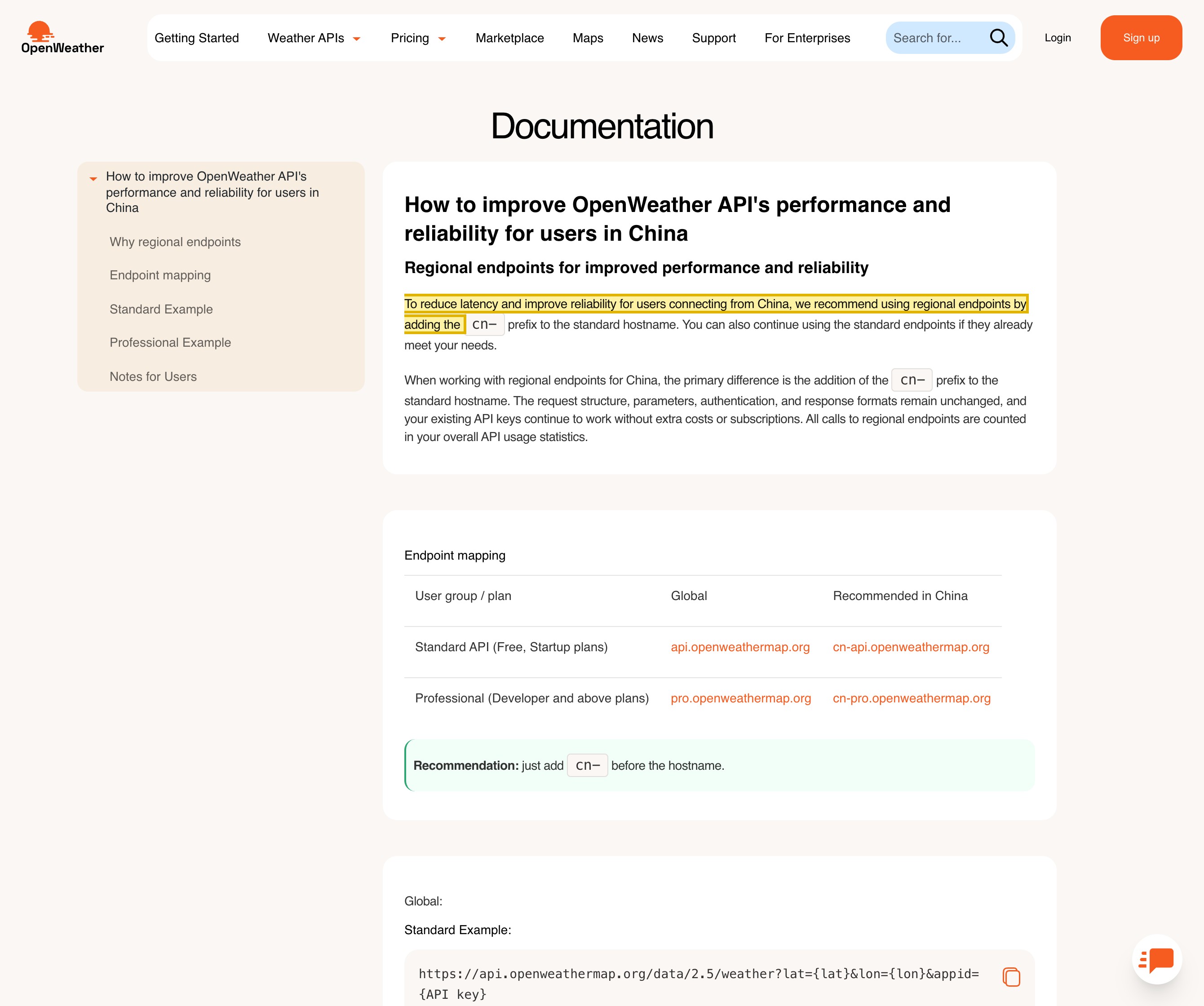
OpenWeather's China endpoints are a latency fix, not a data-residency path. OpenWeather describes itself as a "London-based weather intelligence company" and offers mainland users cn- hostnames "to reduce latency and improve reliability for users connecting from China," while "The request structure, parameters, authentication, and response formats remain unchanged." The page names no mainland-China data region, Chinese operating entity, ICP filing or PIPL handling, and does not state where those servers physically sit — so the same precise coordinates still travel to OpenWeather on every call. | OpenWeather — China endpoints (openweathermap.org), retrieved 2026-10-13 |
| Sending China users' coordinates offshore is a cross-border transfer under PIPL. A China-based individual's precise location is personal information, and exporting it to OpenWeather's offshore service is a cross-border transfer governed by PIPL: the personal-information handler — you, OpenWeather's customer, not OpenWeather — must give notice, obtain separate consent, and satisfy one transfer mechanism (a CAC security assessment, the CAC standard contract, or certification), under Articles 38–40. Precise or continuous location can be sensitive personal information, raising the necessity and consent bar further. | PIPL Chapter III, Articles 38–40 (cross-border transfer); Article 28 (sensitive PI) |
| For some handlers the data must stay in China, and a China-facing surface needs an ICP filing. Where the handler is a critical information infrastructure operator or moves personal information at volume, personal information collected in China must be stored inside the mainland (PIPL Article 40; Cybersecurity Law Article 39 (formerly Article 37)) — a residency duty a UK-only API cannot meet. A public-facing surface actually served from inside China separately requires an ICP filing bound to a mainland host. | Cybersecurity Law Article 39 (formerly Article 37); PIPL Article 40 |
Sources verified by the 21YunBox compliance team on 2026-10-13.
For a mainland-China audience, the deciding question about OpenWeather is not how quickly a forecast comes back — it is whose location has to leave the country for that forecast to exist. OpenWeather is a hosted weather API: you call it with a pair of precise coordinates, latitude and longitude, and it returns the conditions at that point. So the moment your app looks up the weather for someone sitting in China, you are taking that person’s precise location and sending it to an offshore service. Whether the call connects cleanly from a given mainland line is a delivery detail; where those coordinates go, and under whose law they crossed the border, is the exposure.
OpenWeather in China at a glance
| What decides it | In OpenWeather's own terms |
|---|---|
| What it receives | OpenWeather is a hosted API keyed by coordinates: “Requesting API calls by geographical coordinates is the most accurate way to specify any location,” with lat, lon and appid marked required. Each lookup sends a user's precise latitude and longitude to api.openweathermap.org. |
| Why that's personal data | A precise location tied to an individual is personal information under China's law, and precise or continuous location can be sensitive personal information — which PIPL singles out for a necessity test and separate, specific consent. |
| Where the request goes | OpenWeather describes itself as a “London-based weather intelligence company,” with offices in London, Paphos and Delaware and no mainland-China region named. Your China users' coordinates are sent to that offshore service. |
| What the China endpoints change | The cn- endpoints exist “to reduce latency and improve reliability for users connecting from China,” while “The request structure, parameters, authentication, and response formats remain unchanged.” A performance accommodation — not a stated in-country data-residency path, and we could not verify where those servers physically sit. |
| The residency rule | Sending China users' coordinates offshore is a cross-border transfer under PIPL (notice, separate consent, a transfer mechanism, Articles 38–40); for a CIIO or large-volume handler, personal information collected in China must stay in the mainland — which a UK-only API cannot do. |
A user’s coordinates are personal data — and precise location can be sensitive
OpenWeather does not take a city name and guess; the most accurate way to use it is to hand it an exact point. In its own documentation, “Requesting API calls by geographical coordinates is the most accurate way to specify any location,” and both lat and lon are marked required alongside your appid key. That pair of numbers, attached to a real person using your app from inside China, is that person’s personal information under Chinese law. And because location can pinpoint where someone lives, works or travels, precise or continuous location is treated as sensitive personal information — PIPL attaches a stricter necessity test and separate, specific consent to sensitive personal information wherever it appears. So the instant your app fetches weather for a mainland user, you are handling their personal data — sometimes at its most sensitive — and handling it by sending it to OpenWeather.
The requests go to a UK service — and there is no mainland-China region
Asked where it sits, OpenWeather describes itself as a “London-based weather intelligence company,” with offices in London, Paphos and Delaware — none in mainland China, and no China data region named. Each lookup travels to api.openweathermap.org, an offshore endpoint. Under China’s Personal Information Protection Law that export is a cross-border transfer, and the handler — you, not OpenWeather — must give notice, obtain separate consent from each affected user, and clear one transfer mechanism: a CAC security assessment, the CAC standard contract, or certification, under Articles 38–40. For a critical information infrastructure operator or a large-volume handler, personal information collected in China must be stored in the mainland (PIPL Article 40; Cybersecurity Law Article 39 (formerly Article 37)) — a residency duty a UK-only service cannot meet, and one no account setting inside OpenWeather changes. A public-facing surface actually served from inside China would separately need an ICP filing bound to a mainland host. Even where a service says it does not retain the request parameters, the transfer PIPL governs happens at the moment the coordinates are sent — not only if they are stored.
OpenWeather’s China endpoints are a latency fix, not a residency one
OpenWeather does offer mainland users a set of cn- prefixed hostnames, and it is easy to read those as “the China option.” They are not a compliance answer. OpenWeather’s own page states their purpose plainly — “To reduce latency and improve reliability for users connecting from China” — and that “The request structure, parameters, authentication, and response formats remain unchanged.” In other words, the same request, carrying the same precise coordinates, still goes to OpenWeather; the endpoints change how fast it arrives, not whose jurisdiction holds the data. The page names no mainland data region, no Chinese operating entity, no ICP filing and no PIPL handling, and does not say where those servers physically sit. This is the half a reachability check misses: a forecast can load quickly, and from a nearer endpoint, and the cross-border transfer of your China users’ location is still happening on every call. Speed is a delivery property; residency and consent are the legal ones, and they are what decide whether you may use OpenWeather for China.
This is a risk map, not a verdict: whether you owe separate consent, a transfer mechanism, in-country storage, stricter handling for sensitive location data, or all of them turns on how precise and continuous your location use is, your data volumes and your role as handler — worth settling with counsel before you rely on it.
Where 21YunBox fits — a compliant overlay, not a migration
You keep using OpenWeather where it makes sense. What we add is the piece OpenWeather leaves to you. First we map what crosses the border: which lookups carry a China user’s precise coordinates, how precise they are, and on what consent and transfer basis they leave. Then we localize: design the data path so China users’ precise location stays onshore — resolve or coarsen location server-side, minimize to what the feature actually needs, and, where the use case warrants it, source weather from a licensed in-country provider so no mainland user’s coordinates are sent offshore. And we deliver: ICP-filed, in-country delivery set in front of the rest of your stack with no rebuild and no second codebase. Our China team weighs your PIPL cross-border and data-residency duties against your entity and your data volumes, then stands up the lawful, in-mainland foundation a compliant China presence needs — while OpenWeather and the rest of your tools keep running where they already are. 21YunBox never uses or suggests circumvention of any kind.
Related reading:
- Cross-border data transfers under PIPL
- China’s Personal Information Protection Law
- How to get an ICP filing for China


