Does HERE Maps Work in China? Data Residency, ICP & Cross-Border Rules
Map and navigation content in mainland China requires a surveying-and-mapping qualification (测绘资质) a foreign-invested company cannot hold, so HERE's global platform can't be the lawful basis for a China-facing map service — and the user location sent to the API is personal information PIPL governs across the border.
Does HERE Maps work in China?
HERE's tiles reach China — but reachability was never the question. Providing map, navigation or location content in mainland China rests on a surveying-and-mapping qualification (测绘资质) that, by law, a foreign-invested company cannot hold, so HERE's global platform cannot be the lawful basis for a China-facing map service. That is a licensing door no latency test ever shows.
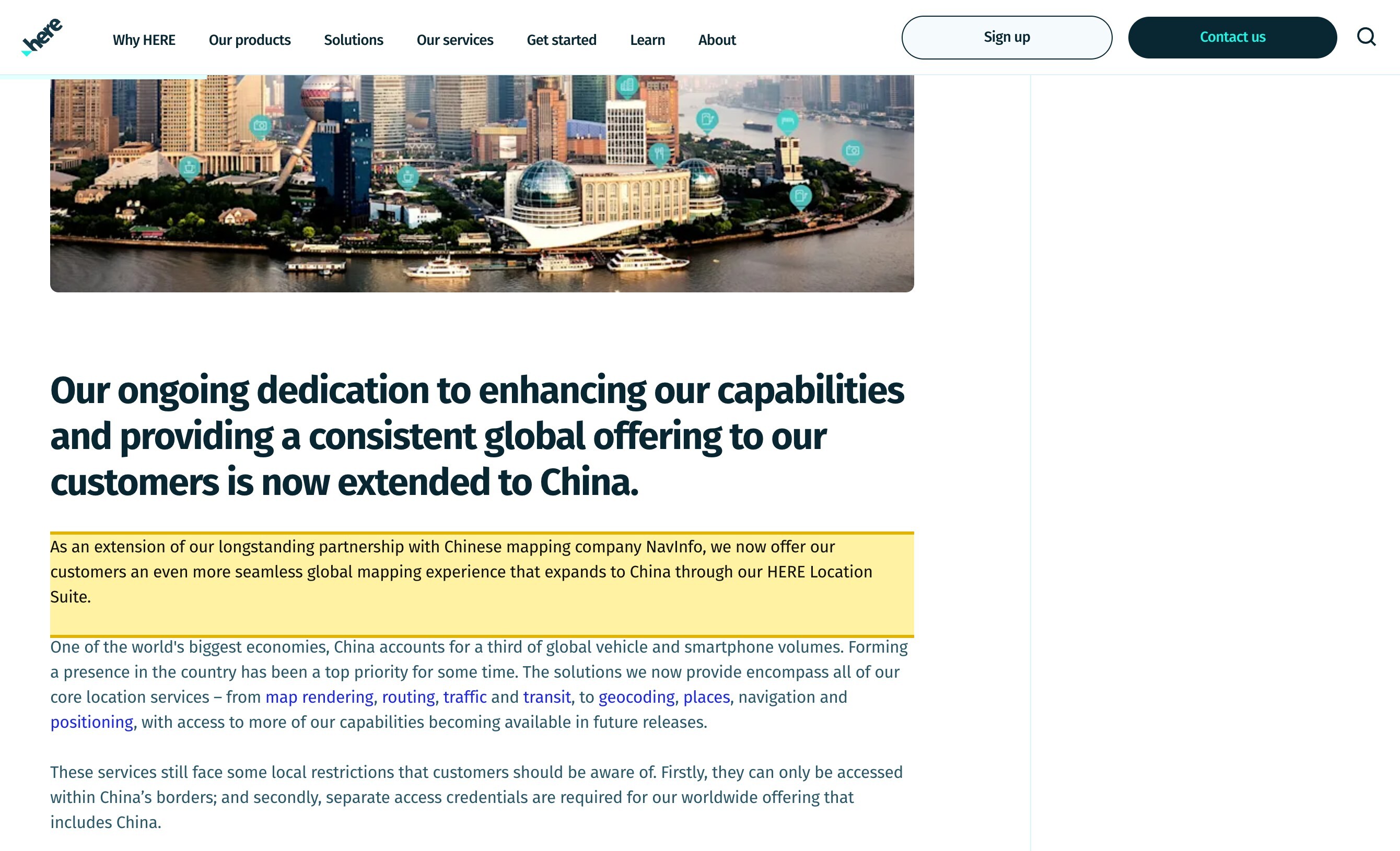
HERE's own history makes the shape plain: its China location suite arrived "As an extension of our longstanding partnership with Chinese mapping company NavInfo," and those services "can only be accessed within China's borders" with separate credentials — HERE reaches the mainland through a Chinese mapping partner, not its worldwide API. Underneath sits a second duty: the coordinates, searches and routes you send the map API are personal information under the PIPL, precise location can be sensitive personal information, and sending your China users' location to an offshore service is a cross-border transfer (Articles 38–40).
This is a risk map, not a verdict — the qualification, consent and transfer rules that apply turn on your service, your data and your users. Our China team can map your exposure with you →
What HERE Maps's own documentation says about China
| Fact | Primary source |
|---|---|
| HERE reaches mainland China through a Chinese mapping partner, not its global platform. In HERE's own words, its China location suite came "As an extension of our longstanding partnership with Chinese mapping company NavInfo," and the company describes a 2017 joint venture built on that partnership. A foreign map platform does not serve the mainland directly — it rides on a qualified domestic provider, which is the shape China's surveying-and-mapping qualification (测绘资质) forces. | HERE Technologies — "HERE Location Suite launch in China" blog (here.com), retrieved 2026-10-13 |
| HERE's China services are walled off from its worldwide offering. HERE states its China location services "can only be accessed within China's borders," and that "separate access credentials are required" for the worldwide offering that includes China. A standard global HERE project is therefore not a China-facing map service — the mainland product is a distinct, partner-backed, in-China-only arrangement, consistent with the fact that offering the map yourself as a foreign provider is not lawful without a qualification you cannot hold. | HERE Technologies — "HERE Location Suite launch in China" blog (here.com), retrieved 2026-10-13 |
| User location sent to an offshore map API is a cross-border transfer of personal information. The coordinates, searches and routes a maps or LBS integration sends are personal information under the PIPL, and precise location can be Article 28 sensitive personal information needing a specific purpose, strict necessity and separate consent. Sending your China users' location offshore triggers notice, separate consent and one transfer mechanism — a CAC security assessment, the CAC standard contract, or certification (Articles 38–43). | PIPL Articles 28, 38–43 (gov.cn), via 21YunBox cross-border guidance |
| Some handlers owe in-China storage an offshore location pipeline can't meet. If you are a critical information infrastructure operator, or you process personal information above the regulated volume thresholds, personal information and important data collected in the mainland must be stored in the mainland (PIPL Article 40; Cybersecurity Law Article 39 (formerly Article 37)). A pipeline that streams every China user's coordinates to an offshore map service cannot satisfy that localization duty. | Cybersecurity Law Article 39 (formerly Article 37); PIPL Article 40 (gov.cn) |
Sources verified by the 21YunBox compliance team on 2026-10-13.
For a team building for mainland China, the question about HERE Maps was never whether the tiles render or how fast they paint from Shanghai. Maps are a regulated category of their own. Providing map, navigation or location-based-service content to the public in mainland China rests on a surveying-and-mapping qualification — the 测绘资质, and for navigation electronic maps the Grade-A 导航电子地图制作 qualification — granted under China’s Surveying and Mapping Law and the Map Management Regulations. That qualification is reserved to qualified Chinese entities; a foreign-invested company cannot hold it directly. So the deciding question for HERE is a licensing one before it is anything else: a foreign map platform cannot be the lawful basis for a China-facing map service, no matter how well its API performs. Underneath it sits a second, data question — the user location you send to the map API is personal information, and sending your China users’ coordinates to an offshore service carries it across the border.
HERE Maps in China at a glance
| What decides it | In HERE's own terms — and China's law |
|---|---|
| The licensing door | Offering map, navigation or location-based-service content to the public in mainland China requires a surveying-and-mapping qualification (测绘资质; for navigation maps, the Grade-A 导航电子地图制作 qualification) under the Surveying and Mapping Law and the Map Management Regulations. It is reserved to qualified Chinese entities, so a foreign-invested company cannot hold it — and HERE's global platform cannot be the lawful basis for a China-facing map service. A reachability test never sees this door. |
| How HERE actually reaches China | In HERE's own words its China offering came "As an extension of our longstanding partnership with Chinese mapping company NavInfo," and those location services "can only be accessed within China's borders," with separate credentials for the worldwide offering. HERE reaches the mainland through a Chinese mapping partner — not its global API — which is the shape the law forces. |
| The coordinate system | Mainland map data must use the GCJ-02 obfuscated coordinate system, produced and served by the qualified domestic provider — not raw coordinates streamed from an offshore map service. A compliant China map rides on the licensed provider's data, another reason the foreign-direct path does not fit. |
| User location is personal information | Every coordinate, search string and route you send to the map API is personal information under the Personal Information Protection Law. Precise location can be Article 28 sensitive personal information, carrying a higher bar of specific purpose, strict necessity and separate consent. Sending your China users' location to an offshore map service is a cross-border transfer (Articles 38–40). |
| The in-country duty for some handlers | For a critical information infrastructure operator or a high-volume handler, personal information and important data collected in China must stay in the mainland (PIPL Article 40; Cybersecurity Law Article 39 (formerly Article 37)). A location pipeline that ships every China user's coordinates offshore cannot meet that duty. |
| Is it reachable? | Reachability is not the axis. Even if tiles render from Shanghai, offering the map service yourself as a foreign provider is not lawful without the qualification, and the user-location data still crosses the border. The lawful path is a licensed Chinese map provider, with any China-facing surface on an ICP-filed footing. |
The licensing door a latency test can’t see
Maps are not treated like an ordinary web service in China. Surveying and mapping — which includes compiling, publishing and serving map, navigation and location-based-service content — is a licensed activity under the Surveying and Mapping Law and the Map Management Regulations. The relevant credential is the surveying-and-mapping qualification (测绘资质); for navigation electronic maps specifically, it is the Grade-A 导航电子地图制作 qualification, a tightly held grant. That qualification is available only to qualified Chinese entities, and a foreign-invested company cannot hold it directly. The consequence is structural: a foreign map platform — HERE’s global API included — cannot be the lawful basis on which you offer a China-facing map service, however well the tiles perform. In practice, mainland map data must also use the GCJ-02 obfuscated coordinate system, produced by the licensed domestic provider, so a compliant map is served through that provider’s qualified data rather than streamed raw from offshore. None of this is visible to a connectivity test: tiles can load and the licensing basis can still be missing.
How HERE itself reaches the mainland
HERE’s own China history shows the lawful shape rather than contradicting it. HERE offers China location services, but it reaches the mainland through a Chinese mapping partner — not on its worldwide platform. In HERE’s own words, its China location suite arrived “As an extension of our longstanding partnership with Chinese mapping company NavInfo,” and the company describes embarking, in 2017, on a joint venture (named HAN Technologies) with that partnership. HERE is also explicit about the restrictions that come with it: the China services “can only be accessed within China’s borders,” and “separate access credentials are required” for the worldwide offering that includes China. That is the model the qualification regime forces — the mainland map service rests on a qualified Chinese provider, and the foreign platform plugs into that, rather than serving the mainland directly. For you, the lesson is the same: the lawful route is to localize to a licensed Chinese map provider, not to point a global HERE project at Chinese users and hope the tiles arriving is the whole of the answer.
The location data you send is personal information
Set the map-licensing door aside and a second obligation remains. A maps or LBS integration is built on a continuous stream of user location: the device coordinates you geocode, the places users search, the routes they request, the position traces a navigation session produces. Under the Personal Information Protection Law, that is personal information the moment it is tied to a person, and precise location is the kind of data that can be Article 28 sensitive personal information — which demands a specific purpose, strict necessity and the user’s separate consent, not a line buried in a blanket agreement.
Send that location to a map API hosted offshore and you have made a cross-border transfer of personal information. PIPL puts the duty on you, the handler — not on HERE — to give notice, obtain separate consent, and clear one transfer mechanism: a CAC security assessment, the CAC standard contract, or certification (Articles 38–43). And for a critical information infrastructure operator, or a handler whose volumes cross the regulators’ thresholds, the law goes further and requires the data to stay in the mainland — personal information and important data collected in China must be stored in China (Cybersecurity Law Article 39 (formerly Article 37) — the 2025 Cybersecurity Law amendment, in force January 1, 2026, renumbered the data-localization article from 37 to 39, substance unchanged; and PIPL Article 40). A pipeline that streams every China user’s coordinates to an offshore endpoint cannot satisfy that duty.
Why a reachability check misses this
It is tempting to test HERE for China the way you would a website — load a map from Shanghai, watch the tiles paint, call it supported. That check answers the wrong question twice over. It cannot see the licensing door: offering a map service as a foreign provider is unlawful without the surveying-and-mapping qualification you cannot hold, whether or not the tiles render. And it cannot see the data flow: a fast response means your China users’ location reached an offshore API quickly, which is the cross-border transfer, not the absence of one. Making an offshore map API merely reachable — or faster — leaves both problems exactly where they were. The fix is not a better connection to a foreign map service; it is resting the map on a licensed Chinese provider and keeping user-location data in-country. Reaching the offshore API is not the answer; localizing the service is.
The lawful path — map, localize, deliver
You do not have to abandon your product to serve maps and location lawfully in mainland China. 21YunBox is a compliant overlay and advisory, a partner to the stack you already run — never a competitor, and we never use or suggest circumvention of any kind. There are three moves, and they fit together.
Map. Our China compliance team inventories what your integration actually sends — device coordinates, search terms, routes, position history — where it is processed, and the consent and transfer basis for each flow, and marks where the service is being offered in a way that needs a surveying-and-mapping qualification. The exposure is written down before anything moves.
Localize. Because the risk is both a licensing one and a residency one, the answer is to rest the map on a licensed Chinese map provider — the qualified domestic entity that holds the 测绘 qualification and serves GCJ-02 data — and to keep user-location data in-country: resolve, store and process it on mainland infrastructure, treat precise location as sensitive personal information, and gather Article 13/23 consent. Only the minimized, lawfully transferable subset ever crosses the border, backed by a transfer mechanism. Localize means standing up the lawful in-country path — never making an offshore map endpoint merely reachable.
Deliver. For any China-facing surface in front of the map — the app, the location API edge, the admin and reporting views your mainland users hit — the 21YunBox Optimizer provides ICP-filed, in-country delivery, in front of the stack you already run. No rebuild, no second codebase.
This page is a risk map, not a verdict — whether you owe a licensed-provider arrangement, in-country storage, a transfer mechanism, a separate consent, an ICP filing, or some combination turns on your entity, your data volumes, and whose location you collect, so settle the specifics with counsel before you build. The goal is plain: your maps and location features run legally and compliantly for your users in China.
Related reading:
- China’s Personal Information Protection Law (PIPL)
- Cross-border data transfers under PIPL
- China’s Cybersecurity Law and data localization
- How to get an ICP filing for China


