Does Teradata Work in China? Data Residency, ICP & Cross-Border Rules
Teradata is an enterprise data warehouse holding your analytical data at rest, so the China question is residency — where that data physically lives. It self-hosts on-premises (the lawful in-country lever), while its managed cloud runs on AWS, Azure and Google Cloud with no mainland-China region.
Does Teradata work in China?
Teradata reaches China fine — but reachability was never the question. Teradata is an enterprise data warehouse, the single largest at-rest store of personal information you hold about your China users, so the compliance axis is residency: where that analytical data physically lives. Self-managed on-premises, it runs in-country — the lawful lever; on its managed cloud it runs on AWS, Azure and Google Cloud, with no mainland-China region.
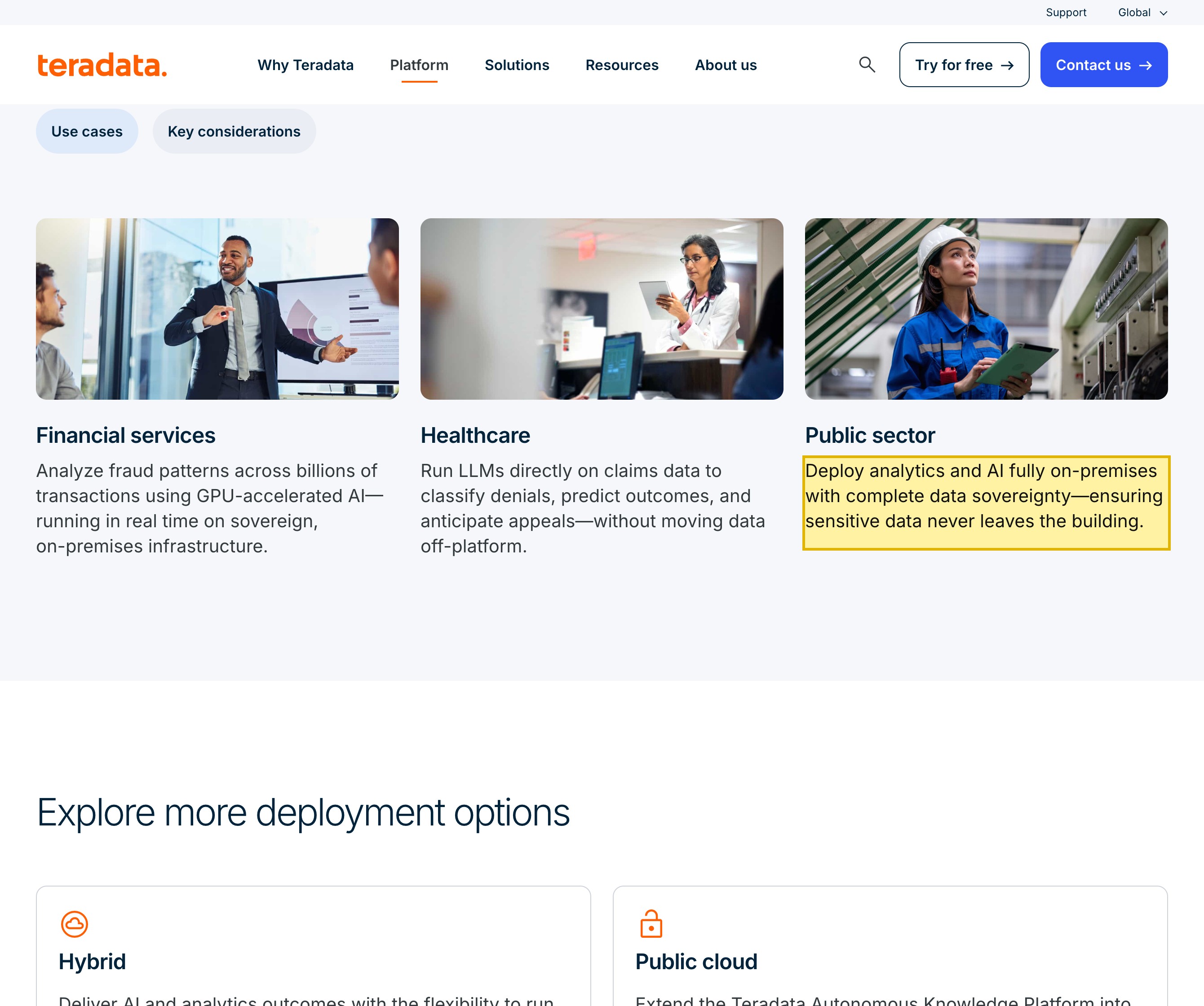
By Teradata's own On-Premises Deployment page you can "Deploy analytics and AI fully on-premises with complete data sovereignty—ensuring sensitive data never leaves the building," so self-hosted on mainland infrastructure the warehouse — and the personal information in it — stays on Chinese soil. Run it instead on Teradata's managed cloud, which its own page says runs "across AWS, Microsoft Azure, and Google Cloud" with no mainland-China region, and your Chinese users' data rests offshore: a cross-border transfer PIPL governs (notice, separate consent and a transfer mechanism), and for a critical information infrastructure operator or a high-volume handler, data the law says must stay in the mainland (PIPL Article 40; Cybersecurity Law Article 39 (formerly Article 37)). Because a warehouse consolidates data at volume, it is especially likely to cross the thresholds that trigger that duty.
This is a risk map, not a verdict — whether you owe in-country storage, a transfer mechanism, a separate consent, an ICP filing, or some combination turns on your entity, your data volumes and whose personal information sits in the warehouse. Our China team can map your exposure with you →
What Teradata's own documentation says about China
| Fact | Primary source |
|---|---|
| Teradata is software you deploy yourself — including fully on-premises. Teradata's own On-Premises Deployment page states you can "Deploy analytics and AI fully on-premises with complete data sovereignty—ensuring sensitive data never leaves the building," and positions on-premises to "Deploy on-premises AI on private data with full governance, sovereignty, and performance at scale for regulated environments." Because it runs on infrastructure you control, it can be self-hosted on mainland-China soil — where its data comes to rest is set by where you deploy it. | Teradata — On-Premises Deployment (teradata.com), retrieved 2026-10-14 |
| Teradata's managed cloud names no mainland-China region. Teradata's own page says its managed cloud is "purpose-built for enterprise workloads across AWS, Microsoft Azure, and Google Cloud," and names no mainland-China region. The AWS and Azure China partitions are separate, locally operated clouds; whether this managed service reaches either is something to confirm with Teradata directly. As published, a managed-cloud warehouse stores your China users' analytical data offshore. | Teradata — Teradata Cloud / VantageCloud (teradata.com), retrieved 2026-10-14 |
| Serving mainland users from an offshore warehouse is a cross-border transfer. Personal information collected from people in China and stored in a warehouse outside the mainland is a cross-border transfer (数据出境) under PIPL Articles 38–40 — requiring notice, a separate consent, and one transfer mechanism: a CAC security assessment, the CAC standard contract, or certification. Every load and query moves that data across the border again. | PIPL Articles 38–40 — cross-border data transfers (gov.cn) |
| At warehouse volumes, some handlers owe in-China storage no offshore region can provide. For a critical information infrastructure operator, or a handler processing personal information above the regulated volume thresholds, personal information and important data collected in the mainland must be stored in the mainland (PIPL Article 40; Cybersecurity Law Article 39 (formerly Article 37) — the 2025 amendment, in force January 1, 2026, renumbered the data-localization article from 37 to 39, substance unchanged). A warehouse consolidates data at volume, so it is especially likely to cross those thresholds, and an offshore deployment structurally cannot meet the duty. | PIPL Article 40; Cybersecurity Law Article 39 (formerly Article 37) (gov.cn) |
Sources verified by the 21YunBox compliance team on 2026-10-14.
For a team serving mainland China, the question about Teradata was never whether it installs or connects — it does, on infrastructure you run yourself as readily as in a data center abroad. Teradata is an enterprise data warehouse: the place a company consolidates its records for analytics — customer master data, orders and transactions, behavioral and event history, and the personal information wrapped up in every one of them — and because it is drawn together from every other system, it is frequently the single largest concentration of personal data a company holds. So the real question is a residency one: where is that data allowed to live? Teradata is helpful here in the way that matters — it is software you deploy yourself. By Teradata’s own On-Premises Deployment page you can “Deploy analytics and AI fully on-premises with complete data sovereignty—ensuring sensitive data never leaves the building.” Run it self-hosted on mainland-China soil and the data stays in-country — the lawful lever. Run it on Teradata’s managed cloud, which its own page says runs “across AWS, Microsoft Azure, and Google Cloud” and which names no mainland-China region, and your China users’ analytical data lives on the wrong side of the border.
Teradata in China at a glance
| What decides it | In Teradata's own terms — and China's law |
|---|---|
| Where the data physically rests | Teradata stores data wherever you deploy it. Self-host it on-premises or on infrastructure you control and the data lives on that machine; put it on Teradata's managed cloud and it lives in whichever region that service offers — and Teradata's own page says the managed cloud runs "across AWS, Microsoft Azure, and Google Cloud," naming no mainland-China region. |
| What Teradata holds | The consolidated system of record for analytics: customer master data, orders and transactions, behavioral and event history, drawn together from every other system. Almost all of it is personal information, and a single column can hold Article 28 sensitive personal information — financial, government-ID, precise-location or health fields. Where the warehouse sits is where that personal information sits — at scale. |
| Your China users' records | Held in a self-managed deployment abroad or a managed-cloud region outside the mainland, your Chinese users' personal data rests offshore — a cross-border transfer PIPL governs (Articles 38–40), carried across the border on every load and query. The handler on the hook is you, the operator, not Teradata. |
| The in-country storage duty | For a critical information infrastructure operator or a high-volume handler, personal information and important data collected in China must stay in the mainland (PIPL Article 40; Cybersecurity Law Article 39 (formerly Article 37)). A warehouse consolidates data at volume, so it is especially likely to cross those thresholds — and an offshore deployment cannot meet the duty. |
| Is it reachable? | Reachability is not the axis — Teradata is software you deploy, not a blocked site. The lawful path is to run it in-country: self-hosted on mainland infrastructure, with any China-facing surface in front of it on an ICP-filed footing. |
Where the data actually rests
Teradata has no home region; your deployment decides. The engine is the same software whether it runs in Virginia, Frankfurt or Shanghai, so the residency question lands entirely on the host you put it on. Deploy Teradata on-premises inside mainland China — on hardware you own, or on in-country infrastructure you control — and the data rests on Chinese soil. Point your analytics at Teradata’s managed cloud, and the data rests wherever that service offers a region.
That is where Teradata’s managed landscape matters. Teradata’s own page states its managed cloud is “purpose-built for enterprise workloads across AWS, Microsoft Azure, and Google Cloud,” and it names no mainland-China region; the AWS and Azure China partitions are separate, locally operated clouds, and whether this managed service reaches either is something to confirm with Teradata directly. As published, a managed-cloud warehouse therefore holds your China data offshore. So, unlike an engine with a genuine mainland region, the in-country path for Teradata is not a managed-cloud region — it is the self-hosted deployment, run on infrastructure inside the mainland. Teradata itself positions on-premises for exactly this reason, offering to “Deploy on-premises AI on private data with full governance, sovereignty, and performance at scale for regulated environments.”
Because Teradata is software you deploy yourself, that in-country path is open to you directly: stand up Teradata on mainland infrastructure and the engine behaves exactly as it does abroad — same SQL, same schema, same loads and workload management — with the records China requires to stay in-country resting on Chinese soil. An in-country deployment is the starting point for compliance, not the whole of it: any public China-facing surface in front of the warehouse still earns its own ICP filing tied to a mainland hosting resource.
What it holds is personal information
A data warehouse earns this scrutiny because of what — and how much — it stores. Unlike a tool that touches one slice of your data, the warehouse is where the whole record of a customer relationship is consolidated for analysis: the accounts, the orders, the payments, the events, the behavioral history, pulled from every operational system into one place. Every one of those rows is personal information under the Personal Information Protection Law the moment it identifies a person, and some of it is Article 28 sensitive personal information — financial records, government-issued IDs, precise location, biometric or health data — which carries a higher bar of specific purpose, strict necessity and separate consent.
Once that information is collected from people in China and stored in an offshore Teradata deployment, holding it there is a cross-border transfer, and every load or query that writes or reads it moves personal data across the border again. PIPL puts the obligation on you — the handler, not Teradata — to give notice, obtain separate consent, and clear one transfer mechanism: a CAC security assessment, the CAC standard contract, or certification (Articles 38–43). For a critical information infrastructure operator, or a handler whose volumes cross the regulators’ thresholds, the law goes further and requires the data to stay put: mainland personal information and important data must be stored in the mainland (Cybersecurity Law Article 39 (formerly Article 37) — the 2025 Cybersecurity Law amendment, in force January 1, 2026, renumbered the data-localization article from 37 to 39, substance unchanged; and PIPL Article 40). A warehouse exists to aggregate data at volume, so it is among the most likely systems you run to sit inside those thresholds — and an offshore deployment structurally cannot satisfy the duty.
Why a reachability check misses this
It is tempting to test Teradata for China the way you would a website — open a connection from Shanghai, measure the latency, call it done. That check answers the wrong question. It only asks whether an application can reach the warehouse; it can, from almost anywhere. What it cannot see is the thing China’s law actually responds to: that the regulated records are stored offshore. Making an offshore Teradata deployment merely reachable — or faster — leaves the data exactly where it was, abroad, which is the residency violation by definition, no matter how quick the round trip. The fix is not a better connection back to the offshore warehouse; it is moving where the data comes to rest. Storing it in-country is the answer; reaching it from in-country is not.
The lawful path — map, localize, deliver
You do not have to drop Teradata to run it lawfully for mainland China. 21YunBox is a compliant overlay, not a migration — and, for an engine you deploy yourself, a partner that sits alongside your stack, not a competitor to it. There are three moves, and they fit together.
Map. Our China compliance team reads your PIPL cross-border, data-residency and data-localization (CII) obligations against your actual entity, your data volumes, and whose personal information sits in the warehouse — so the exposure is written down before anything is moved.
Localize. Because the risk is where the data rests, we run Teradata in-country — self-hosted on mainland infrastructure — so the personal information China requires to stay on mainland soil does, with consented, in-country storage for what must stay. Localize means standing up a lawful in-country deployment of the same engine, never merely making an offshore endpoint reachable; only the minimized, lawfully transferable subset — aggregated or de-identified results — ever crosses, backed by a transfer mechanism.
Deliver. For any China-facing surface in front of the warehouse — the app, the API edge, the dashboards and reporting portals your mainland users hit — the 21YunBox Optimizer provides ICP-filed, in-country delivery, in front of the stack you already run. No rebuild, no second codebase. 21YunBox never uses or suggests circumvention of any kind; the entire point is a lawful, filed, in-country path.
This page is a risk map, not a verdict — whether you owe in-country storage, a transfer mechanism, a separate consent, an ICP filing, or some combination turns on your entity, your data volumes, and whose personal information sits in the warehouse, so settle the specifics with counsel before you build. The goal is plain: your Teradata runs legally and compliantly for your users in China.
Related reading:
- China’s Personal Information Protection Law (PIPL)
- Cross-border data transfers under PIPL
- China’s Cybersecurity Law and data localization
- How to get an ICP filing for China


