Does MongoDB Work in China? Data Residency, Localization & PIPL Cross-Border
MongoDB is not blocked in China — the engine self-hosts fine on mainland soil — but MongoDB Atlas, the managed cloud, has no mainland-China region, so an Atlas cluster keeps your China data offshore. That is a data-residency gap and a PIPL cross-border transfer. A compliance-first look at where your data rests, the in-country storage duty, and the lawful self-host path.
Does MongoDB work in China?
MongoDB is not blocked in China — the engine self-hosts fine on mainland soil — so the real question is data residency, and MongoDB Atlas, the managed cloud, has no mainland-China region.
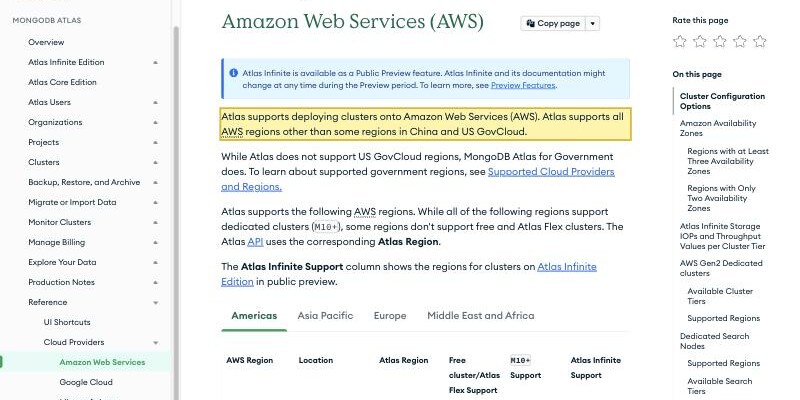
MongoDB Atlas deploys only onto the global regions of AWS, Google Cloud, and Azure; MongoDB's own documentation states that “Atlas supports all AWS regions other than some regions in China and US GovCloud,” Google Cloud has no mainland region, and Azure's China partition (21Vianet) is one Atlas does not use. So an Atlas cluster keeps your China users' records offshore, which is a PIPL cross-border transfer (Articles 38–40). For a critical information infrastructure operator or high-volume handler, PIPL Article 40 and the Cybersecurity Law Article 39 (formerly Article 37) require in-country storage that an offshore cluster cannot provide. The lawful lever is the same engine run in-country — self-hosted MongoDB Community Server or Enterprise Advanced on mainland infrastructure, or a licensed domestic managed option.
Treat the specifics as a risk to confirm with counsel. Our China team can map your exposure →
What MongoDB's own documentation says about China
| Fact | Primary source |
|---|---|
| MongoDB Atlas has no mainland-China region. MongoDB's Atlas documentation for AWS states: “Atlas supports all AWS regions other than some regions in China and US GovCloud.” Atlas also deploys to Google Cloud (which operates no mainland-China region) and to Microsoft Azure's global regions, not the separate 21Vianet-operated China partition — so an Atlas cluster's data comes to rest offshore. | MongoDB Atlas documentation, “Amazon Web Services” region reference (mongodb.com), retrieved 2026-10-10 |
| The MongoDB engine self-hosts in-country, and an authorized domestic managed option exists. MongoDB Community Server (offered under the Server Side Public License) and MongoDB Enterprise Advanced are self-hostable on mainland-China infrastructure, keeping data in-country; and MongoDB describes Alibaba Cloud's ApsaraDB for MongoDB as “the only authorized MongoDB DBaaS offering in mainland China.” MongoDB is not blocked — where you run it decides residency. | MongoDB newsroom, “MongoDB and Alibaba Cloud Launch New Partnership” (2019-10-30), retrieved 2026-10-10 |
| China users' data in an offshore cluster is a PIPL cross-border transfer. Writing the personal information of people in China to an offshore MongoDB deployment is a cross-border transfer under the Personal Information Protection Law (Articles 38–40): it requires notice, a separate consent, and one transfer mechanism — a CAC security assessment, the CAC standard contract, or certification — with heightened duties for sensitive personal information under Article 28. | Personal Information Protection Law of the PRC (2021), Articles 28 and 38–40 |
| For critical information infrastructure, China data must be stored in-country. PIPL Article 40 and the Cybersecurity Law Article 39 (formerly Article 37 — the 2025 amendment, in force January 1, 2026, renumbered it; substance unchanged) require personal information and important data collected in China to be stored in China, with a security assessment before any export — a duty an offshore managed service with no China region cannot meet. | Cybersecurity Law of the PRC, Article 39 (formerly Article 37); PIPL Article 40 |
Sources verified by the 21YunBox compliance team on 2026-10-10.
For a mainland-China audience, the first thing to settle about MongoDB is that the question is not whether it installs or connects. MongoDB is a document database, and it typically holds exactly the data China’s law cares about most: user accounts and profiles, customer and contact records, orders and payment metadata, messages and activity logs, and the JSON documents your product is built around — personal information, and often sensitive personal information. The engine itself is residency-neutral: MongoDB Community Server (offered under the Server Side Public License) and MongoDB Enterprise Advanced are self-hostable, so you can run them on mainland infrastructure and the data stays in-country. What changes the answer is the managed cloud. MongoDB Atlas deploys clusters onto global AWS, Google Cloud, and Azure regions — and by MongoDB’s own documentation, none of them is a mainland-China region. An Atlas cluster therefore keeps your China data offshore. That residency fact, not reachability, is the whole question.
MongoDB in China at a glance
| What decides it | In MongoDB's own terms — and China's law |
|---|---|
| Where the data physically rests | MongoDB Atlas, the managed cloud, deploys onto global AWS, Google Cloud, and Microsoft Azure regions. MongoDB's own AWS region reference states: "Atlas supports all AWS regions other than some regions in China and US GovCloud." Google Cloud operates no mainland-China region, and Atlas does not deploy to Azure's separate, 21Vianet-operated China partition. So there is no mainland-China Atlas region to select — a cluster's data rests offshore. The engine, by contrast, is self-hostable on mainland soil. |
| What it holds, and why it is personal information | A document database is where your application's records come to rest: user accounts and profiles, customer and contact records, orders and payment metadata, messages, and the JSON documents the product is built on. For people in China that is personal information under the Personal Information Protection Law, and sensitive personal information under PIPL Article 28 wherever government IDs, financial, health, or biometric data appear. |
| Your China users' records crossing the border | Write that data to an offshore Atlas cluster (or any offshore managed service) and the personal information of your China users leaves the country. Under PIPL that is a cross-border transfer (数据出境), and Articles 38–40 put the duty on you: notice, a separate consent, and one transfer mechanism — a CAC security assessment, the CAC standard contract, or certification. |
| The in-country storage duty | For a critical information infrastructure operator or a high-volume handler, storage is not optional: PIPL Article 40 and the Cybersecurity Law Article 39 (formerly Article 37) require personal information and important data collected in China to be stored in China, with a security assessment before any export. An offshore database structurally cannot meet that duty. |
| Reachability is not the axis | MongoDB is not blocked and self-hosts fine in China, so speed and reachability are not the deciding factors — residency is. The lawful levers are in-country: self-host MongoDB Community or Enterprise on mainland infrastructure, or use a licensed domestic managed option (Alibaba Cloud's authorized ApsaraDB for MongoDB). Any China-facing app or admin portal in front of the database still carries an ICP filing (备案) duty and needs compliant, in-country delivery. |
Where the data actually rests
Start with where a MongoDB deployment physically keeps its data, because that is what the whole China question rests on. There are two very different pictures.
The managed cloud — MongoDB Atlas — deploys clusters onto the global regions of AWS, Google Cloud, and Microsoft Azure. None of those offers a mainland-China region you can select. MongoDB’s own Atlas documentation says so for AWS in one line: “Atlas supports all AWS regions other than some regions in China and US GovCloud.” Google Cloud operates no mainland-China region at all, and the China regions of Microsoft Azure are a separate partition operated in-country by 21Vianet that Atlas does not deploy to. (The closest Atlas location, listed as “Hong Kong, China,” is ap-east-1 — Hong Kong is not the mainland and does not carry the mainland’s data-localization regime.) The AWS China partition itself — the Beijing and Ningxia regions operated by Sinnet and NWCD — is a wholly separate cloud with its own accounts, and it is not where an Atlas cluster lives. So for a customer putting data into Atlas, the data comes to rest offshore, every time.
The engine is the opposite. MongoDB the database — Community Server, offered under the Server Side Public License, and Enterprise Advanced — is software you install and run wherever you choose, including on servers physically in mainland China. The engine is residency-neutral: it does not “work” or “not work” in China, and it is certainly not blocked. Where you run it is what decides residency, and self-hosting it in-country keeps the data on mainland soil.
What it holds is personal information
A document database is where an application’s records come to rest. MongoDB typically stores user accounts and profiles, customer and contact records, orders and payment metadata, messages and activity logs, and the JSON documents the product is built around. For people in China, almost all of that is personal information under the Personal Information Protection Law, and it is sensitive personal information under PIPL Article 28 wherever it includes government IDs, financial, health, biometric, or children’s data. A database is, by design, the place that data is persisted — so the residency question lands on it more squarely than on any other part of the stack.
The moment that data is written to an offshore cluster, the personal information of your China users has left the country. Under PIPL that is a cross-border transfer (数据出境), and Articles 38–40 put the duty on you, the handler: give notice, obtain a separate consent, and satisfy one transfer mechanism — a CAC security assessment, the CAC standard contract, or certification. Where volumes or data types cross the thresholds, the data-export security assessment is mandatory rather than optional.
And for some handlers, storage is not a matter of mechanism at all — it must stay in-country. If your organization operates critical information infrastructure, or handles personal information at scale, the Cybersecurity Law imposes a data-localization duty: Article 39 (the 2025 Cybersecurity Law amendment, in force January 1, 2026, renumbered the data-localization article from 37 to 39; the substance is unchanged) requires personal information and important data collected and generated in-country to be stored in-country, with a security assessment before any export. PIPL Article 40 states the same duty for critical information infrastructure operators and large-volume handlers. An offshore Atlas cluster structurally cannot meet it.
A no-China-region managed service can’t meet the residency duty — and what can
Put those two facts together and the conclusion is narrow and practical. If your China users’ records must stay in-country — because you operate critical information infrastructure, because the data crosses the volume thresholds, or because you simply decide not to carry the cross-border exposure — then an offshore managed service with no mainland-China region cannot be the system of record. MongoDB Atlas is an excellent managed service; it just has no region on mainland soil, so it is the wrong tool for data that must rest there.
The practical point is that you do not need to migrate off MongoDB to fix this, because the lawful lever is the same engine run in a different place. Self-host MongoDB Community Server or Enterprise Advanced on mainland-China infrastructure and the data never leaves the country. Or use a licensed, in-country managed option: MongoDB describes Alibaba Cloud’s ApsaraDB for MongoDB as the authorized MongoDB managed service in mainland China, running in Alibaba Cloud’s mainland regions. Either way you keep MongoDB — the same drivers, the same query language, the same documents — while the data comes to rest in-country. Any China-facing surface in front of the database (the app, the API edge, the admin or reporting portal your mainland users reach) still carries an ICP filing (备案) duty and needs compliant, in-country delivery.
This page maps exposure; it does not rule on your facts. Whether a given deployment triggers the in-country storage duty, which transfer mechanism applies, and what consent and records you need are decisions to settle with your own counsel, against the real data you handle and the entity that handles it.
The lawful path — map, localize, deliver
21YunBox is a compliant overlay on the stack you already run — not a migration, and not a competitor to MongoDB. Our role is three moves.
First, we map the exposure: whose personal information sits in your MongoDB data, how much of it, whether any is sensitive or “important data,” whether your entity is a critical information infrastructure operator, and how all of that lands against PIPL’s cross-border rules, Article 28, PIPL Article 40, and the Cybersecurity Law — so you and your counsel can decide what must stay in-country.
Second, we localize: run the database in-country so the personal information rests on mainland soil — self-hosted MongoDB Community Server or Enterprise Advanced on mainland infrastructure, or a licensed domestic managed option — with consented, in-country storage for what must stay. Localize means standing up a lawful, in-country MongoDB, not reaching back to an offshore Atlas endpoint.
Third, we deliver: any China-facing surface in front of the database — the app, the API edge, the admin and reporting portals your mainland users hit — over ICP-filed, in-country infrastructure (the 21YunBox Optimizer), in front of the stack you already run, with no rebuild and no second codebase.
The result runs legally and compliantly for your users in China. 21YunBox never uses or suggests circumvention of any kind.
Related reading:
- Cross-border data transfers under PIPL
- China’s Cybersecurity Law (data localization, Article 39)
- China’s data-export security assessment measures
- How to get an ICP filing for China