Does Cloudera Work in China? Data Residency, ICP & Cross-Border Rules
Cloudera is a big-data lakehouse that holds your analytical estate at rest — logs, customer and transaction records, behavioral data — often at petabyte scale, so the China question is residency, not speed. It is self-hostable on-premises (the lawful in-country lever); the managed variant runs on AWS, Azure or Google Cloud, offshore of the mainland.
Does Cloudera work in China?
Whether you can use Cloudera in China is a data-residency question, not a speed one. Cloudera is a big-data lakehouse that holds your analytical estate — event logs, customer and transaction history, behavioral data, ML training sets — at rest, often at petabyte scale, so the whole question is where all that data is allowed to live.
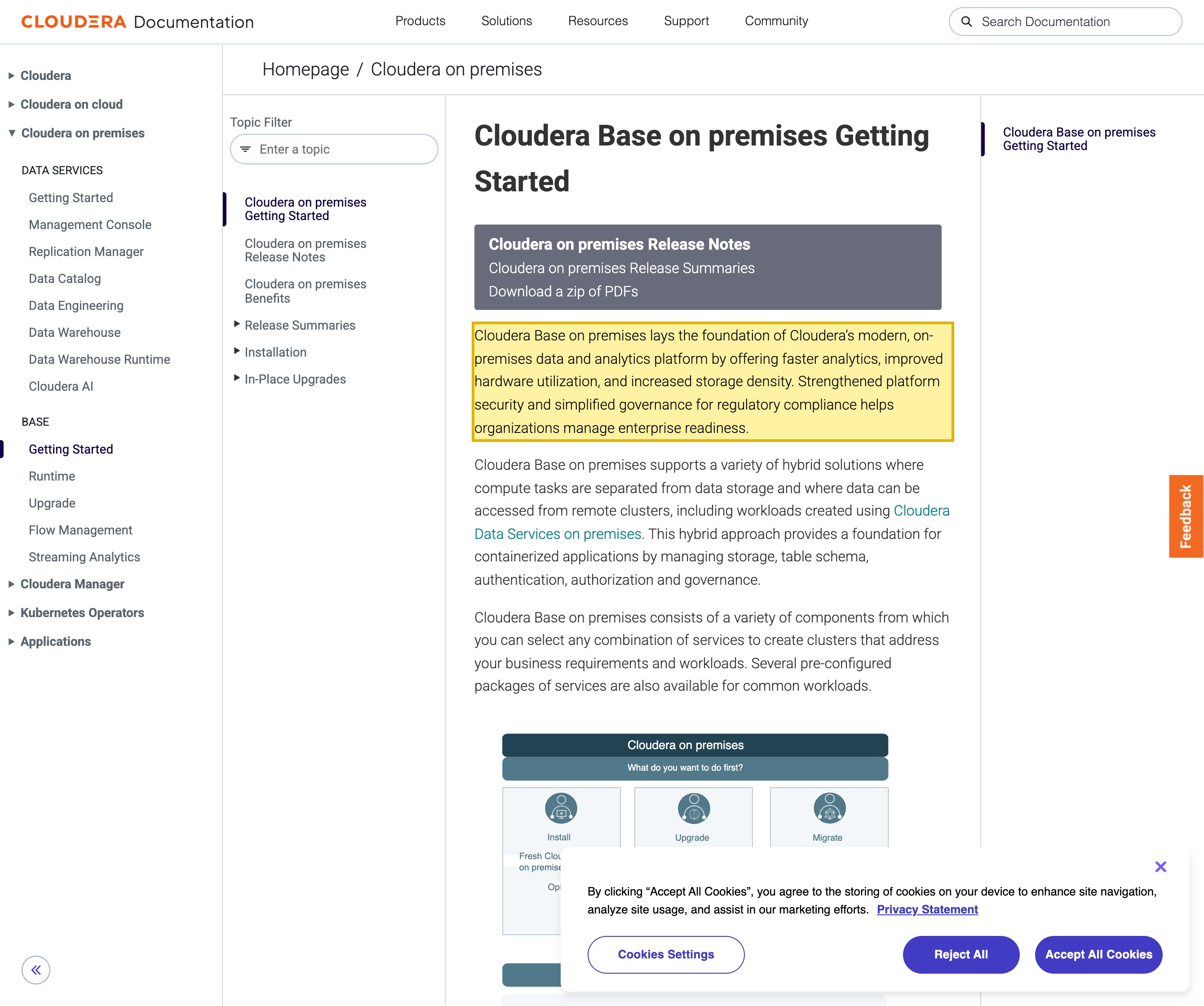
Cloudera ships as software you run yourself: by its own documentation, "Cloudera Base on premises lays the foundation of Cloudera's modern, on-premises data and analytics platform," a deployment you stand up on your own infrastructure — including inside mainland China, which is the lawful lever. Its managed public-cloud variant instead runs on AWS, Azure, or Google Cloud, so your China users' records rest in whichever of those regions you land on — a cross-border transfer of personal information PIPL governs, and at Cloudera's volumes very likely an in-country storage duty an offshore cluster cannot meet. The fix is not a faster link back offshore — it is running Cloudera in-country.
What Cloudera's own documentation says about China
| Fact | Primary source |
|---|---|
| Cloudera's own documentation states that "Cloudera Base on premises lays the foundation of Cloudera's modern, on-premises data and analytics platform" — a deployment you run on your own infrastructure, including on mainland-China soil (the residency lever). | Cloudera Documentation — Cloudera on premises (retrieved 2026-10-14) |
| On Cloudera's products page, the managed variant "runs on AWS, Azure, and Google Cloud", so a managed deployment stores your data in whichever hyperscaler region you select — offshore relative to the mainland unless it physically sits in-country. | Cloudera — Products, deployment options (retrieved 2026-10-14) |
| Personal information collected from users in mainland China and held in an offshore Cloudera deployment is a cross-border transfer under PIPL Articles 38–40, requiring notice, a separate consent, and one transfer mechanism before it may leave the country. | PIPL Articles 38–40 — Cross-border data transfers (21YunBox gov-doc) |
| For a critical information infrastructure operator or a large-volume handler, personal information and important data collected in China must be stored in the mainland (PIPL Article 40; Cybersecurity Law Article 39 (formerly Article 37)) — a petabyte-scale lakehouse readily crosses the volume threshold. | Cybersecurity Law Article 39 (formerly Article 37) — data localization (21YunBox gov-doc) |
Sources verified by the 21YunBox compliance team on 2026-10-14.
For a company serving mainland China, the first question about Cloudera was never whether it installs or whether your pipelines can reach it — they can; Cloudera is a platform you deploy on infrastructure you choose. A big-data lakehouse is where your records physically come to rest, at a scale few other systems reach: raw event and log data, clickstream and behavioral data, customer and transaction history, and the ML training sets built from all of it — the whole analytical estate, frequently at petabyte volumes. So the real question is a residency one — where is all of that data allowed to live? Cloudera is unusual on this list in the way that helps you: it ships as software you run yourself. By Cloudera’s own documentation, “Cloudera Base on premises lays the foundation of Cloudera’s modern, on-premises data and analytics platform” — a deployment you stand up on your own infrastructure, including inside mainland China. Run it on-premises on mainland soil and the data stays in-country — the lawful lever. Run it on Cloudera’s managed public-cloud variant, which the company’s products page says “runs on AWS, Azure, and Google Cloud,” and your China users’ data rests in whichever of those regions you land on.
Cloudera in China at a glance
| What decides it | In Cloudera's own terms — and China's law |
|---|---|
| Where the data physically rests | Cloudera stores data wherever you deploy it. Run it on-premises or as a private cloud on your own infrastructure and the data lives there; run the managed variant and it lives in whichever region your cloud offers — Cloudera's own products page states the platform "runs on AWS, Azure, and Google Cloud," none of which places your data in the mainland by default. |
| What Cloudera holds | The analytical system of record: raw event and log data, clickstream and behavioral data, customer and transaction history, and the ML training sets built from them — frequently at petabyte scale. Almost all of it is personal information, and a single dataset can hold Article 28 sensitive personal information — financial, government-ID, precise-location or health fields. Where the lakehouse sits is where that personal information sits. |
| Your China users' records | Held in an offshore deployment or a managed region outside the mainland, your Chinese users' data rests abroad — a cross-border transfer PIPL governs (Articles 38–40), carried across the border on every ingest and query. The handler on the hook is you, the operator, not Cloudera. |
| The in-country storage duty | For a critical information infrastructure operator or a high-volume handler, personal information and important data collected in China must stay in the mainland (PIPL Article 40; Cybersecurity Law Article 39 (formerly Article 37)). At petabyte scale a lakehouse readily crosses the volume thresholds the regulators set, and an offshore cluster cannot meet the duty. |
| Is it reachable? | Reachability is not the axis — Cloudera is a platform you deploy, not a blocked site. The lawful path is to run it in-country: self-hosted on mainland infrastructure, with any China-facing surface in front of it on an ICP-filed footing. |
Where the data actually rests
Cloudera has no home region; your deployment decides. The platform is the same software whether it runs in Virginia, Frankfurt or Shanghai, so the residency question lands entirely on the host you put it on. Stand Cloudera up on servers inside mainland China — on-premises, or on in-country infrastructure you control — and the lakehouse rests on Chinese soil. Point your pipelines at the managed variant, and the data rests wherever that service offers a region.
That is where Cloudera’s managed landscape matters. Cloudera’s products page describes a managed offering that “runs on AWS, Azure, and Google Cloud,” so a managed deployment holds your data in whichever of those hyperscaler regions you select — and unless the region you land on physically sits in the mainland, that is offshore relative to China. Unlike a database you merely connect to, a Cloudera lakehouse is also the place your organization chooses to concentrate data from every source, which makes the residency of the whole estate, not one table, the thing in question.
Because Cloudera ships as software you deploy yourself, the in-country path is open to you directly: stand up Cloudera on mainland infrastructure and the platform behaves exactly as it does abroad — same engines, same schemas, same jobs and pipelines — with the records China requires to stay in-country resting on Chinese soil. An in-country deployment is the starting point for compliance, not the whole of it: any public China-facing surface in front of the lakehouse still earns its own ICP filing tied to a mainland hosting resource.
What it holds is personal information
A data platform earns this scrutiny because of what — and how much — it stores. A Cloudera lakehouse is built to be the single place an organization lands its analytical data: the raw event logs, clickstream and behavioral records, customer and transaction history, and the ML features and training sets derived from them. Every record that identifies a person is personal information under the Personal Information Protection Law, and some of it is Article 28 sensitive personal information — financial records, government-issued IDs, precise location, biometric or health data — which carries a higher bar of specific purpose, strict necessity and separate consent.
Once that information is collected from people in China and stored in an offshore Cloudera deployment, holding it there is a cross-border transfer, and every ingest, query and export moves personal data across the border again. PIPL puts the obligation on you — the handler, not Cloudera — to give notice, obtain separate consent, and clear one transfer mechanism: a CAC security assessment, the CAC standard contract, or certification (Articles 38–43). Scale sharpens the China question more here than almost anywhere else on this list: a lakehouse exists precisely to accumulate data at volume, and a handler processing personal information at the thresholds the Cyberspace Administration of China specifies falls under heightened duties — including, for a critical information infrastructure operator or a handler at those volumes, a requirement that the data stay put. Under PIPL Article 40 and the Cybersecurity Law Article 39 (formerly Article 37) — the 2025 Cybersecurity Law amendment, in force January 1, 2026, renumbered the data-localization article from 37 to 39, substance unchanged — mainland personal information and important data must be stored in the mainland. An offshore lakehouse structurally cannot satisfy that duty, and the larger your estate, the more likely you are inside the threshold that triggers it.
Why a reachability check misses this
It is tempting to test Cloudera for China the way you would a website — open a connection from Shanghai, measure the latency, call it done. That check answers the wrong question. It only asks whether your pipelines can reach the platform; they can, from almost anywhere. What it cannot see is the thing China’s law actually responds to: that petabytes of regulated records are stored offshore. Making an offshore Cloudera deployment merely reachable — or faster — leaves the data exactly where it was, abroad, which is the residency violation by definition, no matter how quick the round trip. The fix is not a better connection back to the offshore cluster; it is moving where the data comes to rest. Storing it in-country is the answer; reaching it from in-country is not.
The lawful path — map, localize, deliver
You do not have to drop Cloudera to run it lawfully for mainland China. 21YunBox is a compliant overlay, not a migration — and, for a platform you deploy yourself, a partner that sits alongside your stack, not a competitor to it. There are three moves, and they fit together.
Map. Our China compliance team reads your PIPL cross-border, data-residency and data-localization (CII) obligations against your actual entity, your data volumes, and whose personal information sits in the lakehouse — so the exposure is written down before anything is moved. For a system built to hold data at scale, the volume question is not a footnote; it is often what decides whether in-country storage is owed.
Localize. Because the risk is where the data rests, we run Cloudera in-country — self-hosted on mainland infrastructure — so the personal information and important data China requires to stay on mainland soil does. Localize means standing up a lawful in-country deployment of the same platform, never merely making an offshore endpoint reachable; only the minimized, lawfully transferable subset — aggregated or de-identified results that may lawfully leave — ever crosses, backed by a transfer mechanism.
Deliver. For any China-facing surface in front of the lakehouse — the applications, the API edge, the analytics and reporting portals your mainland users reach — the 21YunBox Optimizer provides ICP-filed, in-country delivery, in front of the stack you already run. No rebuild, no second codebase. 21YunBox never uses or suggests circumvention of any kind; the entire point is a lawful, filed, in-country path.
This page is a risk map, not a verdict — whether you owe in-country storage, a transfer mechanism, a separate consent, an ICP filing, or some combination turns on your entity, your data volumes, and whose personal information sits in the lakehouse, so settle the specifics with counsel before you build. The goal is plain: your Cloudera platform runs legally and compliantly for your users in China.
Related reading:
- China’s Personal Information Protection Law (PIPL)
- Cross-border data transfers under PIPL
- China’s Cybersecurity Law and data localization
- How to get an ICP filing for China


