Does Sage Intacct Work in China? PIPL Cross-Border, Data Residency & Employee-Data Compliance
Sage Intacct is a cloud financial-management SaaS hosted on AWS in the United States, with no mainland-China region and no on-premises option — so the financial records and employee personal information (payroll, HR — sensitive PI) your China operation keeps in it sit offshore, making their collection a PIPL cross-border transfer and a data-localization problem. A compliance-first look at the residency, employee-data and cross-border exposure, and the lawful in-country path.
Does Sage Intacct work in China?
Your China operation's financial records and employee personal information — payroll and HR, which is sensitive PI — sit in Sage Intacct's US-hosted cloud, which has no mainland-China region, so the lever is keeping that data in-country, not making the offshore system reachable.
Sage Intacct is a cloud financial-management SaaS hosted on Amazon Web Services in the United States, with no mainland-China region and no on-premises option, so the ledgers, AP/AR and payroll-linked employee records your China entity enters come to rest offshore. Holding them there is a PIPL cross-border transfer (Articles 38–40) and, for a critical or high-volume handler, a data-localization problem; payroll, bank and national-ID data are sensitive personal information with their own consent rules. The lawful lever is to keep the China financial and employee data on an in-country footing, minimize the sensitive employee PI, and ICP-file any China-facing surface — not to make the offshore cloud reachable.
This is a risk map, not a verdict — settle the specifics with counsel. Our China team can map your exposure →
What Sage Intacct's own documentation says about China
| Fact | Primary source |
|---|---|
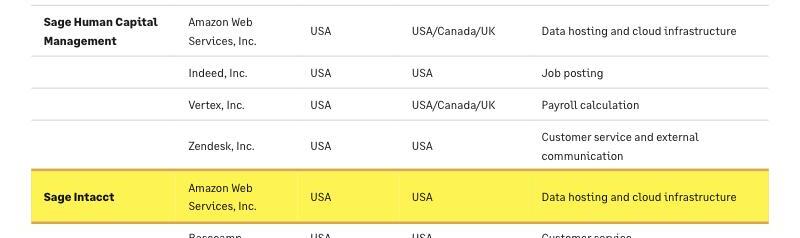
| Sage Intacct is hosted on AWS in the United States. Sage's own Customer due diligence (sub-processor) list names Sage Intacct's sub-processor as “Amazon Web Services, Inc.” with a “Data Hosting & Processing Location” of “USA” for data hosting and cloud infrastructure — there is no mainland-China region to provision. | Sage — Customer due diligence (sub-processors), retrieved 2026-10-10 |
| Sage Intacct runs in a fixed set of AWS regions, none in mainland China, and is cloud-only. Sage's 2023 announcement marks “first-time availability of Sage Intacct on Amazon Web Services in the US,” adding to existing availability in “the AWS Canada (Central) Region, AWS Australia (Sydney) Region, and AWS Europe (Ireland) Region” — a multi-tenant SaaS with no on-premises deployment and no mainland-China region. | Sage — “Amazon Web Services and Sage Expand Partnership” press release (June 28, 2023), retrieved 2026-10-10 |
| Offshore financial and payroll data is a PIPL cross-border transfer — and payroll/ID data is sensitive PI. Under PIPL, moving China personal information to an offshore system is a cross-border transfer needing notice, separate consent and a transfer mechanism (Articles 38–40); payroll, bank and national-ID data are sensitive personal information under Article 28, requiring separate consent and a prior impact assessment. | 21YunBox — China Personal Information Protection Law (PIPL), retrieved 2026-10-10 |
| A critical or high-volume handler owes in-country storage. For a critical information infrastructure operator or high-volume handler, personal information generated in China must be stored in the mainland under the Cybersecurity Law's Article 39 (formerly Article 37 — the 2025 amendment, in force January 1, 2026, renumbered the data-localization article from 37 to 39, substance unchanged) — a duty a US-hosted cloud cannot meet. | 21YunBox — China Cybersecurity Law (data localization), retrieved 2026-10-10 |
Sources verified by the 21YunBox compliance team on 2026-10-10.
For a company running Sage Intacct across a China operation, the instinct is to ask whether it opens from Shanghai or Shenzhen — and it does: Sage Intacct is browser-based, multi-tenant cloud software, not a service China blocks at the border. So reachability is not where the China decision is settled. What settles it is data residency and consent — where the financial records and employee personal information your China entity enters come to rest, and whether the deployment can keep them in the country. Sage Intacct is a cloud financial-management system hosted on Amazon Web Services in the United States, with no mainland-China region and no on-premises or self-managed option, so those records sit offshore. That makes running a China operation on it a cross-border transfer under PIPL — payroll and national-ID data being sensitive personal information under Article 28 — before it is a question of speed.
Sage Intacct in China at a glance
| What decides it | In Sage Intacct's own terms — and China's law |
|---|---|
| What it holds | A cloud financial-management system — general ledger, accounts payable and receivable, cash management, revenue recognition and reporting. For a China entity it holds the statutory financial records (often material non-public information) plus the personal information of employees (payroll, expense and HR data tied to AP/AR and payroll integrations), suppliers and customers. |
| Where it runs | Offshore. Sage's own sub-processor list hosts Sage Intacct on “Amazon Web Services, Inc.” with a “Data Hosting & Processing Location” of “USA”; Sage's AWS regions for the product are the US, Canada, Australia and Ireland. There is no mainland-China region, so the records your China operation enters come to rest in another country — a cross-border transfer (数据出境) under PIPL (Articles 38–40). |
| The in-country lever | A self-managed or on-premises ERP can be deployed in-country to keep the financial and employee data on the mainland — the strong form of the fix. Sage Intacct is cloud-only, with no on-premises or self-managed option and no mainland-China region, so it cannot. The lawful lever here is to keep the China finance and employee data on a separate in-country footing and deliver any China-facing surface in-country. |
| Sensitive employee PI + residency | Payroll, bank and national-ID data are sensitive personal information under PIPL Article 28 — separate consent and a prior impact assessment, with minimization (Article 29). For a critical information infrastructure operator or high-volume handler, personal information generated in China must be stored in the mainland under the Cybersecurity Law's Article 39 (formerly Article 37 — the 2025 Cybersecurity Law amendment, in force January 1, 2026, renumbered the data-localization article from 37 to 39, substance unchanged) — a duty a US-hosted cloud cannot meet. |
| Reachability is not the axis | Whether Sage Intacct opens from the mainland is not the decision; where its financial and employee records are allowed to sit is. The lawful path keeps the China finance and employee data on an in-country footing, minimizes the sensitive employee PI, and delivers any China-facing surface in-country on ICP-filed infrastructure. 21YunBox maps, localizes and delivers; it keeps what must stay in the mainland and never moves personal information offshore by stealth. |
What you actually hold — financials, employee data, and operational records
Sage Intacct does not hold an abstraction; it holds the financial spine of a business. The general ledger, the accounts payable and receivable subledgers, cash and bank records, revenue recognition and the management reports drawn from them are your company’s financial records — frequently material non-public information about the China entity and the group. Around that sit the personal details the finance function carries: the employee records behind payroll, expense and reimbursement entries, the vendor and customer contacts in AP and AR, and the approver identities in every workflow. For a China operation that record is thick with the personal information of Chinese employees, suppliers and customers.
Where does it live? Offshore. Sage’s own Customer due diligence list places Sage Intacct on Amazon Web Services with a data hosting and processing location of the USA, and Sage’s own announcement of first-time US availability names its AWS regions as the US, Canada, Australia and Ireland — none in the mainland. Sage Intacct is delivered only as multi-tenant cloud software; there is no on-premises or self-managed build a customer can stand up in China, and no mainland-China region to provision. So the moment your China people and counterparties generate ledger entries, invoices, payroll runs and vendor records, those records come to rest in the United States.
The doors: cross-border data, sensitive employee PI, and in-country storage
Once the data is offshore, a different body of law decides whether it was allowed to go there. The employee, supplier and customer details inside Sage Intacct are personal information under China’s Personal Information Protection Law, and loading them into a US-hosted instance is a cross-border transfer (数据出境). PIPL puts the duty on the handler — your China entity, not Sage the processor: Articles 38–40 require notice, a separate consent distinct from any general agreement to use your systems, and one transfer mechanism — a CAC security assessment, the CAC standard contract, or certification.
Finance data raises the stakes on two fronts. First, sensitivity: payroll, bank-account and national-ID or social-security data are sensitive personal information under PIPL Article 28, which demands a specific separate consent and a prior personal-information protection impact assessment, and Article 29’s minimization — the employee half of an ERP is the most heavily scrutinized data it holds. Second, volume and residency: a system of record for a sizeable China operation can move personal information at a scale that triggers China’s data-export security assessment (数据出境安全评估) before anything leaves, and consolidated financial data can itself be treated as “important data.” If your organization is a critical information infrastructure operator or a high-volume handler, the Cybersecurity Law’s Article 39 (formerly Article 37) requires personal information generated in China to be stored in the mainland — an in-country duty a US-hosted Sage Intacct cannot satisfy no matter which AWS region it sits in.
Logging in isn’t the question — a compliant in-country ERP is
Because Sage Intacct is cloud-only, with no mainland-China region and no on-premises or self-managed option, you cannot localize the data by relocating the product: there is nothing in the mainland to provision, and switching among its offshore AWS regions merely moves the transfer, it does not end it. The lawful shape is therefore to keep the China financial and employee data on a separate in-country footing, send Sage Intacct only what may lawfully leave for the group consolidation, minimize and protect the sensitive employee PI, and treat any China-facing surface — an employee self-service page, a supplier or expense portal served to mainland users — as a public service that carries an ICP filing duty and needs compliant, in-country delivery. That is a residency-and-delivery design, not a matter of making the offshore cloud load faster, and never a hidden path that ships the data offshore anyway. None of this is a verdict that Sage Intacct is “blocked” or “illegal”: whether you owe separate consent, a transfer mechanism, in-country storage, a data-export assessment, an ICP filing, or some combination depends on your entity, your data volumes, your role as handler and who your users are — worth settling the specifics with counsel before your China operation depends on it.
The lawful path — map, localize, deliver
There is a compliant way to run finance for a China operation, and it has a shape. First, map: our China team inventories what your Sage Intacct holds — which financial records, which employee payroll, expense and HR data (sensitive PI), and which supplier and customer records your China entity generates — where each is processed and stored (a US AWS region, with no mainland-China option), the deployment options, and what your consent, notice and residency basis has to cover. The legal conclusions are settled with counsel; we build the technical picture that feeds them.
Then localize: because Sage Intacct offers no mainland region or self-managed build to localize onto, we help you put the China finance and employee data on a China-resident footing — a consented, in-country processing-and-storage pattern, or a China-legal domestic finance system such as Yonyou (用友) or Kingdee (金蝶) where a full fit applies — so the China books and China personal data stay resident and stop leaving the country by default, while you keep Sage Intacct for your other markets and the group consolidation. We minimize and protect the sensitive employee PI, and what crosses the border afterward is only what may lawfully cross it.
Then deliver: the China-facing surfaces — the screens your in-China finance staff open, an employee self-service or supplier portal — are a public service in the mainland, so they carry an ICP filing (备案) duty and need compliant, in-country delivery. 21YunBox delivers them in-country — the 21YunBox Optimizer — set in front of what you already run, with no rebuild and no re-platform, so your mainland users reach the service reliably on ICP-filed infrastructure. The result is a China operation whose finance stack runs legally and compliantly for your users in China. 21YunBox never uses or suggests circumvention of any kind — we localize what must stay, deliver the rest compliantly from inside the mainland, and never move personal information across the border by stealth.
Related reading:
- Cross-border data transfers under PIPL
- China’s Cybersecurity Law (data localization, Article 39)
- China’s Personal Information Protection Law (PIPL)
- How to get an ICP filing for China