Does Microsoft Dynamics 365 Finance Work in China? The 21Vianet Sovereign-Cloud Deployment, Data Residency & Cross-Border
Microsoft Dynamics 365 Finance — part of the finance and operations apps — is available in mainland China, but through a separate, physically separated sovereign cloud operated by 21Vianet (Shanghai Blue Cloud Technology Co., Ltd), not the global, Microsoft-managed service most organizations run. The real decision for a China ERP deployment isn't speed — it's data residency: running the global service from the mainland puts your general ledger, vendor and customer master data, payroll and the employee and bank records behind them, much of it personal information, in Microsoft's datacenters outside China, a PIPL cross-border transfer, while the data-resident lawful path is the 21Vianet-operated China deployment. A compliance-first look at the two deployments, the cross-border-data question, Cybersecurity Law Article 39 (formerly Article 37) residency, and the lawful in-country path.
Does Microsoft Dynamics 365 Finance work in China?
Yes — Microsoft Dynamics 365 Finance is available in mainland China, but through a separate, physically separated sovereign cloud operated by 21Vianet (Shanghai Blue Cloud Technology Co., Ltd), not the global, Microsoft-managed service most organizations run. Microsoft documents this China deployment — part of the finance and operations apps operated by 21Vianet — as supporting data residency in China, with customer data that “doesn't leave the geographic boundary.”
Because a lawful in-country option exists, the real decision is data residency, not speed. Dynamics 365 Finance holds an organization's financial core — the general ledger and subledgers, vendor and customer master data, invoices and payments, and the employee and bank records attached to them — much of it personal information under Chinese law. Run that on the global service from the mainland and the data sits in Microsoft's datacenters outside China, a PIPL cross-border transfer (and, for a CII operator, a residency problem under Cybersecurity Law Article 39 (formerly Article 37)); larger or sensitive transfers can add a CAC data-export security assessment. The data-resident path is the 21Vianet-operated China deployment — licensed through 21Vianet and not at full feature parity, which you confirm with Microsoft and 21Vianet.
21YunBox maps the deployment choice, localizes your finance stack onto the data-resident China path, and delivers the China-facing portals and integrations that surface it in-country on ICP-filed infrastructure — so it runs legally in the mainland, with no circumvention of any kind. Treat the specifics as a risk to confirm with counsel.
What Microsoft Dynamics 365 Finance's own documentation says about China
| Fact | Primary source |
|---|---|
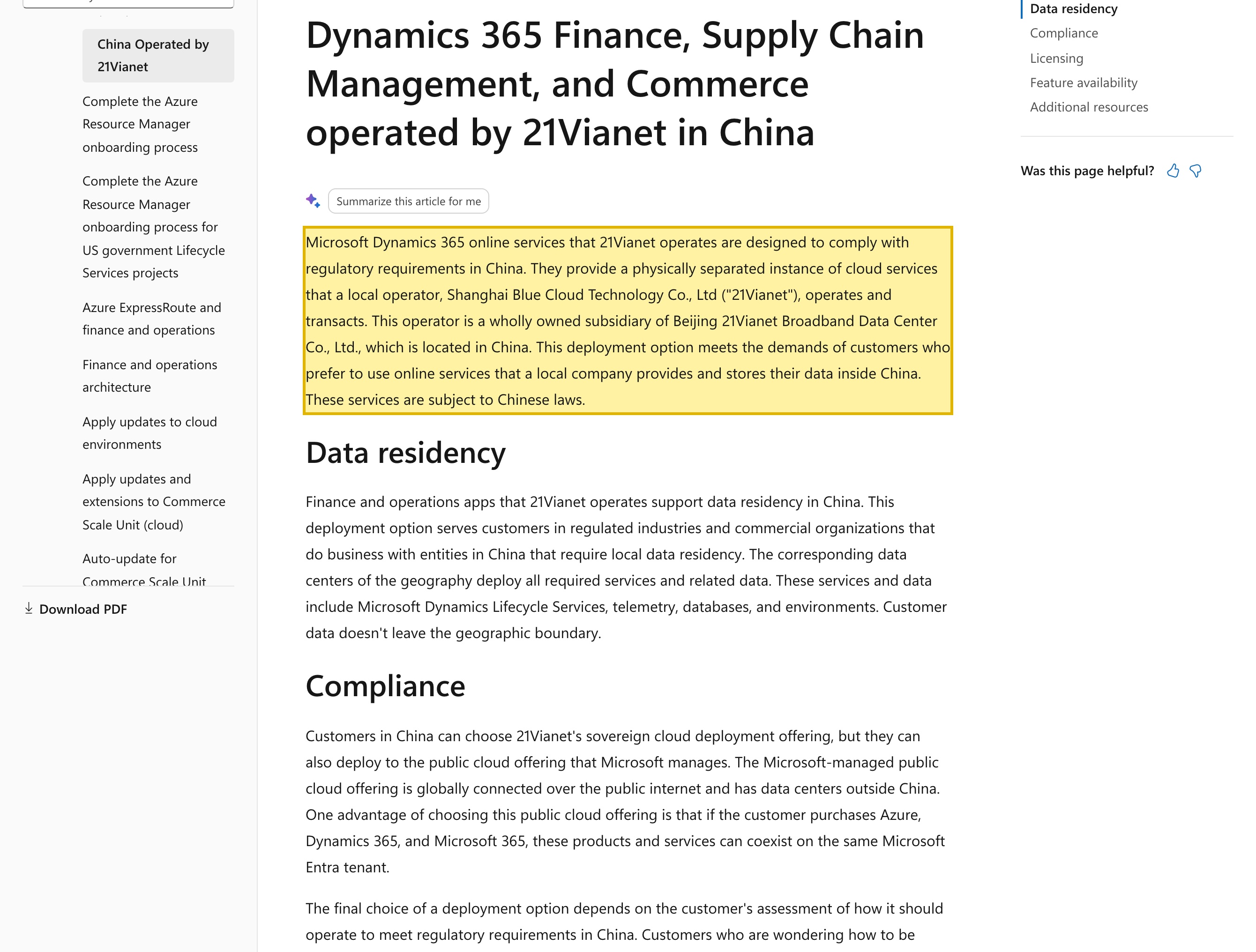
| Dynamics 365 Finance runs in China through a physically separated deployment operated by 21Vianet. Microsoft's documentation states that these online services “provide a physically separated instance of cloud services that a local operator, Shanghai Blue Cloud Technology Co., Ltd ("21Vianet"), operates and transacts,” a wholly owned subsidiary of Beijing 21Vianet Broadband Data Center Co., Ltd. It is a distinct China deployment, not the global, Microsoft-managed service. | Microsoft Learn — Dynamics 365 Finance, Supply Chain Management, and Commerce operated by 21Vianet in China (learn.microsoft.com), updated 2026-03-10, retrieved 2026-10-09 |
| Microsoft says the China deployment keeps customer data in-country. The same article states that “Finance and operations apps that 21Vianet operates support data residency in China,” that the in-country data centers “deploy all required services and related data,” and that “Customer data doesn't leave the geographic boundary.” | Microsoft Learn — Dynamics 365 Finance, Supply Chain Management, and Commerce operated by 21Vianet in China (learn.microsoft.com), updated 2026-03-10, retrieved 2026-10-09 |
| The China deployment is subject to Chinese law, isn't at full feature parity, and is licensed through 21Vianet — not Microsoft. Microsoft states “These services are subject to Chinese laws,” that “Some features aren't available for Dynamics 365 online services that 21Vianet operates in China,” and that “Customers can't acquire licenses for Dynamics 365 online services that 21Vianet operates directly from Microsoft, because Microsoft doesn't manage and deliver the services.” | Microsoft Learn — Dynamics 365 Finance, Supply Chain Management, and Commerce operated by 21Vianet in China (learn.microsoft.com), updated 2026-03-10, retrieved 2026-10-09 |
| Using the global service for China data is a cross-border transfer. Sending a Chinese organization's or individual's personal information to Dynamics 365 Finance hosted outside the mainland triggers PIPL Chapter III (Articles 38–43): notice, a separate consent, and one transfer mechanism — a CAC security assessment, the CAC standard contract, or certification — with in-country storage under Article 40 (and Cybersecurity Law Article 39 (formerly Article 37)) for CII operators. | Personal Information Protection Law of the PRC, Chapter III, Articles 38–43 (cac.gov.cn), retrieved 2026-10-09 |
Sources verified by the 21YunBox compliance team on 2026-10-09.
For an organization running Microsoft Dynamics 365 Finance into mainland China, the first thing to settle is not how quickly a ledger posts or a financial report renders — it is which Dynamics 365 Finance you are running. Microsoft operates two separate things that matter here: the global, Microsoft-managed finance and operations service most organizations sign in to, and a distinct, physically separated China deployment — Dynamics 365 operated by 21Vianet (世纪互联) — run inside the mainland by a licensed local operator, Shanghai Blue Cloud Technology Co., Ltd, with customer data kept in-country. So the honest answer to “does Microsoft Dynamics 365 Finance work in China?” is yes — but through a specific deployment, on a specific legal footing.
Because a lawful in-country option already exists, the decision moves off the speed axis and onto a data one. Dynamics 365 Finance is where an organization’s financial core lives — the general ledger and subledgers, vendor and customer master data, invoices and payments, and the employee and bank records attached to them — and a great deal of it is personal information under Chinese law. Run that on the global service from the mainland and the data rests in Microsoft’s commercial datacenters outside China, which is a cross-border transfer under PIPL; run it on the 21Vianet-operated China deployment and Microsoft’s own documentation says customer data doesn’t leave the geographic boundary. Which deployment you choose, and how you deliver the apps and portals that surface it, is the compliance question — not the posting speed.
Dynamics 365 Finance in China at a glance
| What decides it | In Microsoft's own terms — and China's law |
|---|---|
| What it is | Microsoft Dynamics 365 Finance — the general ledger, accounts payable and receivable, budgeting, fixed assets and financial reporting, part of the finance and operations apps (Finance & Supply Chain Management / F&O). Two separate deployments matter for China: the global, Microsoft-managed service, and a distinct China deployment, Dynamics 365 operated by 21Vianet (世纪互联), run inside the mainland by Shanghai Blue Cloud Technology Co., Ltd. |
| Is it available in the mainland? | Yes — through the separate, physically separated China deployment. Microsoft documents Dynamics 365 Finance "operated by 21Vianet in China," transacted by a local operator, with its own sign-up and licensing through 21Vianet rather than Microsoft directly. The global service is a different deployment and is not connected to it. |
| Where the data lives | On the 21Vianet-operated China deployment, Microsoft says the apps "support data residency in China" and that "Customer data doesn't leave the geographic boundary." On the global service, your ledgers, vendor and customer master data, payroll and the employee and bank records behind them — overwhelmingly personal information — sit in Microsoft's datacenters outside the mainland, which is the cross-border question for China users and China data. |
| Cross-border & residency | Pushing China personal information to the global service is a cross-border transfer under PIPL (Articles 38–43: notice, a separate consent, one transfer mechanism). For a critical information infrastructure operator, in-country storage is required under PIPL Article 40 and Cybersecurity Law Article 39 (formerly Article 37); larger-volume or sensitive transfers can add a CAC data-export security assessment. |
| The lawful path | Deploy on the 21Vianet-operated China deployment (or otherwise keep the finance data in-country), and deliver the China-facing portals, integrations and apps that surface it on ICP-filed, in-country infrastructure. 21YunBox maps the deployment choice, localizes your stack onto the data-resident path, and delivers it in-country — subject to the China deployment's availability and feature parity, which you confirm with Microsoft and 21Vianet. |
Availability: a distinct China deployment, operated by 21Vianet
Dynamics 365 Finance’s presence in the mainland is set in Microsoft’s own documentation, not by a load-time test. The overview for the finance and operations apps operated by 21Vianet states that these online services “provide a physically separated instance of cloud services that a local operator, Shanghai Blue Cloud Technology Co., Ltd (“21Vianet”), operates and transacts,” a wholly owned subsidiary of Beijing 21Vianet Broadband Data Center Co., Ltd., and that the deployment “meets the demands of customers who prefer to use online services that a local company provides and stores their data inside China.” This is a sovereign cloud: operated inside the mainland by a licensed local operator, physically separated, with data kept in-country and the services “subject to Chinese laws.”
Two things follow. First, the China deployment is a separate offering with its own sign-up and its own licensing — Microsoft states plainly that “Customers can’t acquire licenses for Dynamics 365 online services that 21Vianet operates directly from Microsoft, because Microsoft doesn’t manage and deliver the services,” so moving onto it is a procurement and deployment decision, not a region you toggle inside a global tenant. Second, Microsoft notes that “Some features aren’t available for Dynamics 365 online services that 21Vianet operates in China,” and points customers to a dedicated “China (21-V)” feature-availability column — so which finance modules and dependent capabilities you rely on are offered there is something to confirm directly with Microsoft and 21Vianet before you commit. For that reason this page publishes no first-party China latency figure for Dynamics 365 Finance: a lawful in-country deployment already exists, so speed is not the axis the decision turns on.
The cross-border-data story: ledgers, master data and payroll are personal information
The gate that actually decides a China Dynamics 365 Finance deployment is the data. A finance system is not an anonymous sheet of totals: the vendor and customer master holds named contacts and bank details, accounts payable and receivable track who is owed what, expense and payroll records are tied to identified employees, and the audit trail records who did what and when. A large share of it is personal information under China’s Personal Information Protection Law. Served from the global service, that data rests in Microsoft’s commercial datacenters outside the mainland, and moving it there is a cross-border transfer. PIPL puts the duty on the handler — you, not Microsoft: Chapter III (Articles 38–43) requires notice, a separate consent distinct from any ordinary use agreement, and one transfer mechanism — a CAC security assessment, the CAC standard contract, or certification.
Underneath that sits residency. A critical information infrastructure operator or a large-volume handler must store personal information collected in China inside the mainland — PIPL Article 40, together with Cybersecurity Law Article 39 (formerly Article 37), the data-localization article renumbered by the 2025 amendment that took effect on January 1, 2026 — an obligation the global, offshore service structurally cannot meet. And where data volumes or sensitivity cross the thresholds, the transfer itself needs a CAC data-export security assessment before it may proceed. How heavy each of these is scales with your data, your sector and your role as handler, so treat it as a risk to confirm with counsel against what you actually deploy — not a default assumption.
The data-resident path: the 21Vianet-operated China deployment
The lawful, in-country footing is the one Microsoft already documents: the finance and operations apps operated by 21Vianet, where — in Microsoft’s words — the service supports “data residency in China” and “Customer data doesn’t leave the geographic boundary.” On that path the cross-border question does not arise in the same way, because the data does not leave. The work is to plan the deployment onto it. Because the China deployment is a separate offering licensed through 21Vianet rather than a region of a global tenant, environments, legal entities, ledgers and security roles are stood up there rather than switched over by a flag, and any move from a global tenant needs its own migration plan. And because Microsoft states some features “aren’t available,” the first step is an availability-and-parity check: confirming that the finance modules and dependent services your organization runs on are offered in the China deployment as you need them. That check is not a formality; it is what tells you whether the data-resident path carries your deployment as-is or needs adjustment.
The lawful path — and where 21YunBox fits (map, localize, deliver)
There is a lawful way to run Dynamics 365 Finance for operations in China, and its shape is clear: the financial data stays in-country on the 21Vianet-operated China deployment, and the China-facing surfaces that hang off it are themselves delivered compliantly inside the mainland. That second half is easy to miss, because an ERP feels purely internal. But a vendor or customer self-service portal, an e-invoicing or tax integration, a Power Pages site, or a line-of-business app that reads from or writes to Dynamics 365 Finance is a public-facing service in China, so it carries an ICP filing (备案) duty and needs compliant in-country delivery like any other China property — an integration that authenticates instantly but hangs off an unfiled, offshore front end has solved only half the problem.
That is the footing 21YunBox owns, and it is more than advice. Our China team does three things on it. We map the deployment choice and your PIPL and residency exposure, so you know which Dynamics 365 Finance you should be running and what each option obliges. We localize your finance stack onto the data-resident path — standing up and integrating the 21Vianet-operated China deployment, or otherwise keeping the data in-country, in place of a global service that cannot meet the residency duty. And we deliver the China-facing portals, integrations and apps that surface your ERP in-country on ICP-filed infrastructure — the 21YunBox Optimizer — in front of what you already run, with no rebuild and no re-platform. The result is a Dynamics 365 Finance deployment that runs legally and compliantly for your users in China. What we do not do is route anyone around anyone’s terms or around China’s network controls: this is a lawful in-country deployment built on the China service Microsoft and 21Vianet already provide, and we neither use nor suggest circumvention of any kind.
Related reading:
- Cross-border data transfers under PIPL
- China’s Cybersecurity Law — Article 39 (formerly Article 37) and data localization
- China’s data-export security assessment measures
- How to get an ICP filing for China