Does SAP S/4HANA Work in China? Data Residency, PIPL Cross-Border & the Onshore Instance
SAP S/4HANA runs in mainland China — on-premises, in a China customer data center, or on an in-China hyperscaler region — so reaching it is not the question. What decides compliance is data residency: ERP holds your China finance, HR, and customer and vendor master data, and if the instance holding it sits offshore, that data is a cross-border transfer under PIPL, with an in-country storage duty for a CIIO or large-volume handler that an offshore instance cannot meet. A compliance-first look at the onshore-versus-offshore instance decision and the lawful China-resident path.
Does SAP S/4HANA work in China?
Yes — SAP S/4HANA runs in mainland China, so the honest answer is that availability is not the problem. What decides the China question is data residency: whether the S/4HANA instance holding your China data sits in-country or offshore.
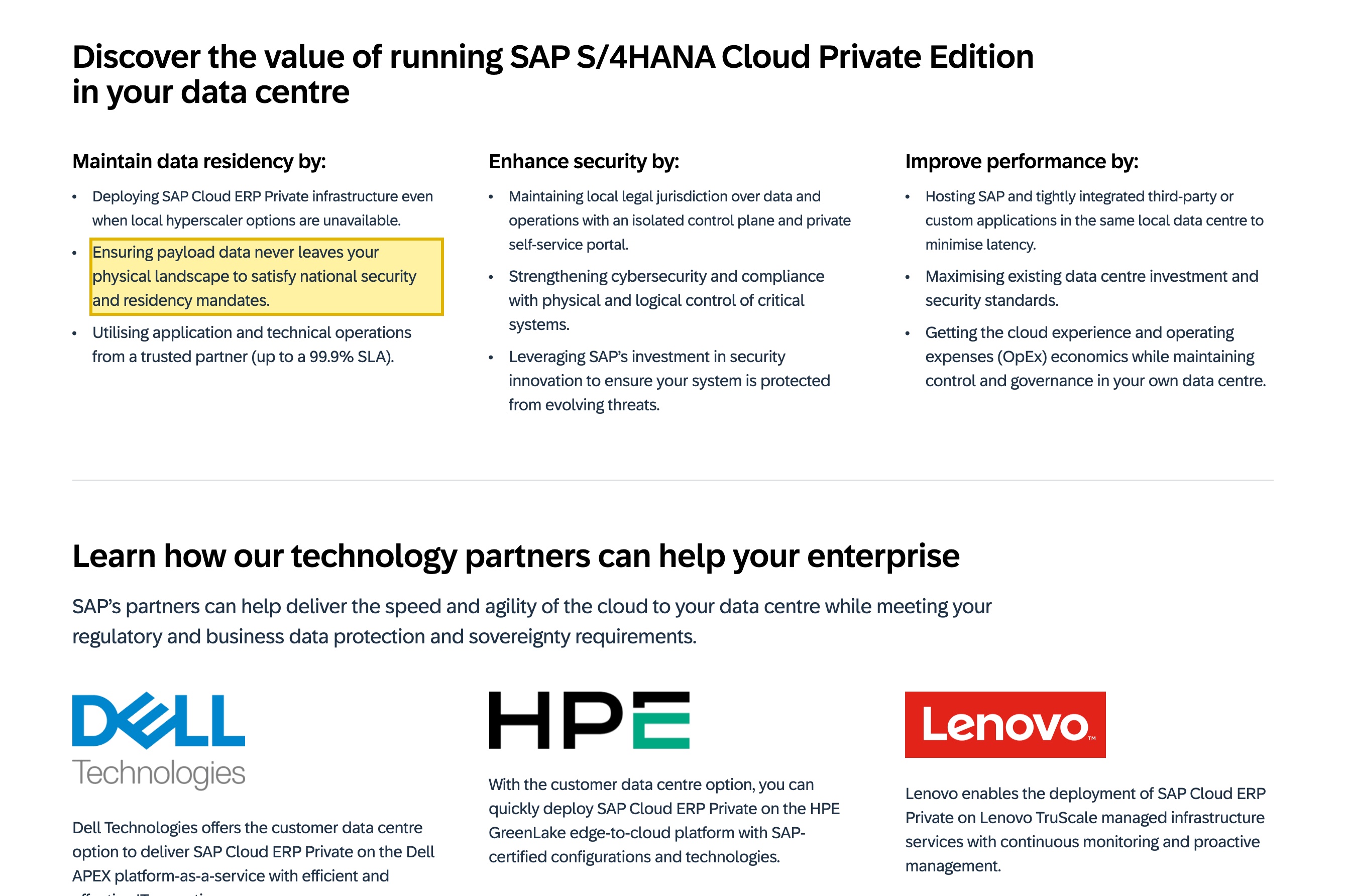
SAP offers in-country deployment — its own customer data centre option for S/4HANA Cloud Private Edition is marketed on residency, ensuring “payload data never leaves your physical landscape to satisfy national security and residency mandates,” and the May 2025 SAP–Alibaba partnership lets Chinese enterprises deploy SAP Cloud ERP on an in-China hyperscaler. The exposure is the common offshore pattern: run China finance, HR, and customer/vendor master data from a global, offshore instance and that personal information is a cross-border transfer (数据出境) under PIPL (Articles 38–40), possibly triggering a data-export security assessment; for a CIIO or large-volume handler, the Cybersecurity Law's Article 39 (formerly Article 37) requires that data to be stored in China.
21YunBox maps the onshore-vs-offshore split, localizes the China data onto a China-resident S/4HANA instance, and delivers the China-facing access in-country on ICP-filed infrastructure — with no rebuild, and never any form of circumvention. Treat the specifics as a risk to confirm with counsel.
What SAP S/4HANA's own documentation says about China
| Fact | Primary source |
|---|---|
| SAP sells an in-country deployment built around data residency. SAP's customer data centre option for SAP S/4HANA Cloud Private Edition is marketed on residency: under “Maintain data residency,” it lets you deploy “even when local hyperscaler options are unavailable” and ensures “payload data never leaves your physical landscape to satisfy national security and residency mandates” (delivered through Dell APEX, HPE GreenLake, and Lenovo TruScale). So a China-resident S/4HANA instance is available — the question is whether the instance holding your China data is that one or an offshore one. | SAP, “SAP S/4HANA Cloud Private Edition — Customer Data Centre Option” (sap.com), retrieved 2026-10-09 |
| In-China hyperscaler deployment is expanding, not absent. SAP's own May 27, 2025 announcement of its strategic partnership with Alibaba Group states: “With Alibaba Group as a certified hyperscaler for SAP software workloads, Chinese enterprises will also be able to deploy SAP Cloud ERP and SAP Cloud ERP Private solutions,” under a collaboration “initially focused on the China market.” SAP Cloud ERP Private is the current name for RISE with SAP S/4HANA Cloud, Private Edition. | SAP News, “SAP and Alibaba Group Partner to Accelerate Cloud Transformation” (news.sap.com, May 27, 2025), retrieved 2026-10-09 |
| China ERP data held in an offshore instance is a PIPL cross-border transfer. Moving personal information collected from users in mainland China — finance, HR, and customer/vendor master data — to an S/4HANA instance hosted outside the mainland triggers PIPL Articles 38–40: notice, a separate consent, and one transfer mechanism (a CAC security assessment, the CAC standard contract, or certification). The duty sits with you as the handler, not with SAP. | Personal Information Protection Law of the PRC, Articles 38–40 (cac.gov.cn), retrieved 2026-10-09 |
| For some handlers the China data must stay in China. Where the handler is a critical information infrastructure operator or moves personal information at volume, personal information collected in China must be stored in the mainland (PIPL Article 40; Cybersecurity Law Article 39 (formerly Article 37) — the data-localization provision was renumbered by the 2025 amendment in force 2026-01-01, substance unchanged). An offshore S/4HANA instance cannot satisfy this, and switching from one offshore region to another does not change it. | Cybersecurity Law of the PRC, Article 39 (formerly Article 37); PIPL Article 40 (npc.gov.cn), retrieved 2026-10-09 |
Sources verified by the 21YunBox compliance team on 2026-10-09.
For a company running SAP S/4HANA into mainland China, the first instinct is to ask whether the system is even available there — and it is. S/4HANA is not a service China blocks at the border, and SAP offers ways to run it inside the country: on-premises in your own data center, and on in-China hyperscaler regions operated under Chinese licenses. So availability is not where the China decision is settled. What settles it is data residency — which S/4HANA instance holds your China data, and whether that instance sits inside the mainland or offshore.
That distinction matters more for ERP than for almost any other system, because S/4HANA is the system of record. It holds the crown-jewel business data: finance and controlling, supply chain and procurement, and the master data for your customers, vendors, and employees. Much of that is personal information under Chinese law, and some of it may be classified as “important data.” The moment that data comes to rest in a global, offshore S/4HANA instance, a different body of law decides whether it was allowed to leave.
SAP S/4HANA in China at a glance
| What decides it | In SAP's own terms — and China's law |
|---|---|
| What it is | SAP S/4HANA is the enterprise system of record — finance and controlling, supply chain, procurement, and the master data for customers, vendors, and employees. It concentrates personal information, and some of it may be “important data,” in a single landscape. |
| Does it run in China? | Yes. S/4HANA is not blocked, and SAP offers in-country deployment: the customer data centre option (on-premises via Dell APEX, HPE GreenLake, Lenovo TruScale) and in-China hyperscaler regions — with Alibaba Cloud added under the May 2025 SAP–Alibaba partnership. Availability is not the China question. |
| Where the China data sits — the decision | Onshore vs offshore instance. If the S/4HANA instance holding your China data is China-resident, the data stays in-country. If a global, offshore instance (an EU, US, or regional hub) serves the China entity, that China finance, HR, and master data is held abroad. |
| Offshore instance → cross-border transfer | China personal information in an offshore instance is a cross-border transfer (数据出境) under PIPL Articles 38–40: notice, a separate consent, and one transfer mechanism. Above thresholds, or where the data is “important data,” a CAC data-export security assessment may apply before anything leaves. |
| In-country storage duty | For a critical information infrastructure operator or large-volume handler, the Cybersecurity Law’s Article 39 (formerly Article 37) requires personal information generated in China to be stored in China — a duty an offshore S/4HANA instance cannot meet, however it is tuned. |
| The lawful path | Run the China-resident S/4HANA instance in-country for the China data, keep the global instance for your other markets, and deliver the China-facing access (portals, launchpad) in-country on ICP-filed infrastructure. 21YunBox maps, localizes, and delivers; it never uses or suggests circumvention. |
Runnable in-country — so residency, not availability, is the question
SAP’s own materials make the in-country option explicit, which is why availability is a dead end for this decision. Its customer data centre option for SAP S/4HANA Cloud Private Edition is marketed squarely on residency: it lets you deploy “even when local hyperscaler options are unavailable,” and ensures “payload data never leaves your physical landscape to satisfy national security and residency mandates,” delivered through infrastructure partners (Dell APEX, HPE GreenLake, Lenovo TruScale). On the public-cloud side, SAP’s May 2025 partnership with Alibaba Group states that “With Alibaba Group as a certified hyperscaler for SAP software workloads, Chinese enterprises will also be able to deploy SAP Cloud ERP and SAP Cloud ERP Private solutions.” (SAP now markets the private and public editions as SAP Cloud ERP Private and SAP Cloud ERP.)
So the real question is not can S/4HANA run in China but does the instance that holds our China data run in China. Many multinationals run a single global S/4HANA instance offshore — in an EU, US, or Singapore hub — and connect their China subsidiary to it. That is precisely the pattern that turns an ERP rollout into a cross-border data question. Where connectivity from the mainland to an offshore instance is slow or inconsistent, the answer is never a network workaround: 21YunBox neither uses nor suggests circumvention of any kind — it is both a compliance risk and beside the point. For the same reason this page publishes no first-party China latency figure for S/4HANA; speed is not the axis on which a residency decision turns.
The data-residency question: an offshore instance is a cross-border transfer
Here is the gate most ERP programs miss. An S/4HANA instance hosted in the EU, the US, or a regional hub outside the mainland is, by definition, offshore. The finance records, HR and payroll data, and customer and vendor master data it holds for your China operations are personal information, and loading them into an offshore instance is a cross-border transfer of personal information under China’s Personal Information Protection Law. PIPL puts the duty on the handler — you, the operating entity, not SAP the vendor: Articles 38–40 require notice, a separate consent distinct from any general employment or customer agreement, and one transfer mechanism — a CAC security assessment, the CAC standard contract, or certification.
Above certain thresholds, or where the ERP data is classified as “important data,” that transfer may also require China’s data-export security assessment (数据出境安全评估) before anything leaves the country. And if your organization is a critical information infrastructure operator, the Cybersecurity Law’s Article 39 (formerly Article 37 — the data-localization provision was renumbered by the 2025 amendment that took effect on January 1, 2026, with its substance unchanged) requires personal information generated in China to be stored in China. None of this turns on how fast a posting runs; it turns on whether the data had a lawful basis to be offshore at all. Which of these bite your specific landscape is a risk to confirm with counsel against what you actually store.
In-country storage, and why “point it at the EU instance” is not the fix
For a CIIO or a large-volume handler, the in-country storage duty under Article 39 (formerly Article 37) is one no offshore instance can satisfy, however it is tuned. Relocating the China data from a US hub to an EU hub does not help — both are outside the mainland, so it merely moves the cross-border transfer, it does not end it. Keeping China-collected ERP data in-country means the instance of record for that data sits inside the mainland: a China-resident S/4HANA deployment — an in-China cloud region or an on-premises customer-data-center landscape — with only what may lawfully leave flowing to your global instance. That split — what must stay, what may go — is the heart of the work, and it is a legal question before it is a technical one.
The China-facing front-ends are their own door
One more door sits on top of the ERP core. S/4HANA by itself is a back-office system, but the web front-ends built on it are often public-facing: a supplier-onboarding portal, a customer self-service or commerce front-end, an employee or applicant portal, a Fiori launchpad exposed to the public internet. Any such service actually served to the public in the mainland is “internet information service,” and that triggers an ICP filing (备案) bound to a mainland hosting resource, plus compliant in-country delivery. The ERP core may be internal; the China-facing surfaces on top of it are a public-service question in their own right.
None of this is a verdict that S/4HANA is “blocked” or “illegal” in China — it runs there, lawfully, when the pieces line up. It is a residency-and-exposure map: which path fits turns on your entity, the data your landscape holds, your role under Chinese law, and who your users are — worth settling with counsel before your China operations depend on it.
The lawful path — map, localize, deliver
There is a compliant way to run SAP S/4HANA for a China operation, and it has a shape. First, map: our China team works through where your China data lives today and where Chinese law needs it to live — which finance, HR, procurement, and master-data records collected in the mainland must stay in-country, what may lawfully flow to your global instance, where a data-export security assessment or an Article 39 (formerly Article 37) storage duty bites, and what your notice and consent has to cover. The legal conclusions are settled with counsel; we build the technical picture that feeds them.
Then localize: we stand up or keep a China-resident S/4HANA instance for the China data — on an in-China cloud region or an on-premises landscape — so the system of record for the mainland sits inside the mainland, while your global instance keeps serving your other markets. Where a domestic ERP is the better fit for a China-scoped process, we integrate a China-legal option — the well-established domestic platforms here are Yonyou (用友) and Kingdee (金蝶) — rather than forcing offshore software to carry data it should not hold.
Then deliver: the China-facing access to that instance — the portals and launchpad your users actually open — is a public service in the mainland, so it carries an ICP filing duty and needs compliant, in-country delivery. 21YunBox delivers it in-country — the 21YunBox Optimizer — in front of what you already run, with no rebuild and no re-platform. The result is an SAP landscape that runs legally and compliantly for your users in China. What we never do — and what no one lawfully can — is hand you a way around China’s data-export rules or around any network restriction: we localize what must stay and deliver in-country, and we never move personal information out of the mainland by stealth.
Related reading:
- Cross-border data transfers under PIPL
- China’s data-export security assessment
- China’s Cybersecurity Law (data localization, Article 39)
- How to get an ICP filing for China