Does Epicor Kinetic Work in China? PIPL Cross-Border, Data Residency & Employee-Data Compliance
Epicor Kinetic runs its public cloud on Microsoft Azure, which has no mainland-China region — so the financial records and employee personal information (payroll, HR — sensitive PI) your China operation keeps in it rest offshore, a PIPL cross-border transfer and a data-localization problem. The lever is Kinetic's on-premises, in-country deployment. A compliance-first look at the residency, employee-data and cross-border exposure.
Does Epicor Kinetic work in China?
An ERP like Epicor Kinetic holds your China operation's financial records and employee personal information (payroll, HR — sensitive PI), and on the public cloud that data sits on Microsoft Azure with no mainland-China region; the lever is an on-premises, in-country deployment — not making the offshore ERP reachable.
Kinetic is Epicor's manufacturing and distribution ERP; it keeps your statutory ledgers, Epicor Financials data and employee payroll/HR records (national-ID = sensitive PI). Epicor's public cloud is “hosted on Microsoft Azure,” whose commercial regions do not include the mainland, so holding that data there is a PIPL cross-border transfer and a data-localization problem. The lawful lever is to keep the financial and employee data in-country — Kinetic's on-premises / self-managed deployment runs on in-country infrastructure — and to ICP-file any China-facing surface, not to make an offshore ERP reachable.
This is a risk map, not a verdict — settle the specifics with counsel. Our China team can map your exposure →
What Epicor Kinetic's own documentation says about China
| Fact | Primary source |
|---|---|
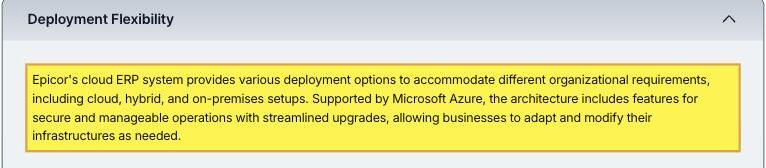
| Epicor offers Kinetic in cloud, hybrid, and on-premises deployments. In Epicor's own words, its cloud ERP “provides various deployment options to accommodate different organizational requirements, including cloud, hybrid, and on-premises setups.” The on-premises / self-managed option can run on in-country infrastructure you control — the genuine data-residency lever for keeping China financial and employee data on the mainland. | Epicor — Kinetic Cloud Business Platform (Deployment Flexibility), retrieved 2026-10-10 |
| Epicor's public cloud runs on Microsoft Azure, which has no mainland-China region. Epicor says Kinetic is “Optimized for Microsoft SQL and Azure” and backed by “a comprehensive cloud portfolio hosted on Microsoft Azure.” Microsoft's commercial Azure footprint has no mainland-China region — Azure's China regions are a separate, locally operated cloud — so a public-cloud Kinetic tenant for a China operation is hosted offshore, making it a PIPL cross-border transfer. | Epicor — Kinetic Cloud Business Platform (Overview; Azure Cloud Infrastructure), retrieved 2026-10-10 |
| Employee payroll and national-ID data are sensitive PI under PIPL Article 28. Processing it needs a separate consent and a prior personal-information protection impact assessment, and sending it abroad is a cross-border transfer under PIPL Articles 38–40 — notice, separate consent, and a transfer mechanism (CAC security assessment, standard contract, or certification). | PIPL — Personal Information Protection Law (Articles 28–29, 38–40), 21YunBox gov-doc, retrieved 2026-10-10 |
| For a CIIO or high-volume handler, data generated in China must be stored in China. Cybersecurity Law Article 39 (formerly Article 37) sets this in-country storage duty; the 2025 amendment, in force January 1, 2026, renumbered the data-localization article from 37 to 39, substance unchanged. An offshore Azure region cannot satisfy it — but an on-premises, in-country Kinetic deployment can. | Cybersecurity Law of the PRC (Article 39, formerly 37), 21YunBox gov-doc, retrieved 2026-10-10 |
Sources verified by the 21YunBox compliance team on 2026-10-10.
For a company running Epicor Kinetic in mainland China, the first instinct is to ask whether staff can open the application from Shanghai or Shenzhen — and they can: Kinetic is a browser-based ERP reached over the public internet, and China does not block it at the border. So reachability is not where the China decision is made. What settles it is where your financial records and employee personal information actually come to rest, and whether the deployment can keep them in-country. By Epicor’s own account, Kinetic ships in “cloud, hybrid, and on-premises setups,” and its public cloud is “hosted on Microsoft Azure,” whose commercial regions do not include the mainland. So the default cloud posture holds your China financials and payroll offshore — a PIPL cross-border transfer, with payroll and national-ID data counting as sensitive personal information — while the on-premises, in-country deployment is the genuine data-residency lever.
Epicor Kinetic in China at a glance
| What decides it | In Epicor's own terms — and China's law |
|---|---|
| What it holds | Epicor Kinetic is a manufacturing and distribution ERP — a system of record. For a China entity it holds the statutory financial ledgers and Epicor Financials data, plus the personal information of employees (payroll, HR, national-ID numbers — sensitive PI under PIPL Article 28), suppliers, customers and approvers. |
| Where it runs | Epicor's public cloud is “hosted on Microsoft Azure” and “Optimized for Microsoft SQL and Azure.” Microsoft's commercial Azure footprint has no mainland-China region — its China regions are a separate, locally operated cloud — so a public-cloud Kinetic tenant for your China operation is hosted offshore. Loading China financial and employee data into it is a cross-border transfer (数据出境) under PIPL Articles 38–40. |
| The deployment lever | On-premises / self-managed is the residency lever. Epicor states Kinetic offers “cloud, hybrid, and on-premises setups,” so it can be deployed on in-country infrastructure you control, keeping the financial and employee data on the mainland. A cloud-only ERP with no mainland region cannot; Kinetic's on-premises option can. |
| Sensitive employee PI + residency | Payroll, bank and national-ID data are sensitive PI — PIPL Articles 28/29 add a separate consent and a prior impact assessment, and cross-border transfer of them is closely scrutinized. For a critical information infrastructure operator or high-volume handler, Cybersecurity Law Article 39 (formerly Article 37) — the 2025 Cybersecurity Law amendment, in force January 1, 2026, renumbered the data-localization article from 37 to 39, substance unchanged — requires in-country storage, which an offshore Azure region cannot meet. |
| Reachability is not the axis | Whether Kinetic opens from Shanghai is an operational detail. The compliance question is where the financial and employee data rest and whether moving them there was lawful — answered by an on-premises, in-country deployment (or an onshore instance where one is offered), not by reachability. |
What you actually hold — financials, employee data, and operational records
An ERP is the most data-dense system a China operation runs. Epicor Kinetic keeps your statutory general ledger, revenue, cost and margin — often material non-public financial information — alongside Epicor Financials’ accounting and reporting records. It holds the personal information of your workforce: payroll, bank details, HR files and national-ID numbers, which are sensitive personal information under PIPL Article 28, carrying their own consent and minimization duties. And it holds supplier, customer and approver records, purchase orders, and the operational trail of a manufacturing business. None of that is about speed; all of it is regulated data whose lawful home is the question.
Where that data runs is set by the deployment you choose. Epicor’s public cloud is “hosted on Microsoft Azure” and “Optimized for Microsoft SQL and Azure,” and Microsoft’s commercial Azure footprint has no mainland-China region — the nearest are offshore in East Asia, Southeast Asia, Japan and Korea, and Azure’s China regions are a separate, locally operated sovereign cloud that Epicor’s public cloud does not use. So a public-cloud Kinetic tenant for your China entity holds its ledgers and employee records in another country. Epicor’s own deployment page, however, lists “cloud, hybrid, and on-premises setups” — and that on-premises, self-managed option is what lets you keep the data in-country.
The doors: cross-border data, sensitive employee PI, and in-country storage
Once the data is offshore, a different body of law decides whether it was allowed to go there. The personal information inside an ERP — employee, supplier, customer and approver records, payroll and expense detail — is personal information under China’s Personal Information Protection Law, and holding it in a Kinetic tenant hosted in an offshore Azure region is a cross-border transfer (数据出境). PIPL puts the duty on the handler — your China entity, not Epicor the processor: Articles 38–40 require notice, a separate consent for the overseas transfer, and one transfer mechanism — a CAC security assessment, the CAC standard contract, or certification.
ERP raises the stakes on two fronts. The employee data is sensitive personal information: payroll, bank and national-ID records fall under PIPL Articles 28 and 29, which demand a separate consent and a prior personal-information protection impact assessment before they are processed or sent abroad. And on volume, a system of record for a sizeable China operation can move personal information at a scale that triggers China’s data-export security assessment (数据出境安全评估) before anything leaves — and consolidated financial data can itself be treated as “important data,” which carries the assessment irrespective of headcount. On residency, if your organization is a critical information infrastructure operator, Cybersecurity Law Article 39 (formerly Article 37) requires personal information generated in China to be stored in China — an in-country duty an offshore Azure region cannot satisfy, but an on-premises, in-country Kinetic deployment can. Which of these bite your specific setup turns on your sector, your data volumes and your role under Chinese law.
Logging in isn’t the question — a compliant in-country ERP is
The way to run Kinetic for a China operation compliantly is not to make an offshore tenant easier to reach; it is to keep the regulated data in the country in the first place. Where Epicor’s on-premises / self-managed deployment is the right fit, the financial ledgers and employee records your mainland entity is obliged to keep in China stop leaving it by default — they live on in-country infrastructure you control, with the global Kinetic cloud kept, where used, as your system of record for everywhere else. Around that, you minimize and protect the sensitive employee PI, obtain the Article 28/29 and Article 13/23 consents, and send offshore only what may lawfully leave. Any China-facing surface — a web portal, an employee self-service page — carries an ICP filing duty and needs compliant, in-country delivery. This is about keeping the data on an in-country path, not routing it abroad and back by a hidden route. Whether each rule bites your deployment is a risk to settle the specifics with counsel against what your ERP actually holds — not a verdict that Kinetic is “blocked” or “illegal.”
The lawful path — map, localize, deliver
There is a compliant way to run ERP for a China operation, and it has a shape. First, map: our China team inventories the financial records, employee PI (payroll, HR, national-ID — sensitive), and supplier and customer data your Kinetic deployment holds; where each is processed and stored (an offshore Azure region, unless you run on-premises in-country); your deployment options; and the consent and residency basis. The legal conclusions are settled with counsel; we build the technical picture that feeds them.
Then localize: we help you put the China financial and employee data on an in-country footing — deploying Kinetic’s on-premises / self-managed edition on in-country infrastructure, or using a licensed onshore instance where one is available — so the records your mainland entity must keep in the country stop leaving it, with the sensitive employee PI minimized and protected and the right consents in place. Localize means keeping the data on an in-country path, never a route that ships it offshore anyway.
Then deliver: the China-facing access to that stack — the screens your mainland finance, procurement and HR users open, and any supplier or employee portal — needs compliant, in-country delivery, and a public-facing service in the mainland carries an ICP filing (备案) duty. 21YunBox delivers it in-country with the 21YunBox Optimizer, in front of what you already run, with no rebuild and no re-platform. The result is an ERP footprint that runs legally and compliantly for your users in China. 21YunBox never uses or suggests circumvention of any kind.
Related reading:
- Cross-border data transfers under PIPL
- China’s Cybersecurity Law (data localization, Article 39)
- China’s Personal Information Protection Law (PIPL)
- How to get an ICP filing for China