Does Rippling Work in China? Employee Data Residency, PIPL Cross-Border & Sensitive PI
Rippling is reachable from mainland China, so speed is not the question — data residency is. Rippling is US-headquartered and, by its own Security page, houses all data in US-based AWS data centers (with an EU data-residency option it describes for European customers) and no mainland-China region, so your China employees' HR, IT and payroll records — identity, government IDs, bank and device data — rest in an offshore Rippling account, a cross-border transfer of often-sensitive personal information under PIPL. A compliance-first look at the residency, cross-border and consent exposure, and the lawful in-country path.
Does Rippling work in China?
Rippling's applications are reachable from mainland China, so the honest answer is that speed is not the question. Rippling unifies HR, IT and payroll in one system of record — identity, compensation, payroll, benefits and the devices and accounts your people use — and the China decision turns on where those employee records live and whether they were allowed to leave the country.
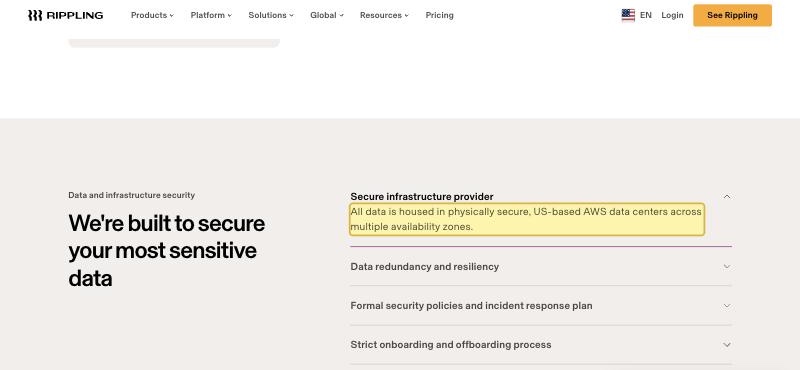
By its own Security page, Rippling houses “all data … in physically secure, US-based AWS data centers,” and the only in-region residency it describes elsewhere is the EU — with no mainland-China region. So your China employees' records rest in an offshore Rippling account, which makes keeping them there a cross-border transfer (数据出境) of personal information under PIPL (Articles 38–40): notice, a transfer mechanism, and a separate consent that is especially fraught for employee data. Because Rippling also carries the IT side, much of what it holds — government IDs, bank and payroll details, device and identity data — is sensitive personal information, raising the consent bar and requiring an impact assessment, and above volume thresholds a data-export security assessment may apply. For a critical information infrastructure operator, the Cybersecurity Law's Article 39 (formerly Article 37) requires in-country storage an offshore region cannot meet.
21YunBox maps your cross-border, residency and consent exposure, localizes the China employee data onto a China-resident footing (sending Rippling only what may lawfully leave), and delivers any China-facing employee surface in-country on ICP-filed infrastructure — no rebuild, and never any form of circumvention. Treat the specifics as a risk to confirm with counsel.
What Rippling's own documentation says about China
| Fact | Primary source |
|---|---|
| Rippling says all data is housed in US-based AWS data centers — and names no mainland-China region. On its own Security page, under “Secure infrastructure provider,” Rippling states: “All data is housed in physically secure, US-based AWS data centers across multiple availability zones.” Because Rippling unifies HR, IT and payroll, that single US footprint holds your China employees' identity, payroll and device records — an offshore, cross-border holding of personal information under PIPL (notice, a separate consent and a transfer mechanism, Articles 38–40). | Rippling — Security (rippling.com/trust/security), retrieved 2026-10-09; PIPL Articles 38–40 |
| Even Rippling's own multiregion data-residency architecture names only the US and the EU — never mainland China. In Rippling's engineering account of how it handles residency, “a company's data is an indivisible ‘atom’ that resides wholly within a single region,” and the in-region commitment it describes is for European customers who want their data “located in the EU.” The only regions it names are offshore; none is in mainland China, so China employee data has no in-country Rippling home to attach an ICP filing to. | Rippling — How Rippling is redefining multiregion data residency (rippling.com/blog), retrieved 2026-10-09 |
| Holding China employees' records in an offshore Rippling account is a PIPL cross-border transfer — with a separate consent that is fraught for employee data. Moving personal information collected from staff in mainland China to a Rippling account hosted abroad triggers PIPL Articles 38–40: notice, one transfer mechanism (a CAC security assessment, the CAC standard contract, or certification), and, where consent is the basis, a separate consent — hard to treat as freely given in an employment relationship, even where human-resources management is the processing basis (Article 13(2)). | Personal Information Protection Law of the PRC, Articles 38–40 (cac.gov.cn), retrieved 2026-10-09 |
| Payroll, government-ID, bank and device data are sensitive personal information, and for some handlers the data must stay in China. Much of what Rippling holds is sensitive personal information under PIPL (Articles 28–29), needing a specific purpose, separate consent and an impact assessment; and for a critical information infrastructure operator or large-volume handler, Cybersecurity Law Article 39 (formerly Article 37) requires in-country storage, with a CAC data-export security assessment possible before anything leaves. | PIPL Articles 28–29; Cybersecurity Law Article 39 (formerly Article 37); Measures for the Security Assessment of Data Exports (cac.gov.cn), retrieved 2026-10-09 |
Sources verified by the 21YunBox compliance team on 2026-10-09.
Whether Rippling “works” in mainland China is, for a platform that runs HR, IT and payroll at once, a data-residency question long before it is a performance one. Rippling is the system of record for your workforce — the personal details, pay and payroll, benefits, and, on its IT side, the devices, accounts and identities each employee uses — and its applications are reachable from the mainland. So the decision is not whether the screens load. It is where those employee records come to rest, and whether they were allowed to leave the country at all. Rippling is US-headquartered and, in its own words, houses all data in US-based AWS data centers — and it is that geography, not latency, that China’s law responds to.
Rippling in China at a glance
| What decides it | In Rippling's own terms — and China's law |
|---|---|
| What it is | Rippling is a unified workforce platform — HR, IT and payroll in one system of record. A single account holds employee identity, compensation and payroll, benefits, and, from the IT side, the devices, accounts and logins tied to each person. That makes it an unusually broad, continuous record of every employee, much of it sensitive. |
| Is it reachable from the mainland? | Yes. Rippling's applications answer from China and it is not a service blocked at the border. Reachability is not the China question. (Cross-border access from the mainland to an offshore account can be uneven — an operational matter, below, not the decision.) |
| Where do the employee records live? | Offshore. Rippling's own Security page states that “all data is housed in physically secure, US-based AWS data centers,” and the in-region data residency it describes elsewhere is the EU — still outside the mainland. Rippling names no mainland-China region, so your China workers' records sit in a US (or EU) Rippling account. |
| Putting China employee data into it | The records are personal information, much of it sensitive — government IDs, bank and payroll details, benefits, and device and identity data. Holding them in an offshore Rippling account is a cross-border transfer (数据出境) under PIPL (Articles 38–40): notice, a transfer mechanism, and — where consent is the basis — a separate consent that an employee can seldom give freely to an employer. Sensitive categories (Articles 28–29) add a specific-purpose, separate-consent and impact-assessment bar. |
| In-country storage & volume | For a critical information infrastructure operator or large-volume handler, personal information generated in China must be stored in the mainland (PIPL Article 40; Cybersecurity Law Article 39 (formerly Article 37)), and a CAC data-export security assessment may apply before data leaves — duties a US or EU Rippling region cannot meet. |
| The lawful path | Keep the China employee data that must stay on a China-resident footing, send Rippling only what may lawfully leave, keep Rippling for the rest of your workforce, and deliver any China-facing employee surface in-country on ICP-filed infrastructure. 21YunBox maps, localizes and delivers; it never uses or suggests circumvention of any kind. |
Reachable — but where do your people’s records live?
Rippling’s applications answer from China, and it is not a service China blocks at the border, so reachability is not where this is settled. Residency settles it. On its own Security page Rippling states that “all data is housed in physically secure, US-based AWS data centers across multiple availability zones,” and the multiregion data residency it has described publicly puts European customers’ data in the EU — a second offshore region, not a mainland one. Rippling publishes no mainland-China data center. So unless and until that changes, your China staff’s HR, IT and payroll records live in a Rippling account hosted abroad, most often the US.
Cross-border access from the mainland to an offshore account can be inconsistent, and the temptation is to force it through a network workaround. 21YunBox neither uses nor suggests any such circumvention — it is both a compliance risk and beside the point. For the same reason this page publishes no first-party China latency figure for Rippling: speed is not the axis for a decision that turns on residency and consent. The question that matters is where the employee data lives and whether it had a lawful basis to be there.
Employee data offshore is a cross-border transfer under PIPL
Here is the gate most HR and IT teams miss. Collecting personal information from staff in mainland China and keeping it in a Rippling account hosted abroad is a cross-border transfer (数据出境) of personal information under the Personal Information Protection Law. PIPL fixes the duty on the personal-information handler — the employer, not Rippling the processor: Articles 38–40 call for notice, one transfer mechanism (a CAC security assessment, the CAC standard contract, or certification), and, where consent is your basis, a separate consent for the overseas transfer.
Employee data makes that consent uncomfortable. PIPL does permit an employer to process staff personal information where it is necessary to carry out human-resources management under a lawfully adopted labor policy or collective contract (Article 13(2)), so routine HR processing need not always rest on consent. But that basis does not switch off the cross-border rules: exporting the records to an offshore Rippling account is a distinct act that engages notice, a lawful basis and a transfer mechanism in their own right, and the sensitive-information duties still stand. And for a critical information infrastructure operator or a large-volume handler, personal information generated in China must be stored in the mainland (PIPL Article 40; Cybersecurity Law Article 39 (formerly Article 37 — the data-localization provision renumbered by the 2025 amendment that took effect on January 1, 2026, with its substance unchanged)) — a duty an offshore Rippling region cannot satisfy. Which of these bite your organization is a risk to confirm with counsel against your actual headcount and data.
One system for HR, IT and payroll — an unusually broad, sensitive footprint
The exposure is sharper for Rippling than for a single-purpose application because of how much it concentrates. Because it unifies HR, IT and payroll, one account holds not only names, pay and bank details but tax and benefits records and — from the IT side — the hardware, accounts and identities each employee signs in with. Much of that is sensitive personal information under PIPL (Articles 28–29), where processing demands a specific purpose, a separate consent, and a personal-information protection impact assessment (Article 55). The IT and device layer widens the picture beyond a classic HR system: Rippling is the record not just of who a person is and what they earn, but of the equipment and logins bound to them, so a single cross-border transfer carries workforce identity, pay and endpoint data together. Moving that data across the border above volume thresholds can additionally trigger China’s data-export security assessment (数据出境安全评估) before anything leaves. None of this turns on how quickly a page renders; it turns on whether the data had a lawful basis to be abroad — so treat every line here as a risk to settle with counsel before you rely on it.
Why pointing Rippling at “a different region” isn’t the fix
The obvious move is to flip the account to Rippling’s EU data residency and call it localized — but every region Rippling offers, the US and its EU option alike, sits outside mainland China, and Rippling itself frames a company’s data as residing wholly within a single region. Relocating China employee data from the US to the EU moves the cross-border transfer; it does not end it. Keeping China-collected employee data in-country means standing up a China-resident footing for the records that must stay, and sending Rippling only what may lawfully leave. That split — what must stay and what may go — is a legal question before it is a technical one, and it is the heart of the work.
The lawful path — map, localize, deliver
There is a lawful way to run Rippling for a workforce that includes mainland China, and it has a shape. First, map: our China team works through your PIPL exposure — which employee, payroll and device records collected in China have to stay in the country, what may lawfully leave, where a data-export security assessment or an Article 39 (formerly Article 37) storage duty applies, and what your notice, consent and impact-assessment flow must cover. The legal conclusions are reached with counsel; we build the technical picture that feeds them.
Then localize: we stand up and integrate a China-resident footing for the China employee data that has to stay — a consented, in-country home for those records — while you keep Rippling as the unified system of record for the rest of your workforce, sending it only what may lawfully cross the border.
Then deliver: any China-facing surface of the platform — an employee self-service portal, an onboarding or benefits page actually served to people in the mainland — is a public service there, so it carries an ICP filing (备案) duty and needs compliant, in-country delivery. The 21YunBox Optimizer delivers it in-country, set in front of what you already run, with no rebuild and no re-platform. The result is a workforce system that runs legally and compliantly for your people in China. What we never do — and what no one lawfully can — is hand you a way around China’s data-export rules or around any network restriction: we localize what must stay and deliver in-country, and we never move personal information out of China by stealth.
Related reading:
- Cross-border data transfers under PIPL
- China’s data-export security assessment
- China’s Cybersecurity Law (data localization, Article 39)
- How to get an ICP filing for China