Does BambooHR Work in China? Employee Data Residency, PIPL Cross-Border & Sensitive PI
BambooHR's HRIS is reachable from mainland China, so speed is not the question — employee data residency is. BambooHR is US-headquartered and, in its own words, hosts customer data in data centers in the United States, Canada, or Ireland, with no mainland-China location and payroll run from the US only, so your China employees' records — government IDs, compensation, documents — rest in an offshore BambooHR account: a cross-border transfer of often-sensitive personal information under PIPL. A compliance-first look at the residency, cross-border and consent exposure, and the lawful in-country path.
Does BambooHR work in China?
BambooHR's application is reachable from mainland China, so the honest answer is that speed is not the question. BambooHR is the HRIS a small or mid-size employer runs its workforce on — names, national ID numbers, compensation, signed documents, often benefits and bank details — and the China decision turns on where those employee records live and whether they were permitted to leave the country.
BambooHR is US-headquartered and, on its own Security page, hosts customer data in data centers in the United States, Canada, or Ireland — with no mainland-China location, and payroll run from the US only. So your China employees' records rest in an offshore BambooHR account, which makes keeping them there a cross-border transfer (数据出境) of personal information under PIPL (Articles 38–40): notice, a transfer mechanism, and a separate consent that is especially fraught between an employer and its staff — and PIPL's HR-management basis (Article 13(2)) does not remove that duty. Much of what BambooHR holds — government IDs, pay, documents, sometimes health and bank details — is sensitive personal information, raising the consent bar and requiring an impact assessment, and above volume thresholds a data-export security assessment may apply. For a critical information infrastructure operator, the Cybersecurity Law's Article 39 (formerly Article 37) requires in-country storage no offshore region can meet.
21YunBox maps your cross-border, residency and consent exposure, localizes the China employee data onto a China-resident footing (sending BambooHR only what may lawfully leave), and delivers any China-facing employee surface in-country on ICP-filed infrastructure — no rebuild, and never a network workaround. Treat the specifics as a risk to confirm with counsel.
What BambooHR's own documentation says about China
| Fact | Primary source |
|---|---|
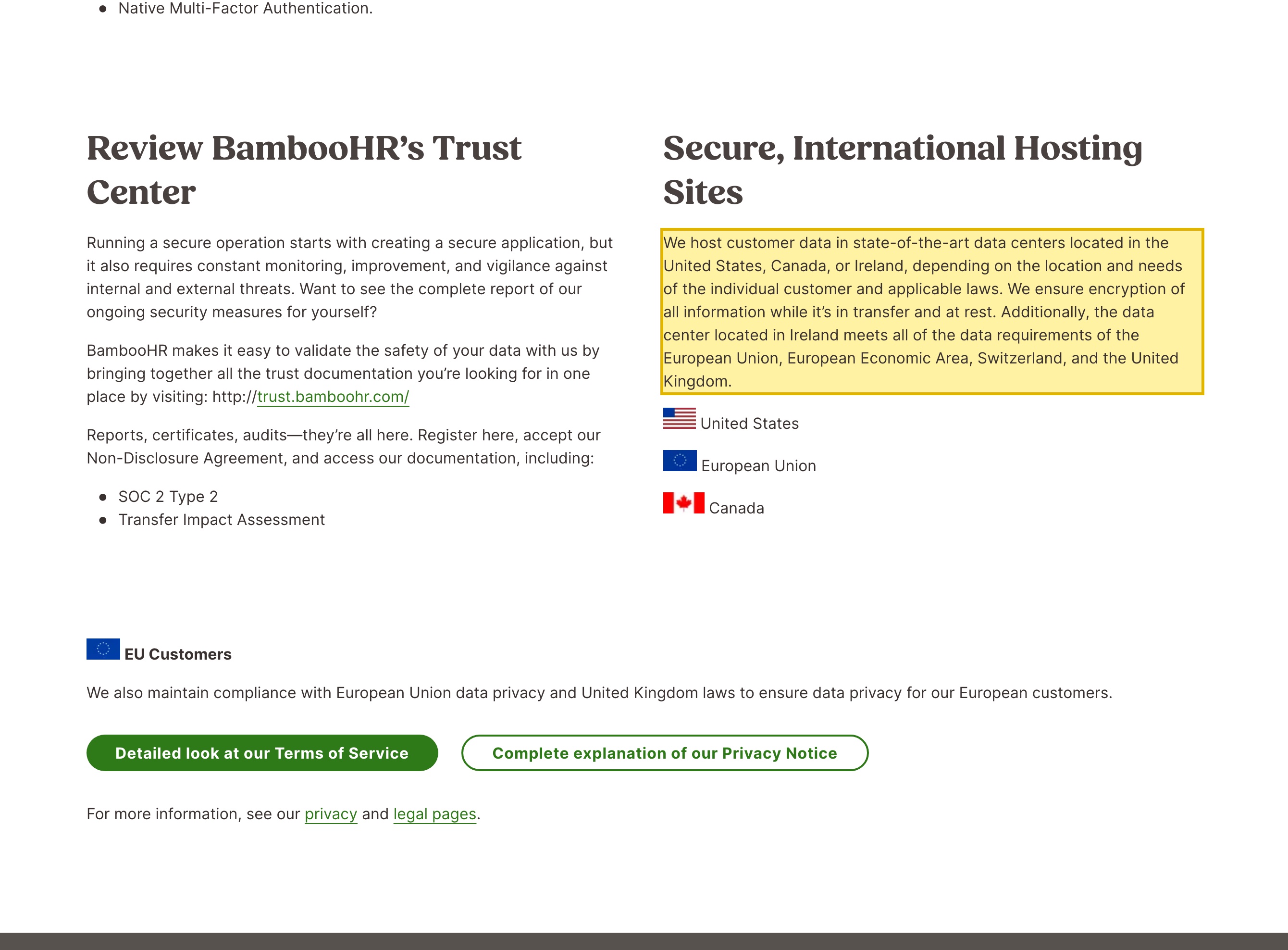
| BambooHR hosts customer data in the United States, Canada, or Ireland — none in mainland China. On its own Security page, BambooHR states it hosts customer data “in state-of-the-art data centers located in the United States, Canada, or Ireland, depending on the location and needs of the individual customer and applicable laws,” and that the Irish center meets EU, EEA, Swiss and UK requirements. It publishes no mainland-China data center, so the employee records of your China staff rest in an offshore BambooHR account. | BambooHR — Security (bamboohr.com/legal/security), retrieved 2026-10-09 |
| BambooHR's production systems run in the US, Europe and Canada on Amazon Web Services — with payroll limited to the US. BambooHR's own third-party subcontractor list states that its “production systems for the Services are located in facilities in the US, Europe, and Canada,” names Amazon Web Services as its “Cloud service hosting provider” across the US, Canada and Europe, and limits BambooHR Payroll to “customers with employees residing in the US.” No listed facility is in mainland China, and employee data also reaches a roster of additional US-based sub-processors. | BambooHR — Third-Party Subcontractor List, February 2025 (bamboohr.com), retrieved 2026-10-09 |
| Holding China employees' records in an offshore BambooHR account is a PIPL cross-border transfer — with a separate consent that is fraught for employee data. Moving personal information collected from staff in mainland China to a BambooHR account hosted abroad triggers PIPL Articles 38–40: notice, one transfer mechanism (a CAC security assessment, the CAC standard contract, or certification), and, where consent is the basis, a separate consent — hard to treat as freely given between an employer and its staff. PIPL's HR-management basis (Article 13(2)) does not remove that cross-border duty. | Personal Information Protection Law of the PRC, Articles 38–40 (cac.gov.cn), retrieved 2026-10-09 |
| Government IDs, pay and documents are sensitive personal information, and for some handlers the data must stay in China. Identity numbers, compensation, benefits and bank details are sensitive personal information under PIPL (Articles 28–29), needing a specific purpose, separate consent and an impact assessment; and for a critical information infrastructure operator or large-volume handler, Cybersecurity Law Article 39 (formerly Article 37) requires in-country storage, with a CAC data-export security assessment possible before anything leaves. | PIPL Articles 28–29; Cybersecurity Law Article 39 (formerly Article 37); Measures for the Security Assessment of Data Exports (cac.gov.cn), retrieved 2026-10-09 |
Sources verified by the 21YunBox compliance team on 2026-10-09.
For a human-resources system, whether BambooHR “works” in mainland China is a data-residency question long before it is a question of load times. BambooHR is where a small or mid-size employer keeps the system of record for its people — names, national ID numbers, salaries, signed documents, time and performance, often benefits and bank details — and the application is reachable from the mainland. So the decision was never whether the screens appear. It is where those employee records come to rest, and whether they were permitted to leave China in the first place. BambooHR is US-headquartered and states plainly where it keeps customer data — the United States, Canada, or Ireland — and that geography, not latency, is what China’s law responds to.
BambooHR in China at a glance
| What decides it | In BambooHR's own terms — and China's law |
|---|---|
| What it is | BambooHR is the cloud HRIS a small or mid-size company runs its workforce on — personal details, national ID numbers, compensation, signed documents, time and performance, often benefits and bank details. It holds a continuous, identifiable record of every employee, much of it sensitive. |
| Is it reachable from the mainland? | Yes. BambooHR's application answers from China and it is not a service blocked at the border. Reachability is not the China question. (Cross-border access to an offshore account can be uneven — an operational matter, below, not the decision, and never one met with a network workaround.) |
| Where do the employee records live? | Offshore. BambooHR is US-headquartered and hosts customer data in the United States, Canada, or Ireland — with no mainland-China location — and runs payroll from the US only. China employees' records therefore sit in an offshore BambooHR account. |
| Putting China employee data into it | The records are personal information, much of it sensitive. Holding them in an offshore BambooHR account is a cross-border transfer (数据出境) under PIPL (Articles 38–40): notice, a transfer mechanism, and — where consent is the basis — a separate consent hard to treat as freely given between an employer and its staff. Government IDs, pay, and health or bank details are sensitive personal information (Articles 28–29), adding a specific-purpose, separate-consent and impact-assessment bar. |
| In-country storage & volume | For a critical information infrastructure operator or large-volume handler, personal information generated in China must be stored in the mainland (PIPL Article 40; Cybersecurity Law Article 39 (formerly Article 37)), and a CAC data-export security assessment may apply before data leaves — duties no offshore BambooHR region can meet. |
| The lawful path | Keep the China employee data that must stay on a China-resident footing, send BambooHR only what may lawfully leave, keep BambooHR for the rest of your workforce, and deliver any China-facing employee surface in-country on ICP-filed infrastructure. 21YunBox maps, localizes and delivers; it never uses or suggests circumvention. |
Reachable — but where do your employees’ records live?
BambooHR’s application answers from China, and it is not a service China blocks at the border, so reachability is not where the decision is settled. What settles it is residency. BambooHR is US-headquartered, and both its Security page and its own third-party subcontractor list name where customer data lives: data centers in the United States, Canada, or Ireland, hosted on Amazon Web Services, with payroll run from the US only. The Irish center, BambooHR notes, is built to meet EU, EEA, Swiss and UK requirements — so this is a vendor that deliberately offers regional residency, yet has made no mainland-China commitment and names no facility there. Unless and until that changes, your China employees’ system-of-record data sits in an offshore BambooHR account.
Cross-border access from the mainland to an offshore account can be uneven, and the temptation is to force it through a network shortcut. 21YunBox never uses or suggests circumvention of any kind — it would be both a compliance risk and beside the point. For the same reason this page publishes no first-party China latency figure for BambooHR: speed is not the axis for a decision that turns on residency and consent. The productive question is where the employee data lives and whether it had a lawful basis to be there.
Employee personal data offshore is a cross-border transfer under PIPL
Here is the gate most HR teams miss. Collecting personal information from staff in mainland China and keeping it in a BambooHR account hosted abroad is a cross-border transfer (数据出境) of personal information under the Personal Information Protection Law. PIPL puts the duty on the personal-information handler — the employer, not BambooHR the processor: Articles 38–40 require notice, one transfer mechanism (a CAC security assessment, the CAC standard contract, or certification), and, where consent is your basis, a separate consent for the overseas transfer.
Employee data makes that consent uneasy. PIPL does let an employer process staff personal information where it is necessary for human-resources management under a lawfully adopted labor policy or collective contract (Article 13(2)), so routine HR processing need not always rest on consent. But that management basis does not reach across the border: exporting those records to an offshore BambooHR account is a distinct act that engages the cross-border rules in their own right, and a separate consent is rarely something an employee can give freely to their employer. Recent CAC rules lift some transfers necessary for cross-border human-resources management out of the heaviest assessment route, yet they leave the underlying duties of notice, a lawful basis and a transfer mechanism intact. Which of these bite your organization is a risk to confirm with counsel against your actual headcount and data.
Government IDs, pay and documents are sensitive — a higher bar
The exposure is sharper for BambooHR than for an ordinary application because of what an HRIS holds. National ID or passport numbers, compensation, bonus and benefits data, uploaded identity and employment documents, and often health and bank details are sensitive personal information under PIPL (Articles 28–29), and processing sensitive personal information demands a specific purpose, a separate consent, and a personal-information protection impact assessment (Article 55). That same employee data also flows onward to a roster of additional US-based sub-processors named in BambooHR’s own subcontractor list — each an extension of the same offshore footing, not a separate jurisdiction. For a critical information infrastructure operator or a large-volume handler, personal information generated in China must be stored in the mainland (PIPL Article 40; Cybersecurity Law Article 39 (formerly Article 37 — the data-localization provision renumbered by the 2025 amendment that took effect on January 1, 2026, its substance unchanged)) — a duty no offshore BambooHR region can satisfy. Moving sensitive employee data across the border above volume thresholds can additionally trigger China’s data-export security assessment (数据出境安全评估) before anything leaves. None of this turns on how fast a page renders; it turns on whether the data had a lawful basis to be abroad. Because employee personal data is sensitive, treat every line here as a risk to settle with counsel before you rely on it.
Why choosing a different BambooHR region isn’t the fix
Because BambooHR lets some customers sit in the US, Canada, or Ireland — and because the Irish center satisfies EU, EEA, Swiss and UK requirements — the instinct is to pick a region and call the data localized. But each of those locations is outside mainland China. Moving China employee data from the US facility to the Irish one relocates the cross-border transfer; it does not end it, and it does not create a China-resident home for the records. Keeping China-collected employee data in-country means standing up a China-resident footing for the records that must stay, and sending BambooHR only what may lawfully leave. That split — what must stay and what may go — is a legal question before it is a technical one, and it is the heart of the work.
The lawful path — map, localize, deliver
There is a lawful way to run BambooHR for a workforce that includes mainland China, and it has a shape. First, map: our China team works through your PIPL exposure — which employee records collected in China must stay in the country, what may lawfully leave, where a data-export security assessment or an Article 39 (formerly Article 37) storage duty bites, and what your notice, consent and impact-assessment flow has to cover. The legal conclusions are settled with counsel; we build the technical picture that feeds them.
Then localize: we stand up and integrate a China-resident footing for the China employee data that has to stay — a consented, in-country home for those records — while you keep BambooHR as the system of record for the rest of your workforce, sending it only what may lawfully cross the border.
Then deliver: any China-facing surface of the system — an employee self-service portal, an onboarding or recruiting page actually served to people in the mainland — is a public service there, so it carries an ICP filing (备案) duty and needs compliant, in-country delivery. The 21YunBox Optimizer delivers it in-country, in front of what you already run, with no rebuild and no re-platform. The result is a workforce system that runs legally and compliantly for your people in China. What we never do — and what no one lawfully can — is hand you a route around China’s data-export rules or around any network restriction: we localize what must stay and deliver in-country, and we never move personal information out of China by stealth.
Related reading:
- Cross-border data transfers under PIPL
- China’s data-export security assessment
- China’s Cybersecurity Law (data localization, Article 39)
- How to get an ICP filing for China