Does SAP SuccessFactors Work in China? Employee-Data Residency, Cross-Border PIPL & SAP's China Data Center
SAP SuccessFactors is reachable from mainland China, so the real question isn't speed — it's where your employees' HR records live. SAP does publish a Shanghai, China data center for SuccessFactors, but most tenants are provisioned in offshore regions (US, EU and others), which turns the employee personal information you collect in China into a cross-border transfer under PIPL, with a separate-consent duty for employee data and, for a critical information infrastructure operator, an in-country storage duty under the Cybersecurity Law. A compliance-first look at the data-residency, cross-border and consent questions — and the lawful in-country path.
Does SAP SuccessFactors work in China?
Yes — SAP SuccessFactors is reachable from mainland China, so the honest answer is that reachability isn't the problem. And unlike most HR SaaS, SAP does run a data center inside the mainland (Shanghai), so an in-country, data-resident footing exists. What decides the China question is where your tenant actually lives.
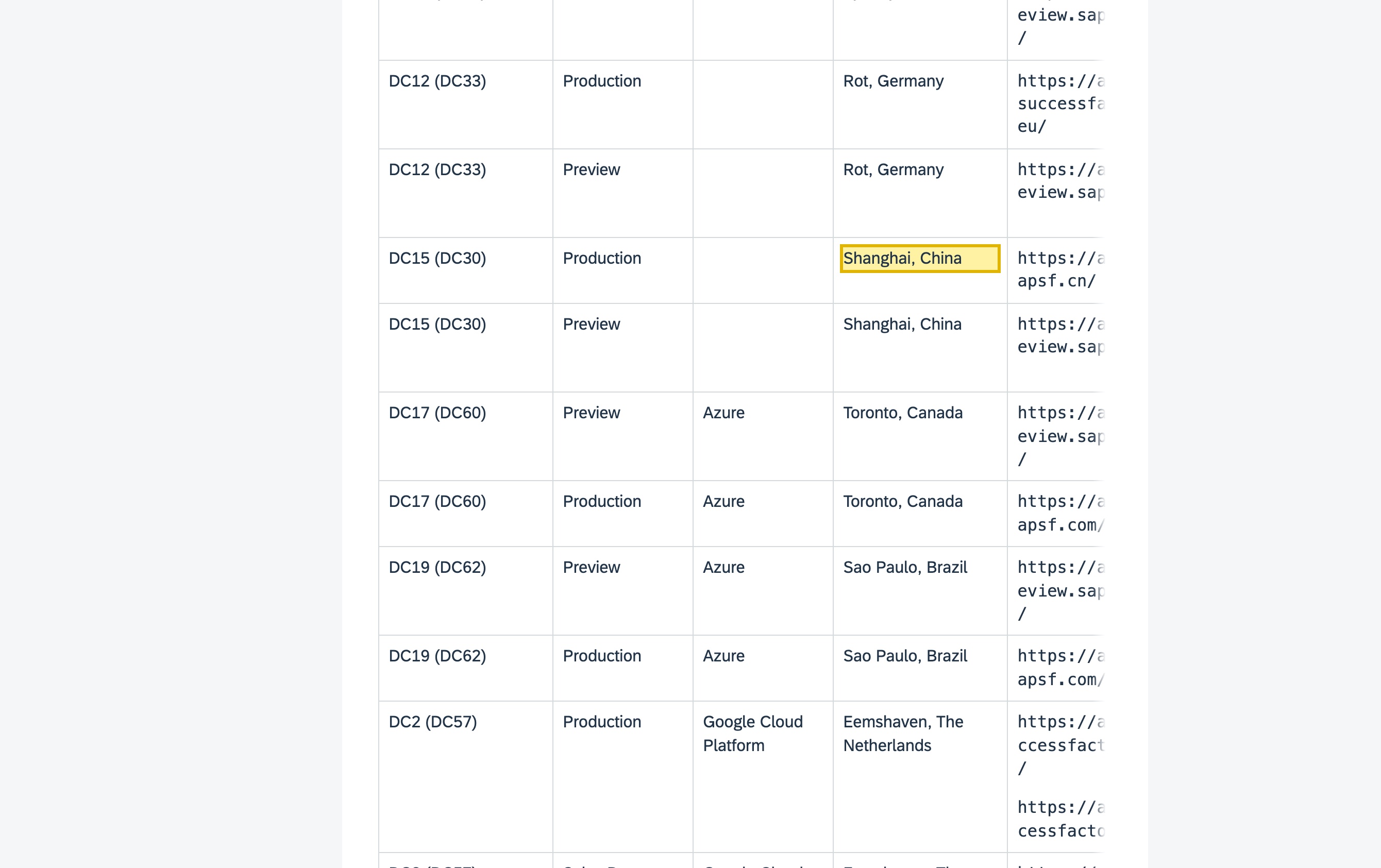
SAP's own Help Portal lists SuccessFactors' data centers and names exactly one in the mainland — Shanghai (DC15 / DC30, api15.sapsf.cn) — among offshore locations in the US, Germany, Canada and elsewhere. Which one holds your data is set when the tenant is provisioned. If yours sits offshore, the employee personal information you collect in China — recruiting, performance, compensation, learning — rests outside the mainland, which makes its collection a cross-border transfer (数据出境) under PIPL (notice, a separate consent for the transfer, and one transfer mechanism), may trigger China's data-export security assessment above thresholds, and for a critical information infrastructure operator runs into the Cybersecurity Law's Article 39 (formerly Article 37) in-country storage duty.
21YunBox maps your residency and cross-border exposure, localizes the China employee data onto an in-country footing (SAP's Shanghai data center where it fits), and delivers your employee- and candidate-facing surfaces in-country on ICP-filed infrastructure — with no rebuild, and never any form of circumvention. Treat the specifics as a risk to confirm with counsel.
What SAP SuccessFactors's own documentation says about China
| Fact | Primary source |
|---|---|
| SAP runs a SuccessFactors data center inside mainland China. SAP's own Help Portal — “List of SAP SuccessFactors API Servers,” version 2H 2026 — lists the platform's data centers and names one in the mainland: DC15 (DC30), Production, “Shanghai, China,” served from https://api15.sapsf.cn/. So, unlike most HR SaaS, SuccessFactors offers a genuine in-country, data-resident option for employee personal information. | SAP Help Portal — “List of SAP SuccessFactors API Servers,” version 2H 2026 (help.sap.com), retrieved 2026-10-09 |
| But most of SAP's SuccessFactors data centers are offshore, and which one holds your data is fixed at provisioning. The same SAP list shows data centers in the US (Virginia), Germany (Frankfurt and Rot), Canada (Toronto), Australia (Sydney), Japan (Tokyo), Singapore and more — with Shanghai the only mainland-China location. A tenant provisioned in any offshore region keeps its China employees' records outside the mainland, whatever its performance. | SAP Help Portal — “List of SAP SuccessFactors API Servers,” version 2H 2026 (help.sap.com), retrieved 2026-10-09 |
| Moving China employees' data into an offshore tenant is a PIPL cross-border transfer — and employee data gets no automatic pass. Transferring personal information collected from staff in mainland China to a SuccessFactors tenant hosted in the US or EU triggers PIPL Articles 38–40: notice, a separate consent for the transfer, and one transfer mechanism — a CAC security assessment, the CAC standard contract, or certification. Consent to an employment relationship does not by itself cover the overseas transfer. | Personal Information Protection Law of the PRC, Articles 38–40 (cac.gov.cn), retrieved 2026-10-09 |
| For some employers the data must stay in China, and large transfers face a government assessment. Where the employer is a critical information infrastructure operator, personal information generated in China must be stored in the mainland (PIPL Article 40; Cybersecurity Law Article 39, formerly Article 37) — a duty only the Shanghai data center can meet. Above the regulated thresholds, the cross-border transfer may also require China's data-export security assessment before any employee data leaves. | PIPL Article 40; Cybersecurity Law Article 39 (formerly Article 37); Measures for the Security Assessment of Outbound Data Transfers (npc.gov.cn), retrieved 2026-10-09 |
Sources verified by the 21YunBox compliance team on 2026-10-09.
For a company running SAP SuccessFactors across a China workforce, the first instinct is to ask whether the platform even reaches the mainland. It does — SuccessFactors is cloud HCM, its API servers answer from inside China’s reach, and it is not a service blocked at the border. So reachability is not where this decision is settled. What settles it is data residency: where the employee records SuccessFactors holds — recruiting, performance reviews, compensation, learning history, core HR master data — actually come to rest, and whether moving the personal information of your China staff to wherever that is was lawful in the first place. That is a question for China’s Personal Information Protection Law, not a load-time test.
And here SuccessFactors sits in a better position than most HR SaaS: SAP does operate a data center inside mainland China. Its own Help Portal lists one — Shanghai — among the regions a SuccessFactors tenant can run in, so a genuine in-country, data-resident footing exists. The catch is that Shanghai is a single location among many offshore ones, and whether your employees’ data enjoys it depends entirely on where your tenant was provisioned.
SAP SuccessFactors in China at a glance
| What decides it | In SAP's own terms — and China's law |
|---|---|
| What it is | SuccessFactors is SAP's cloud HCM suite — recruiting, onboarding, performance, compensation, learning and core HR. It holds a continuous, identifiable record of your employees' and candidates' personal information. |
| Is it reachable from the mainland? | Yes. Its API servers are callable from China and it is not blocked at the border. Reachability is not the China question. (Cross-border access from the mainland to an offshore tenant can be inconsistent — an operational matter, not the decision.) |
| Does SAP offer a China data center? | Yes — and this is the part that sets SuccessFactors apart. SAP's own list names a mainland location, “Shanghai, China” (DC15 / DC30, served from api15.sapsf.cn), alongside offshore data centers. An in-country, data-resident footing exists if your tenant is actually provisioned there. |
| Where does your tenant's data sit? | Wherever your instance was provisioned. SAP's list shows most data centers offshore — the US, Germany, Canada, Australia, Japan, Singapore and more — with Shanghai the only one in the mainland. A tenant on any offshore region keeps your China employees' records outside China. |
| Collecting China employee data into an offshore tenant | That is a cross-border transfer (数据出境) under PIPL (Articles 38–40): notice, a separate consent for the transfer, and one transfer mechanism. Employee data gets no automatic pass. Above thresholds a data-export security assessment may apply; for a critical information infrastructure operator, the Cybersecurity Law's Article 39 (formerly Article 37) requires in-country storage. |
| The lawful path | Put the China employee data on an in-country footing — SAP's Shanghai data center where it fits — send offshore only what may lawfully leave, and deliver the employee- and candidate-facing surfaces in-country on ICP-filed infrastructure. 21YunBox maps, localizes and delivers; it never uses or suggests circumvention. |
SAP does run a China data center — the good news, and the catch
Start with the good news, because it is unusual. Most HR and privacy SaaS runs no infrastructure in the mainland at all; SuccessFactors does. SAP’s own Help Portal publishes the list of data centers a SuccessFactors tenant can run in, and one of them — “Shanghai, China” (DC15, renumbered DC30), reachable at api15.sapsf.cn — is physically inside mainland China. For employee personal information that otherwise has nowhere lawful to rest, that in-country region is a real, SAP-operated option.
The catch is that it is one region among many. The same list places the great majority of SuccessFactors data centers offshore — Virginia in the United States, Frankfurt and Rot in Germany, Toronto in Canada, Sydney, Tokyo, Singapore and others — and which one your company’s tenant lives in was fixed when that tenant was provisioned, not by anything a user in China does at runtime. So “we run SuccessFactors” does not, by itself, answer the China question. The honest answer depends on a single fact most teams have never checked: is our tenant on the Shanghai data center, or on an offshore one? If it is offshore, every HR record you keep on your China workforce rests outside the mainland — and a different body of law decides whether it was allowed to go there.
Offshore tenant, offshore employees’ data — the transfer PIPL governs
If your SuccessFactors tenant is hosted in the US or the EU, the event is quiet but legally definite: the personal information you collect from staff in mainland China — names, national IDs, pay, performance, family and benefits details — is loaded into a system outside the country. Under China’s Personal Information Protection Law that is a cross-border transfer of personal information, and the duty falls on the handler — you, the employer, not SAP the processor. PIPL Articles 38–40 require notice, a separate consent for the overseas transfer, and one cleared transfer mechanism: a CAC security assessment, the CAC standard contract, or certification.
The employee-data angle is where teams most often slip. It is tempting to assume that because someone is your employee, their consent is a given — but under PIPL, agreeing to an employment relationship is not the same as consenting to have one’s personal information shipped abroad, and the separate-consent requirement for the cross-border transfer still applies. Human-resources management gives you a lawful basis to process staff data in-country; it does not, on its own, discharge the notice-and-separate-consent duty that attaches the moment that data crosses the border into an offshore tenant. None of this turns on how fast a page in SuccessFactors loads; it turns on whether the data had a lawful basis to leave.
When the data must stay in China
For some employers the answer is firmer than “transfer it lawfully” — it is “do not transfer it at all.” Where your organization is a critical information infrastructure operator, personal information generated in China must be stored in the mainland (PIPL Article 40; Cybersecurity Law Article 39 (formerly Article 37 — the data-localization clause was renumbered by the 2025 amendment that took effect on January 1, 2026, with its substance unchanged)). That is a residency duty an offshore SuccessFactors region cannot meet by configuration — the only SAP region that satisfies it is the Shanghai data center. And above the regulated volume thresholds, the cross-border transfer may itself require China’s data-export security assessment (数据出境安全评估) — a government review that must clear before any employee data leaves.
This is a risk map, not a verdict. SuccessFactors is not “blocked” or “illegal” in China; it offers a compliant in-country home for your employee data and an offshore default that may not be one. Which obligations bite — separate consent, a transfer mechanism, a data-export assessment, in-country storage, or some combination — turns on your entity, your role under Chinese law, your data volumes and who your staff are. It is worth settling with counsel before your HR system’s China footing is assumed rather than confirmed.
The lawful path — map, localize, deliver
There is a lawful way to run SuccessFactors for a China workforce, and it has a shape.
First, map. Our China team establishes the fact your audit probably hasn’t: which data center your tenant actually lives in, and therefore where your China employees’ records rest today. From there we chart the PIPL exposure — what notice and separate consent your China staff were owed, which transfer mechanism applies, whether a data-export security assessment is triggered, and whether an Article 39 residency duty lands on you as a critical information infrastructure operator. The legal conclusions are settled with counsel; we build the technical and data-flow picture that feeds them.
Then localize. Where the right answer is to keep China employee data in the mainland, we move it onto an in-country footing — SAP’s own Shanghai data center for SuccessFactors where that is the clean fit, or an in-country HR-data arrangement where it is not — so that the records stop leaving China by default, while you keep SuccessFactors as the system of record for your other markets. The point is the split: what must stay in China, and what may lawfully go abroad.
Then deliver. The surfaces your people and candidates actually open — the self-service portals, the onboarding flows, the public recruiting and careers site — are a service presented in the mainland, so a public-facing one carries an ICP filing (备案) duty and needs compliant, in-country delivery. 21YunBox delivers it in-country — the 21YunBox Optimizer — set in front of what you already run, with no rebuild and no re-platform. The result is an HCM stack that runs legally and compliantly for your users in China. What we never do — and what no one lawfully can — is hand you a route around China’s data-export rules or around any network restriction; we localize what must stay and deliver in-country, and we never move personal information out of China by stealth.
Related reading:
- Cross-border data transfers under PIPL
- China’s Cybersecurity Law (data localization, Article 39)
- China’s data-export security assessment
- How to get an ICP filing for China