Does Mia-Platform Work in China? Self-Hosted vs PaaS, ICP & PIPL
Mia-Platform is a developer platform you deploy, so compliance turns on where you run it: self-host it on licensed, in-country infrastructure and the apps it runs can sit lawfully inside the mainland — but its managed PaaS is operated offshore with no mainland-China region, and Mia-Platform supplies no ICP filing of its own. Public apps you run on it still need an ICP filing and raise PIPL. A compliance-first look at both models.
Does Mia-Platform work in China?
Not a flat yes or no — Mia-Platform is a developer platform you deploy, so where it runs is your choice. Self-host it on licensed, in-country infrastructure and the apps it runs can sit lawfully in the mainland; take its managed PaaS, or run the stack offshore, and you inherit ICP and PIPL exposure. Mia-Platform itself is no compliance shortcut: it supplies no ICP filing, no mainland data center and no China license.
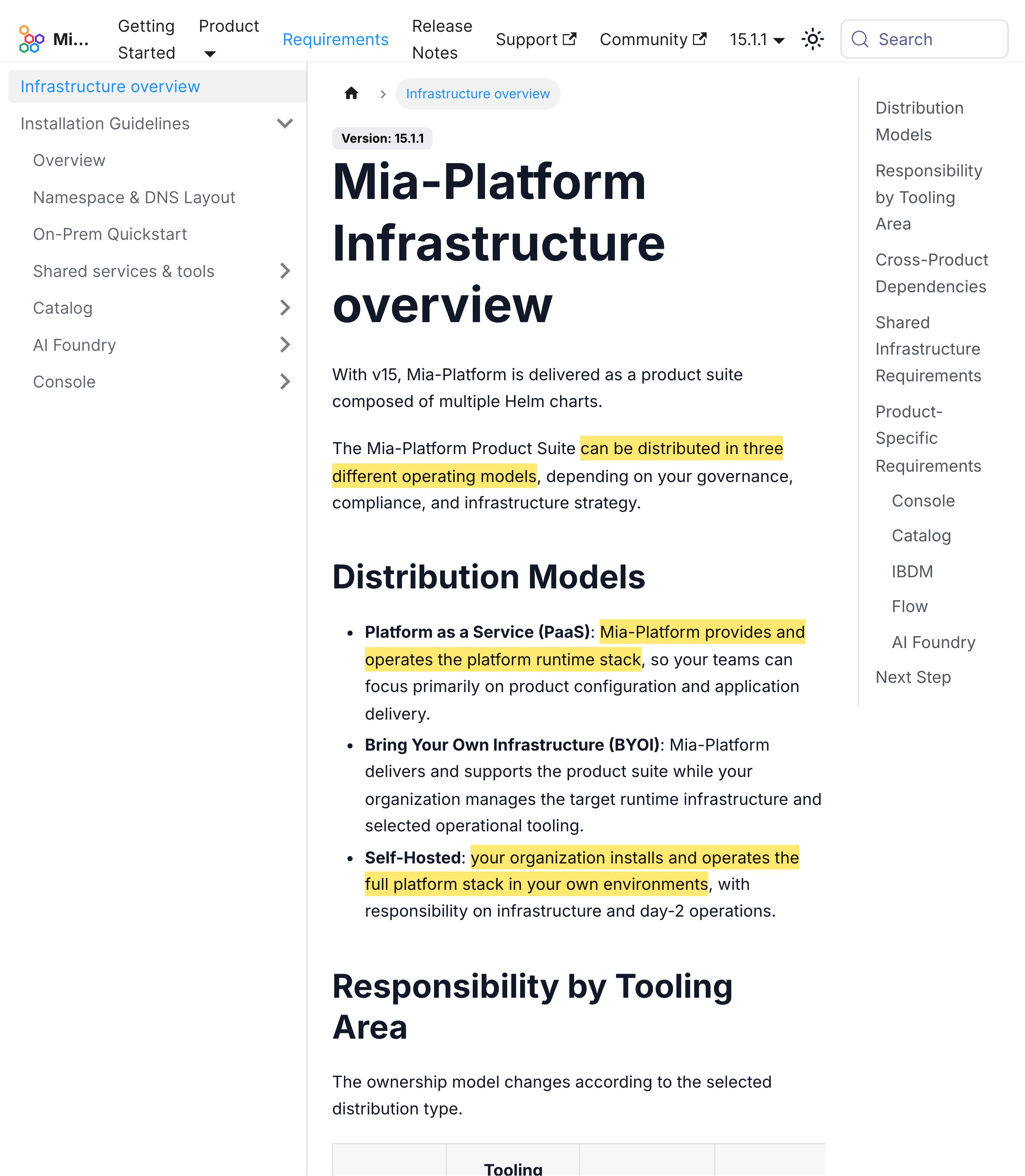
In Mia-Platform's own words the product "can be distributed in three different operating models" — a managed "Platform as a Service (PaaS)" where "Mia-Platform provides and operates the platform runtime stack," "Bring Your Own Infrastructure (BYOI)," and "Self-Hosted," where "your organization installs and operates the full platform stack in your own environments." Because the platform is where your digital products are built and run, that choice also fixes where your mainland users' apps and data physically sit. Run them on an offshore runtime and their personal information makes a cross-border transfer PIPL governs; serve a public app to the mainland and it needs an ICP filing bound to in-country hosting — which Mia-Platform does not provide. The table below is Mia-Platform's own wording and the rule each model triggers.
This is a risk map, not a verdict — which model fits turns on where you deploy, the data you hold and who your users are. Our China team can map your exposure with you →
Compliance snapshot
- ✓ Self-host it on licensed, in-country infrastructure and it can run lawfully in the mainland
- ! Mia-Platform's managed PaaS is operated offshore — no mainland-China region is documented
- ✕ Mia-Platform supplies no ICP filing, mainland data center or China license of its own
- ! Public apps you run on it for mainland visitors still need an ICP filing on in-country hosting
- ! Mainland users' personal data crossing the border is governed by PIPL — where your nodes sit decides it
What Mia-Platform's own documentation says about China
| Fact | Primary source |
|---|---|
| Mia-Platform is software you deploy, in one of three models. In its own infrastructure docs the product "can be distributed in three different operating models" and is "delivered as a product suite composed of multiple Helm charts": a managed "Platform as a Service (PaaS)," "Bring Your Own Infrastructure (BYOI)," and "Self-Hosted." Which one you run is the first thing that decides the China answer — and "the ownership model changes according to the selected distribution type." | Mia-Platform Infrastructure overview (docs.mia-platform.eu), retrieved 2026-10-07 |
| Self-host it and the mainland footing is yours to provide; take the PaaS and it is offshore. Under "Self-Hosted," "your organization installs and operates the full platform stack in your own environments," and the "Kubernetes runtime and networking" is "Customer managed" — so you can place it on licensed, in-country infrastructure. Under the managed PaaS that runtime is "Managed by Mia-Platform" on its own infrastructure, and Mia-Platform documents no mainland-China region for it. | Mia-Platform Infrastructure overview (docs.mia-platform.eu), retrieved 2026-10-07 |
| Mia-Platform carries no ICP of its own — the public app it runs does. A platform is infrastructure, not a filed website, so there is no "Mia-Platform ICP." But a public-facing app, portal or API you build on it and serve to mainland visitors needs an ICP filing (ICP 备案) under State Council Order No. 292 and MIIT Order No. 33, attached to a hosting resource physically in the mainland. Run the platform and its origins offshore and there is nothing in-country to file against. | Mia-Platform Infrastructure overview (docs.mia-platform.eu), retrieved 2026-10-07; State Council Order No. 292; MIIT Order No. 33 |
| Where you deploy the runtime decides the PIPL question. The platform's Kubernetes runtime is what serves your users, so if it runs offshore — or mainland users' requests travel across the border to reach it — their personal information makes a cross-border transfer under PIPL (notice, separate consent and one transfer mechanism, Articles 38–43). For a critical information infrastructure operator or large-volume handler, personal information collected in China must be stored in the mainland (PIPL Article 40; Cybersecurity Law Article 39 (formerly Article 37)) — a residency duty an offshore runtime cannot meet. | Mia-Platform Infrastructure overview (docs.mia-platform.eu), retrieved 2026-10-07; PIPL Articles 38–43 & 40; Cybersecurity Law Article 39 (formerly Article 37) |
Sources verified by the 21YunBox compliance team on 2026-10-07.
Whether Mia-Platform “works” in mainland China is a question about where you deploy it, not how quickly its console loads. Mia-Platform is an internal developer platform you install and operate — software, not a hosted address — so the honest answer is neither a flat yes nor a flat no. Run its platform stack yourself on licensed, in-country infrastructure and the digital products it builds can sit lawfully inside the mainland; reach instead for Mia-Platform’s managed PaaS, or operate the runtime offshore and route mainland users across the border to it, and you take on a cross-border personal-data question China’s law governs. The platform is where your applications are built and run, so where it runs is the compliance decision — and Mia-Platform documents the models in its own words.
Mia-Platform in China at a glance
| What decides it | In Mia-Platform's own terms |
|---|---|
| Which model you run | Mia-Platform “can be distributed in three different operating models”: a managed PaaS where “Mia-Platform provides and operates the platform runtime stack,” BYOI, and Self-Hosted, where “your organization installs and operates the full platform stack in your own environments.” The China answer differs by model. |
| Where the runtime sits | Under Self-Hosted and BYOI the “Kubernetes runtime and networking” is “Customer managed,” so you choose the cloud or data center — including licensed, in-country infrastructure. Under the managed PaaS it is “Managed by Mia-Platform” on its own infrastructure. |
| Managed PaaS residency | Mia-Platform documents no mainland-China region for its managed PaaS, so for a China audience the managed option is offshore by default — the opposite of an in-country footing. |
| Serving the public | A public website, portal or API you run on Mia-Platform for mainland visitors needs an ICP filing on a host physically in the mainland. Mia-Platform holds no ICP of its own; “the ownership model changes according to the selected distribution type,” never into the platform carrying that for you. |
| Your users' data | Personal data of mainland users processed on an offshore runtime is a cross-border transfer PIPL governs, plus a data-localization duty for CIIOs and large-volume handlers that offshore deployment cannot meet. |
Two deployment models, two very different answers
Mia-Platform is not a single hosted address you point at China — it is a platform you install and run, and its own documentation says so. The product “can be distributed in three different operating models”: a managed “Platform as a Service (PaaS),” in which “Mia-Platform provides and operates the platform runtime stack” so your teams “can focus primarily on product configuration and application delivery”; “Bring Your Own Infrastructure (BYOI),” where “Mia-Platform delivers and supports the product suite while your organization manages the target runtime infrastructure”; and “Self-Hosted,” where “your organization installs and operates the full platform stack in your own environments.” So the first thing that settles whether Mia-Platform “works” in China is which of these you are actually running — and the answer is genuinely different for each.
Self-host it, and the mainland footing is yours to stand up
Choose Self-Hosted or BYOI and the deciding layer — in Mia-Platform’s responsibility matrix, the “Kubernetes runtime and networking” — is “Customer managed.” That is the honest reason the answer here is not a flat no: you pick where that runtime lives, and nothing in the platform stops you placing it on licensed, in-country infrastructure inside the mainland. What self-hosting does not hand you is the rest of a lawful China presence. Mia-Platform gives you the software; it does not give you an ICP filing, a mainland data center, or a Chinese operating entity, and “the ownership model changes according to the selected distribution type” — never into Mia-Platform carrying those duties for you. Reach instead for the managed PaaS and the runtime is “Managed by Mia-Platform” on infrastructure Mia-Platform operates, with no mainland-China region documented — convenient, but offshore, which is the opposite of the in-country footing the rest of this page turns on. Either way, deploying in-country gives you the footing; you still have to file against it.
Where your mainland users’ data actually lives
The platform’s runtime is what serves your users, so where you deploy it is where their personal data is handled. Keep that runtime — or the origins behind it — offshore, or route mainland users’ requests across the border to reach it, and their personal information makes a cross-border transfer under China’s Personal Information Protection Law: as the handler, you must give notice, obtain separate consent, and satisfy one transfer mechanism — a CAC security assessment, the CAC standard contract, or certification (Articles 38–43). If you are a critical information infrastructure operator or a large-volume handler, personal information collected in China has to be stored in the mainland (PIPL Article 40; Cybersecurity Law Article 39 (formerly Article 37)) — a residency duty no offshore deployment, managed or self-run, can satisfy. Self-host the runtime in-country and this is the door you can actually close; leave it offshore and it stays open.
Mia-Platform carries no ICP — the apps it runs do
A developer platform is infrastructure, not a public website, so there is no “Mia-Platform ICP.” But every public-facing app, portal or API you build on Mia-Platform and serve to mainland visitors does need an ICP filing (ICP 备案) under State Council Order No. 292 and MIIT Order No. 33, and that filing must attach to a hosting resource physically in the mainland. Run the platform and the origins behind it offshore and there is nothing in-country to file against; deploy them inside the mainland and the filing finally has a home. This is the half that “we already build on Mia-Platform” does not settle: a running platform is not a licensed, filed presence.
This is a risk map, not a verdict: whether you need in-country placement, an ICP filing, a cross-border mechanism, or all three depends on which Mia-Platform model you run, how much personal data you hold, and who your users are — worth settling with counsel before you build.
Where 21YunBox fits — a compliant overlay, not a migration
You keep running Mia-Platform exactly as you do — PaaS, BYOI or self-hosted. We add the one piece none of those models hands you: compliant, ICP-filed delivery from inside the mainland, set in front of the origins your platform already serves — no rebuild, no second codebase, and no move off Mia-Platform. Our China team maps which model you run and where your platform runtime sits, assesses your PIPL cross-border and data-residency obligations against your entity and data volumes, and stands up the in-country, filed delivery a lawful China presence needs — while your platform configuration stays exactly where it already lives.
Related reading:
Frequently Asked Questions
Can we run Mia-Platform compliantly inside mainland China?
Potentially — and that is the honest answer, not a flat no. Because Mia-Platform is self-hostable ("your organization installs and operates the full platform stack in your own environments"), you can deploy its runtime on licensed, in-country infrastructure, which is the footing a mainland presence needs. What Mia-Platform does not give you is any of the license-to-operate pieces — no ICP filing, no mainland data center, no Chinese operating entity; those you provide. Treat it as a risk to map with counsel: the platform can be placed lawfully in-country, but it is not itself a compliance shortcut.
Does Mia-Platform's managed PaaS keep our data in China?
No. Under the managed PaaS, "Mia-Platform provides and operates the platform runtime stack" on its own infrastructure, and Mia-Platform documents no mainland-China region for it — so the managed option is offshore for a China audience. Serve mainland users from there and their personal information crosses the border, which PIPL governs as a cross-border transfer. To keep placement in your own hands, the Self-Hosted or BYOI models let you run the runtime where you choose, including inside the mainland.
Can 21YunBox help make our Mia-Platform setup work in China?
Yes. Our China team can map which model you run — PaaS, BYOI or Self-Hosted — and where your platform runtime and origin sit, assess your PIPL cross-border and data-residency exposure for your entity, data volumes and users, and stand up the ICP-filed, in-country delivery a compliant China presence requires, in front of the Mia-Platform stack you already run. Get in touch to work through your specific case.