Does Google Cloud Vision AI Work in China? PIPL Cross-Border, Data Residency & Sensitive-Data Rules
Google Cloud Vision AI reads the images your China operation sends it — and those images ARE the personal information, often the most sensitive kind: a face is biometric data and a scanned ID carries an ID or financial-account number. Google Cloud has no mainland-China region, so Vision processes them offshore — a PIPL cross-border transfer of sensitive personal data. A compliance-first look at the residency, sensitive-data and cross-border exposure.
Does Google Cloud Vision AI work in China?
The images your China operation sends Google Cloud Vision AI to read ARE the personal information — often the most sensitive kind: faces are biometric data and scanned IDs carry ID and financial-account numbers — and Google Cloud has no mainland-China region, so processing them is a PIPL cross-border transfer of sensitive personal data.
You send Vision an image and it detects faces, extracts document text (OCR) and flags adult or violent content; the content itself is sensitive personal information you cannot minimize, because the face or ID number IS the input (PIPL Article 28). Cloud Vision documents only US and EU data locations with a global default — none in mainland China — so sending China-collected images to it is a cross-border transfer under Articles 38–40, reinforced by the Article 29 separate consent for sensitive data. The lawful lever is to keep the image processing in-country, minimize what crosses the border, obtain the separate consent, and ICP-file any China-facing surface — not to make the offshore API reachable.
Whether a given image or its volume is “sensitive” or “important data” turns on what you process and your sector — settle the specifics with counsel. Our China team can map your exposure →
What Google Cloud Vision AI's own documentation says about China
| Fact | Primary source |
|---|---|
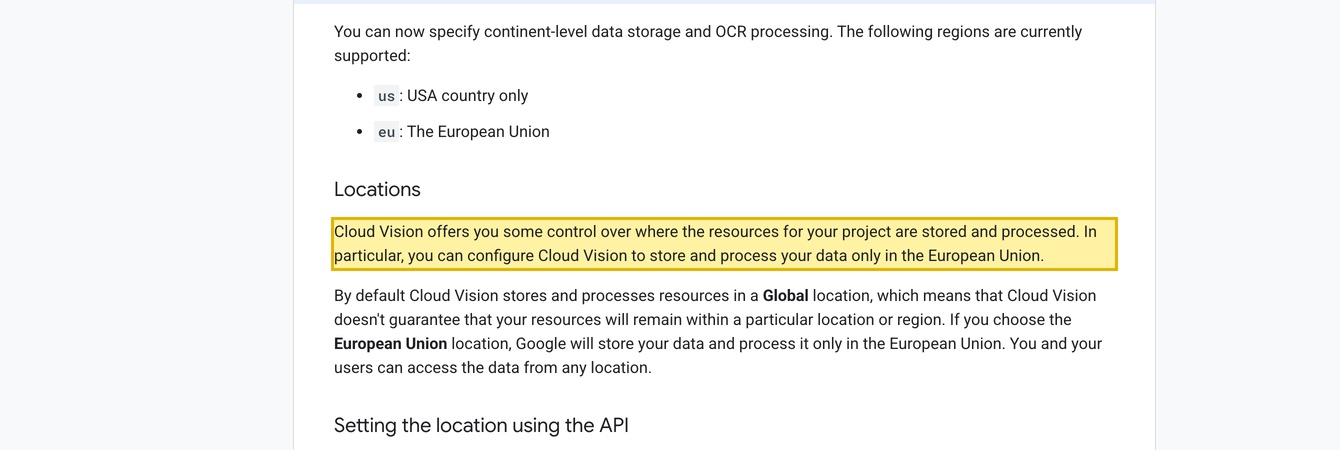
| Google Cloud Vision AI runs only in global, US and EU locations — there is no mainland-China region. Cloud Vision's documentation offers data-storage and OCR-processing control for the United States or the European Union only, with a global default; Google Cloud operates no region in mainland China, so images from a China operation are processed offshore. | Google Cloud — Cloud Vision API documentation (retrieved 2026-10-11) |
| Vision AI reads the image you send it: faces, text on scanned documents, and content categories. It detects faces with landmarks and emotion (specific-individual facial recognition is not supported), extracts text from documents via OCR, and flags adult, violent or racy content (SafeSearch) — so the image you transmit is itself the personal information, often sensitive. | Google Cloud — Vision API feature list & Detect faces (retrieved 2026-10-11) |
| Faces and ID / financial-account numbers are sensitive personal information under PIPL Article 28. Handling them needs a specific purpose, a prior impact assessment, and — for any cross-border transfer — the separate consent required by Article 29; the sensitive data cannot be minimized because it is the input you sent Vision to read. | 21YunBox — China Personal Information Protection Law (PIPL) (retrieved 2026-10-11) |
| Sending China-collected images offshore is a cross-border transfer under PIPL Articles 38–40. It needs notice, a transfer mechanism and, at high volume, a mandatory CAC data-export security assessment; a CIIO or high-volume handler also owes in-country storage under Cybersecurity Law Article 39 (formerly Article 37). | 21YunBox — Cross-border data transfers & CAC data-export security assessment (retrieved 2026-10-11) |
Sources verified by the 21YunBox compliance team on 2026-10-11.
For a company running Google Cloud Vision AI in mainland China, the instinct is to ask whether it answers from Shanghai. It does — but that is not the China decision. Vision AI works by you sending it the image to be read, so the image is the personal information, often the most sensitive kind: a face is biometric data, and a scanned ID or bank card carries an identification or financial-account number. Google Cloud operates no region in mainland China — its US/EU residency control covers OCR only; face and content detection run in a global default — so the images your China operation sends go offshore. That is a PIPL cross-border transfer of sensitive personal information (Articles 38–40, plus the Article 29 separate consent) you cannot minimize, because the face or ID number is the input. Automated flagging engages Article 24; any China-facing surface carries an ICP filing.
Google Cloud Vision AI in China at a glance
| What decides it | In Google Cloud Vision AI's own terms — and China's law |
|---|---|
| What you send it | Vision AI reads the image you hand it. It detects faces (with facial landmarks and emotion likelihoods; specific-individual facial recognition is not supported), extracts text from photos, dense documents and handwriting (OCR), labels objects and logos, and rates images for adult, violent or racy content (SafeSearch). For a China operation the input itself is the personal information — and often the most sensitive kind: a face is biometric data, and a scanned ID, passport or bank card carries an identification or financial-account number. |
| Where it runs | Offshore. Cloud Vision documents data-storage and processing locations for the United States or the European Union, with a global default — and Google Cloud operates no region in mainland China. That continent-level control covers OCR only; face detection and SafeSearch run in the global default location. So the images your China operation sends rest and are processed outside the mainland, and that is a cross-border transfer (数据出境) of (often sensitive) personal information under PIPL (Articles 38–40, with the Article 29 separate consent). Vision AI is a managed cloud API, so there is no customer-run, in-country deployment to change that by itself. |
| The sensitive-PI door (Article 28) | This is the half most reviews miss. A face is biometric data; an ID number or a bank-card number is a financial identifier — both sensitive personal information under PIPL Article 28, needing a specific purpose, a prior impact assessment and a separate consent. You cannot minimize or anonymize it, because the face or the number IS what you sent Vision to read. Where a deployment applies facial recognition, China's Security Management Measures for the Application of Facial Recognition Technology (in force June 1, 2025) add further duties. |
| Automated decision & residency | If a flow uses Vision to decide an outcome automatically — pass a verification, or flag or remove content on a SafeSearch score — that is automated decision-making under PIPL Article 24, and the data subject may refuse a decision made solely by the machine. A critical information infrastructure operator or high-volume handler also owes in-country storage under Cybersecurity Law Article 39 (formerly Article 37 — the 2025 Cybersecurity Law amendment, in force January 1, 2026, renumbered the data-localization article from 37 to 39, substance unchanged); and high volumes of image or biometric data, or data classed "important data," can trigger a mandatory CAC data-export security assessment. |
| Reachability is not the axis | Whether the endpoint answers quickly from Shanghai is an operational detail, not the decision. The lawful path is to keep the China image and document processing in-country — a China-resident path or a domestic alternative, with the sensitive data minimized and the Article 29 separate consent in place — handle any Article 24 and important-data duty, and deliver any China-facing surface (an upload page, a KYC flow) in-country under an ICP filing. 21YunBox maps the exposure, localizes the regulated data onto an in-country path, and delivers in-country. |
What you actually send it — and why the content is the risk
Google Cloud Vision AI is not a service you point at your data; it is a service you feed your data to. Every call hands Vision an image, and Vision reads it. Its features are computer vision and content analysis: face detection (bounding boxes, facial landmarks such as eyes, nose and mouth, and emotion likelihoods — though specific-individual facial recognition is not supported), optical character recognition that extracts text from photos and from dense documents and handwriting (PDF/TIFF), label and object detection, logo and landmark detection, web detection, and explicit-content detection (SafeSearch) that rates an image for adult, violent or racy content.
For a China operation, two kinds of input carry the sharpest risk. The first is faces. A photograph of a person’s face is biometric data, and biometric data is sensitive personal information under PIPL Article 28 — and where a deployment uses that output in a facial-recognition application, China’s Security Management Measures for the Application of Facial Recognition Technology (in force June 1, 2025) impose their own duties. The second is documents. An invoice or contract is personal and commercial information; a scanned ID card, passport, driver’s license or bank card carries an identification number or a financial-account number — also sensitive personal information under Article 28. User-generated photos sent for SafeSearch review are other people’s personal information and expression.
Where is all of it processed? In a Google Cloud location — and Google Cloud operates no region in mainland China. Cloud Vision’s documentation lets you store and process data in the United States or the European Union, with a global default, but offers no mainland-China location; and that continent-level control applies only to OCR — face detection and SafeSearch run in the global default location, with no residency guarantee at all. Vision AI is a managed cloud API, so there is no customer-run, in-country deployment to change that on its own.
The doors: sensitive personal data, cross-border transfer, and automated decisions
Once the image is offshore, Chinese law decides whether it was allowed to go there — and for a vision and content service several doors open at once.
Sensitive personal information — the distinctive door. This is the half most reviews miss. The thing you sent Vision to read is the regulated data, and for faces and identity documents it is the most protected category: PIPL Article 28 treats biometric data, ID numbers and financial-account numbers as sensitive personal information, which may be handled only for a specific purpose, with a prior impact assessment and — reinforced by Article 29 — a separate consent. You cannot escape this by de-identifying before transfer, the usual minimization move, because the face or the ID number is not metadata around the payload; it is the payload you sent Vision to analyze.
Cross-border transfer of personal information. Sending China-collected images into a Google Cloud location outside the mainland is a cross-border transfer (数据出境) under China’s Personal Information Protection Law. PIPL puts the duty on the handler — your China entity, not Google the processor: Articles 38–40 require notice, the Article 29 separate consent for the overseas transfer of sensitive data, and one transfer mechanism (a CAC security assessment, the CAC standard contract, or certification), with Articles 13 and 23 setting the consent basis for collecting the image in the first place. At high volumes, or where image or biometric data is classified “important data” (重要数据) under the Data Security Law, a mandatory CAC data-export security assessment (数据出境安全评估) is required before anything leaves.
Automated decisions, and in-country storage. If a China-facing flow uses Vision to decide an outcome automatically — approving a verification, or flagging and removing a user’s content on a SafeSearch score — that is automated decision-making under PIPL Article 24, and the data subject can ask for a human and refuse a decision made solely by the machine. Separately, a critical information infrastructure operator or a high-volume handler owes in-country storage of personal information generated in China under PIPL Article 40 and Cybersecurity Law Article 39 (formerly Article 37) — a duty an offshore Google Cloud location cannot meet.
Calling the API isn’t the question — compliant in-country processing is
Notice what is not on that list: how quickly Vision answers from Shanghai, or how to smooth a connection to an offshore endpoint. Those are operational questions, and chasing them misses the decision. The decision is whether the faces, identity documents and user content your China operation sends Vision are allowed to be processed where Vision processes them — and, for sensitive data, whether you hold the separate consent and the transfer mechanism that allow it to cross the border at all.
For a cloud-only API with no mainland-China location, the lawful move is not to make the offshore endpoint reachable — it is to keep the China image and document processing on an in-country footing. You keep Vision AI as your global vision service, and for the China entity you process the regulated images on a China-resident path or a China-legal domestic alternative, send offshore only what may lawfully leave, minimize the sensitive data, and carry the Article 13/23 notice-and-consent and the Article 29 separate consent for faces and identity numbers. Keeping it in-country means the data stays on an in-country path — never quietly routed offshore anyway. Any China-facing surface the service powers — a photo-upload page, a KYC or identity-verification flow, a moderated community — is a public service in the mainland and carries an ICP filing duty, delivered compliantly and in-country.
None of this is a verdict that Google Cloud Vision AI is “blocked” or “illegal.” It is a risk map: whether a given image or document is sensitive personal information or “important data,” and whether you owe a separate consent, a transfer mechanism, an impact assessment, in-country storage, a data-export assessment, an ICP filing, or some combination, turns on what you process, your data volumes, your sector and your role under Chinese law — specifics to settle with counsel before your China operation depends on them.
The lawful path — map, localize, deliver
There is a compliant way to run a vision and content service for a China operation, and it has a shape.
First, map: our China team inventories what your China entity sends Vision AI — the faces and photos, the scanned IDs and documents, the user-generated content — identifies which of it is sensitive personal information under Article 28 (biometrics, ID numbers, financial accounts), establishes where each is processed (a global, US or EU Google Cloud location, since Vision has no mainland-China region), whether any of it is “important data,” and whether a flow makes an Article 24 automated decision. The legal conclusions are settled with counsel; we build the technical picture that feeds them.
Then localize: we help you keep the China image and document processing in-country — a China-resident processing path or a China-legal domestic alternative for the mainland entity — minimize what crosses the border, obtain the Article 13/23 and Article 29 separate consent for the sensitive data, and handle any Article 24 automated-decision and important-data or data-export-assessment duty, while Vision AI stays your global service everywhere else. Localizing means keeping the data on an in-country path, never moving it offshore by stealth.
Then deliver: the China-facing surfaces the service powers — an upload page, a KYC or verification flow, a moderated community — carry an ICP filing (备案) duty and need compliant, in-country delivery. 21YunBox delivers them in-country — the 21YunBox Optimizer — in front of what you already run, with no rebuild and no re-platform, so the service runs legally and compliantly for your users in China. 21YunBox never uses or suggests circumvention of any kind. We are a compliance overlay and partner to the stack you already run, not a competitor to it.
Related reading:
- China’s Personal Information Protection Law (PIPL)
- Cross-border data transfers under PIPL
- China’s data-export security assessment (CAC)
- How to get an ICP filing for China